

What Is a Plastic Recycling Pelletizing Machine and Why It Matters
Imagine a mountain of crumpled plastic film, crushed bottles, and shredded containers. None of it can go straight back into a manufacturing line — not in that form. Something has to bridge the gap between raw plastic waste and a material that injection molders, film extruders, and blow molders can actually use. That bridge is the plastic recycling pelletizing machine.
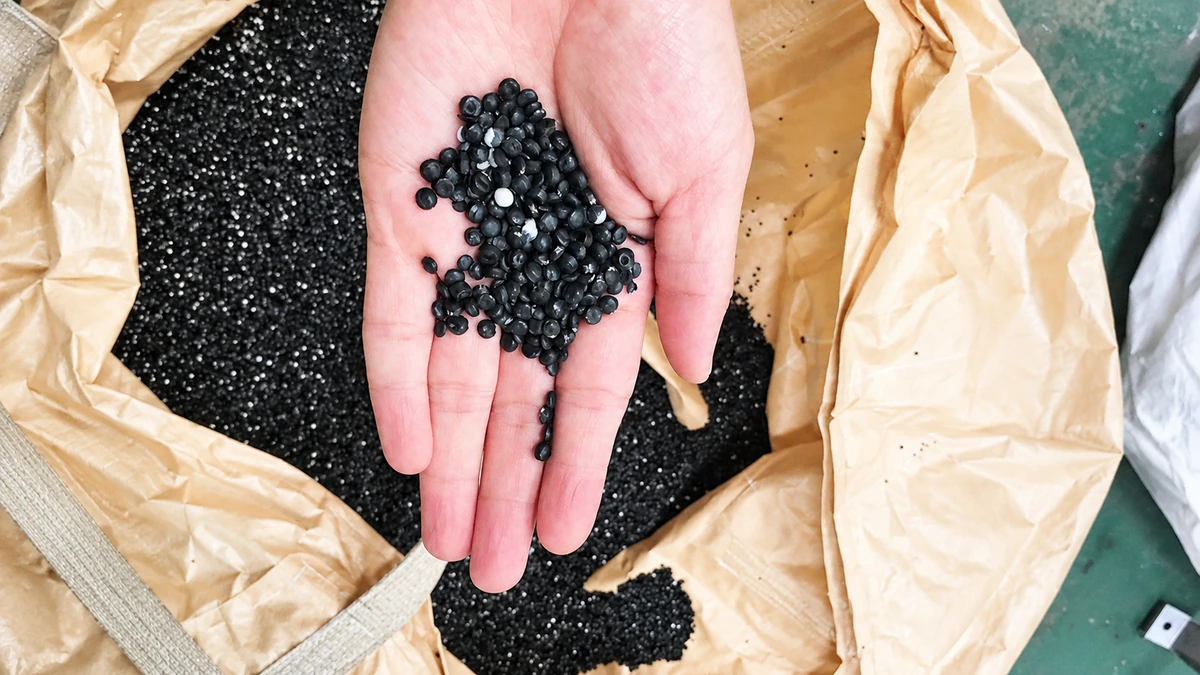
A plastic recycling pelletizing machine is a system that melts, filters, and cuts post-consumer or post-industrial plastic waste into small, uniform pellets — typically 2 to 5 mm in diameter — that serve as ready-to-use feedstock for new plastic products.
What a Plastic Recycling Pelletizing Machine Actually Does
The core concept is straightforward: waste plastic goes in, market-ready pellets come out. But between those two endpoints, the machine performs several critical functions — melting the scrap, removing contaminants, squeezing out trapped moisture and gases, and shaping the clean melt into consistently sized granules. These pellets, sometimes called nurdles or granules, flow freely through hoppers and dosing systems, behaving almost identically to virgin resin in downstream processes like injection molding, blown film extrusion, and pipe production.
You'll find three main machine families handling this work across the recycling industry:
- Single-screw extruder systems — simpler designs well suited for clean, pre-sorted scrap like post-industrial film trim or rigid regrind.
- Twin-screw extruder systems — more advanced machines built for intensive mixing and handling of difficult, contaminated, or multi-component waste streams.
- Agglomerator-extruder (cutter-compactor) combos — purpose-built for lightweight, low-bulk-density materials such as flexible film and woven bags that would otherwise bridge and starve a standard hopper.
Each family addresses different feedstock challenges, throughput demands, and budget realities — distinctions that matter far more than most sales brochures let on.
Why Pelletizing Is the Backbone of Circular Plastics
Plastic recycling pelletizing does not exist in isolation. It sits near the end of a multi-step value chain that determines whether discarded plastic actually re-enters the manufacturing economy or simply gets downcycled into low-value applications. The typical sequence looks like this: collection, sorting by polymer type, washing to remove dirt and adhesives, size reduction into flakes, pelletizing into uniform granules, and finally, end-market manufacturing into new products.
Here is the part most people overlook: without the pelletizing step, the vast majority of recycled plastics cannot re-enter conventional supply chains. Flakes vary in size, shape, and bulk density. They feed inconsistently, melt unevenly, and create processing headaches for manufacturers accustomed to working with uniform pellets. As the Global Partners for Plastics Circularity emphasizes, reprocessors who convert plastics into pellet-form feedstocks are essential to displacing virgin fossil resources and keeping used plastics out of the environment. The pelletizing machine, in other words, is where recycled plastic becomes a real commodity.
This article is built as a vendor-neutral, buyer-education resource. Rather than pushing a specific brand, it covers the technology decisions, economics, operational realities, and vendor evaluation strategies that equipment sellers rarely lay out transparently. The goal is simple — give you the information you need to make a confident, well-informed purchasing decision.
That confidence starts with understanding exactly what happens inside the machine, step by step, from the moment waste plastic hits the hopper to the moment finished pellets drop into a storage silo.
How the Pelletizing Process Works From Waste Input to Finished Pellet
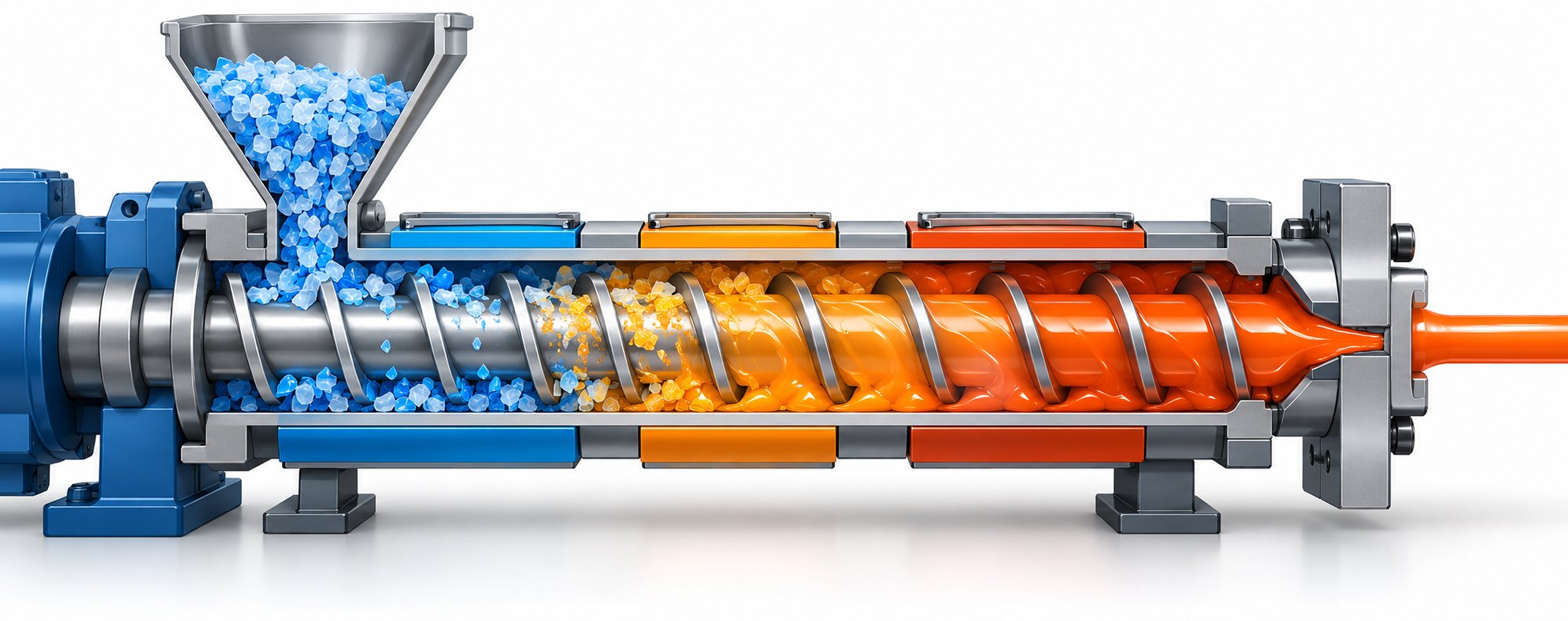
Strip away the brand names and marketing language, and every plastic pelletizer follows the same basic sequence: feed, melt, clean, shape, cool. The differences that separate a good pelletizing line from a frustrating one come down to how well each stage is executed — and how seamlessly they hand off to one another. Walking through the process in order reveals where quality is built in and where it falls apart.
Feeding and Melting the Plastic Waste
Everything begins at the feed throat. For rigid flakes and regrind, a simple gravity-fed hopper usually does the job — material drops by its own weight into the extruder barrel. Lightweight materials like flexible film or fiber, however, have bulk densities so low (sometimes under 100 kg/m³) that gravity alone cannot push them into the screw channel. That is where force-feeders, crammers, or cutter-compactor units come in. These devices mechanically compress and push the material into the barrel so the screw can grab it consistently. If you skip this step with film, expect the screw to spin in an air pocket while output plummets.
Once the plastic enters the barrel, two forces go to work simultaneously: external heat from electric heater bands wrapped around the barrel, and internal shear heat generated by the rotating screw compressing and dragging material forward. The screw's geometry — its flight depth, pitch, and compression ratio — determines how aggressively the material is conveyed, compacted, and melted. A deeper-flighted feed zone, for example, accepts more low-bulk-density material, while a tighter metering zone at the discharge end builds pressure to force molten plastic through the die.
Different screw configurations directly affect throughput and material quality. A screw designed for HDPE regrind will not efficiently process PP fiber or printed PE film. Mismatched geometry leads to incomplete melting, uneven melt temperature, and inconsistent output — problems that no amount of downstream adjustment can fix. This is one reason experienced operators say the pelletizing process is really won or lost in the first half of the barrel.
Filtration and Degassing Before Pellet Formation
Here is a stage that rarely makes the brochure photos but fundamentally determines whether your pellets sell at premium or commodity prices: melt filtration. As the molten plastic exits the extruder screw, it passes through a screen changer — essentially a fine metal mesh (typically 80 to 250 microns) held in a steel housing. This filter catches contaminants that survived the upstream washing process: paper fibers, wood fragments, metal particles, rubber bits, and unmelted gels.
Continuous screen changers — hydraulic slide-plate or backflush types — allow operators to swap or clean screens without stopping the line. On a post-consumer feed stream, screen changes can be needed every few minutes if contamination levels are high. Without adequate filtration, those contaminants end up embedded in the pellets, lowering their grade and market value dramatically. As one industry rule of thumb puts it: the difference between a $900/ton pellet and a $400/ton pellet often comes down to filtration mesh size.
Equally important is degassing. Post-consumer plastics carry moisture, residual inks, adhesives, and volatile organic compounds that turn into gas when heated. If those gases stay trapped in the melt, they show up as bubbles, voids, or surface defects in the finished pellets. Degassing zones — typically one or two vented sections along the barrel connected to vacuum pumps — extract these volatiles before the melt reaches the die. For heavily printed or laminated film, twin-screw extruders with dual vacuum vents are often the only realistic option. Skipping or undersizing the degassing step is a classic cost-cutting mistake that haunts pellet quality for the life of the machine.
Cutting and Cooling Methods
The final transformation — melt into pellet — happens at the die and the pelletizer cutter. Molten plastic is forced through small holes in a die plate, and a cutting mechanism shapes those extrusions into individual pellets. How the cutting and cooling work together defines the pellet's shape, surface finish, and the range of polymers the system can handle. Three main methods dominate plastic pelletizing equipment used in recycling operations.
Strand pelletizing is the most widely recognized approach. Molten plastic extrudes through the die as continuous spaghetti-like strands, which travel through a water bath to cool and solidify. The cooled strands then feed into a rotary pelletizer cutter that chops them into cylindrical pellets. It is a proven, affordable technology — but the strands can break if moisture content is too high or if the melt is inconsistent, leading to frustrating stop-start cycles.
Underwater pelletizing takes a different approach entirely. The die face sits submerged in a pressurized water chamber. As molten plastic emerges from the die holes, rotating blades cut it immediately, and the surrounding water quenches each pellet almost instantly. The result is near-spherical pellets with excellent uniformity — ideal for PET recycling lines and any high-output operation above 500 kg/h. The trade-off is significantly higher equipment cost and tighter process control requirements.
Die-face air-cooled cutting (sometimes called hot-face air-cooled pelletizing) positions the cutter blades directly against the die face, similar to underwater systems, but uses an air stream instead of water for cooling. This method is the go-to solution for materials that react poorly to water — soft LDPE film, EVA, hot-melt adhesives, and certain thermoplastic elastomers that clump or stick when water-quenched. Output rates and pellet uniformity are generally lower, but for water-sensitive polymers, air-cooled cutting is often the only practical choice.
The following table puts these three cutting methods side by side across the criteria that matter most when selecting plastic pelletizing equipment:
| Criteria | Strand Pelletizing | Underwater Pelletizing | Die-Face Air-Cooled Cutting |
|---|---|---|---|
| Pellet Shape | Cylindrical | Near-spherical | Lens / teardrop |
| Typical Throughput Range | 100 – 2,000 kg/h | 300 – 6,000 kg/h | 80 – 800 kg/h |
| Best-Suited Polymers | Rigid HDPE, PP, ABS, PS, PET flake | PET, engineering resins, high-output PE/PP | Soft LDPE film, EVA, TPE, hot-melt adhesives |
| Pellet Uniformity | Good (consistent length requires stable strands) | Excellent (rapid quench, consistent cut) | Moderate (slight shape variation common) |
| Tolerance for Moisture in Feed | Low (strands break above ~1% moisture) | High (enclosed water system) | Moderate (no water contact, but drying still needed) |
| Relative Equipment Cost | Low to moderate | High (3–5x a strand die) | Low |
| Maintenance Complexity | Low (blade changes in minutes) | Higher (pressurized water system, die maintenance) | Low to moderate |
| Typical Energy Use (kWh/ton) | 280 – 380 | 220 – 310 | 200 – 280 |
Choosing the right pelletizing machine and cutting method is not a one-size-fits-all decision. It depends on the polymer you are processing, the throughput you need, the pellet quality your buyers demand, and the capital you can commit. A strand system handles the majority of rigid scrap economically, while underwater pelletizing is practically mandatory for high-volume PET bottle-to-bottle operations. Air-cooled die-face cutting fills a critical niche for soft, sticky, or water-sensitive materials that would jam or clump in either of the other systems.
Yet the cutting method is only part of the technology puzzle. The extruder driving the entire process — whether single-screw or twin-screw — shapes everything from feedstock flexibility to mixing quality and energy consumption. That distinction deserves its own close look.
Single-Screw vs Twin-Screw Extruders Compared
Ask a vendor which extruder type you should buy, and the answer almost always matches whichever model they happen to sell. That is not helpful when you are committing six figures to a plastic pelletizing machine that will define your output quality and operating costs for the next decade. The single-screw versus twin-screw decision is the most consequential technology choice in any recycling pelletizing line — and it deserves an honest, application-driven breakdown rather than a sales pitch.
Single-Screw Extruders and Their Best-Fit Applications
A single-screw extruder does exactly what the name suggests: one rotating screw inside a heated barrel conveys, compresses, and melts plastic. The design is mechanically straightforward, which translates into lower purchase price, simpler operation, and easier maintenance. For a plastic reprocessing machine handling clean, pre-sorted, single-polymer feedstock — think post-industrial film trim, rigid HDPE regrind, or in-house PP production scrap — a single-screw system delivers reliable throughput at attractive economics.
Where the single-screw design runs into trouble is mixing. Because a single screw relies primarily on drag flow to move material forward, its ability to blend additives, homogenize variable-quality feedstock, or disperse colorants is limited. You will also notice performance drops when contamination levels rise or when moisture content creeps above one or two percent. The screw cannot self-clean the way twin-screw designs can, so material buildup and thermal degradation become risks during long runs with inconsistent input. For processors handling straightforward, well-controlled waste streams, none of these limitations are deal-breakers. For everyone else, they become expensive daily headaches.
Twin-Screw Extruders for Demanding Recycling Scenarios
Imagine feeding a hopper with mixed post-consumer film — some of it printed, some laminated, varying in moisture from batch to batch, and carrying trace contaminants that survived the washing line. A single-screw machine would struggle to produce consistent melt quality under those conditions. A co-rotating parallel twin-screw extruder, by contrast, is engineered precisely for this kind of chaos.
Two intermeshing screws rotating in the same direction create a self-wiping action that continuously scrapes material off internal surfaces, preventing dead spots and thermal degradation. The intermeshing geometry also generates intensive distributive and dispersive mixing — essential for achieving a homogeneous melt from feedstocks that vary in composition, particle size, or contamination level. This is why twin-screw machines dominate in recycling applications that handle post-consumer plastics, engineering plastic blends, fiber-reinforced waste, or heavily printed laminates.
The real versatility comes from modularity. Twin-screw extruders use a segmented screw-and-barrel architecture where individual elements — conveying sections, kneading blocks, reverse elements, and venting zones — can be rearranged along the shaft to match the specific demands of each application. Processing high-moisture agricultural film? Add an extra vacuum degassing port. Compounding recycled PP with calcium carbonate filler? Swap in more intensive kneading blocks. This building-block flexibility means one plastic pelletizer machine can be reconfigured for entirely different feedstocks without replacing the entire screw set.
Twin-screw systems also offer superior degassing performance, a critical advantage when processing post-consumer materials loaded with volatiles, residual inks, and trapped moisture. Controlled residence time and excellent melt surface renewal at venting zones allow vacuum ports to extract gases more efficiently, resulting in cleaner, higher-grade pellets that command better market prices.
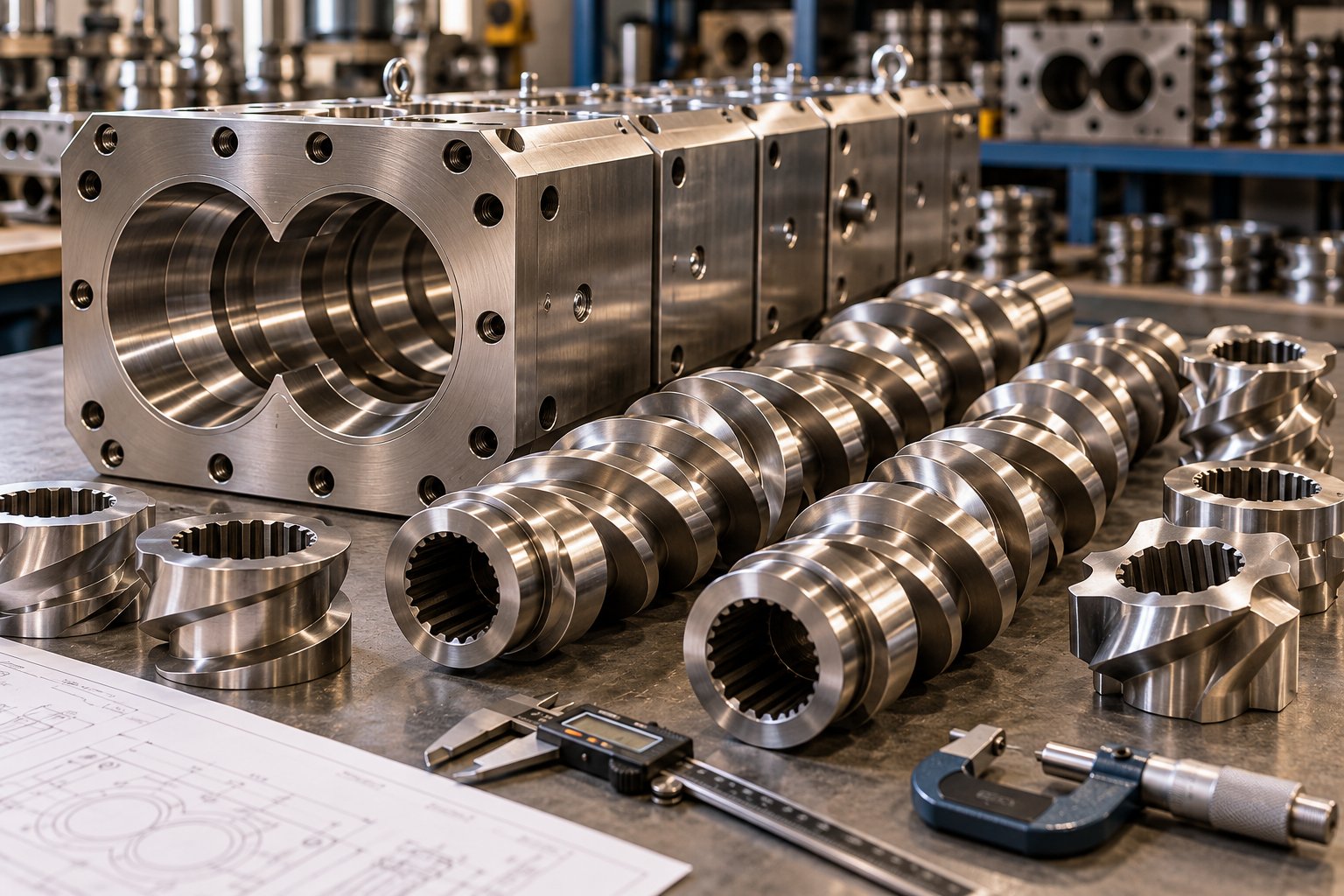
One factor buyers often overlook: the quality of the twin-screw barrel itself directly affects wear life, output consistency, and energy consumption over the machine's operational lifetime. Barrels manufactured with improper metallurgy or loose tolerances degrade faster, increase screw-to-barrel clearances prematurely, and force operators into the same compensating cycle of higher temperatures and slower speeds that erodes profitability. This is where sourcing barrels from a specialist matters. NANHAIYA, for example, engineers custom parallel twin screw barrels specifically for recycling, pelletizing, compounding, and masterbatch applications — covering the full spectrum of demanding mixing and conveying scenarios. Their application-specific design approach helps processors maintain tighter clearances longer, which preserves energy efficiency and pellet quality across thousands of production hours.
Head-to-Head: Which Extruder Fits Your Recycling Operation?
Specifications matter more than generalizations. The table below compares twin-screw and single-screw extruders across the dimensions that most directly affect your daily operations and long-term return on investment for any plastic pelletizing machine purchase:
| Comparison Dimension | Co-Rotating Twin-Screw Extruder | Single-Screw Extruder |
|---|---|---|
| Mixing Capability | Excellent — intensive distributive and dispersive mixing from intermeshing, self-wiping screws | Basic — limited to drag-flow mixing; poor at blending additives or homogenizing variable feedstock |
| Feedstock Flexibility | High — handles mixed, contaminated, high-moisture, and multi-polymer waste streams | Low to moderate — best with clean, single-polymer, pre-sorted material |
| Degassing Performance | Strong — multiple vacuum vent ports, excellent melt surface renewal for volatile extraction | Limited — typically one vent zone with lower extraction efficiency |
| Throughput Range | 50 – 5,000+ kg/h (scalable via screw diameter from 20 mm to 135 mm+) | 50 – 3,000 kg/h (common in recycling: 200 – 1,500 kg/h) |
| Screw and Barrel Modularity | Fully modular — conveying, kneading, venting, and reverse elements are interchangeable | Fixed geometry — typically one-piece screw designed for a specific material range |
| Energy Efficiency (kWh/kg) | Higher per-kg energy input, but lower rejects and higher pellet quality can offset cost per ton of saleable output | Lower per-kg energy input for clean streams; efficiency drops with difficult feedstock |
| Maintenance Complexity | Moderate to high — modular screws simplify element replacement but require trained technicians; high-torque gearbox needs periodic inspection | Low — fewer components, simpler drive train, easier for general maintenance staff |
| Capital Cost | Higher (roughly 2 – 3x a comparable single-screw system, largely driven by gearbox and modular screw costs) | Lower initial investment; attractive for startups and clean-stream operations |
| Best-Fit Recycling Scenarios | Post-consumer mixed plastics, printed film, laminates, engineering plastics, filled compounds, masterbatch production | Post-industrial film trim, clean rigid regrind (HDPE, PP), single-polymer bottle flake |
| Long-Term ROI | Strong for complex or variable feedstocks — fewer rejects, higher pellet grades, greater market flexibility | Strong for simple, consistent streams — lower overhead, faster payback at smaller scale |
A few patterns emerge from this comparison. If your operation processes clean, single-polymer scrap at moderate volumes, a single-screw system is the pragmatic, cost-effective choice — and it is the specialized easy-to-use recycling machine that many startups rightly begin with. But the moment your feedstock variability increases — mixed colors, post-consumer contamination, high-moisture film, or the need to compound additives during pelletizing — the twin-screw extruder's mixing, degassing, and modular flexibility become difficult to replicate at any price with a single-screw alternative.
The hidden cost trap, however, is not always the extruder itself. Twin-screw gearboxes, modular screw elements, and especially barrel linings represent significant ongoing investments. Wear on screws and barrels is inevitable — industry data confirms that as soon as screw rotation begins inside the barrel, abrasive, adhesive, and corrosive wear start degrading clearances and output quality. Processors who source replacement barrels from generalist suppliers often find that poor metallurgy or dimensional tolerances shorten service life dramatically, wiping out the savings. Working with application-focused component specialists — like NANHAIYA's custom parallel twin screw barrels engineered for recycling and compounding environments — helps extend wear life and protect the consistency that justifies the twin-screw investment.
Regardless of which extruder type you select, the machine can only perform as well as the material it receives. Even the most advanced twin-screw system cannot overcome severely contaminated or poorly prepared feedstock — a reality that shifts attention to the upstream steps most equipment buyers underestimate.
Pre-Processing Steps That Determine Your Pellet Quality
Here is an uncomfortable truth most equipment sellers gloss over: the most expensive, most technically advanced pelletizing machine on the market will still produce low-grade pellets if the feedstock entering it is poorly prepared. Contaminated, mixed-polymer, or excessively wet material degrades pellet quality in ways no extruder setting can compensate for. Upstream preparation is not a nice-to-have add-on — it is the single biggest lever you have over your pellet grade, your market price, and your machine's long-term health.
Yet walk through most vendor presentations, and you will find detailed specifications on extruder motors, barrel configurations, and cutting systems, with barely a passing mention of what happens before plastic reaches the hopper. That gap costs first-time buyers dearly. So what does a proper pre-processing setup actually look like?
Sorting and Washing Requirements by Waste Stream
Think of sorting as your first quality gate. Every polymer has a different melt temperature, viscosity, and chemical behavior. Even small amounts of the wrong polymer mixed into a batch — PVC fragments in an HDPE stream, for instance — can cause discoloration, gels, and toxic off-gassing during extrusion. A PVC pelletizing machine configured for that specific resin cannot tolerate stray polyolefins any more than an HDPE line tolerates stray PVC. Polymer separation, whether by manual picking, near-infrared (NIR) optical sorters, or float-sink density tanks, is non-negotiable for producing pellets that buyers will pay premium prices for.
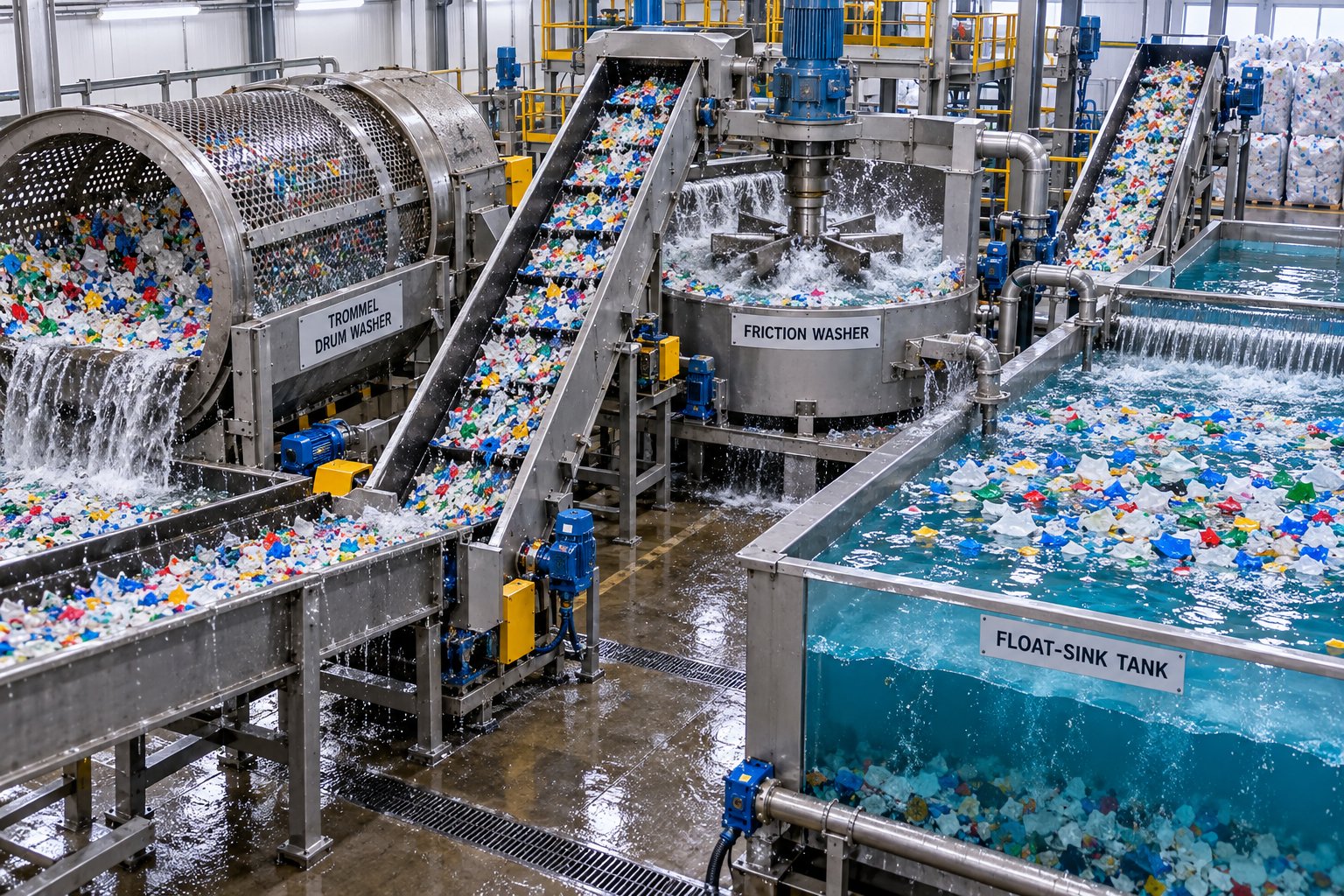
Washing comes next, and its complexity should match the contamination level of your specific waste stream. Post-industrial film trim from a converter may only need a light rinse. Post-consumer curbside bales, on the other hand, arrive with food residue, adhesive residue, paper labels, sand, and sometimes metal fragments embedded in the material. A typical washing line addresses each contaminant type through a specific piece of equipment:
- Pre-wash drum or trommel — removes loose dirt, sand, and small debris through tumbling and water spray before heavier processing begins.
- Friction washer (high-speed) — uses intense mechanical action and water to scrub surface contamination, inks, and light adhesives from flake surfaces. Effective on printed flexible packaging and lightly soiled rigid containers.
- Float-sink separation tank — exploits density differences to separate target polymers from contaminants. Polyolefins like PE and PP float (density below 1.0 g/cm³), while heavier materials like PET, PVC, sand, and metal sink. This step is essential for separating mixed rigid streams from curbside collection.
- Hot wash tank — uses heated caustic water (typically 80-90°C with sodium hydroxide) to dissolve stubborn adhesives, labels, and food-grade glue residues that cold washing cannot remove. Critical for post-consumer bottle flake destined for food-contact pellet grades.
Skipping any of these stages — or under-sizing them to save capital — means contaminants pass through to the extruder. The melt filter catches some of it, but at a cost: more frequent screen changes, higher melt pressure, reduced throughput, and accelerated wear on screws and barrels. Data from recyclers running post-consumer film streams illustrates the impact clearly — facilities processing poorly washed film report screen changes every 4-6 hours, while the same lines running properly washed material extend screen life to 18-24 hours. That difference alone translates into thousands of dollars in annual downtime and consumable costs.
Size Reduction and Drying Before Extrusion
Even perfectly sorted and washed plastic will not feed consistently into an extruder if the particle size varies wildly. A hopper full of flakes ranging from dust-sized fragments to palm-sized chunks creates erratic feeding — some screw flights fill completely while others run half-empty, producing surging melt output and inconsistent pellet weight. That is why size reduction is a dedicated, controlled step rather than an afterthought.
The process typically involves two stages. A shredder first breaks bulky items — baled bottles, large containers, or tangled film — into rough pieces, usually 20-50 mm. A granulator then cuts those pieces into uniform flakes, typically in the 8-12 mm range for most pelletizing applications. Consistent flake geometry means consistent bulk density, which means predictable screw filling and stable melt output. Sounds simple, but the payoff is enormous: steady throughput, uniform melt temperature, and pellets that pass dimensional specs without constant operator adjustment.
Drying is the final pre-processing hurdle — and arguably the most underestimated. Moisture trapped on or inside plastic flakes turns to steam during extrusion, creating bubbles, voids, and surface defects in finished pellets. Worse, certain polymers like PET and nylon undergo hydrolytic degradation when processed with excess moisture, permanently reducing molecular weight and mechanical properties. Once that chain scission happens, no downstream drying recovers the lost molecular weight — the material's value drops permanently.
Moisture targets vary by polymer: polyolefins like PE and PP generally tolerate up to 1-3% surface moisture before pellet quality visibly suffers, while PET requires moisture levels below 0.02% to prevent degradation. Mechanical drying — centrifugal spin dryers or squeeze-roll presses — handles the heavy lifting by removing surface water quickly and cheaply. Thermal drying with hot-air or desiccant-rotor systems then brings moisture down to the final target. Film and flexible packaging present the toughest drying challenge because their high surface-area-to-mass ratio allows them to cling to moisture tenaciously. Standard hot-air hoppers sized for rigid regrind often leave film at three to five times the acceptable moisture level, a mismatch that causes persistent quality problems operators mistakenly blame on the extruder.
The Pre-Processing Checklist Every Buyer Should Follow
Before evaluating any pelletizer, run your feedstock plan through this checklist. Each item directly affects the grade and market price of your output pellets:
- Sort by polymer type — eliminate cross-contamination using manual sorting, NIR optical sorters, or density separation before material reaches the washing line.
- Remove labels and adhesives — match your washing intensity to the contamination level; hot wash with caustic solution for post-consumer materials carrying stubborn adhesives or glue.
- Scale washing intensity to contamination level — post-industrial trim may need only a friction wash; post-consumer bales typically require the full sequence of pre-wash, friction wash, float-sink, and hot wash.
- Achieve flake size uniformity — shred and granulate to a consistent 8-12 mm particle size for stable extruder feeding and uniform melt behavior.
- Hit moisture content targets — dry to under 1-3% for polyolefins, under 0.5% for general recycling, and under 0.02% for PET and nylon; use mechanical pre-drying followed by thermal drying for best results.
- Test incoming feedstock regularly — measure moisture at least weekly, as seasonal humidity swings in warehouse environments can shift material moisture by 0.3-0.8% between summer and winter.
The cause-and-effect relationship here is direct and measurable. Facilities that invest properly in pre-processing consistently produce pellets that meet prime-grade specifications — stable melt flow index, minimal voids, consistent color — and those pellets command significantly higher prices. Mid-2026 U.S. spot market data highlights the gap starkly: prime-grade natural HDPE recycled pellets trade at $0.55-0.75 per pound, while off-spec material from lines with poor moisture and contamination control sells for just $0.18-0.30 per pound. That $0.30-0.45 per pound differential, multiplied across hundreds of tons per month, represents the real return on upstream investment.
Better pre-processing also extends the life of your most expensive wear components — extruder screws, barrels, screen packs, and die plates. Clean, dry, uniformly sized flakes create less abrasive wear, fewer pressure spikes, and longer intervals between maintenance shutdowns. The pelletizers themselves do not operate in isolation; they depend entirely on what arrives at the feed throat.
That dependency extends beyond the extruder to every piece of ancillary equipment in the line — screen changers, degassing systems, cooling conveyors, classifiers, and bagging units — each of which plays a specific role in turning raw melt into market-ready pellets.
Essential Ancillary Equipment for a Complete Pelletizing System
Picture this: you have invested heavily in a top-tier extruder and a cutting-edge pelletizer cutter. The melt quality looks great, the pellets drop out at the right size — and then everything stalls. Pellets clump in the cooling stage, fines contaminate the storage silo, and your bagging crew spends half their shift scooping off-spec material out of finished bags. What went wrong? The extruder was never the weak link. The ancillary equipment was.
Most plastic recycling machine manufacturers focus their sales presentations squarely on the extruder and the pelletizer head. That makes sense from a marketing perspective — those are the glamorous, high-ticket components. But a pelletizing line is a chain, and its throughput, uptime, and final pellet quality are limited by whichever link is weakest. First-time buyers routinely underbudget the supporting equipment by 30-40%, then spend the first year fighting bottlenecks that a modest upfront investment would have prevented entirely.
Here is every component in the material flow path, in the order your plastic encounters it from feed throat to finished bag:
- Force-feeder or cutter-compactor — mechanically pushes low-bulk-density materials (film, fiber, woven bags) into the extruder barrel to prevent bridging and ensure consistent screw filling.
- Extruder — melts, mixes, and conveys the plastic, generating a homogeneous melt stream under controlled pressure and temperature.
- Screen changer (melt filter) — removes solid contaminants from the melt before it reaches the die, protecting downstream tooling and determining pellet purity.
- Die head — shapes the filtered melt into strands or droplets, with hole diameter and count setting pellet size and line throughput.
- Pelletizer cutter — chops or shears the melt into individual pellets using strand, underwater, or die-face air-cooled methods.
- Cooling system — solidifies the pellets via water bath, centrifugal dryer, or air conveyor, depending on the cutting method and polymer sensitivity.
- Vibrating screen (pellet classifier) — separates on-spec pellets from fines, tails, and oversized pieces that would degrade downstream processing.
- Storage silo — holds classified pellets in a clean, moisture-controlled environment until packaging or dispatch.
- Bagging unit — fills 25 kg bags, big bags (FIBCs), or octabins for shipment, often with integrated weighing and sealing automation.
Each of these components deserves more than a checkbox on a quotation sheet. Two stages in particular — melt filtration and pellet classification — have an outsized impact on profitability and are worth understanding in detail.
Melt Filtration and Degassing Systems
If the extruder is the heart of your pelletizing system, the screen changer is the kidney — quietly filtering out contaminants that would otherwise poison your output. Every post-consumer feedstock carries particles that survive even aggressive washing: paper fibers, aluminum fragments, rubber bits, wood splinters, and unmelted polymer gels. A screen changer traps these contaminants on a fine mesh (typically 80-250 microns) so only clean melt reaches the die plate.
Two screen changer types dominate OEM durable waste recycling equipment lines:
- Hydraulic slide-plate screen changers — two or more filter screens are mounted on a steel plate that slides horizontally through the melt channel. When one screen loads up with contaminants, the hydraulic cylinder shifts a fresh screen into position. Changeover takes seconds, but there is a brief pressure disruption during the switch. Suitable for moderately contaminated streams where changes happen every 30-60 minutes.
- Continuous backflush screen changers — these units reverse a small portion of clean melt through the contaminated screen, flushing trapped particles into a waste port without ever stopping the line. Backflush systems are essential for heavily contaminated post-consumer feeds where a standard slide-plate changer would need swapping every few minutes. They cost more upfront but pay for themselves quickly in reduced downtime and lower screen-pack consumption.
Filtration mesh size directly controls pellet purity — and pellet purity directly controls resale price. Running an 80-micron mesh on post-consumer HDPE can push pellet contamination below 200 ppm, meeting commodity buyer specs. Stepping down to 40-60 microns can qualify output for more demanding applications, but screen pressure builds faster, requiring a backflush system to maintain stable throughput. The choice is ultimately economic: finer filtration yields higher-value pellets, but demands more capable (and more expensive) screen-changing hardware.
Degassing deserves equal attention, especially for operators handling post-consumer materials. Residual moisture, printing inks, adhesive residues, and volatile organic compounds trapped in the melt all turn to gas under extrusion temperatures. If these gases remain in the melt stream, they appear as bubbles, voids, and cloudy discoloration in the finished pellets — defects that immediately downgrade the material. Vacuum degassing ports, positioned at one or two points along the extruder barrel and connected to vacuum pumps, draw these volatiles out of the melt before it reaches the die. For heavily printed film or laminates, dual vacuum vents are practically mandatory. Undersizing the vacuum pump or placing the vent port in the wrong barrel zone are common mistakes that leave operators chasing pellet clarity problems they cannot solve with temperature adjustments alone.
Pellet Classification and Downstream Handling
Freshly cut plastic pelletizers produce output that is not quite ready for market. Even a well-tuned cutter generates a small percentage of fines (sub-1 mm dust), tails (elongated strands), and oversized pellets that fall outside spec. Left in the product stream, these irregularities jam downstream feeders, clog injection mold hoppers, and give buyers a reason to demand a price discount — or reject the shipment entirely.
A vibrating screen solves this at minimal cost. Positioned immediately after the cooling stage, a two-deck vibrating sieve separates the pellet stream into three fractions: oversized pieces caught on the top deck, on-spec pellets passing through to collection, and fines dropping through the bottom screen. Rotary vibrating screens offer higher grading precision for pellets in the 2-5 mm range, while linear vibrating screens handle higher volumes when coarse screening and dewatering are the primary goals. A basic two-deck unit costs under $4,000 — a trivial investment that eliminates the single most common customer complaint about pellet quality.
Air classifiers serve a complementary role, using airflow to separate lightweight dust, film remnants, and fines from heavier on-spec pellets. They are especially valuable on lines processing post-consumer film, where static-charged dust tends to cling to pellet surfaces and evade vibrating screens.
Cooling is another stage that deserves deliberate sizing rather than afterthought specification. Strand pelletizing lines use water baths followed by centrifugal dryers to remove surface moisture before pellets reach the classifier. Underwater pelletizing systems rely on pellet-water separators and dewatering screens. Air-cooled die-face lines use cooling conveyors with forced-air blowers. Whichever method applies, insufficient cooling capacity leads to pellets that are still soft when they hit the vibrating screen — causing them to deform, stick together, and create the very clumps and tails you are trying to eliminate.
Storage silos and automated bagging close the loop. A properly designed silo keeps classified pellets in a clean, moisture-controlled environment, preventing recontamination before packaging. Modern bagging units handle 25 kg sacks, 500-1,000 kg big bags (FIBCs), and octabins with integrated weighing, heat-sealing, and labeling — reducing labor requirements per ton and improving shipment consistency. For operations above 500 kg/h, automated big-bag filling systems are not a luxury; they are a throughput necessity that prevents the pellet silo from backing up and forcing the extruder to stop.
The broader point is worth emphasizing: every component selection in this chain affects line throughput, uptime, and final pellet quality. An undersized screen changer creates backpressure spikes that disrupt pellet uniformity. A missing vibrating screen lets fines contaminate finished bags. A too-short cooling section produces sticky, deformed pellets. Neglecting these ancillary components in your capital budget is one of the most common and costly mistakes among first-time buyers of plastic pelletizers — and one that no extruder upgrade can compensate for after the fact.
Getting the equipment right is half the equation. The other half is matching your entire line — extruder type, cutting method, and every ancillary component — to the specific waste stream you plan to process and the production scale your business model demands.
Matching the Right Machine to Your Waste Stream and Business Scale
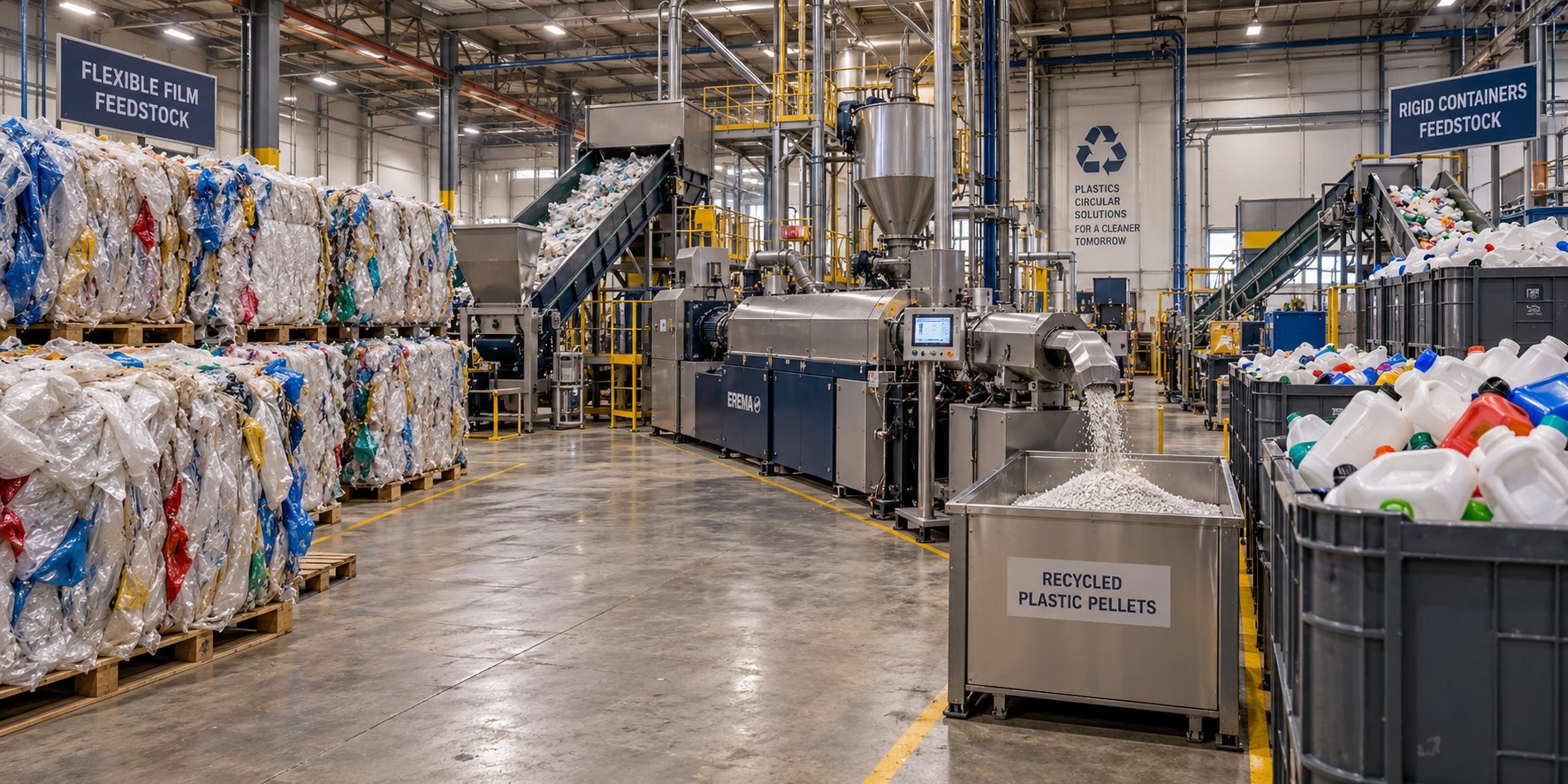
You can memorize every specification on every extruder datasheet, compare cutting methods for hours, and still end up with the wrong pelletizing equipment — because the real question was never "which machine is best?" It was "which machine is best for my feedstock, at my volume, given my budget?" Vendors list capabilities. What buyers actually need is a decision framework that connects their specific waste stream and production goals to the right configuration. That is exactly what this section provides.
Machine Configurations for Common Waste Streams
Every plastic waste stream brings its own combination of headaches — moisture, contamination, melt behavior, bulk density, abrasion potential. The extruder type, feeding system, and cutting method that works beautifully for clean HDPE regrind can fail spectacularly on wet agricultural film. Walking through the six most common recycling feedstocks reveals why one-size-fits-all recommendations from vendors rarely survive contact with real-world material.
Post-consumer flexible film (PE/PP) is arguably the most challenging mainstream feedstock. Film arrives as low-bulk-density bales full of printing ink, adhesive residue, and moisture that can exceed 10% before drying. Standard gravity hoppers cannot feed it — the material bridges, wraps around screws, and starves the barrel. A cutter-compactor or agglomerator-extruder combo is practically mandatory, and a twin-screw system with dual vacuum degassing handles the volatile load far more effectively than a single-screw alternative. Strand pelletizing works at moderate throughputs, but higher-capacity film lines increasingly use underwater or water-ring pelletizing to avoid the strand breakage that plagues wet, inconsistent melt streams.
Rigid containers (HDPE/PP) — bottle and crate regrind — present an easier scenario. After proper washing and granulating, rigid flake feeds consistently by gravity, has relatively low moisture, and melts predictably. A single-screw extruder paired with strand pelletizing handles this stream economically at most production scales. The primary concern is contamination from labels, caps in a different polymer, or food residue; a good screen changer with 100-150 micron mesh keeps pellet quality high without excessive pressure buildup.
PET bottle flake demands a specialized approach. PET is hygroscopic, meaning it absorbs moisture from the air and undergoes permanent molecular-weight degradation (hydrolysis) if extruded above roughly 0.02% moisture content. A crystallizer is essential before drying — it converts amorphous PET flakes into a crystalline state that can withstand the 300-350°F drying temperatures required without softening and fusing together. As Plastics Technology notes, crystallizing also pre-dries the flake and provides additional decontamination by driving off residual volatiles. Twin-screw or specialized single-screw extruders with deep-flighted feed zones handle crystallized PET flake effectively, and underwater pelletizing is the dominant cutting method for PET recycling — its rapid quench produces the dense, spherical pellets that PET bottle preform manufacturers require.
PVC profiles — window frames, pipe, siding — introduce thermal sensitivity and toxicity concerns. PVC degrades rapidly at temperatures above 205°C, releasing hydrochloric acid gas that corrodes steel barrels and poisons any downstream equipment not built with corrosion-resistant metallurgy. A conical twin-screw extruder or specialized single-screw with hardened, corrosion-resistant barrel linings is the standard configuration. Die-face air-cooled pelletizing avoids the water-contact issues that can affect PVC pellet surface finish, and throughputs tend to be lower (100-500 kg/h) because of the tight processing window. Adequate fume extraction is non-negotiable for operator safety.
Agricultural film shares many of the challenges of post-consumer flexible film but adds sand, soil, and organic contamination that dramatically accelerate barrel and screw wear. Incoming moisture levels can reach 15-20% straight from the field, requiring aggressive mechanical pre-drying before extrusion is even feasible. A cutter-compactor feeder with integrated moisture evaporation is the standard front-end solution. Twin-screw extruders tolerate the remaining contamination and moisture better than single-screw machines, and heavy-duty screen changers with backflush capability are essential — sand particles clog standard screens within minutes. Strand pelletizing works for most agricultural film recyclers, though lines above 800 kg/h often move to water-ring systems for higher output stability.
Fiber and textile waste — carpet fiber, nonwoven scraps, synthetic fabric trimmings — present extreme feeding challenges. Long fibers wrap around screws, bridge in hoppers, and resist consistent metering by almost every conventional feeding method. A cutter-compactor with high-speed rotor blades that simultaneously shred, compact, and pre-heat the material before feeding it into the extruder is the only reliable approach. Twin-screw extruders with aggressive kneading configurations handle the variable melt behavior of mixed fiber types (often PP/PET blends), and multiple degassing zones address the high volatile content from dyes, finishes, and flame retardants common in textile waste. Strand pelletizing dominates at moderate throughputs; underwater systems take over for large-scale carpet recycling operations.
The table below consolidates these recommendations into a quick-reference format for evaluating pelletizing equipment against your specific situation:
| Waste Stream | Recommended Extruder Type | Preferred Cutting Method | Typical Throughput Range | Special Requirements |
|---|---|---|---|---|
| Post-Consumer Flexible Film (PE/PP) | Twin-screw or agglomerator-extruder combo | Strand or underwater (water-ring) | 200 – 2,000 kg/h | Forced feeding (cutter-compactor), dual vacuum degassing, intensive washing line |
| Rigid Containers (HDPE/PP) | Single-screw (clean stream) or twin-screw (post-consumer) | Strand pelletizing | 200 – 3,000 kg/h | Good screen changer (100–150 micron), gravity or light force-feeding |
| PET Bottle Flake | Specialized single-screw or twin-screw | Underwater pelletizing | 300 – 3,000 kg/h | Crystallizer + dehumidifying dryer mandatory, moisture below 0.02% |
| PVC Profiles | Conical twin-screw or corrosion-resistant single-screw | Die-face air-cooled | 100 – 500 kg/h | Corrosion-resistant barrel/screws, fume extraction, tight temperature control |
| Agricultural Film | Twin-screw with cutter-compactor | Strand or water-ring | 200 – 1,500 kg/h | Aggressive pre-drying, backflush screen changer, heavy-duty wear components |
| Fiber / Textile Waste | Twin-screw with cutter-compactor | Strand or underwater | 150 – 1,000 kg/h | High-speed rotor feeder, multiple degassing zones, aggressive kneading configuration |
A pattern jumps off the page: twin-screw systems or cutter-compactor combos appear in nearly every challenging waste stream. Single-screw machines earn their place with clean, rigid, single-polymer feedstock — but the moment contamination, moisture, or feeding difficulty enters the picture, the equipment requirements escalate. Recognizing which category your feedstock falls into before contacting vendors saves months of frustration and prevents the classic mistake of buying a simple machine for a complex material.
Scaling Your Line From Startup to Industrial Output
Feedstock type tells you what to buy. Business scale tells you how much machine — and how much surrounding infrastructure — you actually need. A pp recycling machine running at 150 kg/h in a startup garage has almost nothing in common with a 2,000 kg/h industrial line serving regional waste haulers, even if both process the same polymer. Complexity, automation, staffing, and capital requirements shift dramatically across three recognizable tiers.
Small-scale startup (under 200 kg/h) — This is the entry point for first-time operators, side businesses, and proof-of-concept ventures. Equipment is typically a compact, integrated pelletizing line or a simple single-screw extruder paired with strand pelletizing and basic ancillary gear. Automation is minimal: operators manually monitor temperatures, feed rates, and pellet quality. Total capital investment falls in the $30,000 to $150,000 range depending on feedstock complexity and whether you buy new or used. Staffing is one to two people per shift. The advantage is low financial risk and fast learning; the limitation is that throughput caps your revenue ceiling, and you are typically locked into clean, easy-to-process waste streams because the equipment lacks the degassing, filtration, and feeding sophistication for post-consumer material.
Mid-size facility (200 – 1,000 kg/h) — This tier represents the sweet spot for serious recycling businesses. Modular pelletizing lines with separate shredders, washers, dryers, and extruders replace the integrated machines of the startup phase. Automation increases significantly: PLC-based control panels manage barrel temperatures, screw speed, and melt pressure automatically, and continuous screen changers reduce operator intervention during filtration. Twin-screw extruders become viable and often necessary at this scale because feedstock diversity and contamination levels typically increase as operations grow and source from broader waste streams. Capital investment ranges from $150,000 to $500,000 for the pelletizing line alone, with staffing at three to six people per shift. The jump from startup to mid-size is not just about buying a bigger extruder — it requires investing in upstream washing and drying, downstream classification and bagging, and the quality-control instrumentation that buyers at this volume demand.
Large industrial operation (over 1,000 kg/h) — At this scale, the pelletizing line is one part of a fully integrated recycling plant. Automated sorting (NIR, robotic picking), multi-stage washing lines with hot-wash capability, thermal dryers, twin-screw extruders with multiple degassing ports, underwater pelletizing, automated pellet classification, silo storage systems, and robotic bagging all work in concert under SCADA or MES-level process control. Capital investment for the pelletizing section alone starts around $400,000 and can exceed $1,200,000, while the total plant — including sorting, washing, and infrastructure — may require $500,000 to $1,500,000+. Staffing ranges from 5 to 15 people per shift across operations, maintenance, QC, and logistics. At industrial scale, the economics shift: energy consumption per ton drops as larger motors run more efficiently, pellet quality becomes more consistent because automation reduces human variability, and the operation can negotiate long-term offtake contracts with large compounders and brand owners who require certified recycled content at volumes small operators cannot supply.
Which tier fits you? Ask yourself three honest questions: How much capital can I commit without jeopardizing the business if the first six months underperform? How contaminated and variable is the feedstock I can realistically source? And how many tons per month do my identified buyers actually want? Match those answers to the tier descriptions above, and you will have a realistic starting point rather than a vendor-driven aspiration.
Selecting the right machine and scale is a critical milestone — but it is not the finish line. The financial viability of any pelletizing operation ultimately depends on what it costs to run per ton of output and what those finished pellets actually sell for. Those numbers deserve their own hard look.
Operational Costs and Revenue Potential of Pelletizing Operations
You have selected the right extruder type, matched a cutting method to your waste stream, and budgeted for every ancillary component from screen changer to bagging unit. The equipment decision is behind you. The financial question, however, is just beginning. How much does it actually cost to convert a ton of plastic waste into saleable pellets — and what will those pellets fetch on the open market? Surprisingly few equipment buyers model these numbers rigorously before signing a purchase order. Vendors quote throughput in kilograms per hour but rarely walk you through the plastic pelletizing cost per ton that determines whether your operation makes money or bleeds cash month after month.
This section breaks down both sides of the equation — the costs that eat into every kilogram of output and the revenue factors that determine what buyers will pay for it. Think of it as a financial framework you can populate with your own local data: utility rates, labor costs, feedstock contracts, and buyer specifications.
Breaking Down Operational Cost Per Ton of Output
Running an extruder plastic pelletizing line generates costs across several categories, some obvious and some easily overlooked. The danger is not any single cost item — it is the cumulative weight of all of them together, especially the ones that did not appear on your original spreadsheet.
Electricity is the largest variable cost for most pelletizing operations. The extruder motor drives the screw, generating the shear and pressure needed to melt and convey plastic. Barrel heaters add thermal energy. Vacuum pumps, water pumps, pelletizer motors, cooling fans, and conveyors all draw additional power. Pelletizing line energy consumption typically falls between 200 and 380 kWh per ton of output, depending on the polymer, extruder type, and cutting method. Reference data from equipment suppliers puts strand pelletizing systems at roughly 280-380 kWh/ton, underwater systems at 220-310 kWh/ton, and air-cooled die-face cutters at 200-280 kWh/ton. Multiply those figures by your local electricity tariff and the annual tonnage target, and electricity alone can represent 15-25% of total operating cost. A facility processing 1,000 tons per month at $0.10/kWh and 300 kWh/ton spends roughly $30,000 monthly on power for the pelletizing line alone — before touching any other cost category.
Labor scales with line complexity and automation level. A small startup line under 200 kg/h might run with one or two operators per shift. A mid-size facility processing 500-1,000 kg/h typically needs three to six people per shift covering machine operation, quality checks, material handling, and forklift work. Industrial lines above 1,000 kg/h add supervisors, maintenance technicians, and QC staff. A common modeling error is counting only machine operators while forgetting sorters, forklift drivers, maintenance crew, and supervisory overhead. Loaded annual labor costs — including benefits, insurance, and overtime — should replace raw hourly wages in any serious cost model.
Consumable parts wear out on a predictable schedule, yet first-time operators routinely underbudget this category. Screen packs need replacing every few hours to every few days depending on feedstock contamination. Die plates erode over thousands of hours of abrasive melt flow. Pelletizer blades dull — on clean PE/PP scrap, strand-cutter blades last roughly 800-2,000 hours between regrinds, while glass-filled or mineral-loaded compounds can chew through blades in under 100 hours. Screw and barrel wear components represent the highest single consumable cost over a machine's lifetime, with replacement intervals ranging from 2,000 to 8,000 operating hours depending on feedstock abrasiveness and metallurgy quality. Heater bands, thermocouples, seals, and gearbox oil round out the consumable budget.
Maintenance includes both planned preventive schedules and unplanned breakdowns. Planned maintenance — gearbox lubrication, heater band inspections, screw and barrel wear measurements, electrical system checks — keeps the line running predictably. Unplanned downtime from screen changer seal failures, motor faults, or cooling system leaks costs far more per hour because it interrupts production runs and often damages in-process material. Budgeting 3-5% of equipment value annually for maintenance is a reasonable starting estimate, though heavily contaminated feedstocks push this higher.
The table below organizes these cost categories with their primary drivers and practical strategies for controlling them:
| Cost Category | Typical Cost Drivers | Cost-Reduction Strategies |
|---|---|---|
| Electricity (200-380 kWh/ton) | Extruder motor size, barrel heater zones, cutting method, cooling system pumps, vacuum pumps | Match motor size to actual throughput (avoid oversizing); use high-efficiency IE3/IE4 motors; optimize barrel temperature profiles to reduce heater demand; negotiate off-peak power rates; consider energy recovery from cooling water |
| Labor (1-6+ operators per shift) | Number of shifts, line automation level, feedstock complexity, QC requirements, material handling | Invest in PLC automation and recipe management to reduce manual adjustment; use automated bagging to cut packaging labor; cross-train operators to cover multiple stations; automate screen changer operation to eliminate manual filter swaps |
| Consumable Parts | Screen pack consumption (driven by contamination), die plate erosion, pelletizer blade wear, screw/barrel wear rate, heater band life | Improve upstream washing to extend screen life; use backflush screen changers on dirty streams; source application-specific barrel metallurgy for longer wear life; keep spare blade sets sharpened and rotated; track wear rates per feedstock type |
| Planned Maintenance | Gearbox service intervals, heater inspections, screw/barrel wear measurement, electrical and safety checks | Follow manufacturer-recommended service intervals; measure screw-to-barrel clearance every 2,000-4,000 hours and replace before quality degrades; keep critical spares on-site to avoid production delays |
| Unplanned Downtime | Screen changer failures, motor faults, cooling system leaks, contamination spikes, feedstock supply interruptions | Install metal detectors before the extruder; maintain screen changer seals proactively; balance line capacity so no single component becomes a chronic bottleneck; build feedstock buffer inventory |
| Water and Wastewater | Cooling water makeup, water treatment chemicals, sludge disposal, discharge compliance | Recirculate cooling water with chillers; filter and reuse process water; design closed-loop systems to minimize freshwater consumption and discharge fees |
A useful exercise: take a single realistic production month, plug your local electricity tariff, labor rates, and consumable costs into these categories, and calculate the total cost per ton of pellet output. That number — not the equipment price tag — is what determines your margin. An illustrative model for a 500 kg/h PP/PE line running 8 hours a day, 300 days a year at 85% utilization shows operating costs (electricity, labor, water, maintenance, and packaging combined) consuming roughly $170,000-$200,000 annually against approximately $650,000 in revenue from 816,000 kg of saleable pellets. The specifics will differ for your operation, but the structure holds: if you cannot quantify each cost category before buying equipment, you are flying blind.
Revenue Potential and Pellet Market Pricing Factors
Cost control keeps you in business. Revenue determines whether the business is worth being in. And the recycled pellet market price you achieve depends on far more than polymer type alone.
Start with the basics. Different polymers command different price ranges. Recycled HDPE and PP pellets typically trade at a 20-35% discount to virgin resin prices, though that spread fluctuates with crude oil markets and regional supply-demand dynamics. PET recycled pellets — particularly food-grade rPET — have historically commanded tighter spreads to virgin, and in some periods have actually traded at a premium over virgin PET due to supply constraints and brand-owner demand for certified recycled content. S&P Global Platts data shows recycled PET pellet premiums to virgin ranging from roughly $22 to $128 per metric ton in the U.S. market, driven by the cleaning and processing costs required to meet food-contact specifications.
Beyond polymer type, several factors directly influence what buyers will pay for your pellets:
- Color and clarity — Natural (uncolored) pellets command the highest prices because they can be recolored for any application. Mixed-color pellets sell at deep discounts because they limit downstream use to dark-colored or black products. Sorting by color before pelletizing is one of the simplest ways to increase revenue per ton.
- Grade and certification — Food-contact pellets meeting FDA or EFSA standards sell at significant premiums over non-food grades. Achieving food-contact certification requires stringent decontamination processes, often including super-clean washing, fine melt filtration (under 50 ppm contamination), and documented chain-of-custody traceability. The investment is substantial, but the price premium can reach 30-50% over commodity-grade pellets of the same polymer.
- Melt flow consistency — Buyers running injection molding or blown film lines need pellets with a narrow, predictable melt flow index (MFI) range. Batch-to-batch MFI variation signals inconsistent feedstock or process control and triggers price penalties or outright rejection. Consistent upstream sorting and stable extrusion parameters are the keys to steady MFI.
- Contamination level (ppm) — Commodity HDPE and PP buyers may accept 200-500 ppm of foreign particles. Fiber and film buyers typically require under 50 ppm. Every step down in contamination tolerance requires finer filtration, better washing, and more careful sorting — but each step also opens higher-value market segments.
- Regional supply-demand dynamics — Recycled pellet prices are not uniform globally. Regions with strong regulatory mandates for recycled content — the EU being the most prominent example — tend to sustain higher price floors for certified recycled pellets. Markets without binding mandates, particularly across much of Asia and the Americas, see recycled pellets competing directly on price with virgin resin, where drops in crude oil prices can quickly erode the economic case for recycled content.
Here is the connection that ties everything together: pellet quality is not just a technical metric — it is a revenue multiplier. Higher-grade pellets open access to premium buyers, longer-term contracts, and more stable pricing. Lower-grade pellets push you into commodity markets where you compete against every other recycler with a basic extruder and a truck full of cheap feedstock. The difference in revenue per ton between premium and commodity grades can easily exceed the difference in total operating cost — meaning that the upstream investments in better washing, finer filtration, and proper machine configuration discussed throughout this article pay for themselves not just in reduced machine wear, but in dramatically higher selling prices.
Consider the math concretely. If commodity-grade mixed-color HDPE pellets sell at $0.35/lb and properly sorted, natural-color, low-contamination HDPE pellets sell at $0.55/lb, the $0.20/lb premium across 100 tons of monthly output generates an additional $44,000 per month in revenue. That single improvement — driven by better sorting and filtration, not by a more expensive extruder — can shift an operation from marginal profitability to strong returns. The recycled pellet market price you achieve is a direct reflection of every decision made upstream of the bagging station.
Profitability modeling and equipment selection set the strategic direction of your operation. Day-to-day reality, though, lives in the details: pellets coming out misshapen, dies clogging mid-shift, output surging unpredictably. Those operational problems have specific, diagnosable causes — and knowing how to trace symptoms back to root causes separates experienced operators from ones perpetually chasing the wrong fix.
Troubleshooting Common Pelletizing Problems and Their Root Causes
Your pelletizing line ran beautifully during commissioning. The vendor's technician smiled, shook hands, and flew home. Three weeks later, pellets are coming out lopsided, the die keeps clogging, and the hopper bridges every time humidity spikes. Sound familiar? Nearly every operator hits this wall — and the instinct is usually to blame the machine. But most pellet quality problems trace back to just a handful of recurring causes, and once you learn to read the symptoms, corrective action becomes surprisingly systematic rather than a game of guesswork.
This pelletizer troubleshooting guide covers the issues that generate the most downtime, scrap, and frustration in real-world recycling operations. Grab it, bookmark it, and use it the next time your line starts misbehaving.
Diagnosing Pellet Size and Shape Inconsistencies
When buyers reject a shipment, uneven pellet size and poor shape are the most common reasons cited. Injection molders and film extruders rely on uniform granules for consistent dosing, stable melt flow, and predictable part dimensions. Pellets that vary in length by more than 20% or carry visible tails and strings create feeding problems downstream — and that kills repeat orders faster than almost anything else.
Uneven pellet size usually points to one of three culprits. Inconsistent die flow — where some die holes pass more melt than others — creates pellets of varying diameter and weight. This happens when individual die holes become partially blocked by contaminants, when the die plate wears unevenly, or when melt temperature varies across the die face. Worn cutter blades are the second suspect; as blade edges dull, they smear rather than shear the melt, producing elongated or irregularly shaped granules instead of clean cuts. Fluctuating melt temperature rounds out the trio — if barrel zone temperatures oscillate due to faulty thermocouples or cycling heaters, the melt viscosity shifts between cuts, and each pellet solidifies at a slightly different rate and size.
Excessive fines — those sub-millimeter dust particles that contaminate storage silos and trigger customer complaints — are a telltale sign of brittle melt or mechanical cutting problems. Dull blades shatter brittle polymers instead of slicing them cleanly. Incorrect cutting speed compounds the issue: too fast, and the blade fractures partially solidified material; too slow, and strands pile up before being cut, creating both oversized pellets and fragmented dust in the same batch. Brittle melt itself often traces back to degraded polymer — material that has been overheated or has lost molecular weight due to excessive moisture during extrusion.
Pellet tailing and stringing — those thin whiskers of plastic clinging to pellet edges — frustrate operators because the pellets technically meet size specs but look terrible and jam pneumatic conveying systems. In strand pelletizing, tailing typically means the strand was still too warm and soft at the cutter entrance, often because the water bath is too short or the water temperature too high. In underwater systems, stringing points to excessive die temperature, insufficient water flow through the cutting chamber, or a knife-to-die-face gap that has opened up from wear. Reducing die temperature by 5-10°C or increasing process water flow rate often eliminates tailing within minutes — but only if you identify it as a thermal problem rather than a mechanical one.
Solving Feed and Flow Problems
Plastic pellet quality problems do not always originate at the cutting end. Some of the most disruptive issues start at the very beginning of the line — in the hopper and the first few barrel zones — where material either fails to enter the extruder consistently or flows through it erratically.
Die clogging is the quintessential flow disruption. Pressure climbs, output drops, strands break or go thin, and eventually the operator has to shut down for a manual die cleanout. The root cause is almost always contamination that passed through the screen changer — paper fibers, unmelted gels, carbonized polymer, or metal particles that lodge in individual die holes and restrict flow. Sometimes the screen changer itself is the weak link: mesh that is too coarse, screens that are not being changed frequently enough, or a backflush system that is not flushing effectively. In other cases, the feedstock simply contains more contamination than the filtration system was sized to handle. Extruder die clogging solutions nearly always involve improving upstream filtration — stepping down to a finer mesh, switching from manual slide-plate to continuous backflush screen changers, or adding a second-stage filter before the die head.
Hopper bridging is the bane of anyone processing film, fiber, or irregularly shaped regrind. Material forms an arch or tunnel inside the hopper, and the screw spins in empty space while the operator assumes it is still feeding. Inconsistent flake size is a primary trigger — a mix of fine dust and large chunks creates interlocking bridges that gravity alone cannot break. High-moisture film is especially problematic: wet, flexible flakes cling to hopper walls and to each other, forming a compacted mass that refuses to flow. Force-feeders, crammer units, or stirring agitators mounted inside the hopper throat solve most bridging issues mechanically, but the underlying cause — poor size reduction or inadequate drying — should be addressed upstream to prevent recurrence.
Surging output shows up as rhythmic fluctuations in melt pressure and pellet weight. You will notice the die strands pulsing thicker and thinner, or the pellet cutter cycling between overloaded and starved. Inconsistent feeding is the most common driver — the screw fills unevenly because material enters the feed throat in clumps rather than a steady stream. Worn screw flights compound the problem by reducing the screw's ability to convey material forward consistently. As flight edges erode, backflow increases and the screw loses its positive-displacement character, causing the melt pressure at the die to oscillate. Checking screw-to-barrel clearance every 2,000-4,000 operating hours and replacing flights before they wear beyond tolerance is one of the most effective pelletizing machine maintenance tips for preventing surge-related quality problems.
Quick-Reference Troubleshooting Table
When the line is down and pressure is mounting, you do not have time to read paragraphs. The table below condenses the most common problems, their likely causes, and the corrective actions that resolve them — organized so you can scan it in under a minute and start fixing the right thing first:
| Problem | Likely Causes | Corrective Actions |
|---|---|---|
| Uneven pellet size | Partially blocked die holes; uneven die plate wear; fluctuating melt temperature; inconsistent extruder output | Clean and inspect die plate; replace worn die plates; calibrate barrel zone thermocouples and heater bands; stabilize feed rate and screw speed |
| Excessive fines and dust | Dull or chipped cutter blades; cutting speed too high for material; brittle melt from thermal degradation or excess moisture | Sharpen or replace blades; reduce cutter RPM to match throughput; lower barrel temperature if degradation is occurring; improve upstream drying |
| Pellet tailing or stringing | Die temperature too high; insufficient cooling water flow; knife-to-die-face gap too wide; strand too warm at cutter entry | Reduce die head temperature 5-10°C; increase water flow rate or extend water bath length; re-adjust cutter-to-die clearance; check water temperature (target varies by polymer) |
| Die clogging | Contaminated feedstock passing through filtration; screen mesh too coarse; infrequent screen changes; carbonized polymer buildup | Improve upstream washing; step down to finer filter mesh; switch to continuous backflush screen changer; purge die plate on scheduled intervals; install metal detector before extruder |
| Hopper bridging | Inconsistent flake size; high-moisture film or fiber; static charge causing material to cling; hopper geometry too steep or too shallow | Improve size reduction to achieve uniform 8-12 mm flakes; dry material below target moisture before feeding; install force-feeder, crammer, or hopper agitator; review hopper throat angle |
| Surging or pulsating output | Inconsistent feeding (clumping material); worn screw flights increasing backflow; partially blocked screen changer raising variable backpressure | Stabilize feed rate with gravimetric or volumetric feeder; measure screw-to-barrel clearance and replace worn screw elements; change screens more frequently or install continuous screen changer |
| Bubbles or voids in pellets | Excessive moisture in feedstock; inadequate degassing (vacuum port undersized or improperly positioned); trapped volatiles from inks or adhesives | Improve mechanical and thermal pre-drying; verify vacuum pump capacity and check for leaks in vent port seals; add second vacuum vent zone for heavily printed or laminated film |
| Discoloration or black specks | Thermal degradation from excessive barrel temperature or long residence time; carbonized material in dead zones; contaminated feedstock | Lower barrel temperatures in metering zone; reduce screw speed if residence time is excessive; purge extruder thoroughly at startup and between material changes; improve feedstock sorting |
A pattern runs through nearly every row of that table: the root cause is rarely the pelletizer cutter alone. Most problems originate either upstream — in material preparation failures like poor washing, inconsistent size reduction, or inadequate drying — or inside the extruder itself, where worn screws, barrels, and die plates gradually degrade output quality in ways that mimic other faults. An operator chasing cutter adjustments to fix a pellet shape problem caused by a worn screw flight will burn hours and solve nothing.
The most effective long-term troubleshooting strategy is also the least exciting: invest in preventive maintenance and quality feeding practices before problems appear, rather than diagnosing them after production stops.
That means measuring screw-to-barrel clearances on a schedule, sharpening blades before pellet quality visibly degrades, changing screens before pressure spikes force emergency shutdowns, and — above all — treating upstream washing, drying, and size reduction as integral parts of the pelletizing process rather than someone else's responsibility. The operators who internalize this mindset spend their shifts monitoring a stable line instead of firefighting one crisis after another.
Troubleshooting skill keeps your line running day to day. But the longer-term question — who supports you when a problem exceeds your team's expertise, when critical wear parts need replacing, or when you want to scale into a new waste stream — depends entirely on the equipment partners and component suppliers you chose at the outset.
How to Evaluate Vendors and Choose the Right Equipment Partner
A plastic recycling pelletizing machine is not a commodity purchase like buying office furniture. It is a ten-year commitment disguised as a one-time transaction. The vendor you choose does not just deliver equipment — they become the voice on the other end of the phone when your die clogs at 2 a.m., the source of replacement screws and barrels when wear components hit their limit, and the engineering partner you rely on when a new feedstock demands different screw geometry. Choose well, and that relationship quietly pays dividends for a decade. Choose poorly, and you spend years working around gaps that should never have existed.
Yet most buyers evaluate vendors the same way they shop for any industrial equipment: compare prices across three or four quotations, pick the lowest or second-lowest bidder, and hope for the best. That approach works when buying a forklift. It fails spectacularly when buying a pelletizing line, because the real costs — downtime from slow spare parts delivery, production losses from poor technical support, pellet quality problems from mismatched screw designs — show up months or years after the invoice is paid.
What to Evaluate Beyond the Machine Price Tag
Imagine two vendors quoting the same throughput on the same waste stream. Vendor A prices 15% lower. Vendor B includes a detailed screw configuration rationale, itemized wear parts pricing, a named service engineer with a guaranteed response time, and references from three facilities running your exact polymer at comparable volumes. Which quotation actually costs less over five years? The answer is almost never the one with the smaller number at the bottom of page one.
The following checklist covers the evaluation criteria that separate equipment partners from equipment sellers. Use it as a scoring framework — run every shortlisted supplier through the same questions in the same order, and record their responses side by side. Differences that take weeks to surface in scattered email threads become obvious in a single comparison table.
- Proven installations in similar applications — Ask for reference projects processing the same polymer, at comparable throughput, with a similar contamination profile. A vendor who has successfully commissioned five PE film lines but has never handled PET bottle flake is not the right partner for your PET operation, regardless of price. Request specific details: feedstock type, throughput achieved, pellet grade produced, and — if possible — direct contact with the reference customer. As industry evaluation guides note, material type, throughput, and output spec are not confidential — only the customer name might be. A supplier who cannot provide configuration details for past projects likely does not have relevant experience to share.
- Spare parts availability and lead times — Wear parts consumption is continuous and predictable. Blades, screen packs, die plates, heater bands, seals, screws, and barrel linings all have finite lifespans. Ask for an itemized wear parts list for your specific configuration — with prices and lead times — not a vague promise that "spare parts are available." Ask how many years parts remain available after purchase and whether the supplier would release part drawings if the model is discontinued.
- Technical support responsiveness — Who do you call when the line stops? A named engineer, or a generic sales inbox? In what language? Within how many hours? Remote troubleshooting capability via video call or PLC remote access can resolve many issues without a site visit, but only if the person on the other end understands your screw configuration and process parameters. Test this before signing: ask one technically specific question during the quotation phase and see who answers, how quickly, and how competently.
- Warranty terms and coverage scope — Standard warranties typically cover 12 months from commissioning or 18 months from shipment, but the devil lives in the exclusions. Does the warranty cover wear parts? Electrical components? Gearbox internals? What voids the warranty — processing a material not specified in the original order? Running above rated throughput? Get every term in the contract, not in a handshake.
- Training offerings — A pelletizing line is only as capable as the operators running it. Does the vendor provide on-site operator training during commissioning? How many days? Is the training conducted by an engineer who understands the process, or a technician who knows only the mechanical assembly? Will they train your maintenance staff on screw removal, screen changer servicing, and die plate inspection — the tasks that prevent 80% of unplanned downtime?
- Ability to supply application-specific components — This criterion is less obvious but critically important. Can the vendor configure screw elements, barrel linings, and die plates specifically for your feedstock, or do they offer a standard package and expect you to adapt? Recycling applications vary enormously in abrasion, corrosion, moisture, and contamination load. A vendor who asks detailed questions about your feedstock before specifying the screw and barrel metallurgy is engineering a solution. One who quotes the same screw for agricultural film and clean HDPE regrind is selling a catalog item.
One evaluation signal costs nothing and is nearly impossible to fake: watch what questions a supplier asks you before sending a quotation. A vendor with genuine engineering depth will want to know the polymer, grade, form, contamination type and percentage, bulk density, throughput target, output specification, floor space, local voltage, and water availability. Those are not sales friction — they set screw geometry, filtration mesh, degassing configuration, and line balance. A turnkey price returned within an hour of a one-line inquiry means nothing was engineered; a catalog package was selected and priced.
Building a Reliable Supply Chain for Critical Wear Components
Even the best pelletizing equipment vendor selection cannot eliminate one unavoidable reality: extruder screws and barrels wear out. Every hour of operation grinds away at the clearances between screw flights and barrel walls, gradually degrading melt quality, increasing energy consumption, and reducing output consistency. Industry data from Plastics Technology identifies three distinct wear mechanisms — adhesive wear from metal-to-metal contact, abrasive wear from fillers and contaminants, and corrosive wear from chemically aggressive polymers — all of which accelerate in recycling applications where feedstocks carry sand, metal fragments, glass fibers, and corrosive residues that virgin-resin processors never encounter.
Here is where many operators make a costly assumption: that OEM replacement barrels and screws are always the best or only option. In practice, original equipment manufacturers often source their barrels and screw elements from third-party specialists anyway. When you order a "factory original" replacement barrel, it may come from the same type of generalist supplier available to you directly — at a markup. Worse, if the OEM discontinues your model or exits the market, replacement components become difficult or impossible to source through that single channel.
The smarter approach is building a direct relationship with a specialist supplier who understands the metallurgy, dimensional tolerances, and screw geometry requirements specific to recycling and pelletizing applications. The differences between a generalist barrel and an application-engineered one are not academic — they show up in measurable wear life, energy consumption, and pellet consistency. Research on twin-screw extruder wear confirms that material selection — particularly powder metallurgy steels with high tungsten carbide content — dramatically extends service life in high-wear zones like the feeding section, filler introduction zone, and discharge area. A barrel manufactured with the wrong alloy or insufficient hardness in these critical zones can wear out in half the time, forcing premature replacement and all the production losses that come with an unplanned shutdown.
NANHAIYA is one example of a component supplier that takes this application-specific approach. They design custom parallel twin screw barrels specifically for recycling, pelletizing, compounding, granulation, and masterbatch operations — the full range of demanding mixing and conveying scenarios where generic barrels fall short. Rather than offering a single barrel specification across all applications, their engineering process accounts for the specific polymer, filler type, abrasion profile, and processing temperatures that each customer's operation demands. For recyclers running abrasive post-consumer waste streams or filled compounds, that kind of targeted metallurgy translates directly into longer barrel life, fewer unplanned shutdowns, and more consistent pellet quality across thousands of production hours.
Whether you work with NANHAIYA or another specialist, the principle remains the same: treat your extruder screw and barrel replacement supply chain as a strategic decision, not a reactive purchase you make when something breaks. Keep dimensional records of screw flight diameters and barrel bore measurements so you can track wear rates per feedstock type and predict replacement timing. Identify your component supplier during the equipment purchasing phase — not during the emergency phone call when the line is already down. And verify that your chosen recycling equipment spare parts supplier can deliver replacement barrels within a lead time that does not force weeks of lost production.
The vendors who sell you the machine and the suppliers who keep it running are equally important partners — evaluate both with the same rigor before committing capital.
A final thought worth internalizing: the best equipment partner is the one whose long-term interests align with yours. A vendor who profits from selling you the right machine, supporting it through commissioning, and supplying wear parts for a decade has every incentive to get the initial specification right. A vendor whose profit ends at the shipping dock has no such incentive. The questions on the checklist above are designed to reveal which type you are talking to — before the contract is signed and the leverage shifts permanently.
Frequently Asked Questions About Plastic Recycling Pelletizing Machines
1. What is a plastic recycling pelletizing machine and how does it work?
A plastic recycling pelletizing machine converts post-consumer or post-industrial plastic waste into uniform pellets (typically 2-5 mm) that manufacturers use as feedstock. The process follows a defined sequence: plastic scrap is fed into an extruder barrel, where rotating screws and external heaters melt it. The molten plastic then passes through a melt filter to remove contaminants like paper, metal, and unmelted gels. Degassing zones extract trapped moisture and volatiles using vacuum ports. Finally, the clean melt is forced through a die and cut into pellets using strand, underwater, or die-face air-cooled methods. Each stage directly influences the final pellet grade, market value, and suitability for downstream applications such as injection molding, blown film, and pipe extrusion.
2. Should I choose a single-screw or twin-screw extruder for plastic pelletizing?
The choice depends primarily on your feedstock quality and complexity. Single-screw extruders cost less, are simpler to operate, and perform well with clean, pre-sorted, single-polymer streams like post-industrial film trim or rigid HDPE regrind. Twin-screw extruders cost roughly 2-3x more but offer superior mixing, self-wiping action, modular screw configurations, and multiple degassing zones — making them essential for post-consumer plastics, printed laminates, high-moisture film, filled compounds, or any feedstock with significant contamination or variability. For twin-screw systems, barrel quality is critical: suppliers like NANHAIYA engineer custom parallel twin screw barrels specifically for recycling and pelletizing applications, which helps maintain tighter clearances and better energy efficiency over the machine's lifetime.
3. How much does it cost to run a plastic pelletizing line per ton of output?
Operational costs vary by scale, feedstock, and region, but the major categories include electricity (200-380 kWh per ton, typically the largest variable cost), labor (1-6+ operators per shift depending on automation level), consumable parts (screen packs, die plates, cutter blades, and screw/barrel replacements), planned maintenance (budgeting 3-5% of equipment value annually is a reasonable baseline), and water or wastewater treatment. For a mid-size 500 kg/h PE/PP line running 8 hours daily at 85% utilization, annual operating costs typically fall in the $170,000-$200,000 range. Accurately modeling your cost per ton before purchasing equipment is essential — it determines actual profitability far more than the machine's sticker price.
4. What pre-processing steps are needed before pelletizing plastic waste?
Pre-processing is the single biggest lever over pellet quality and market price. Key steps include sorting by polymer type using manual picking, NIR optical sorters, or density separation to eliminate cross-contamination. Washing follows, with intensity matched to contamination level — post-consumer bales typically require pre-wash, friction wash, float-sink separation, and hot caustic wash for stubborn adhesives. Size reduction through shredding and granulating to a uniform 8-12 mm flake ensures stable extruder feeding. Finally, drying to target moisture levels is critical: under 1-3% for polyolefins and below 0.02% for PET to prevent hydrolytic degradation. Facilities that invest properly in these upstream steps consistently produce higher-grade pellets that command significantly better market prices.
5. How do I evaluate and choose the right pelletizing equipment vendor?
Look beyond the price tag and evaluate vendors on six critical criteria: proven installations processing your specific polymer at comparable throughput and contamination levels, spare parts availability with itemized pricing and lead times, technical support responsiveness with named engineers and guaranteed response windows, warranty terms with clearly documented coverage and exclusions, operator and maintenance training during commissioning, and the ability to supply application-specific screw and barrel configurations rather than generic catalog packages. A strong signal of vendor quality is the depth of questions they ask you before quoting — a serious engineering partner will want to know your polymer, contamination profile, throughput target, and output specifications before proposing any configuration. Also build a separate supply chain for critical wear components like twin-screw barrels from specialists such as NANHAIYA, who engineer barrels for specific recycling and compounding demands.
Written by
Nanhaiya Technical Team
Zhoushan Nanhaiya Plastic Machinery Co., Ltd.
The Nanhaiya technical team supports screw and barrel manufacturing projects through application review, technical communication, custom manufacturing coordination, and production and quality control.
Discuss Your Application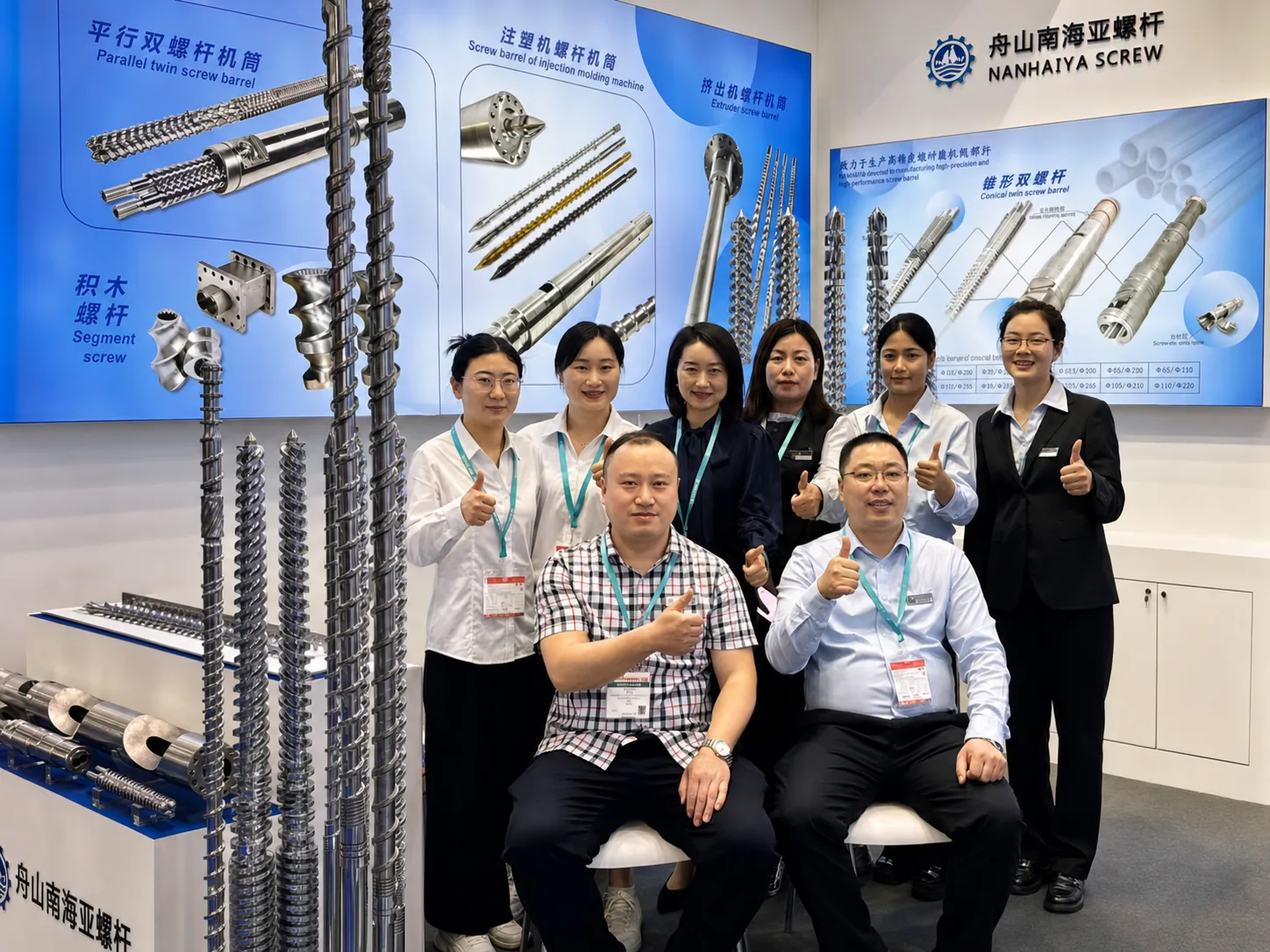
Related Articles
More insights on screw barrel technology and plastics processing.
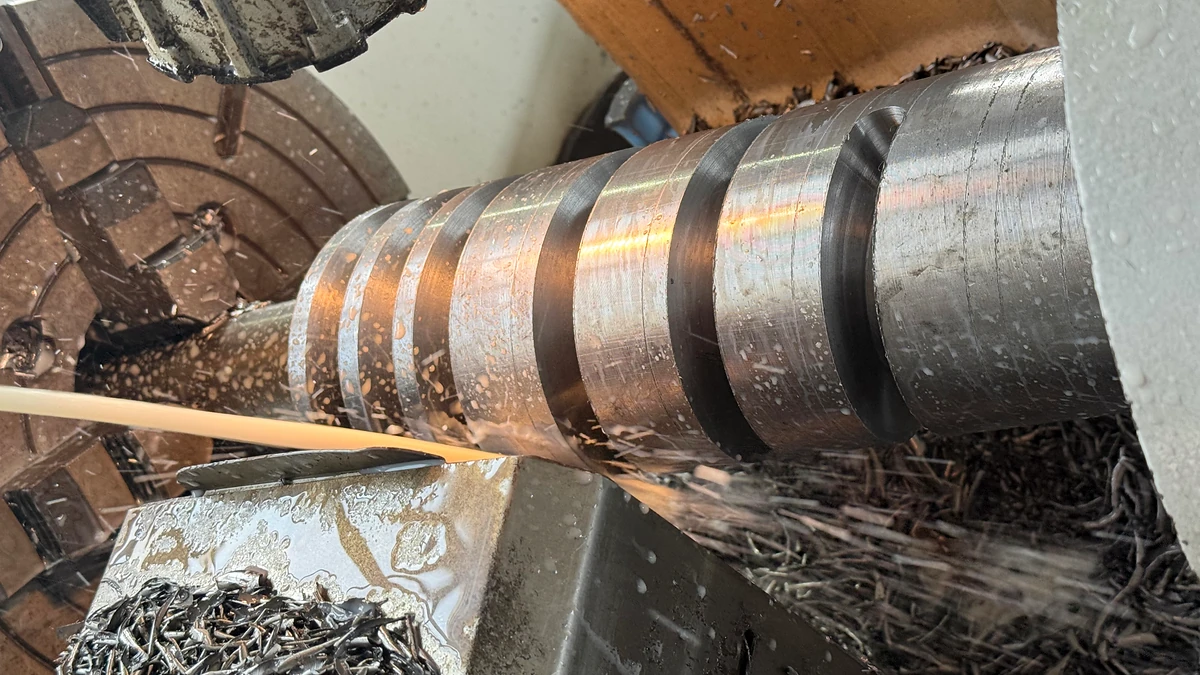
What Really Drives Screw Barrel Price (It's Not Just Steel)
Oct 30, 2026
Learn what really drives screw barrel price — from material alloys and configuration types to hidden costs, TCO analysis, and smart sourcing strategies for buyers.
Read Article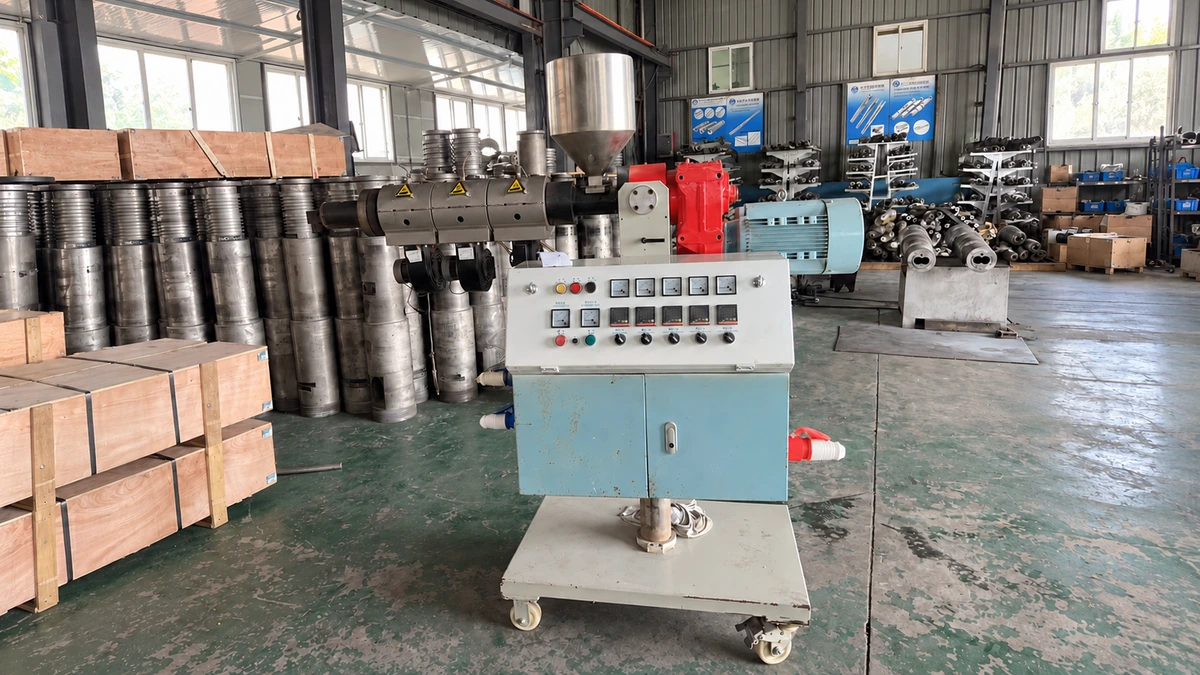
Extruder Barrel Supplier Red Flags Every Buyer Learns Too Late
Oct 30, 2026
Learn how to evaluate an extruder barrel supplier with red-flag checklists, capability matrices, metallurgy comparisons, and pre-order questions for smarter procurement.
Read Article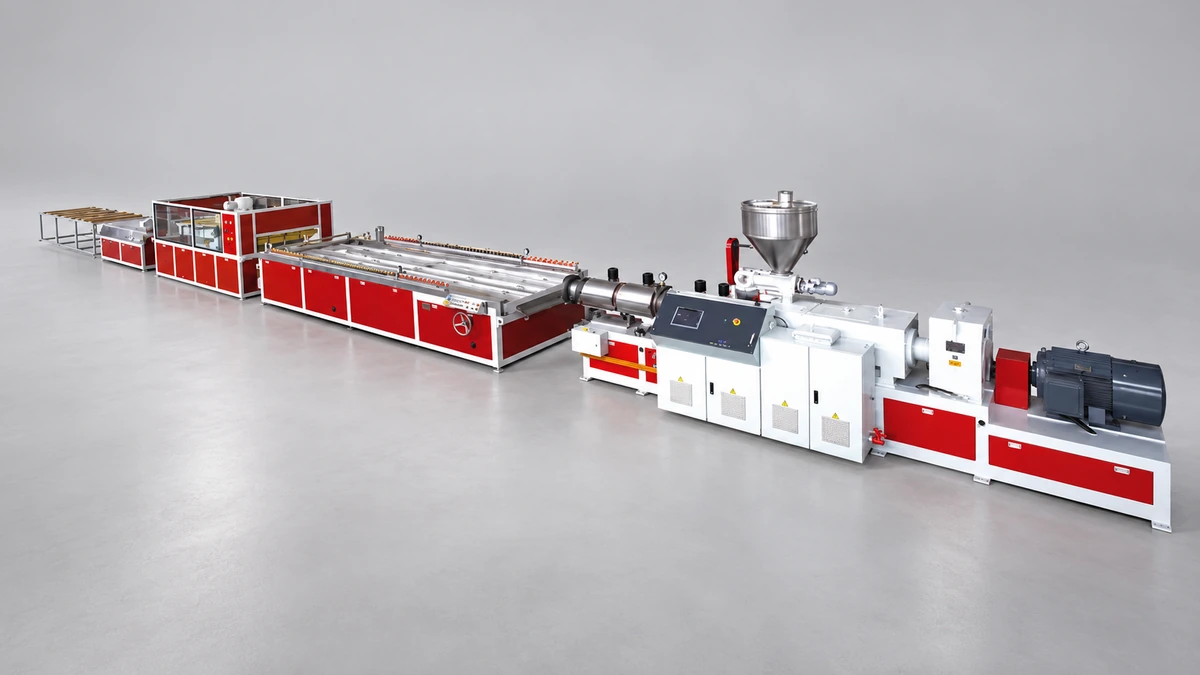
What Most Buyers Get Wrong About WPC Extrusion Machine Selection
Oct 29, 2026
Learn how to select the right WPC extrusion machine by comparing extruder types, resin systems, wear-part metallurgy, and capacity planning to avoid costly mistakes.
Read ArticleLooking for something else?
Search by material, symptom or product and jump straight to the relevant page.
These are navigation suggestions based on keyword matching — not a quotation, not a delivery commitment, and not a substitute for engineering review. Final specification is confirmed by our engineers against your drawings and processed material.
Need help with screw barrel selection?
Share your machine model, processed material and application. Our team can help with pricing and technical support.