

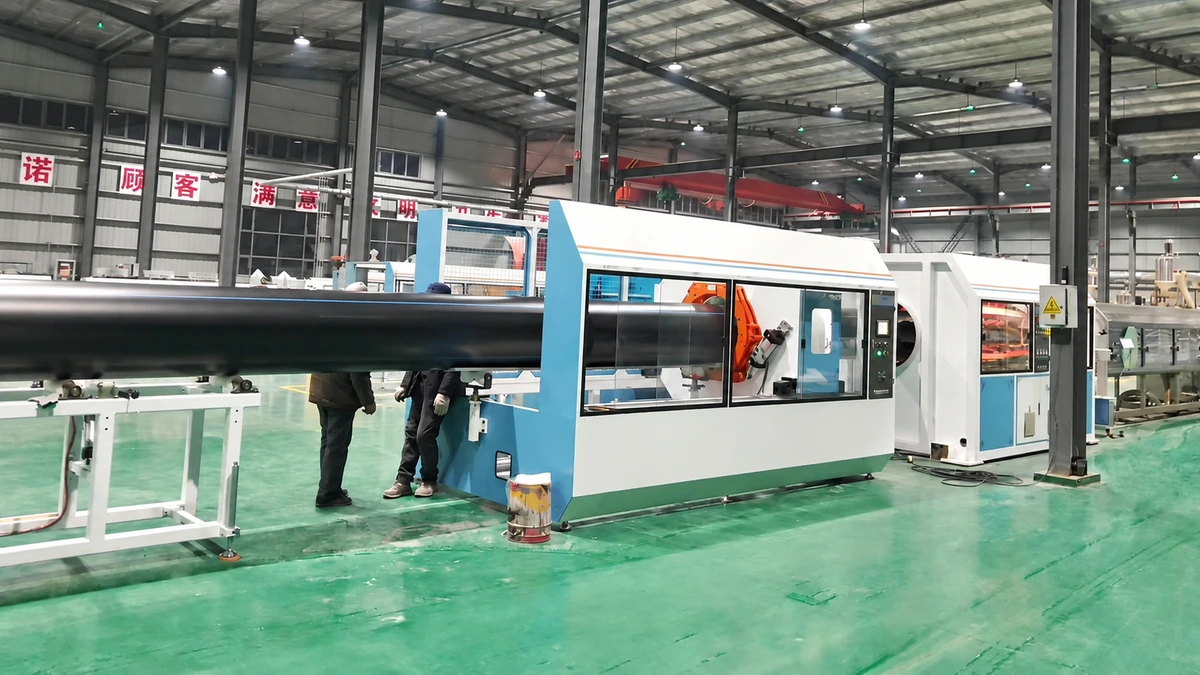
What Is a PVC Conduit Pipe Extrusion Line
Every plastic conduit pipe running through the walls, floors, and underground duct banks of modern buildings started as a raw PVC compound sitting in a storage silo. The system responsible for transforming that powder into a finished, dimensionally precise pipe is called a PVC conduit pipe extrusion line — and most buyers know far less about it than they should.
A PVC conduit pipe extrusion line is an integrated, continuous manufacturing system that melts, shapes, sizes, cools, and cuts rigid PVC compound into hollow conduit pipes used to protect electrical wiring in residential, commercial, and industrial installations. It typically produces pipes ranging from 16 mm to 110 mm in outer diameter.
What a PVC Conduit Pipe Extrusion Line Actually Does
Think of this production line as a chain of specialized machines working in tight sequence. Raw PVC compound enters a pipe extruder, where rotating screws melt and pressurize the material. The molten PVC then passes through a die head that shapes it into a hollow tube. Downstream, vacuum calibration tanks lock in the exact outer diameter, spray cooling tanks solidify the pipe wall, a haul-off unit pulls at constant speed, and a cutter slices each pipe to length. Every stage depends on the one before it — a disruption anywhere ripples through the entire output.
Why PVC Dominates Electrical Conduit Production
PVC earns its place in electrical infrastructure for practical reasons: it is naturally flame-retardant, resistant to moisture and corrosion, lightweight, and cost-effective at scale. These properties make it the go-to material for conduit pipes that must meet strict safety standards like UL 651 in North America and IEC 61386 internationally. A well-configured plastic pipe extrusion machine can run continuously for 24 hours, producing thousands of meters of conduit that meet tight dimensional tolerances — but only when operators understand how each component and process parameter interacts.
Who This Guide Is For
If you are evaluating pipe extruders for a new production facility, troubleshooting quality issues on an existing line, or comparing equipment configurations before a major capital investment, this guide was written for you. The following sections break down every component, every critical process variable, and every decision point that suppliers rarely explain in full — starting with a complete walkthrough of the machinery itself.
Every Component in a PVC Pipe Extrusion Machine Explained Step by Step
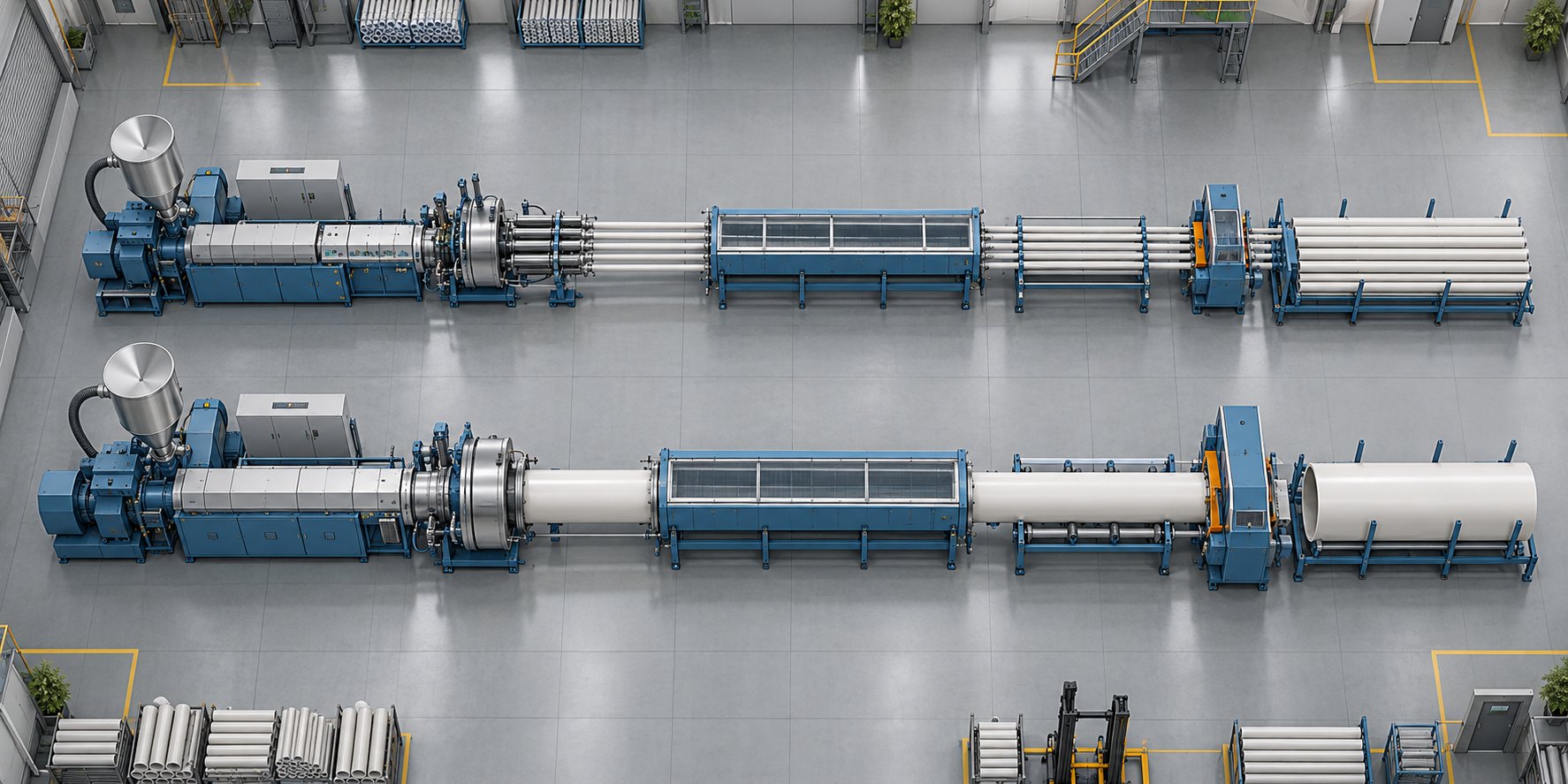
A PVC conduit pipe extrusion line is not a single machine — it is a carefully orchestrated sequence of eight or more individual units, each performing one precise task and handing the result to the next. Miss the function of even one unit, and you will struggle to diagnose quality problems or compare supplier quotations meaningfully. Below is the full walkthrough, from raw material preparation all the way to finished pipe stacking.
Upstream Preparation — Hot-Cold Mixer Units
Before any plastic touches the extruder, the PVC dry-blend must be prepared. A hot-cold mixer system handles this critical first step. The hot mixer (typically operating at around 120 degrees Celsius) blends raw PVC resin powder with stabilizers, lubricants, fillers like calcium carbonate, and pigments. Friction from high-speed blades generates heat, activating additives and driving off residual moisture. Once the compound reaches its target temperature, it drops automatically into the cold mixer, which cools the batch to roughly 40-50 degrees Celsius so it flows freely and does not pre-gel before reaching the extruder hopper.
Why does this matter to you as a buyer? The mixer's batch capacity and cycle time directly determine how fast you can feed your PVC pipe extruder machine. If the mixer cannot keep pace with your extruder's throughput, your entire line sits idle waiting for material.
The Extruder and Die Head — Heart of the Line
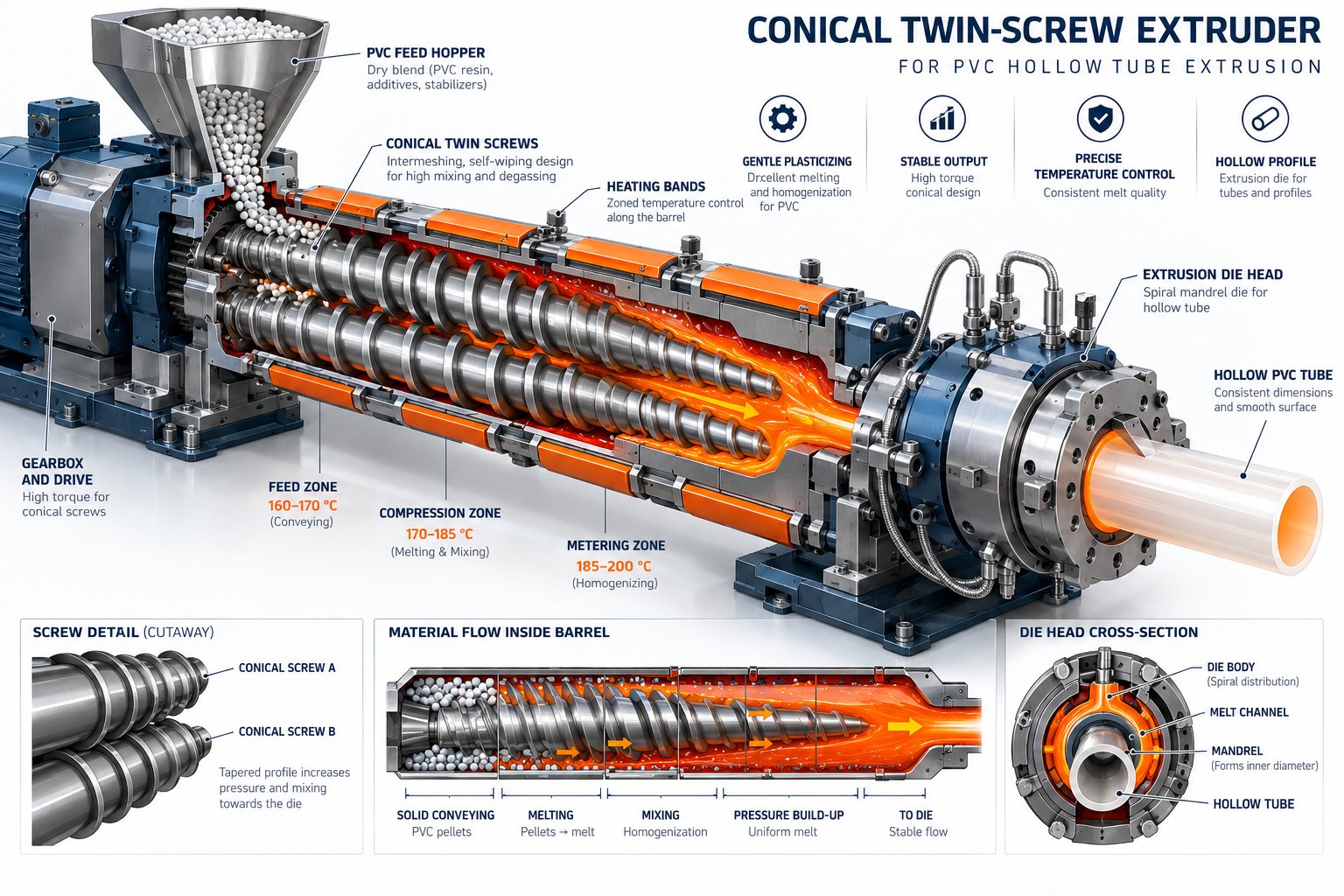
The extruder is where raw powder becomes a homogeneous, pressurized melt — and it is the single most important piece of equipment in any PVC extrusion machine. Counter-rotating conical twin-screw extruders dominate this application because their tapered screw geometry generates high torque at low speed, gently plasticizing heat-sensitive PVC without thermal degradation. The screw and barrel quality, including metallurgy, surface hardness, and dimensional precision, directly affects melt consistency and long-term production stability.
Immediately downstream of the extruder sits the extrusion die head. This precision-machined tool forces the molten PVC through an annular gap, forming a continuous hollow tube. Die centering adjustments control wall thickness uniformity around the pipe circumference. A poorly centered die head is one of the most common — and most overlooked — causes of uneven wall thickness in finished conduit.
Downstream Equipment — Calibration to Stacking
Once the soft, molten tube exits the die, it enters a chain of downstream machines that cool, size, pull, mark, cut, and stack it:
- Vacuum calibration tank: A calibration sleeve combined with vacuum pressure holds the still-soft pipe to its exact outer diameter while circulating water begins cooling the surface. The vacuum level, sleeve dimensions, and water temperature must be precisely matched to the target pipe size.
- Spray cooling tank: The pipe passes through one or more spray cooling tanks where water jets cool it uniformly to near room temperature. Insufficient cooling at this stage leads to residual heat that can cause deformation under haul-off tension, as Fangli Technology's engineering documentation notes regarding radial temperature gradients in incompletely cooled pipes.
- Haul-off machine: Caterpillar-style belt pullers grip the pipe and draw it through the cooling tanks at a constant, adjustable speed. The haul-off speed relative to extruder output determines final wall thickness — a slower speed yields thicker walls, a faster speed yields thinner ones. Clamping force must be adjustable to avoid deforming the pipe surface.
- Printer: An inkjet or hot-stamp printer marks the pipe with brand identification, diameter, standard compliance codes, and production date. Many electrical conduit standards require permanent marking at regular intervals.
- Cutting machine: A planetary or guillotine cutter clamps onto the moving pipe, travels with it, and makes a clean cut to the specified length — typically 3 or 4 meters for electrical conduit. After cutting, a pneumatic mechanism resets the cutter to its starting position automatically.
- Stacker or belling machine: Cut pipes either drop onto a dump table and are bundled by an automatic stacker, or they feed into a belling (socketing) machine that heats one pipe end and forms a bell-shaped socket for push-fit joints.
Additional downstream equipment can include ultrasonic wall thickness gauges and laser diameter measurement systems for real-time quality monitoring. These instruments feed data back to the PLC control panel, allowing operators — or automated systems — to adjust process parameters before defects accumulate.
| Component Name | Primary Function | Key Specifications to Evaluate |
|---|---|---|
| Hot-Cold Mixer | Blends raw PVC resin with additives; cools the compound for feeding | Batch capacity (kg), mixing speed (RPM), cycle time, heating/cooling efficiency |
| Conical Twin-Screw Extruder | Melts, plasticizes, and pressurizes the PVC compound | Screw diameter (e.g., SJZ-65/132), motor power (kW), max output (kg/h), screw/barrel material |
| Extrusion Die Head | Shapes molten PVC into a hollow tube with controlled wall thickness | Diameter range, centering adjustment mechanism, number of heating zones, flow channel design |
| Vacuum Calibration Tank | Sizes the pipe OD and begins cooling under vacuum | Vacuum range (kPa), calibration sleeve size, tank length, water circulation rate |
| Spray Cooling Tank | Completes pipe cooling to near ambient temperature | Total tank length (m), number of spray sections, water temperature control, drainage capacity |
| Haul-Off Machine | Pulls the pipe at constant speed through downstream equipment | Max haul-off speed (m/min), clamping force range (N), number of caterpillar tracks, speed accuracy |
| Printer | Applies product identification and standard compliance markings | Print type (inkjet/hot stamp), character resolution, marking interval, ink adhesion durability |
| Cutting Machine | Cuts pipe to specified lengths while traveling with the line | Cutting type (planetary/guillotine), length accuracy (mm), max pipe OD, dust collection system |
| Stacker / Belling Machine | Bundles finished pipes or forms socket ends for push-fit joints | Stacking capacity, belling diameter range, heating method, cycle time per socket |
Each unit in this sequence must be speed-synchronized with every other unit. The extruder's output rate, the haul-off pull speed, and the cutter cycle all need to operate in harmony — a mismatch at any point causes dimensional defects or line stoppages. This interconnectedness is exactly why evaluating a PVC pipe extrusion machine as isolated components, rather than as an integrated system, leads to costly surprises after installation.
Yet the extruder itself deserves a deeper look, because the type of screw configuration you choose — conical twin-screw, parallel twin-screw, or single-screw — shapes nearly every performance characteristic of the finished line.
Conical Twin-Screw vs Parallel Twin-Screw vs Single-Screw Extruders
Choosing the right extruder type is not a matter of picking the most expensive option on the market. It is a process-driven decision that determines how well your PVC conduit pipe extrusion line plasticizes raw compound, how stable your output remains over an eight-hour shift, and how much maintenance you will face over the machine's lifespan. Three screw configurations dominate PVC conduit production — and each one fits a different operational profile.
Conical Twin-Screw Extruders — The Industry Standard for PVC Conduit
Walk into any factory producing rigid PVC electrical conduit in the 16 mm to 110 mm diameter range, and you will almost certainly find a conical twin-screw extruder at the heart of the line. There is a reason this design has held its position for decades: it solves PVC's biggest processing challenge better than any alternative.
PVC dry-blend powder is notoriously heat-sensitive. Push it too hard and it degrades. The conical twin-screw design addresses this by using two tapered, counter-rotating screws that are wider at the feed end and narrower at the discharge end. This geometry delivers three critical advantages:
- High torque at low rotational speed: The larger feed-end diameter provides a massive root cross-section, allowing the screws to generate the force needed to compress and convey PVC powder without spinning fast enough to create excessive frictional heat.
- Gentle, controlled shear: Because the screws taper progressively, material is compressed gradually rather than abruptly. This prevents localized overheating that would release HCl gas and cause discoloration or burn marks in the finished conduit.
- Excellent plasticizing uniformity: The intermeshing, counter-rotating action creates a positive conveying mechanism with minimal backflow. Every particle of PVC compound receives consistent thermal and mechanical energy, producing a homogeneous melt that translates directly into uniform wall thickness and smooth pipe surfaces.
Common conical twin-screw models used for conduit production include the SJZ-51/105, SJZ-55/110, SJZ-65/132, and SJZ-80/156 — with the designation numbers reflecting the small-end and large-end screw diameters in millimeters. For small-diameter conduit pipes (16 mm to 32 mm OD), the SJZ-51/105 or SJZ-55/110 typically provides sufficient output, while larger conduit or higher throughput requirements call for the SJZ-65/132 or above.
Parallel Twin-Screw and Single-Screw Alternatives
Conical twin-screw extruders cover most PVC conduit applications, but they are not the only option. Two alternatives appear in the market, each with a distinct use case.
Parallel twin-screw extruders use two screws of equal diameter running side by side. They can achieve higher output rates than conical designs of similar motor power, making them attractive for large-diameter pipe production or high-volume operations. However, they are mechanically more complex, generate more shear heat at equivalent throughput, and typically carry a higher purchase price along with greater maintenance demands. You will see parallel twin-screw plastic pipe extruders more often in plants producing larger PVC pressure pipe or drainage pipe rather than standard electrical conduit.
Single-screw extruders represent the simplest and lowest-cost option. A single rotating screw melts and conveys material through the barrel, relying more heavily on conductive heat from barrel heaters and less on internal mixing action. This architecture works well for pre-compounded PVC pellets that have already been thoroughly blended and densified. But for processing PVC dry-blend powder — the standard feedstock in most conduit manufacturing — a single-screw design struggles to deliver the mixing intensity and plasticizing consistency that rigid conduit quality demands. As Jinxin Extruder's technical comparison notes, rigid PVC powder or dry blend usually points toward a twin-screw extruder because the single-screw architecture simply cannot replicate the same level of material control.
| Extruder Type | Best Use Case | Advantages | Limitations |
|---|---|---|---|
| Conical Twin-Screw | Rigid PVC conduit from dry-blend powder (16-110 mm OD); standard to mid-volume production | High torque at low RPM; gentle shear for heat-sensitive PVC; excellent melt uniformity; compact gearbox design | Output ceiling lower than parallel twin-screw at equivalent screw speed; limited to PVC and similar heat-sensitive polymers |
| Parallel Twin-Screw | Large-diameter PVC pipe; high-volume production lines; applications requiring maximum throughput | Higher output capacity; flexible screw element configuration; strong mixing performance | More complex gearbox and drive system; higher shear heat generation; greater capital and maintenance cost |
| Single-Screw | Pre-compounded PVC pellets; simple profiles; applications where material is already fully blended | Lower machine cost; simpler operation and maintenance; fewer wear components | Poor mixing of powder feedstock; limited plasticizing capability for rigid PVC dry-blend; inconsistent melt quality with complex formulations |
When browsing a pipe extruder machine sale listing, you will frequently see all three types offered side by side. The table above helps you cut through marketing language and match the right architecture to your actual feedstock and production volume.
Why Screw and Barrel Quality Determines Output Consistency
Here is what most equipment suppliers gloss over: the extruder frame, motor, and gearbox are important, but the screws and barrel are where plasticizing actually happens. These are the components in direct contact with abrasive PVC compound for thousands of hours per year, and their precision dictates whether your line produces consistent conduit or generates reject after reject.
Several parameters of screw and barrel design directly affect melt quality. The clearance between screw and barrel, typically controlled within 0.1 to 0.6 mm, governs backflow and leakage of molten PVC. When this gap widens due to wear, you get pressure fluctuations, increased frictional heat, and — in severe cases — thermal degradation that produces discolored or brittle pipe. The screw's compression ratio, L/D ratio, and groove depth all influence how thoroughly the powder is densified and homogenized before reaching the die head.
For thermally sensitive polymers like PVC, a shorter L/D ratio is generally preferred because extended residence time inside the barrel raises the risk of degradation. But shorter screws demand more precise engineering to achieve adequate plasticizing within fewer screw turns. This is exactly why the metallurgy, surface hardness, and dimensional tolerances of your screw barrel set matter enormously — a barrel machined to loose tolerances or built from inferior alloy will wear faster, widen that critical screw-barrel clearance sooner, and force earlier replacement or rework.
Manufacturers who run conical twin-screw extruders should treat barrel sourcing as a strategic decision, not an afterthought. The barrel is a wear component with a finite service life, and having a reliable supply partner for precision-engineered replacements minimizes unplanned downtime. NANHAIYA, for example, specializes in custom and replacement conical twin screw barrels built specifically for PVC pipe, profile, and board extrusion applications. Their focus on this niche means the barrels are engineered for the thermal and abrasive demands of rigid PVC processing — a relevant resource for conduit producers evaluating barrel upgrade or replacement options.
Whether you source barrels from your original equipment manufacturer or from a specialist like NANHAIYA, the key takeaway remains the same: screw and barrel quality is not a line item to minimize on a purchase order. It is the variable that determines whether your extrusion line delivers stable, specification-compliant conduit pipe month after month — or slowly drifts out of tolerance as wear accumulates.
Screw configuration and barrel precision set the foundation, but they do not operate in isolation. The pipe diameter you target — and whether you run single-cavity or multi-cavity dies — reshapes the entire line configuration in ways that deserve their own close examination.
How Pipe Sizing Shapes Your Extrusion Line Configuration
A 16 mm conduit pipe and a 110 mm conduit pipe are both rigid PVC tubes designed to protect electrical wiring. Yet the extrusion pipe machine that produces each one looks remarkably different — different PVC extruder size, different die geometry, different calibration sleeves, different haul-off clamp force, and often a different cutting mechanism. Pipe diameter is the single variable that cascades through every equipment decision on the line.
Matching Extruder Size to Target Pipe Diameter
Electrical conduit OD ranges from roughly 16 mm to 110 mm, and each segment of that range demands a specific extruder PVC capacity to deliver enough melt volume without overworking the screw. Here is how typical conical twin-screw models map to diameter brackets:
- 16 mm – 32 mm OD: SJZ-51/105 or SJZ-55/110 extruder. Lower melt volume requirement; motor power typically 18–37 kW. Often paired with multi-cavity die heads to maximize throughput from a compact machine.
- 32 mm – 63 mm OD: SJZ-55/110 or SJZ-65/132 extruder. Mid-range output; motor power typically 37–55 kW. Single- or double-cavity dies depending on production volume targets.
- 63 mm – 110 mm OD: SJZ-65/132 or SJZ-80/156 extruder. Higher melt demand and greater die pressure; motor power often 55–90 kW. Almost always single-cavity production to maintain wall thickness uniformity at larger diameters.
Diameter does not just determine the extruder — it ripples downstream. Larger pipes require longer vacuum calibration tanks because thicker walls take more time to cool and solidify under vacuum. Haul-off machines need stronger clamping force to grip heavier pipe without slippage, yet they must avoid crushing the still-warm wall. Even the cutter changes: small-diameter conduit can be cut cleanly with a simple guillotine blade, while larger diameters often call for a planetary cutter that orbits the pipe for a chip-free, square cut.
Multi-Cavity Extrusion for Small-Diameter Conduit
Imagine your factory needs to produce 20 mm electrical conduit at high volume. Running a single pipe through a full-sized extrusion line wastes capacity — the extruder can melt far more PVC than one small tube can carry away. The solution is multi-cavity extrusion: a single extruder feeds a die head that splits the melt stream into two or even four separate channels, producing multiple pipes simultaneously.
This approach dramatically improves economics. As Chenxing Machinery's configuration guide explains, multi-cavity systems share one extruder, one control system, and one operator while delivering two to four times the output — reducing labor cost per ton, energy consumption per unit, and production cycle time.
However, multi-cavity setups introduce complexity that single-cavity lines avoid:
- Die head balance: The melt must split evenly across all channels. Uneven flow means one pipe comes out thicker while another runs thin — a reject-generating problem that requires precision die engineering and careful temperature zoning.
- Calibration tank layout: Each cavity needs its own calibration sleeve inside the vacuum tank, and all sleeves must maintain identical vacuum pressure and water flow. A pressure imbalance between lanes produces diameter variation between the pipes running side by side.
- Synchronized haul-off and cutting: Every pipe must be pulled at exactly the same speed and cut at precisely the same moment. Any deviation in one lane affects all lanes simultaneously, because they share the same haul-off and cutter unit. This demands tighter mechanical tolerances and more responsive speed control than a single-cavity line requires.
The practical decision framework is straightforward: four-out configurations suit mass production of very small conduit (16 mm – 32 mm), double-out lines balance efficiency and manageable complexity for mid-range small diameters, and single-cavity setups remain the right choice for anything above roughly 50 mm OD where wall thickness control becomes the overriding priority.
Rigid vs Flexible PVC Conduit Line Differences
Most of this guide focuses on rigid PVC conduit — the hard, straight tubes that dominate electrical installation. But flexible PVC conduit occupies its own market segment, protecting wiring in applications where bending or vibration resistance matters, and its production line looks quite different.
Flexible conduit starts with a fundamentally different PVC formulation — one loaded with plasticizers that soften the polymer and give the finished tube its pliability. This softer melt behaves differently in the extruder, requiring lower die land pressures and modified screw compression ratios to avoid excessive shear on the already lubricated compound. Die heads for flexible conduit use wider, less restrictive flow channels because the material does not need the same forming pressure rigid PVC demands.
Some flexible conduit products feature a corrugated wall profile that allows the pipe to bend without collapsing. Producing this profile calls for a specialized corrugation unit downstream of the die — a pair of rotating mold blocks that form the characteristic ridges and valleys while the PVC is still warm. This equipment has no equivalent on a rigid conduit line.
If your business plan includes both rigid and flexible conduit, understand that one extrusion line rarely handles both well. The formulation differences, die designs, and downstream equipment are distinct enough that most manufacturers run dedicated lines for each product type.
Selecting the right line configuration for your target diameter and conduit type is a structural decision — one you live with for years. But even the perfectly configured line will underperform if the temperature profile across the barrel and die zones is not managed with the precision that PVC uniquely demands.
Temperature Profile Management for PVC Extrusion
PVC conduit pipe manufacturing process parameters can be divided into dozens of variables, but none carries more risk than temperature. Set it too low and you get poorly fused, rough-surfaced pipe. Set it a few degrees too high and you trigger irreversible chemical degradation that ruins your product and releases toxic gas into the plant. Most pvc pipe extrusion temperature settings guides give you a chart and tell you to follow it. This section explains why each zone is set the way it is — so you can adapt intelligently rather than guess when conditions change.
Why PVC's Processing Window Is Uniquely Narrow
Imagine standing on a narrow ledge: one wrong step in either direction sends you over the edge. That is essentially what operating a PVC cable extruder machine feels like from a thermal perspective. Unlike polyethylene or polypropylene — polymers that can tolerate a wide melt temperature range without consequence — PVC begins to thermally decompose at temperatures uncomfortably close to the point where it actually becomes processable.
Rigid PVC compound typically requires melt temperatures between 170 degrees Celsius and 190 degrees Celsius for proper fusion and flow. Yet thermal degradation begins accelerating above roughly 200 degrees Celsius, and localized hot spots can push portions of the melt past that threshold even when average barrel temperatures appear safe. Research published in ChemistrySelect confirms that PVC thermal degradation is autocatalytic — the hydrochloric acid (HCl) released during initial decomposition actively accelerates further breakdown, creating a runaway reaction. Once degradation starts, it feeds itself.
PVC's decomposition temperature sits dangerously close to its melt processing temperature, and the degradation reaction is autocatalytic — meaning even brief overheating can trigger a self-accelerating chain of HCl release, discoloration, and material destruction that no downstream correction can reverse.
This is the fundamental reason PVC extrusion process parameters demand tighter thermal control than virtually any other thermoplastic. Polyolefins give you a 40 to 60 degree Celsius comfort zone between processing and degradation. PVC gives you roughly 10 to 20 degrees — and that margin shrinks further when you factor in localized shear heat within the screw channels.
Zone-by-Zone Temperature Strategy
A conical twin-screw extruder barrel used in conduit production typically has three to four independently controlled heating zones, plus one or more zones on the die head. Each zone has a specific thermal purpose, and the overall strategy follows a gradually ascending profile from hopper to die exit. Here is what happens at each stage and why:
Feed Zone (Zone 1): 150 to 165 degrees Celsius. The feed zone receives cold PVC dry-blend powder from the hopper. Its job is to pre-heat the material and begin softening the resin particles without melting them prematurely. If you set this zone too high, the powder melts at the barrel wall before it has been conveyed forward, creating a phenomenon called bridging — a clogged mass that blocks further material entry and causes torque spikes. If the feed zone runs too cold, the powder remains rigid, requiring excessive screw force to push it forward and generating high motor torque that can overload the drive system.
Compression Zone (Zone 2): 165 to 175 degrees Celsius. As the tapered screws compress the PVC forward, the material begins true fusion. Air trapped between powder particles is squeezed out, and the compound transitions from a granular mass into a cohesive, partially molten state. Improper temperatures here produce incomplete fusion — you will see this downstream as melt lumps, inconsistent pressure readings, and rough pipe surfaces. This zone often requires the most careful tuning because it is where the material undergoes its most dramatic physical change.
Metering Zone (Zone 3): 170 to 185 degrees Celsius. By this zone, PVC should be fully plasticized — a uniform, homogeneous melt with consistent viscosity. The metering zone's role is to stabilize melt pressure and deliver a predictable, even flow to the die head. Overheating in this zone is particularly dangerous because the material has already been in the barrel for a significant residence time. Even a 10 to 15 degree overshoot here can push the melt into the degradation window, resulting in yellow discoloration, gloss variation, or the unmistakable burning smell of HCl release.
Adapter and Die Head (Zone 4+): 175 to 190 degrees Celsius. The die zone maintains melt fluidity as PVC flows through the annular channel that forms the conduit pipe shape. If the die temperature drops too low, increased melt viscosity creates surface drag marks and a rough exterior finish on the pipe. If it runs too high, the melt loses structural integrity, causing the soft tube to sag or deform before it reaches the vacuum calibration tank.
The overall principle is a controlled, gradual thermal climb — never an abrupt jump. As one process optimization guide emphasizes, operators should never adjust more than one zone at a time, and changes should be limited to increments of no more than 5 degrees Celsius. After each adjustment, monitor torque trends, melt pressure stability, and surface finish before making the next change. Documenting your final stable profile is not optional — it is the baseline you will return to every time you restart the line or troubleshoot a quality issue.
Managing Shear Heat vs Conductive Heat
Here is where many operators get caught off guard: the temperature readings on your barrel controller do not tell the whole story. Two distinct heat sources work simultaneously inside the extruder barrel, and you must understand both to manage the process accurately.
Conductive heat comes from the electric heater bands wrapped around the outside of the barrel. This is the heat your PLC directly controls — it is set, measured by thermocouples, and adjusted through your control panel. It is also relatively slow to respond, with thermal mass creating a lag between a setpoint change and the actual barrel wall reaching that temperature.
Shear heat (also called frictional heat) is generated internally by the mechanical action of the screws rotating against the viscous PVC compound. As Paul Murphy Plastics notes, in screw-based extrusion the melting process relies heavily on shear heating rather than purely on conductive heat transfer from the barrel wall. The rotating screws create friction within the highly viscous melt, and because polymers are inherently poor thermal conductors, this internally generated heat can accumulate faster than it dissipates — especially in deeper screw channels or at higher RPMs.
Why does this matter practically? Because a barrel thermocouple might read 175 degrees Celsius while the actual melt temperature in the center of the screw channel runs 10 to 15 degrees hotter due to accumulated shear energy. This hidden temperature differential is one of the most common causes of unexplained degradation in PVC conduit production — the barrel readings look fine, but the melt itself is overheating internally.
Manufacturers address this imbalance through several mechanisms:
- Barrel cooling fans: Air-cooled blowers mounted along the barrel length activate when zone temperatures exceed setpoints, removing excess shear heat. On well-designed lines, these fans cycle frequently during steady-state operation — a sign the screw is generating significant frictional energy that barrel heaters alone cannot regulate.
- Oil cooling channels: Some barrel designs incorporate internal oil circulation channels that provide more aggressive and uniform heat removal than air cooling, particularly in high-output configurations where shear heat generation is intense.
- Screw speed management: Reducing screw RPM directly lowers shear heat input. If your line consistently runs with cooling fans at maximum and the barrel still exceeds target temperature, the screw speed may be set too high for the formulation — and the answer is slowing the screw, not cranking up the cooling.
- Screw and barrel condition: As the clearance between screw flights and barrel wall widens due to wear, melt leakage back across the flights increases. This backflow generates additional frictional heat without contributing to forward output — effectively raising melt temperature while reducing throughput. Worn screw barrels do not just decrease productivity; they destabilize the thermal profile in ways that are difficult to compensate for through heater settings alone.
The interplay between conductive heating and shear heating is what makes PVC extrusion process parameters so demanding to optimize. You are not simply setting a number on a screen — you are balancing two independent heat sources that vary with screw speed, compound viscosity, fill level, and component wear, all within a processing window that tolerates almost no margin of error.
Mastering the temperature profile keeps your melt homogeneous and your conduit dimensionally stable. But what happens when something still goes wrong — when the pipe comes out with rough surfaces, uneven walls, or brittle sections despite seemingly correct settings? Each of those defects traces back to a specific root cause, and knowing the cause-and-effect chain is the fastest path to corrective action.
Common PVC Conduit Extrusion Defects and How to Fix Them
A perfectly tuned temperature profile does not guarantee defect-free pipe. Worn tooling, misaligned downstream equipment, or a subtle formulation shift can quietly introduce pvc conduit pipe quality problems that only become visible after meters of reject material have already been produced. Effective pvc pipe extrusion troubleshooting requires more than symptom recognition — it demands tracing each visible defect backward through the root cause chain until you reach the specific equipment component or process parameter responsible.
The five defect categories below cover the vast majority of quality failures encountered on a PVC conduit pipe extrusion line. For each one, you will find the visual clue that alerts you, the underlying causes ranked by likelihood, and the corrective actions that resolve the issue at its source rather than masking it downstream.
Wall Thickness Variation and Ovality
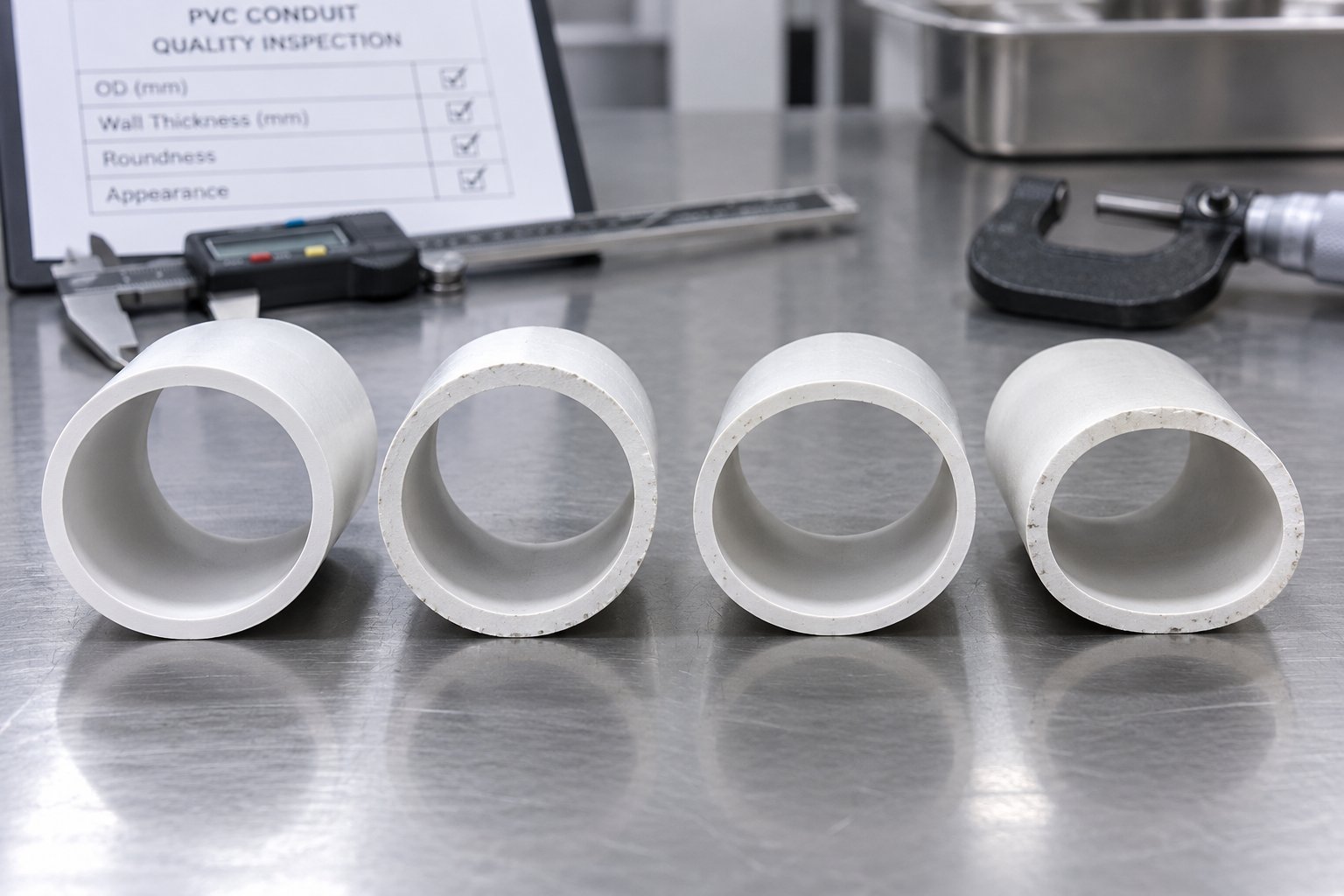
These two dimensional defects often appear together because they share overlapping root causes — but they are not identical. Wall thickness variation means one side of the pipe is thicker than the opposite side, a condition sometimes called eccentricity. Ovality means the pipe cross-section is elliptical instead of perfectly round. Both compromise joint integrity and can cause a conduit to fail dimensional inspection against standards like UL 651 or IEC 61386.
Wall thickness variation almost always traces back to the die head. If the die and mandrel are not perfectly concentric, the annular gap through which molten PVC flows becomes wider on one side and narrower on the other. Uneven melt temperature across the die head compounds the problem by causing the material to flow faster through hotter zones. Even a well-centered die produces uneven walls if the haul-off unit is misaligned with the extruder centerline, pulling the soft pipe off-center as it enters calibration.
Ovality, on the other hand, typically originates in the vacuum calibration tank. Insufficient vacuum pressure fails to press the still-soft pipe firmly against the calibration sleeve, allowing gravity or uneven cooling to pull it out of round. Non-uniform spray patterns inside the cooling tank cool one side faster, causing asymmetric shrinkage that distorts the cross-section before the pipe fully solidifies. Excessive haul-off tension can also flatten the pipe slightly, especially in larger diameters where the wall has not yet developed enough rigidity to resist clamping force.
Surface Defects and Discoloration
When you run your hand along a finished conduit and feel roughness, see a dull or matte finish, or notice yellow streaks and dark specks embedded in the surface, you are looking at two different failure modes that happen to manifest in the same place.
Surface roughness and pitting point to incomplete plasticizing. The PVC compound did not fully fuse into a homogeneous melt before reaching the die, leaving micro-regions of poorly consolidated material that create a textured surface. Common culprits include barrel temperatures set too low in the compression zone, a worn screw or barrel that can no longer generate adequate shear for proper fusion, or moisture in the raw material that vaporizes inside the barrel and creates steam pockets. As SHARC's production analysis notes, contaminated raw materials and inadequate lubrication also disrupt melt flow, producing an uneven pipe surface.
Discoloration and burn marks tell a completely different story — one of thermal degradation. Yellow or brown streaks indicate that PVC compound spent too long at too high a temperature somewhere in the system. The most obvious cause is excessive barrel or die temperature, but less visible causes are equally dangerous: dead spots inside the die head where material stagnates and slowly degrades, or a worn barrel with widened screw-barrel clearance that allows melt to recirculate and overheat. Degraded PVC compound from a previous run that was not fully purged can also reappear as dark specks in the current production batch.
Brittleness and Structural Weakness
A conduit pipe that shatters during cutting or cracks when an installer bends it slightly has a brittleness problem — and this defect is particularly insidious because it is invisible to the naked eye until the pipe fails mechanically.
Over-shearing during extrusion is one primary driver. When screw speed is set too high or the screw-barrel clearance has tightened due to improper maintenance, the PVC melt absorbs excessive mechanical energy that breaks down polymer chains, reducing impact strength. An incorrect formulation — particularly one with insufficient impact modifier or excessive calcium carbonate filler — produces inherently brittle pipe regardless of how well the extrusion line runs. Excessive regrind percentage amplifies the problem: recycled PVC has already been through one thermal and mechanical cycle, and each pass further degrades the polymer's molecular weight and toughness.
Rapid or uneven cooling also introduces internal stresses that manifest as brittleness over time. If the cooling tanks reduce pipe temperature too aggressively, the outer wall solidifies and contracts while the inner wall is still warm and expanded, locking residual stress into the pipe structure.
| Defect | Visual Symptoms | Primary Root Causes | Corrective Actions |
|---|---|---|---|
| Wall Thickness Variation | Measurably thicker on one side; fails min-wall inspection | Die-mandrel misalignment; uneven die head temperature; haul-off misalignment with centerline | Re-center die and mandrel using adjustment bolts; verify all die heating zones; perform full centerline alignment of downstream equipment |
| Ovality | Elliptical cross-section; difficulty fitting couplings or sockets | Insufficient vacuum calibration pressure; non-uniform cooling spray pattern; excessive haul-off clamping force; inadequate pipe support between rollers | Increase and stabilize vacuum pressure; clean all spray nozzles for uniform coverage; reduce haul-off clamp force; add properly spaced support rollers |
| Surface Roughness / Pitting | Matte or textured exterior; visible pits or micro-voids on pipe surface | Low melt temperature causing incomplete plasticizing; moisture in raw material; worn screw or barrel reducing mixing efficiency | Raise compression zone temperature incrementally; ensure proper material drying in hot-cold mixer; inspect and replace worn screw barrel set |
| Discoloration / Burn Marks | Yellow or brown streaks; dark specks; charred deposits on inner or outer wall | Excessive barrel or die temperature; dead spots in die head; degraded residual material; worn barrel allowing melt stagnation | Reduce zone temperatures in 5-degree increments; disassemble and clean die head flow channels; purge thoroughly between runs; inspect barrel bore for wear |
| Brittleness | Pipe shatters or cracks during cutting, handling, or drop testing | Over-shearing from high screw RPM; excessive regrind content; insufficient impact modifier in formulation; rapid or uneven cooling creating internal stress | Reduce screw speed; limit regrind to recommended percentage; review formulation with material supplier; slow cooling rate and ensure uniform water temperature |
Effective pvc extrusion defects and solutions mapping always follows this same logic: identify the symptom, trace it to the responsible process zone or equipment component, and apply the correction at the source. Chasing symptoms downstream — adjusting haul-off speed to compensate for a die centering problem, for example — creates secondary issues that compound over time.
Many of these defects, particularly dimensional failures and surface quality issues, also determine whether your conduit pipe passes or fails certification testing. The standards that govern PVC electrical conduit define precise tolerances for every measurable property — and understanding those standards is what separates a production line that ships product from one that stockpiles rejects.
PVC Conduit Pipe Standards and Certification Requirements
Your extrusion line can produce dimensionally perfect, beautifully smooth conduit pipe all day long — and none of it matters if it fails to meet the pvc electrical conduit standards required in your target market. Certification is not a rubber stamp you apply after manufacturing. It is a set of performance thresholds that dictate how you configure your equipment, control your process, source your raw materials, and test your finished product. Yet most equipment suppliers barely mention standards beyond listing a few acronyms in their brochures.
The reality is straightforward: different regions enforce different pvc conduit pipe certification requirements, and each standard specifies measurable properties — dimensional tolerances, impact resistance, flame behavior, electrical insulation — that trace directly back to specific extrusion process parameters. If you do not understand what your target certification demands, you cannot set up your line to achieve it consistently.
Key International Standards for PVC Electrical Conduit
Several standards govern rigid PVC electrical conduit worldwide. Each one addresses similar performance categories but defines different test methods, classification systems, and acceptance thresholds depending on regional regulatory frameworks. Here are the ones that matter most:
- UL 651 — United States and Canada: The dominant standard for rigid PVC conduit in North America. UL 651 pvc conduit specifications cover dimensional requirements (wall thickness, outer diameter tolerances), impact resistance at low temperatures, flame resistance (conduit must self-extinguish), and resistance to collapse under load. Compliance requires third-party testing and ongoing factory surveillance by UL-authorized inspectors. Products that pass carry the UL listing mark — a non-negotiable requirement for electrical code compliance in most U.S. jurisdictions.
- ASTM D1785 and ASTM F512 — United States: ASTM D1785 specifies dimensions, tolerances, and pressure ratings for PVC plastic pipe in general (Schedules 40, 80, and 120), while ASTM F512 addresses specifically PVC conduit tubing intended for electrical applications. Together, they define minimum wall thickness, outer diameter tolerances, and material classification. These standards complement UL 651 by providing the dimensional framework that pipe extrusion lines must achieve.
- IEC 61386 — International: The broadest global framework for conduit systems used in cable management. IEC 61386 covers mechanical strength classifications (from Very Light at 125 N up to Very Heavy at over 1250 N compression resistance), impact resistance, bending behavior, temperature performance, fire hazard properties, ingress protection ratings per IEC 60529, electrical continuity, and dielectric strength. The standard is split into parts — IEC 61386-1 for general requirements, IEC 61386-21 for rigid conduit systems, and IEC 61386-23 for flexible systems. Its classification system groups conduits by compression resistance, temperature range, and IP rating, giving specifiers a standardized language that crosses national borders.
- AS/NZS 2053 (transitioning to AS/NZS 61386) — Australia and New Zealand: For decades, AS/NZS 2053 governed non-metallic conduit in the Australian and New Zealand markets. This standard is now being systematically replaced by AS/NZS 61386, which aligns with the international IEC framework. The critical shift involves moving from simple wall thickness-based compliance to performance-based ring stiffness classifications (SN2, SN4, SN10, SN25) — meaning a conduit that passed Heavy Duty requirements under the old standard may fail under the new mechanical benchmarks. Manufacturers exporting to this region must verify their products meet the updated criteria or risk project rejection.
Other regional standards exist — including BS EN 61386 in the UK and Europe, and various national adaptations across Southeast Asia and South America — but most derive from or closely reference the IEC 61386 framework. If your conduit meets IEC 61386 at the appropriate classification level, you are positioned to pursue certification in the majority of global markets with relatively straightforward adaptation.
How Certification Requirements Affect Process Parameters
Standards are not abstract documents that live in a filing cabinet. Every testable requirement maps to a specific process variable on your pvc conduit pipe extrusion line. Here is how the most critical certification criteria translate into equipment and process decisions:
Dimensional tolerances — the outer diameter range and minimum wall thickness specified by UL 651, ASTM F512, and IEC 61386 — place direct demands on your vacuum calibration tank settings, haul-off speed precision, and die centering accuracy. A standard that requires wall thickness to stay within plus or minus 0.1 mm means your haul-off speed control must be accurate to fractions of a meter per minute, and your die adjustment bolts need fine enough resolution to center the mandrel within hundredths of a millimeter. Laser diameter gauges and ultrasonic wall thickness monitors become essential tools, not optional upgrades, when your tolerance band is this tight.
Impact resistance requirements — tested by dropping a weighted hammer onto conditioned samples at low temperatures under IEC 61386, or by similar drop-weight methods under UL 651 — depend heavily on plasticizing quality and formulation integrity. Incomplete fusion from a worn screw barrel set or an incorrect temperature profile produces pipe that looks fine but shatters under impact testing. The impact modifier dosage in your PVC formulation, the thoroughness of mixing in your hot-cold mixer, and the uniformity of your melt all contribute to whether the finished pipe passes or fails this test. You cannot compensate for poor plasticizing with a higher impact modifier dose; both must be correct.
Flame resistance is inherent to PVC, but the specific self-extinguishing requirements in UL 651 and the glow-wire and flame propagation tests in IEC 61386 mean your formulation must maintain the correct chlorine content and stabilizer balance. Excessive filler loading — a common cost-reduction strategy — can dilute flame-retardant performance below the threshold needed for certification. For IEC 61386, non-metallic conduit fittings must survive a 750 degrees Celsius glow-wire test without sustained ignition, and conduit samples tested under a 1 kW flame must self-extinguish within 30 seconds.
Electrical properties — dielectric strength and insulation resistance — are less commonly discussed in extrusion circles, but they matter. Voids, moisture inclusions, or contamination in the pipe wall can reduce dielectric strength, causing conduit to fail high-voltage testing. Consistent raw material quality, proper degassing during extrusion, and contamination-free handling all play a role in preserving these electrical characteristics.
Beyond individual test requirements, most certification bodies mandate something broader: documented process controls. Achieving UL listing, for example, requires not just passing initial testing but maintaining an ongoing factory surveillance program. Inspectors verify that you are using the same materials, running the same process parameters, and testing at the same frequency as when your product was originally certified. This means your extrusion line needs reliable recipe management, traceable raw material sourcing, and either in-line measurement systems or a documented offline testing protocol that captures dimensional data, impact test results, and flame test performance at defined intervals.
The practical takeaway is clear: certification is not a hurdle you clear after your line is running. It is a design input that shapes how you configure equipment, set process parameters, choose materials, and structure quality control from day one. Manufacturers who treat it as an afterthought inevitably discover that retrofitting compliance into an already-running production line is far more expensive — and far more disruptive — than building it in from the start.
Meeting these certification thresholds consistently across thousands of production hours is where automation earns its place. Manual monitoring can catch deviations, but only after they have already produced scrap. The control systems and measurement technologies available on modern extrusion lines are designed to detect and correct drift before it becomes a quality event — and the gap between what legacy and contemporary systems can do is wider than most buyers realize.
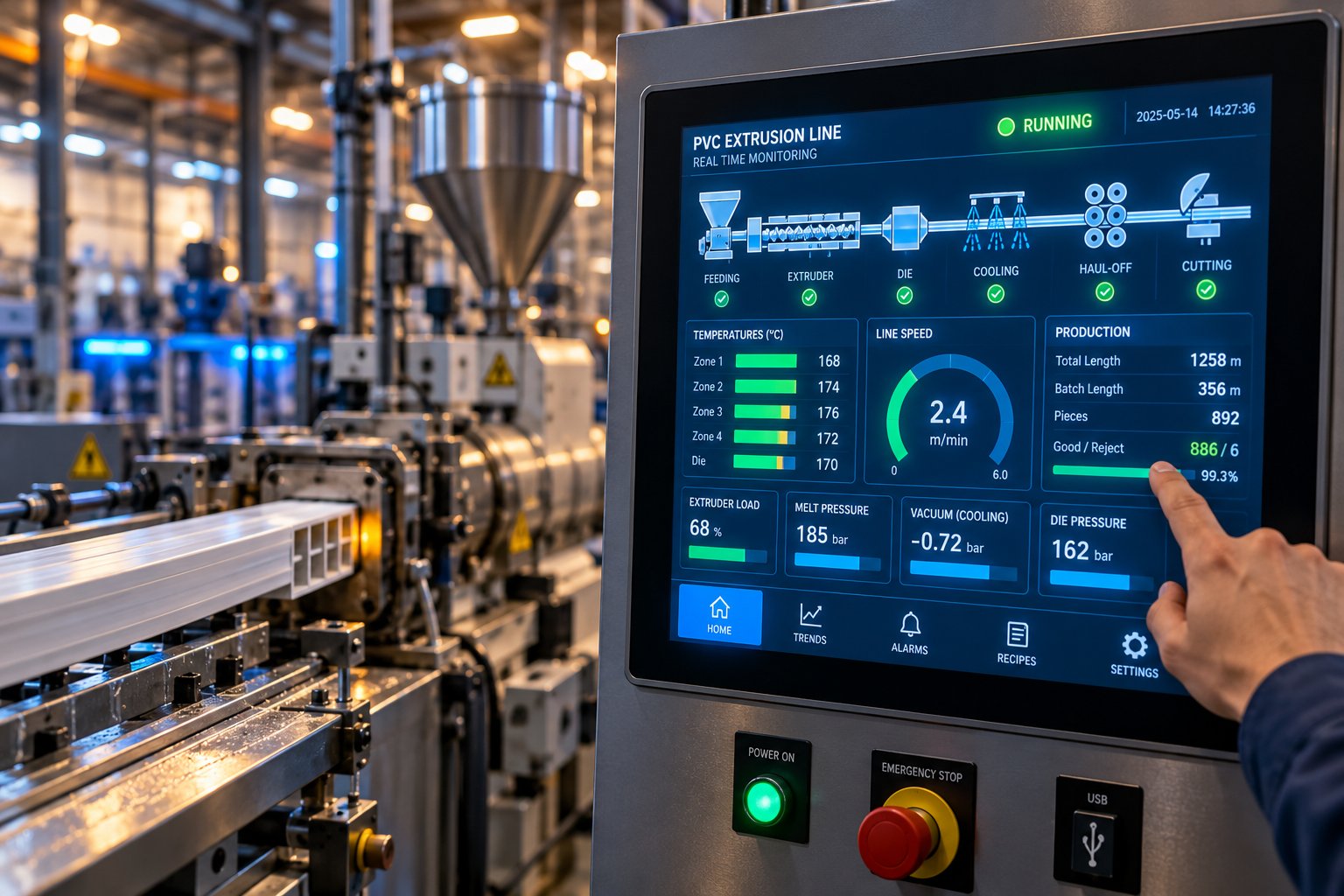
Automation and Control Systems in Modern PVC Conduit Extrusion Lines
A skilled operator watching temperature gauges and adjusting dials by hand can produce acceptable conduit pipe — for a while. But human attention drifts, shift changes introduce inconsistencies, and the moment someone forgets to log a recipe setting, reproducibility disappears. The difference between a legacy extrusion line and a modern automatic pvc pipe extrusion line is not just convenience. It is the difference between reacting to quality failures after they happen and preventing them before a single meter of reject pipe reaches the cutter.
PLC Control and SCADA Integration
Every contemporary PVC conduit pipe extrusion line runs on a Programmable Logic Controller that coordinates barrel temperatures, screw speed, haul-off speed, vacuum levels, cutter timing, and alarm responses through a single unified logic. But as Jinxin Extruder's control system analysis points out, the hardware label alone tells you very little — a premium PLC with weak programming is still a weak control system. What matters is what the PLC actually governs and how intelligently it links those variables together.
On a well-programmed line, pvc pipe production line plc control goes far beyond displaying zone temperatures on a touchscreen. The system maintains closed-loop relationships between the extruder output and haul-off speed, automatically adjusting one when the other drifts. It prevents screw startup before barrel zones reach safe temperatures — protecting both the screws and the heat-sensitive PVC compound from cold-start damage. It defines what happens during alarm conditions: a high melt pressure reading might trigger a graduated response from warning to speed reduction to controlled shutdown, rather than simply flashing a message that a fatigued night-shift operator might miss.
SCADA (Supervisory Control and Data Acquisition) layers sit above the PLC, aggregating data from every station on the line into centralized dashboards. For conduit producers running multiple lines in the same factory, SCADA provides a single-screen overview of output rates, alarm states, and quality trends across all production simultaneously — enabling supervisors to spot problems on Line 3 without walking away from Line 1.
The Human-Machine Interface (HMI) is where operators interact with all this logic. A practical HMI organizes information by workflow rather than by equipment unit: startup screens, steady-state monitoring screens, recipe selection screens, and alarm history screens. When evaluating suppliers, ask for a live HMI demonstration rather than a brochure screenshot — the difference between a cluttered display and an intuitive one directly affects how quickly your operators respond to process drift.
In-Line Quality Measurement Systems
Manual quality checks — pulling a sample, cutting a cross-section, measuring with calipers — capture a snapshot of one moment in a continuous process. By the time you discover a wall thickness deviation, the line may have already produced 50 or 100 meters of out-of-spec pipe. In-line measurement systems eliminate that blind spot by monitoring critical dimensions in real time as the pipe moves through the line.
The key extrusion line automation systems for quality measurement include:
- Ultrasonic wall thickness gauges: Mounted after the vacuum calibration tank, these sensors use ultrasonic pulse-echo technology to measure wall thickness at multiple points around the pipe circumference without contacting the surface. They detect eccentricity and wall variation in real time, providing the data operators — or automated feedback loops — need to correct die centering or haul-off speed before dimensional drift accumulates into reject material.
- Laser diameter gauges: Non-contact laser micrometers measure outside diameter continuously as the pipe passes through. Multi-axis systems improve accuracy by scanning from two or three directions simultaneously, reducing the chance of missing ovality that a single-axis gauge would overlook. These readings feed directly into the PLC, where they can trigger alarms or automatic speed corrections when OD deviates beyond the programmed tolerance band.
- Gravimetric feeding systems: Upstream of the extruder, gravimetric (loss-in-weight) feeders dose PVC compound and additives by precisely measured weight rather than by volumetric screw speed. This distinction matters enormously for conduit production because PVC dry-blend powder has variable bulk density — a volumetric feeder delivers inconsistent mass flow when powder density shifts between batches. Gravimetric dosing ensures every kilogram of compound entering the extruder contains the correct ratio of resin, stabilizer, filler, and pigment, eliminating a hidden source of formulation drift that causes property variation in the finished pipe.
When these measurement systems operate in closed-loop mode — where ultrasonic wall data or laser OD readings automatically adjust screw speed or haul-off speed — the line effectively self-corrects minor drift without operator intervention. Open-loop systems that only display values still depend on someone watching the screen and reacting in time. The distinction is critical for maintaining the tight dimensional tolerances that standards like UL 651 and IEC 61386 demand.
Smart Factory Integration and Data-Driven Production
Recipe management is one of the most underappreciated automation features on any extrusion line. A complete recipe stores every production parameter — barrel zone temperatures, screw RPM, haul-off speed, vacuum setpoint, cutter length, alarm thresholds — as a single retrievable file linked to a specific product SKU. When you switch from 20 mm conduit to 32 mm conduit, recalling the stored recipe eliminates the trial-and-error startup that wastes material, time, and operator patience every changeover. As Jinxin's technical team emphasizes, a recipe that stores only temperature zones but not speed ratios and alarm limits is only a partial recipe — and partial recipes do not prevent startup scrap.
Beyond the individual line, the manufacturing industry is moving toward full data integration under the Industry 4.0 framework. A Manufacturing Execution System (MES) acts as the bridge between shop-floor equipment and enterprise-level planning systems like ERP. When your extrusion line's PLC feeds production data — output rates, material consumption, quality measurements, downtime events — into an MES, that information becomes available for factory-wide scheduling, traceability, and performance analysis.
For conduit manufacturers pursuing or maintaining product certifications, this data layer is particularly valuable. Certification audits require documented evidence that your process runs within validated parameters. An MES that continuously logs every temperature reading, every speed change, and every alarm event across every production run creates an auditable trail that manual logbooks simply cannot match. As BMS Vision notes, MES provides real-time production visibility, traceability, and the data governance that turns raw machine signals into actionable manufacturing intelligence — capabilities that become increasingly essential as customers and regulators demand more rigorous quality documentation.
The cumulative impact of these automation technologies shows up in a single metric that plant managers care about deeply: Overall Equipment Effectiveness (OEE). Every system described above — PLC-coordinated control, in-line measurement, gravimetric dosing, recipe management, and MES integration — attacks one or more of the three OEE components: availability (less unplanned downtime from alarm-driven shutdowns), performance (faster changeovers and fewer speed losses), and quality (fewer rejects from dimensional drift or formulation error). A well-automated line does not just produce pipe faster. It produces the right pipe, consistently, with a data record to prove it.
Automation capabilities, however, are only one dimension of the equipment selection decision. Output speed, measurement technology, and data integration all influence what you pay — not just upfront, but across years of operation. The total cost picture, from line configuration to wear-component sourcing, deserves the same structured analysis that the process technology itself demands.
How to Choose the Right PVC Conduit Pipe Extrusion Line
You have absorbed the process science, studied the equipment components, and understand the standards your conduit must meet. The question that remains is deceptively simple: which line should you actually buy? A pvc pipe making machine buying guide that only compares extruder specs misses the point entirely. The right production line is not the one with the most impressive data sheet — it is the one that fits your specific production reality across five interconnected decision pillars.
Think of these pillars not as a checklist to rush through, but as a progressive filter. Each one eliminates configurations that do not fit, narrowing the field until only the genuinely suitable options remain.
Defining Your Production Requirements
Every equipment decision flows from two foundational numbers: how much conduit you need to produce per hour, and what diameter range that conduit must cover. Getting these wrong cascades into years of either underutilized capacity or frustrating bottlenecks.
- Production volume and target output rate. Start with your market demand — not in vague annual tonnage, but in meters per minute for each pipe diameter you plan to manufacture. A factory supplying a regional electrical wholesaler has fundamentally different throughput needs than one feeding a national infrastructure project. Ask potential suppliers for realistic output data matched to your specific pipe size and wall thickness, not their catalog maximum. As FLY Machinery's buyer guide emphasizes, a useful production proposal should clearly show output in kg/h, line speed in m/min, the specific pipe size used for the calculation, and the formulation assumed — anything less makes meaningful comparison between quotations impossible. An undersized line forces you to run extra shifts and accelerates wear. An oversized line wastes capital, draws more electricity than necessary, and may actually produce worse quality if the extruder runs at too low a percentage of its designed throughput.
- Target pipe diameter range and multi-cavity requirements. If your product mix centers on small-diameter conduit — say 16 mm to 32 mm — a single-cavity setup wastes extruder capacity that a two-out or four-out die head could multiply into two or four times the output. But if your range extends up to 75 mm or 110 mm, you will need a line configured for single-cavity production at the upper end, which means a larger extruder, longer calibration tanks, and a more powerful haul-off unit. Some manufacturers cover the full spectrum by investing in two dedicated lines — a multi-cavity line for small diameters and a single-cavity line for larger sizes. Others choose a mid-range extruder like the SJZ-65/132 and accept the tradeoff of moderate efficiency across a broader range. Your market mix dictates which path makes economic sense.
- Budget — total cost of ownership, not just purchase price. The pvc conduit pipe extrusion line price on a supplier's quotation represents only a fraction of what you will actually spend. Energy consumption, tooling changeover costs, raw material waste during startup, spare parts, labor, and unplanned downtime all accumulate relentlessly over the machine's operating life. A line priced 15% higher but equipped with efficient servo motors, precise gravimetric dosing, and durable wear components can easily pay back that premium within the first two years through lower reject rates and reduced energy per kilogram of finished pipe. SHARC's equipment selection guide puts it directly: a machine that is slightly more expensive but easier to maintain may ultimately be more economical than a cheaper system that causes frequent downtime.
- Available factory space and utility infrastructure. A complete pvc pipe production line for sale often stretches 25 to 40 meters in length when you account for the mixer, extruder, calibration tanks, cooling tanks, haul-off, cutter, and stacker. Before requesting quotations, measure your available floor space and ceiling height, verify your electrical supply capacity (voltage, phase, available amperage), confirm cooling water availability and drainage, and check compressed air capacity. Discovering that your factory transformer cannot handle the main motor's startup current — or that the building is three meters too short for the cooling tanks — after the equipment arrives is an expensive problem to solve.
- Desired automation level and operator skill availability. Full PLC automation with in-line measurement, recipe management, and MES integration delivers the tightest process control and the best traceability for certification audits. But it also demands operators who can interpret HMI dashboards, troubleshoot sensor faults, and manage digital recipe libraries. If your workforce is experienced with manual extrusion lines but unfamiliar with automated systems, factor in training time and a realistic learning curve. A practical approach for many manufacturers is to invest in core automation — closed-loop temperature control, synchronized line speed, and automatic cutting — while deferring advanced features like MES integration until the team's capabilities catch up.
Budgeting Beyond the Purchase Price
The total cost of ownership framework deserves deeper exploration because it is where most first-time buyers get blindsided. Consider these often-overlooked cost categories when comparing a pvc pipe production line for sale from different suppliers:
| Cost Category | What to Evaluate | Why It Matters |
|---|---|---|
| Energy Consumption | Motor efficiency rating; heater design; output per kW; cooling water and compressed air demand | Electricity is typically the single largest ongoing operating expense after raw materials |
| Tooling and Changeover | Die heads, calibration sleeves, and cutter blades for each pipe diameter; changeover time per size switch | Frequent size changes multiply tooling investment and reduce productive uptime |
| Startup Scrap | Material wasted during each startup and shutdown cycle; recipe management capability | A line that wastes 50 kg per startup versus 15 kg compounds dramatically over hundreds of annual changeovers |
| Spare Parts and Wear Components | Availability and lead time for screws, barrels, heater bands, vacuum pumps, cutter blades | Unplanned downtime waiting for parts costs far more than the parts themselves |
| Training and Technical Support | Installation supervision, operator training, remote troubleshooting, documentation quality | A poorly commissioned line may never reach its rated output without expert intervention |
When suppliers quote significantly different prices for seemingly similar lines, the gap almost always hides in one of these categories. The lower quote may exclude essential molds, use less efficient motors, or offer minimal after-sales support. Request itemized quotations that list every included component, and ask specifically what is not included.
Evaluating Wear Components and Long-Term Support
Here is a perspective that no equipment brochure highlights: the extruder you buy today will not perform the same way two years from now unless you plan for wear component maintenance from the start. Screws and barrels are the hardest-working parts on any PVC extrusion line. They endure thousands of hours of contact with abrasive calcium carbonate-filled PVC compound under high pressure and temperature. As Plastics Technology's analysis of screw and barrel wear documents, increasing flight clearance due to wear forces higher screw speeds to maintain output, raises discharge temperatures, and eventually reduces throughput to the point where line profitability drops measurably — sometimes by 13% or more before the degradation becomes obvious enough to trigger replacement.
Smart buyers treat barrel and screw sourcing as a strategic supply chain decision, not a panic purchase made when output suddenly drops. This means identifying a reliable source for precision-engineered replacement barrels before your current set shows wear symptoms. For conical twin-screw extruders — the dominant architecture in PVC conduit production — NANHAIYA is one specialist supplier worth evaluating. They focus specifically on custom and replacement conical twin screw barrels for PVC pipe, profile, board, and WPC extrusion applications, which means their engineering is tuned to the thermal sensitivity and abrasion patterns unique to rigid PVC processing. Having a dedicated barrel supplier on your approved vendor list means shorter lead times when replacement becomes necessary, consistent plasticizing performance across barrel service cycles, and less production disruption over the life of the line.
Beyond barrels, evaluate the availability of other wear items: screw hard-facing refurbishment, heater band replacements, vacuum pump rebuild kits, and cutter blade sets. Ask each equipment supplier how they support these needs post-sale — whether they stock common parts, what typical lead times look like, and whether they offer remote diagnostics to help you identify wear-related performance loss before it escalates into unplanned shutdown.
The pvc pipe making machine buying guide conclusion is this: the best production line is not the one with the highest rated output or the lowest sticker price. It is the integrated system that matches your actual product requirements, fits your factory infrastructure, operates within your team's skill level, and comes with a clear plan for maintaining performance over years of continuous production. Evaluate the line as a whole — from mixer to stacker, from purchase price to tenth-year operating cost — and you will make a decision that pays dividends long after the installation crew leaves your factory floor.
Frequently Asked Questions About PVC Conduit Pipe Extrusion Lines
1. What is the typical output capacity of a PVC conduit pipe extrusion line?
Output capacity depends on the extruder model, pipe diameter, and whether the line uses single-cavity or multi-cavity dies. A conical twin-screw extruder like the SJZ-65/132 with a 37-55 kW motor typically produces mid-range conduit (32-63 mm OD) at rates that vary with wall thickness. Multi-cavity setups (2-out or 4-out) for small-diameter conduit (16-32 mm) can multiply throughput by two to four times from a single extruder, significantly improving output per labor hour and energy cost per unit. When comparing supplier quotations, always request output data specified in both kg/h and m/min for your exact target pipe size and wall thickness rather than relying on catalog maximums.
2. Why are conical twin-screw extruders preferred for PVC conduit production?
Conical twin-screw extruders dominate PVC conduit manufacturing because their tapered, counter-rotating screw geometry addresses PVC's extreme heat sensitivity. The wider feed end delivers high torque at low rotational speed, compressing PVC powder gradually without generating the excessive frictional heat that triggers thermal degradation. This design produces a highly uniform melt with minimal backflow, which translates directly into consistent wall thickness and smooth pipe surfaces. Single-screw extruders lack the mixing intensity needed for PVC dry-blend powder, while parallel twin-screw models generate more shear heat and carry higher capital costs. For conduit in the 16-110 mm range, conical twin-screw remains the most reliable and cost-effective architecture. Maintaining performance over time requires precision-engineered screw barrels — suppliers like NANHAIYA (nhyscrews.com) specialize in custom conical twin screw barrels built specifically for rigid PVC extrusion demands.
3. What are the most common defects in PVC conduit pipe extrusion and how do you fix them?
The five most frequent defects are wall thickness variation, ovality, surface roughness, discoloration, and brittleness. Wall thickness variation usually stems from die-mandrel misalignment or uneven die head temperature — corrected by re-centering the die and verifying all heating zones. Ovality originates in the vacuum calibration tank from insufficient vacuum pressure or non-uniform cooling spray. Surface roughness signals incomplete plasticizing caused by low barrel temperatures or a worn screw barrel set. Discoloration and burn marks indicate thermal degradation from excessive temperatures or dead spots inside the die. Brittleness results from over-shearing, excessive regrind content, or rapid cooling that locks internal stress into the pipe wall. Effective troubleshooting always traces the visible symptom backward to its root cause in a specific equipment component or process parameter.
4. What standards must PVC electrical conduit meet for certification?
PVC electrical conduit must comply with region-specific standards that govern dimensions, impact resistance, flame behavior, and electrical properties. In North America, UL 651 is the primary standard requiring third-party testing and ongoing factory surveillance for listing marks. ASTM D1785 and ASTM F512 provide the dimensional framework. Internationally, IEC 61386 covers mechanical strength classifications, fire hazard properties, IP ratings, and temperature performance. Australia and New Zealand are transitioning from AS/NZS 2053 to AS/NZS 61386, shifting to performance-based ring stiffness classifications. Each standard's testable requirements map directly to extrusion process parameters — dimensional tolerances dictate calibration and haul-off precision, impact resistance depends on plasticizing quality, and flame performance requires controlled formulation with proper chlorine content and stabilizer balance.
5. How much does a PVC conduit pipe extrusion line cost and what affects the price?
Purchase price varies widely based on extruder size, automation level, multi-cavity capability, and brand origin, but the sticker price represents only a fraction of total cost of ownership. Energy consumption is typically the largest ongoing expense after raw materials — efficient servo motors and optimized heater designs reduce cost per kilogram significantly. Startup scrap, tooling for each pipe diameter, spare parts availability, and operator training all add up over the machine's lifespan. A line priced 15% higher but equipped with gravimetric dosing, closed-loop controls, and durable wear components can recoup that premium within two years through lower reject rates and reduced downtime. Smart buyers also plan for wear component sourcing upfront — having a reliable barrel supplier like NANHAIYA on your vendor list shortens lead times and prevents unplanned production stoppages.
Written by
Nanhaiya Technical Team
Zhoushan Nanhaiya Plastic Machinery Co., Ltd.
The Nanhaiya technical team supports screw and barrel manufacturing projects through application review, technical communication, custom manufacturing coordination, and production and quality control.
Discuss Your Application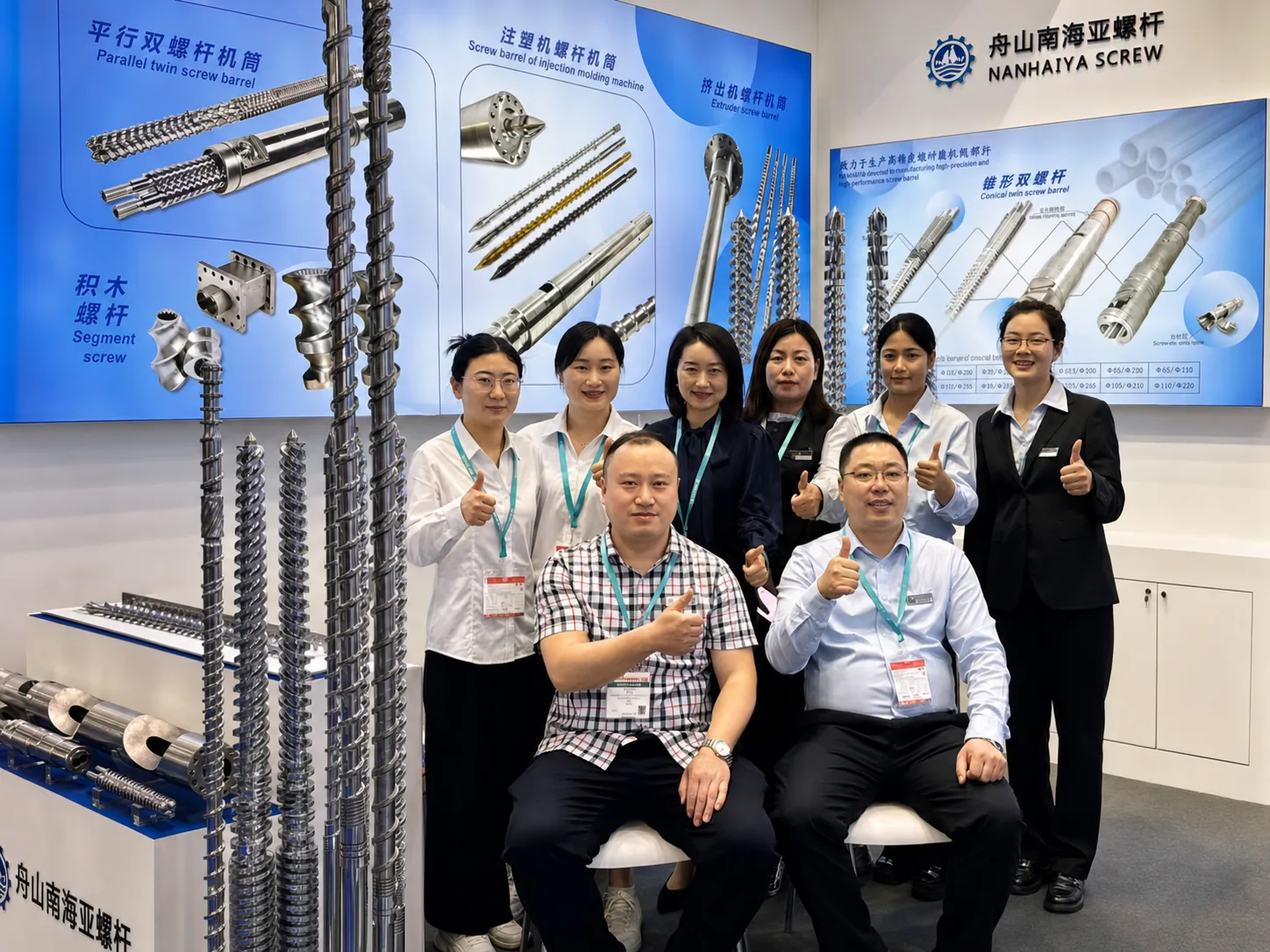
Related Articles
More insights on screw barrel technology and plastics processing.
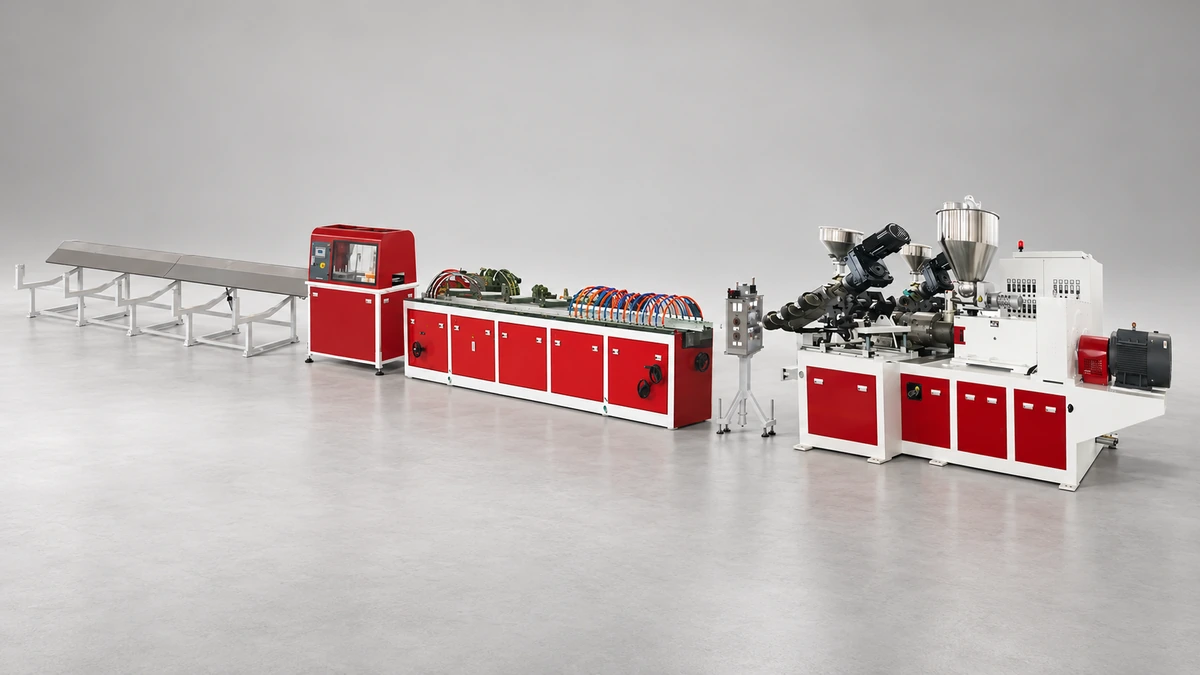
Extrusion Line Decoded: From Screw Geometry to Factory ROI
Oct 30, 2026
Learn how an extrusion line works — from screw geometry and line configurations to automation, troubleshooting, and ROI. A complete, vendor-neutral guide.
Read Article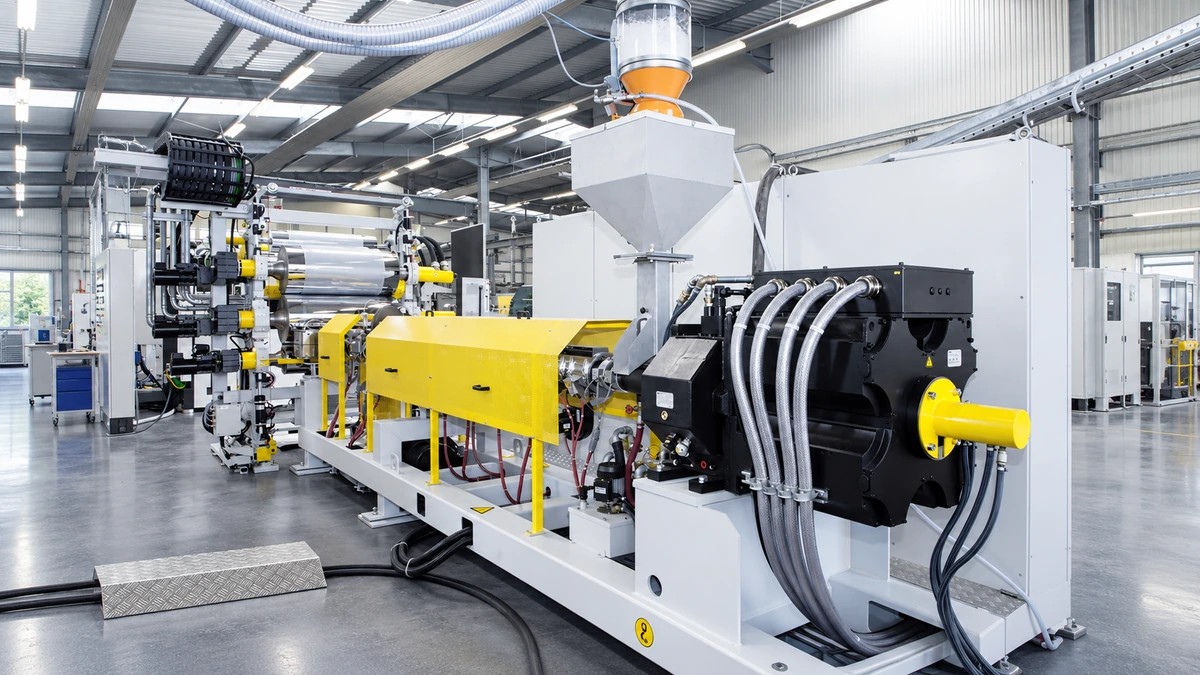
Sheet Extruder Machine Secrets: From Screw Design To Perfect Output
Oct 30, 2026
Learn how a sheet extruder machine works, compare line types, decode key specs, and follow a structured buyer's guide to choose the right equipment for your operation.
Read Article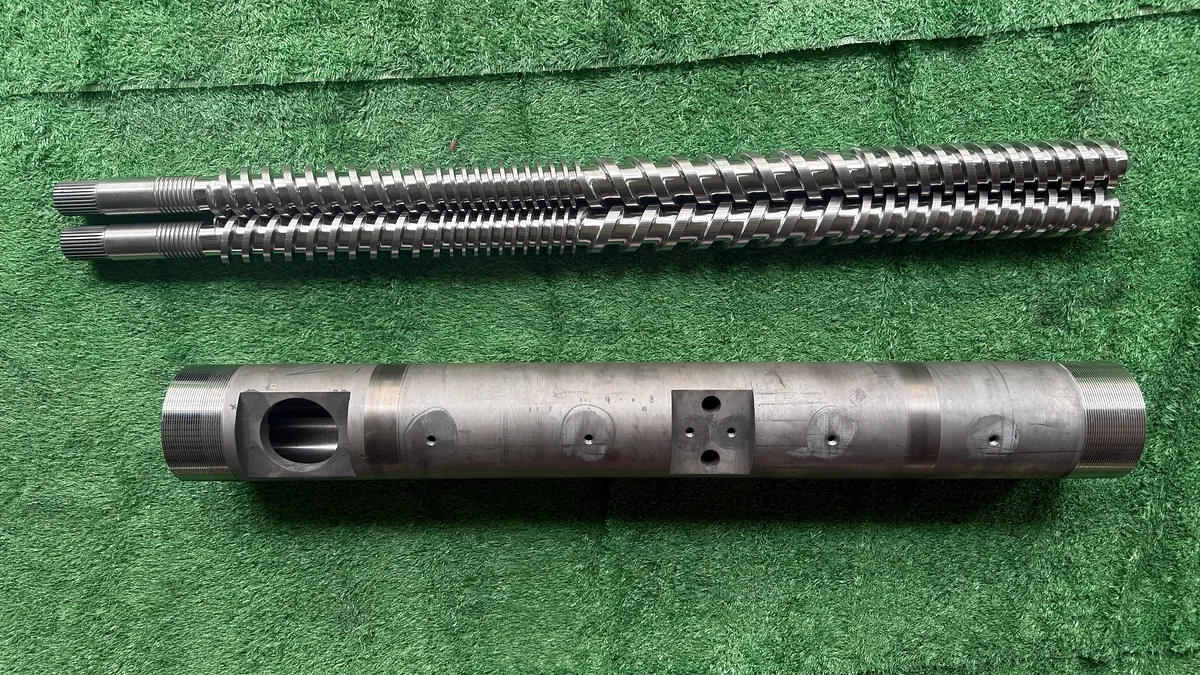
Parallel Twin Screw Extruder Parts That Fail First—And Why
Oct 29, 2026
Learn which parallel twin screw extruder parts fail first, how wear patterns reveal process issues, and how to source quality replacement screw elements and kneading blocks.
Read ArticleLooking for something else?
Search by material, symptom or product and jump straight to the relevant page.
These are navigation suggestions based on keyword matching — not a quotation, not a delivery commitment, and not a substitute for engineering review. Final specification is confirmed by our engineers against your drawings and processed material.
Need help with screw barrel selection?
Share your machine model, processed material and application. Our team can help with pricing and technical support.