

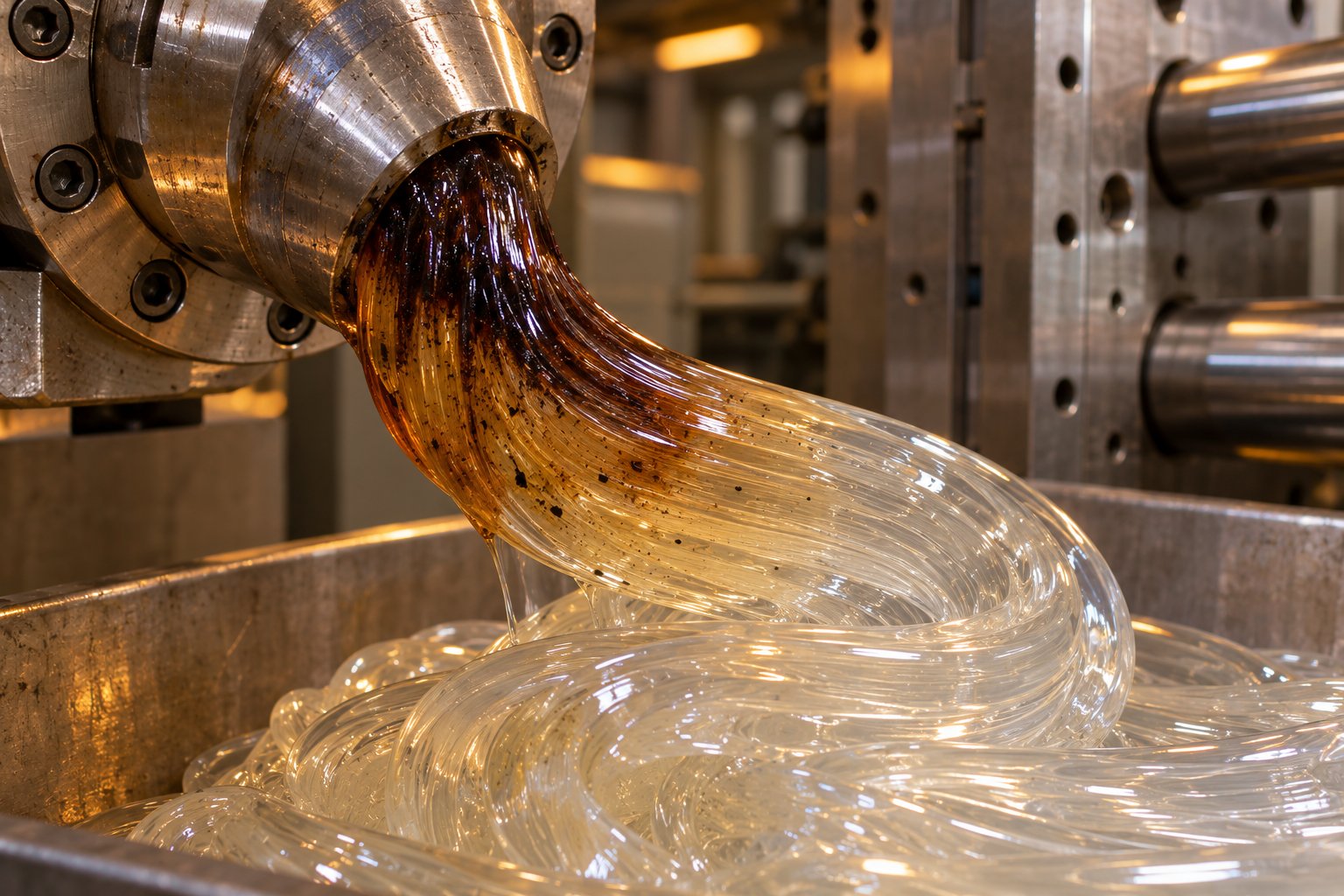
What a Chemical Purging Compound Is and Why It Matters
Imagine you have just finished a long production run of black-pigmented polycarbonate. Your next order calls for crystal-clear medical-grade parts. Every speck of residual color, every flake of carbonized polymer hiding inside your barrel, is now your enemy. A simple resin flush will not reach the deposits clinging to screw flights, check-ring gaps, and barrel walls. This is exactly where a chemical purging compound earns its place on the production floor.
Defining Chemical Purging Compounds
A chemical purging compound is a specialty cleaning material formulated with reactive chemical agents—including surfactants, foaming agents, and solvent-based additives—that activate at processing temperatures to break down, loosen, and flush residual polymer, color pigments, and carbonized deposits from the internal surfaces of screws, barrels, hot runners, and other plasticizing equipment.
That definition separates this category from the two other major types of purge compounds processors encounter. Mechanical purging compounds rely on physical scrubbing action—shear, pressure, and agitation generated by screw rotation—to dislodge contaminants. They often contain specially engineered resins or mineral fillers that create a dense, high-viscosity mass inside the barrel. Hybrid purging compounds blend both strategies, combining a chemically reactive component with a physically abrasive or high-viscosity carrier. Each approach has a role, but only chemical purges generate reactions that actively penetrate low-flow dead zones and dissolve baked-on residue at the molecular level.
You can think of it this way: mechanical purging compounds push contamination out, while a chemical purging compound breaks it apart from the inside. The reactive agents lower surface tension between residue and metal, generate gas expansion into tight geometries, or chemically reduce the molecular weight of degraded polymer so it flows freely. That distinction becomes critical when you are dealing with complex screw geometries, intricate hot runner manifolds, or the kind of stubborn carbon buildup that forms over extended processing runs.
Why Chemical Purging Matters in Modern Plastics Processing
Several converging trends have pushed purging compounds—and chemical formulations in particular—from "nice to have" to operational necessity:
- Tighter part tolerances. Automotive, medical, and electronics applications demand cosmetic and dimensional precision that zero-defect programs once considered aspirational. A single black speck can reject a light-pipe or a transparent housing.
- Faster changeovers. Shorter production runs and just-in-time scheduling mean processors switch colors and resins more frequently than ever. Every minute of transition time is a minute of lost output.
- Engineering and high-performance resins. Materials like PC, POM, nylon, PET, and PEEK process at elevated temperatures, degrade more aggressively, and leave tenacious residues that commodity-resin flushes simply cannot remove.
- The rising cost of scrap. With resin prices volatile and sustainability targets tightening, the pounds of transition scrap generated during a poorly executed changeover carry real financial and environmental weight.
Chemical activity is what lets these purging compounds reach areas that mechanical scrubbing alone falls short of cleaning—the stagnant melt pockets behind check rings, the root of screw flights, the narrow channels inside a 1 in NPT fitting or manifold transition, and the barrel wall surfaces where degraded polymer bakes into a stubborn film. As industry formulation experts have noted, purging compound selection is partly a materials question and partly a fluid dynamics question, and chemical formulations address both sides of that equation.
The reality on many plant floors—whether you are running injection molding in a tier-one automotive supplier or operating a blown-film line near an econo lodge socorro off the highway in New Mexico—is that contamination does not wait for a convenient time to appear. Proactive chemical purging keeps equipment clean, changeovers predictable, and scrap rates under control.
This article goes well beyond the surface-level overviews you will find elsewhere. In the sections ahead, you will explore the molecular mechanisms behind surfactant, reactive, and foaming-action purges; learn how to match purging compounds to specific resin families and temperature windows; walk through step-by-step purging procedures for injection molding, extrusion, and hot runner systems; and discover how to integrate chemical purging into a preventive maintenance program that delivers measurable ROI. You will also learn when a chemical purge is not the right tool—because no single solution fits every scenario.
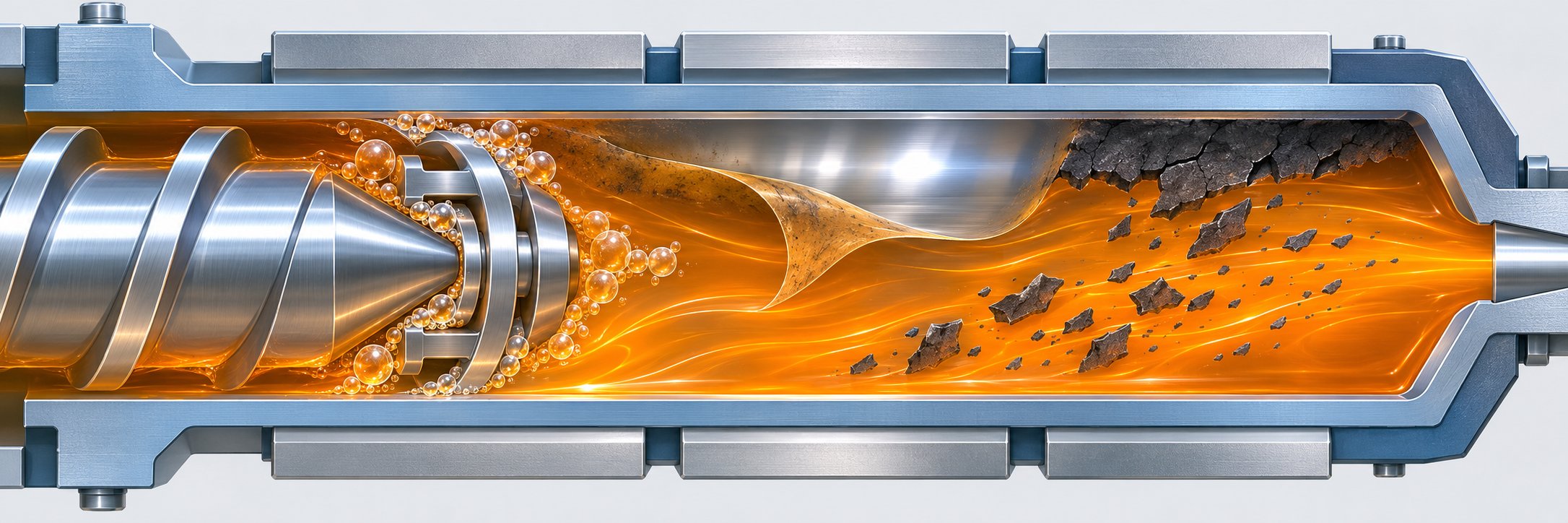
How Chemical Purging Compounds Work at the Molecular Level
Knowing that a chemical purging compound "cleans" your barrel is one thing. Understanding how it cleans—at the molecular and physical level—gives you the insight to choose the right purging agents, dial in parameters, and troubleshoot when results fall short. Three distinct chemical families do the heavy lifting inside most formulations, and each one attacks residual contamination through a different mechanism. Think of them as three specialized tools in the same toolbox, often working in concert within a single compound.
Surfactants and Surface-Tension Reduction
Picture a thin film of degraded polymer baked onto a barrel wall. It clings there because molecular adhesion forces bond the residue tightly to the metal surface. Surfactants—surface-active agents—are the chemical family designed to break that bond.
When a surfactant molecule reaches the interface between residual polymer and steel, it lowers the surface tension at that boundary. The molecule has a dual nature: one end has a strong affinity for the metal surface (often through anionic or non-ionic bonding with superficial metal cations), while the other end is compatible with the polymer melt stream. This "bridge" effect lifts the residue away from the barrel wall and disperses it into the flowing purge material, where it can be carried out through the nozzle.
Effective processing surfactants are typically long-chain fatty acids, metal soaps, or similar molecules with strong metal-surface affinity. Research from ESPOL Polytechnic University confirmed through FTIR spectroscopy that the filler in a polyethylene-based chemical purge contained surfactant components—identified in the aliphatic vibration region around 2900 cm-1—that serve dual roles: externally lubricating the compound during flow and softening contaminant deposits on metal surfaces. Stearic acid, for example, is a well-known coating for calcium carbonate particles and has long been recommended for loosening build-ups in plasticizing units.
Surfactant-based cleaning is especially effective for color changeovers and for removing additive plate-out—those thin, stubborn films that brute-force flushing with virgin resin barely touches. Liquid purging compounds often rely heavily on surfactant chemistry because the liquid carrier can wet metal surfaces more intimately than pellet-form alternatives in certain geometries.
Reactive Agents That Break Down Carbonized Deposits
Surfactants handle adhesion, but what about the deposits that have been thermally degraded so severely they have essentially turned into carbon? Imagine resin that has sat at elevated temperature in a stagnant zone for hours or even days. Its polymer chains have cross-linked and charred into a material that will not simply "lift off" a surface, no matter how much surface tension you reduce.
This is where reactive or solvent-based purging agents enter the picture. These agents chemically attack the polymer backbone through a process called chain scission—breaking long, entangled chains into shorter fragments. By reducing the molecular weight of the degraded residue, they transform a rigid, baked-on deposit into a lower-viscosity material that can flow out of the barrel with the purge stream.
The mechanism is temperature-dependent. Reactive agents require a minimum activation temperature before the chemistry "switches on." Below that threshold, the compound behaves more like a standard carrier resin. Above it, the reactive components begin depolymerizing degraded material on contact. This is precisely why chemical purging compounds have been shown to act more effectively with increased soaking time and temperature—the dwell period gives the reactive agents time to penetrate and break down stubborn carbon layers. However, excessive temperatures can push the chemistry past its effective window and cause the purge itself to degrade, generating new contamination rather than removing it.
For processors running engineering resins at high barrel temperatures, reactive purging agents are often the only practical way to address the heavy carbonization that accumulates during extended production runs. These types of purging compounds are the go-to choice when black specks, gels, or oxidized degradation products are the primary contaminants.
Foaming Action in Dead Zones and Check Rings
Even the best surfactant or reactive agent can only clean surfaces that the melt stream actually reaches. And here is the challenge: every injection molding barrel and extruder has dead zones—areas where the normal melt flow path does not generate enough velocity or pressure to displace stagnant material. Common culprits include check-ring gaps, screw-tip pockets, manifold transitions in hot runners, and the root areas between screw flights.
Foaming agents solve this problem through gas-phase expansion. These are typically endothermic or exothermic chemical blowing agents—compounds like citric acid and sodium bicarbonate blends—that decompose at processing temperatures to release CO2 or N2 gas. The ESPOL research team's thermogravimetric analysis pinpointed this decomposition window between approximately 150 and 280 degrees Celsius, aligning with the temperature range at which most thermoplastic purging extruders and injection molding barrels operate.
When these blowing agents activate, the expanding gas creates pressure spikes inside confined spaces—exactly the dead zones that normal melt flow bypasses. The gas physically dislodges residue from check rings, pushes degraded material out of stagnant pockets, and forces the purge compound into contact with surfaces that a non-foaming purge would simply flow past. You'll notice the effect during purging as a characteristic expansion of the extrudate, often accompanied by a rough, porous surface texture on the purge shots.
The foaming mechanism also complements the other two chemical families. Gas expansion increases contact area between the purge and barrel surfaces, giving surfactants more opportunity to wet and release deposits, and giving reactive agents more access to carbonized material hidden in geometrically complex areas.
Three Mechanisms Working Together
Most commercial chemical purging compounds do not rely on a single mechanism in isolation. Instead, they combine two or all three chemical families into one formulation. Here is a side-by-side summary of how each mechanism contributes to the cleaning process:
- Surfactants: Lower the adhesion force between residual polymer and metal surfaces; ideal for color changeovers, additive plate-out, and thin-film residue; work by wetting the metal-polymer interface and dispersing loosened deposits into the flowing melt stream.
- Reactive / Solvent-Based Agents: Chemically break polymer chains of carbonized and thermally degraded residue through chain scission; reduce molecular weight so rigid deposits become flowable; temperature-activated and benefit from soak time; essential for heavy carbon buildup and black speck elimination.
- Foaming Agents (Chemical Blowing Agents): Generate gas-phase expansion (CO2 or N2) inside dead zones, check rings, and stagnant pockets; physically push residue out of areas the melt stream normally bypasses; enhance the reach and effectiveness of surfactants and reactive agents by increasing surface contact.
Understanding which mechanism dominates a given formulation is the key to matching a purge to your specific contamination challenge. A color changeover on polyolefins may lean heavily on surfactant action, while purging carbonized PC after a long weekend shutdown demands strong reactive chemistry. Cleaning a complex hot runner system with multiple dead spots may call for a formulation where foaming action is the primary driver.
Evaluating Equipment Compatibility Through Independent Testing
One concern that surfaces frequently—sometimes heard in conversations at industry events or even casually at an econo lodge lafayette near university after a late conference session—is whether chemical purging compounds damage barrel or screw metallurgy. It is a fair question, given that reactive agents and foaming chemistry involve active chemical processes happening directly against metal surfaces.
This is where independent, data-driven testing becomes critical. The Covestro/ENGEL AUSTRIA wear and abrasion testing methodology represents one example of a rigorous, third-party evaluation framework specifically designed to measure how purging compounds interact with equipment surfaces over time. Testing protocols like these assess corrosion potential, surface wear patterns, and metallurgical effects under realistic processing conditions—giving processors confidence that a properly formulated chemical purge, used within its specified parameters, will not compromise screw or barrel integrity.
When evaluating different types of purging compounds, look for manufacturers who can point to independent testing data rather than relying solely on internal claims. This is especially important for operations running expensive bimetallic barrels or specialty-coated screws, where any surface degradation carries significant replacement cost. The presence of third-party validation should be a key selection criterion alongside cleaning performance, temperature range, and resin compatibility.
With these molecular mechanisms clearly mapped, the natural next question becomes: how do these three chemical families translate into distinct product sub-types, and which formulation matches your specific application?
Sub-Types and Formulations Within Chemical Purging Compounds
Most processors treat the chemical purging compound category as a single bucket—one product type, one decision. In reality, the category splits into three distinct sub-types, each built around a dominant cleaning mechanism. Recognizing the differences is what separates a precise purge injection molding teams can rely on from an expensive guessing game.
The table below breaks down each sub-type across the dimensions that matter most when selecting purging agents injection molding and extrusion operations encounter daily:
| Sub-Type | Primary Mechanism | Ideal Use Case | Effective Temperature Range | Typical Form Factor |
|---|---|---|---|---|
| Foaming-Action Chemical Purge | Gas expansion from chemical blowing agents (CO2 / N2 release) pressurizes dead zones and stagnant pockets | Hot runner systems, check-ring areas, complex screw geometries with known dead spots | ~150–300 °C (varies by blowing agent system) | Ready-to-use pellets or concentrate blended with carrier resin |
| Reactive / Solvent-Based Chemical Purge | Chain scission that chemically depolymerizes carbonized and thermally degraded residue | Heavy carbon buildup, black speck elimination, extended-shutdown recovery | ~200–350 °C (activation threshold is critical) | Ready-to-use pellets; some liquid formulations available |
| Surfactant-Based Chemical Purge | Surface-tension reduction at the metal-polymer interface lifts residue and disperses it into the flowing melt | Color changeovers, additive plate-out removal, thin-film residue on barrel walls | ~150–280 °C (broad compatibility with commodity and mid-range resins) | Concentrate mixed with production resin or ready-to-use |
Foaming-Action Chemical Purges
Foaming formulations shine wherever stagnant melt pockets resist conventional flow. The gas expansion physically forces purge material into areas that the normal melt stream bypasses—manifold transitions, nozzle tips, and accumulator heads. If your operation battles recurring contamination traced to dead zones, a foaming-dominant purge is usually the first sub-type worth trialing.
Reactive and Solvent-Based Chemical Purges
When the problem is not hidden pockets but baked-on residue, reactive chemistry takes the lead. These formulations need sufficient temperature and soak time to activate. As the PekuTherm technical overview notes, chemical purges that rely on reactive agents may require additional purging cycles before production material is introduced, because the chain-scission byproducts themselves need to be flushed from the system. That tradeoff is worthwhile when the alternative is a manual screw pull.
Surfactant-Based Chemical Purges
For routine color changes and light contamination, surfactant-dominant purges deliver fast turnaround with minimal residue risk. They work by wetting the metal surface and floating deposits into the melt stream rather than chemically decomposing them. Many processors—whether running a small shop near econo lodge brockport in upstate New York or managing a multi-press facility—find surfactant-based purges are the most cost-effective option for day-to-day changeovers where heavy carbon is not the primary concern.
Concentration, Dosage, and Blended Formulations
Beyond sub-type, the form factor matters. Some chemical purging compounds ship as ready-to-use pellets; others are concentrates designed to be blended with a processor's own production resin at a recommended ratio. Industry data from purge concentrate suppliers confirms that concentrates give processors more control over resin compatibility—particularly valuable in sensitive clear or natural applications—while ready-to-use grades simplify the procedure and reduce operator variability. The blend ratio directly influences cleaning effectiveness: too little concentrate and the chemistry is diluted below its effective threshold; too much and you increase material cost without proportional cleaning gain. Always follow the manufacturer's recommended letdown ratio as a starting point, then adjust based on observed extrudate clarity.
Here is the nuance many selection guides miss: the majority of commercial chemical purging compounds are not pure single-mechanism products. A foaming-action purge almost always includes surfactant components to improve surface wetting, and a reactive purge may incorporate mild foaming agents to extend its reach into dead zones. Understanding the dominant mechanism—not the only mechanism—helps you match the right tool to the contamination challenge at hand. A color changeover does not need aggressive chain scission; a carbonized barrel after a weekend shutdown does not need gentle surfactant action alone.
Sorting these sub-types into the right context also means understanding how they stack up against an entirely different cleaning philosophy—mechanical purging—and the hybrid formulations that attempt to bridge both worlds.
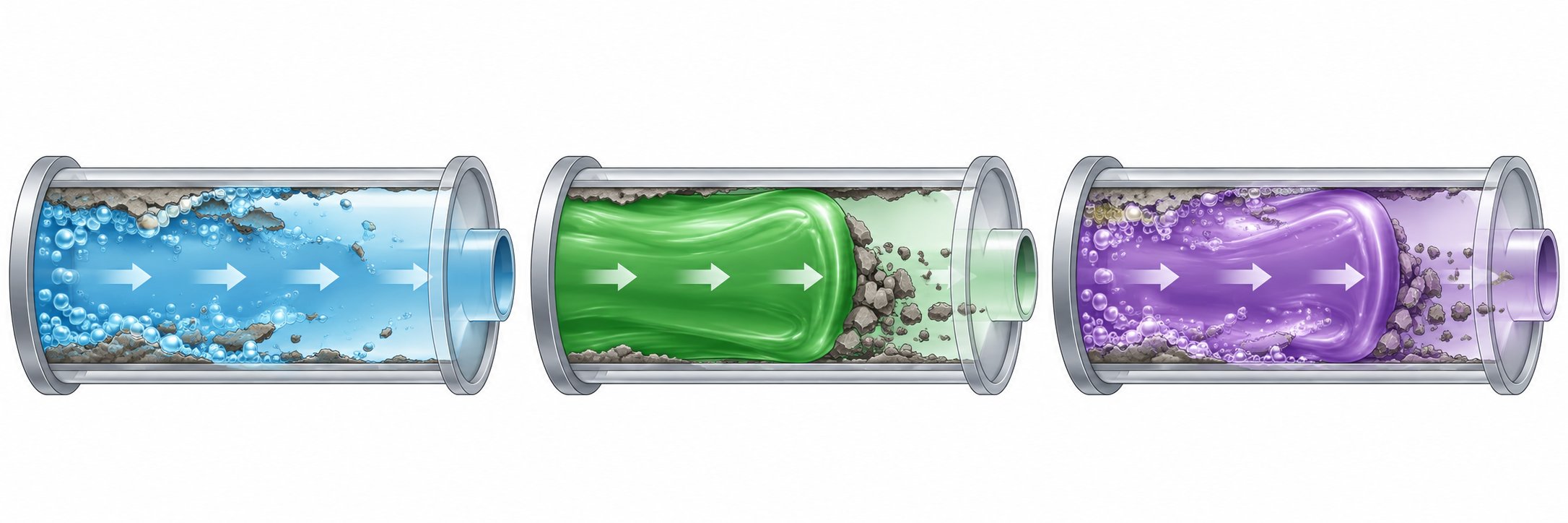
Chemical vs Mechanical vs Hybrid Purging Compounds Compared
Understanding sub-types within the chemical purge compound family is half the selection equation. The other half is knowing when chemical purging is actually the right approach—and when a mechanical or hybrid formulation would serve you better. Too many guides treat this comparison as a footnote. In practice, choosing the wrong category wastes material, extends downtime, and can even leave your equipment dirtier than when you started.
The table below provides the side-by-side comparison that most selection guides leave shallow, covering eight criteria across all three purging technologies:
| Criteria | Chemical Purging Compound | Mechanical Purging Compound | Hybrid Purging Compound |
|---|---|---|---|
| Cleaning Mechanism | Thermal chemical reaction—surfactants, reactive agents, and/or foaming agents activate at processing temperature | Physical scrubbing via shear, pressure, and agitation from high-viscosity or filled resin mass | Combination of chemical reactivity with a physically abrasive or high-viscosity carrier |
| Best Application Scenario | Hot runners, complex flow paths, heavy carbon/degradation, color-critical parts, packaging purging compounds applications | Routine color and material changeovers, standard barrel/screw geometries, quick turnaround needs | Moderate carbon buildup combined with dead-zone cleaning; processors needing versatility across job types |
| Temperature Range | ~150–350 °C depending on chemistry (activation threshold required) | Broader range—some grades span ~80–400 °C since cleaning is physically driven | Moderate range; limited by the activation window of the chemical component |
| Cleaning Power in Dead Zones | Excellent—gas expansion and chemical penetration reach stagnant pockets, check rings, and manifold channels | Limited—relies on melt-flow path and screw movement; material must physically reach the zone | Good—chemical component extends reach beyond what mechanical action alone achieves |
| Abrasiveness to Equipment | Very low—non-abrasive chemical action; reputable formulations tested for metallurgical compatibility | Low to moderate—glass-fiber or mineral-filled grades can cause wear on softer barrel linings over time | Low—typically formulated to minimize abrasive content while retaining some scrubbing action |
| Residue Risk | Moderate—reactive byproducts or foaming residue may require additional displacement cycles | Low—exits as a solid mass, displacing existing polymer without introducing chemical byproducts | Low to moderate—depends on the ratio of chemical to mechanical components in the formulation |
| Relative Cost Per Purge | Higher material cost per pound, but often lower total cost when factoring in reduced downtime and scrap for difficult changeovers | Lower material cost per pound; most economical for simple, frequent changeovers | Mid-range—balances cost against broader capability |
| Regulatory Suitability (Food-Contact / Medical) | Varies—some grades carry FDA or EU food-contact compliance; verification required per application | Often easier to document for regulated environments due to simpler, non-reactive chemistry | Case-by-case—chemical component must meet the same regulatory scrutiny as a fully chemical purge |
When Chemical Purging Outperforms Mechanical Methods
Chemical purging earns its premium in scenarios where mechanical scrubbing simply cannot reach the contamination. Consider a multi-drop hot runner mold with a dozen nozzle tips and several manifold turns. The melt flow path through those channels is fixed—there is no rotating screw to generate shear against the walls, and the narrow cross-sections create stagnant zones that trap degraded polymer. A mechanical purge compound introduced through the barrel can only clean what the flow stream physically displaces. A chemical formulation, especially one with a foaming component, generates gas expansion inside those channels and chemically loosens residue from surfaces that the melt stream flows past without disturbing.
The same logic applies to complex screw geometries—barrier screws, mixing sections with tight clearances, and worn check rings where gaps create pockets of stagnant material. Chemical purging also proves its value when contamination is not just positional but chemical in nature: heavily carbonized deposits that have cross-linked and hardened onto metal surfaces resist physical displacement. Reactive agents break those carbon bonds in a way that no amount of mechanical scrubbing can replicate.
Color-critical applications—think optical-grade lenses, transparent packaging, or light-colored automotive interior trim—represent another strong case. Even trace pigment residue invisible in a dark part becomes a reject in a clear one. The surfactant action in chemical formulations lifts pigment films from barrel walls more thoroughly than physical scrubbing alone, delivering cleaner transitions with fewer scrap shots. Processors running high-frequency changeovers for packaging purging compounds applications, where brand colors shift multiple times per shift, often find that the higher per-pound cost of a chemical purge is offset by dramatic reductions in transition scrap.
Where Mechanical Purging Compounds Still Excel
None of this means mechanical purging is obsolete. Far from it. For straightforward color or material changeovers in standard barrel-and-screw setups—particularly injection molding machines with simple screw tips and no hot runner—a mechanical purge compound delivers fast, predictable results at a lower material cost. Industry observations from mechanical purge suppliers confirm that these compounds can be introduced directly into the machine during normal processing conditions without special preparation steps, partial barrel emptying, or chemical soak periods.
Mechanical purges also carry a practical advantage in residue management. Because they clean through displacement rather than chemical reaction, they exit the barrel as a solid mass without introducing reactive byproducts that might require additional flushing cycles. For operations where every minute of downtime is measured—picture a contract molder juggling dozens of jobs per day, whether the plant sits near econo lodge nashville near percy priest lake or in any other high-volume manufacturing corridor—that simplicity translates directly into faster press availability.
Large-barrel-diameter machines represent another scenario favoring mechanical compounds. When barrel volume exceeds a certain threshold, the sheer quantity of chemical purge required to fill the plasticizing unit and maintain soak time can make per-purge costs impractical. A high-viscosity mechanical compound that cleans through pressure and scrubbing action scales more economically in those applications.
The Case for Hybrid Purging Compounds
Hybrid purging compounds aim to split the difference. They pair a chemically reactive or surfactant component with a carrier resin engineered for physical scrubbing. The result is a purge compound that offers better dead-zone penetration than a purely mechanical grade while maintaining the displacement efficiency and lower residue profile that mechanical formulations are known for.
Hybrids tend to fit best in operations that face a range of cleaning challenges rather than a single dominant one. A facility running multiple resin families across several machines—say, commodity polyolefins on one press and engineering-grade nylon on another—may find that a well-chosen hybrid reduces the number of purge SKUs it needs to stock. Processors in remote locations, even those operating near an econo lodge hobbs nm in the Permian Basin oil-country where quick supply-chain access to specialty purging products is not always guaranteed, benefit from the versatility a single hybrid grade can provide across varied production scenarios.
The tradeoff is that hybrids rarely match the peak performance of a dedicated chemical or dedicated mechanical purge in their respective sweet spots. A hybrid will not penetrate a complex hot runner as aggressively as a foaming chemical formulation, and it will not displace material as rapidly as a purpose-built mechanical grade in a simple barrel changeover. Think of it as a multi-tool versus a set of specialized instruments: extremely useful when flexibility matters, but not always the sharpest option for a specific task.
Chemical purging is not universally superior to mechanical or hybrid methods. The best purge compound for any given situation depends on the specific processing scenario—equipment geometry, resin being run, type of contamination, changeover frequency, and regulatory requirements. Effective purge selection is an engineering decision, not a brand loyalty exercise.
Recognizing where each technology fits is the foundation. The next layer of specificity—matching your purge choice to the exact resin family and processing temperature window—is where selection decisions become truly precise.
Matching Chemical Purging Compounds to Resins and Temperatures
Choosing between chemical, mechanical, and hybrid purging is the first decision. The second—and often more consequential—decision is matching your purge purging compound selection to the specific resin family running through your barrel. Every polymer brings a unique combination of thermal behavior, degradation chemistry, and adhesion characteristics that directly determines which purging agent will clean effectively and which will waste your time and material.
Yet most selection guides stop at generic advice like "use a chemical purge for engineering resins." That is not enough. A purge formulation perfectly suited for polycarbonate may perform poorly on POM, and a compound rated for polyolefins will almost certainly fail when asked to clean PEEK residue at 400 degrees Celsius. The table below maps the major resin families to specific purging compound guidance, along with the reasoning behind each recommendation:
| Resin Family | Key Processing Challenge | Recommended Purge Sub-Type | Typical Processing Temp Range | Rationale |
|---|---|---|---|---|
| PC and PC Blends | Prone to thermal degradation and yellowing; forms stubborn carbonized deposits at elevated temperatures | Reactive / solvent-based chemical purge | ~260–320 °C | Reactive agents break down cross-linked carbon via chain scission; surfactant-only purges often lack the chemical aggression needed for heavy PC degradation |
| POM (Acetal) | Releases formaldehyde gas at processing temperature; thermally unstable above its narrow processing window | Surfactant-based or mild foaming chemical purge with appropriate temperature stability | ~190–230 °C | Purge must remain stable within POM's narrow window without triggering additional formaldehyde release; aggressive reactive chemistry can worsen off-gassing |
| Nylon / PA (PA6, PA66) | Hygroscopic; prone to hydrolytic degradation; degraded nylon adheres to metal surfaces | Surfactant-based chemical purge | ~240–300 °C | Surfactants effectively break the adhesion bond between degraded nylon residue and barrel walls; moisture control prior to purging is critical |
| PET | High processing temperatures; rapid thermal degradation produces acetaldehyde; crystallization in stagnant zones | Reactive chemical purge rated above 280 °C | ~270–310 °C | PET degradation products require chemical chain scission to mobilize; the purge compound must remain thermally stable well above 280 °C |
| TPU | Extremely sticky; adheres tenaciously to screw surfaces and barrel walls; resists displacement | Strong surfactant-action chemical purge, often combined with foaming | ~180–230 °C | Surfactant action is essential to break the adhesive bond TPU forms with metal; foaming helps dislodge material from screw root areas |
| PEEK and High-Performance Polymers (PEI, PPS, LCP) | Extremely high processing temperatures; standard purge compounds degrade or burn | High-temperature reactive chemical purge specifically formulated for extreme heat | ~350–420 °C | Conventional purges simply burn at these temperatures; only specialty high-temperature grades remain stable and chemically active |
Purging Guidance for Engineering and High-Temperature Resins
Engineering resins are where chemical purging compounds earn their keep—and where poor selection decisions carry the steepest penalties. Consider polycarbonate. PC processes cleanly when fresh, but the moment barrel temperatures creep above the recommended window or material sits stagnant during a production delay, thermal degradation accelerates. The result is yellowed, carbonized residue that adheres to screw flights and barrel walls with remarkable tenacity. A surfactant-based purge might loosen surface-level discoloration, but it will not break down cross-linked carbon deposits that have chemically bonded to the metal. Reactive purging agents that perform chain scission are the practical answer—they reduce the molecular weight of baked-on PC residue until it becomes flowable enough to exit the barrel.
POM presents a different challenge entirely. As Plastics Technology's purging guidance underscores, high-performance resins demand purge compounds specifically rated for their processing temperatures. POM is thermally unstable above its narrow processing window and releases formaldehyde gas during degradation. Choosing a purging agent with aggressive reactive chemistry that generates additional heat or off-gassing can actually worsen the situation. A milder surfactant-based or gentle foaming formulation—one that stays stable within POM's tight temperature band—is the safer, more effective choice.
At the extreme end of the temperature spectrum, PEEK and its high-performance cousins (PEI, PPS, LCP) process at melt temperatures ranging from roughly 350 to over 400 degrees Celsius. As Slide Products has demonstrated, traditional purging compounds simply burn at these temperatures, making them useless. Specialty high-temperature purging compounds built with thermally stable carrier resins—rated up to approximately 400 °C—are essential. The cost of these high-performance engineering resins often exceeds usd 473 per 100 pounds or more, so minimizing transition scrap through effective purging delivers direct bottom-line impact. Always verify exact temperature ratings from manufacturer technical data sheets before committing to a grade for high-heat applications.
Considerations for Commodity Resins and Polyolefins
Commodity resins—polyethylene, polypropylene, polystyrene—process at lower temperatures and typically produce less aggressive degradation than engineering polymers. Does that mean chemical purging compounds are unnecessary? Not at all. Color changeovers on polyolefins are among the most frequent purging events in the industry, and pigment residue clinging to barrel walls and screw root surfaces can persist through dozens of virgin-resin flush shots.
Surfactant-based chemical purges are often the ideal fit here. They break the adhesion between pigment and metal efficiently, delivering cleaner color transitions with fewer scrap shots than a simple resin flush. The lower processing temperatures of polyolefins (typically 180–260 °C) mean that virtually all chemical purge sub-types are thermally compatible, giving processors a wide selection. The deciding factor becomes cost-effectiveness: a surfactant-dominant concentrate blended with the processor's own carrier resin often delivers the best balance of cleaning performance and material economy for high-frequency commodity changeovers.
Nylon occupies a middle ground between commodity and high-performance. Its hygroscopic nature means that moisture absorbed before or during processing contributes to hydrolytic degradation—producing residue that clings stubbornly to metal. Surfactant-based purging agents work well for nylon because they target that adhesion bond directly. The practical tip? Ensure the purging compound itself is properly dried before use, just as you would dry the production nylon. Introducing a moisture-laden purge into a nylon-fouled barrel replaces one contamination source with another. Processors running purging compounds for extrusion Noblesville IN facilities or anywhere in humid climates should pay particular attention to this detail.
Temperature Compatibility and Operating Windows
Every chemical purging compound has an effective temperature window—a range within which its active chemistry performs as designed. Sounds straightforward, but the consequences of operating outside that window catch processors off guard more often than you might expect.
Too low: When barrel temperatures fall below the purge compound's activation threshold, the chemical agents never "switch on." The surfactants remain inert, the reactive agents do not initiate chain scission, and the foaming agents do not decompose to generate gas. What you are left with is essentially an expensive carrier resin performing a basic displacement flush—exactly the kind of generic approach you were trying to avoid. This scenario commonly occurs when processors lower barrel temperatures prematurely during a shutdown transition, or when they attempt to use a high-temperature purge grade at a barrel temperature well below its designed range.
Too high: Pushing a chemical purging compound above its rated ceiling creates a different set of problems. The purge compound itself begins to thermally degrade, generating its own carbonized residue, off-gassing, and potentially discolored byproducts. Foaming agents may decompose too rapidly, producing uncontrolled gas expansion that creates voids and inconsistent cleaning rather than targeted dead-zone penetration. In extreme cases, excessive temperatures can cause the purge to char inside the barrel—leaving you with more contamination than you started with. The expert guidance from Plastics Technology's high-temperature purging series reinforces this point: always purge at the lower end of the recommended resin melt-temperature range, and do not leave any purge compound in the barrel at elevated temperatures for extended periods. A maximum dwell time of approximately 30 minutes is a common guideline, though specific limits vary by product.
Processors visiting supplier booths at trade shows—or even researching solutions from an econo lodge greenville ms after a long day at a regional plastics conference—will often encounter temperature claims that sound impressively broad. The critical question to ask is not just "what is the maximum temperature?" but "at what temperature does the chemistry activate, and at what point does it begin to degrade?" That effective operating window, not the extremes, is what determines real-world performance.
The interplay between resin chemistry, purge chemistry, and barrel temperature creates a three-variable equation. Getting it right means shorter changeovers, less scrap, and cleaner parts. Getting it wrong means wasted compound, extended downtime, and possibly a barrel that needs more aggressive intervention to recover. With the right purge matched to the right resin and the right temperature, the remaining challenge is execution—the step-by-step procedure that turns chemistry into clean parts.
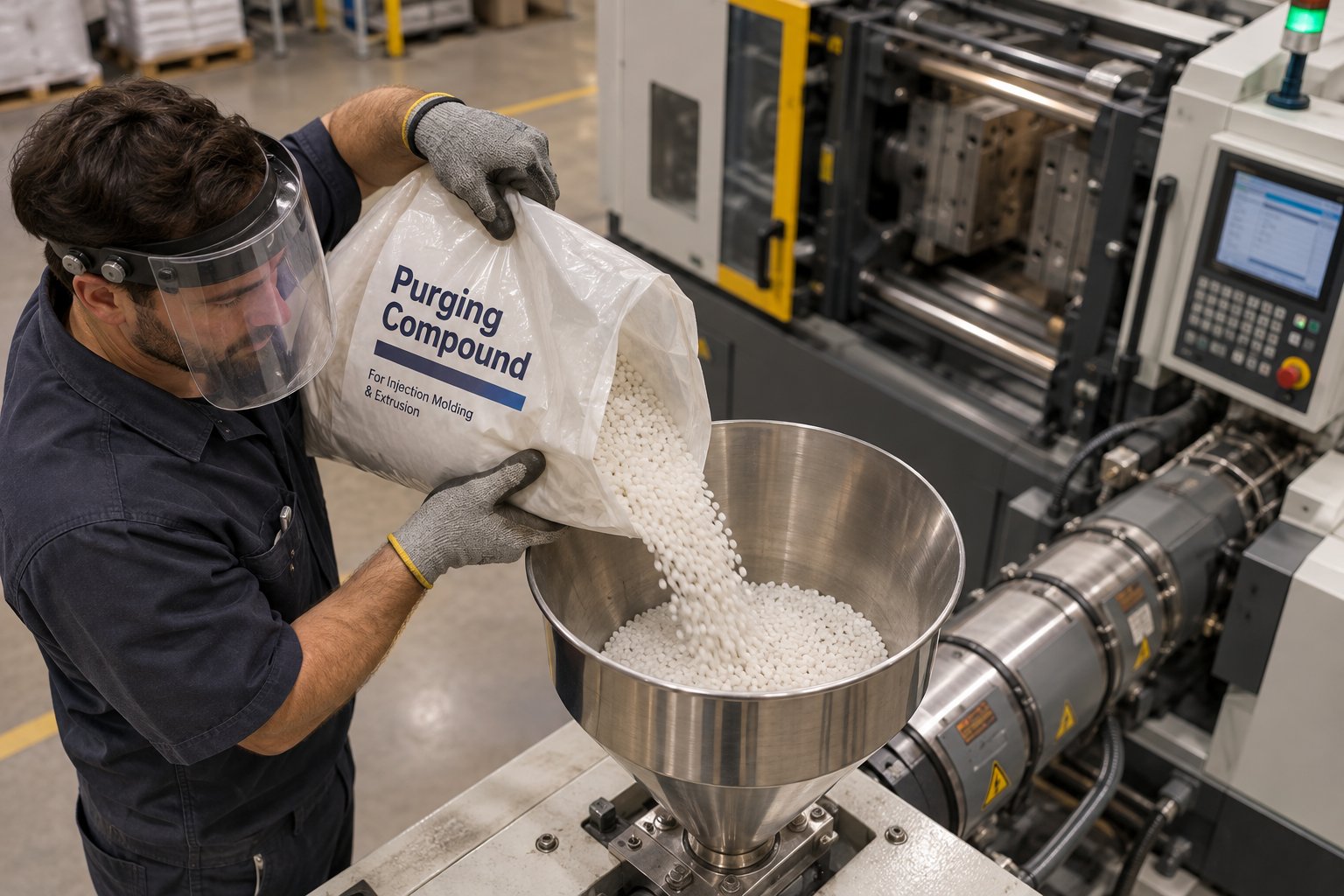
Step-by-Step Chemical Purging Procedures and Protocols
Matching the right purge chemistry to the right resin and temperature window is essential—but chemistry alone does not clean a barrel. Execution does. A perfectly selected chemical purging compound, introduced with the wrong barrel temperature, inadequate soak time, or improper shot technique, will underperform a mediocre product used correctly. Yet detailed, phase-by-phase purging protocols remain one of the most glaring gaps in publicly available plastics processing guidance.
The general procedure below applies to most injection molding and extrusion operations running chemical purge compounds. Specific parameters—temperatures, soak durations, screw speeds—always defer to the purging compound manufacturer's technical data sheet, but the sequence and logic are universal.
Pre-Purge Preparation and Barrel Temperature Settings
Effective mold purging starts before a single pellet of purge material enters the hopper. Skipping preparation is the most common reason chemical purges disappoint—and the easiest problem to fix.
- Empty the hopper of production resin. Allow the machine to cycle until the majority of the existing material has cleared from the screw flights. The goal is not a completely dry barrel—Routsis training data emphasizes that "wet purging" (always keeping some material in the barrel) is far more effective than running the barrel empty, which risks baking residual polymer onto hot metal surfaces. Use a telescoping mirror over the feed throat to monitor screw-flight visibility and stop before the barrel runs dry.
- Verify barrel zone temperatures. Set each zone to match the purging compound manufacturer's recommended operating range. Remember the temperature-window principle from the previous section: too low and the chemistry never activates; too high and the purge itself degrades. If you are transitioning from a high-temperature resin to a lower-temperature one, purge at the higher temperature first, then reduce while continuing to run purge material—never let the barrel sit static during a temperature transition, as Noztek's extrusion purging guide reinforces.
- Inspect screw tip and check-ring condition. This step is often overlooked, yet it directly determines whether your chemical purging compound can do its job. Worn screw flights, damaged check rings, and excessive barrel clearance create material-retention zones—dead pockets where degraded polymer accumulates and resists even the most aggressive chemistry. If your purging performance has degraded over time despite using the same compound and procedure, the plasticizing hardware itself may be the root cause. For operations facing persistent retention issues, evaluating the screw and barrel assembly is a logical next step. NANHAIYA's custom injection molding screw barrels offer processors a resource for this assessment—their technical review considers screw geometry, wear patterns, melting behavior, mixing efficiency, and material-retention concerns to determine whether component replacement or upgrade is warranted.
- Confirm adequate purge material quantity. A common misconception is that barrel capacity equals maximum shot size. In reality, barrel capacity is typically 2 to 2.5 times the maximum shot size. If a full barrel of purge material is needed, you will require at least twice the maximum shot size in purge compound. Under-dosing is one of the fastest ways to waste time and material—the chemistry cannot work if there is not enough compound to contact contaminated surfaces.
Purge Execution Including Soak Time and Shot Sequence
With preparation complete, the active purging phase begins. This is where chemical purge compounds differentiate themselves most clearly from mechanical alternatives—the soak or dwell period gives reactive agents and surfactants time to chemically interact with deposits before displacement.
- Introduce the purging compound into the hopper. Feed the material and allow it to enter the screw at moderate speed. Avoid flooding the feed throat—steady, controlled feeding ensures the purge compound fills the screw flights evenly.
- Adjust screw speed and back pressure per manufacturer guidance. Here is an important nuance: during barrel purging, minimum or zero back pressure is generally most effective because the goal is positive conveyance—pushing contamination forward and out through the nozzle. Back pressure creates reverse flow in screw channels, which works against that objective. However, if you are purging through a hot runner system (which behaves more like an extruder from a flow standpoint), back pressure may be applied after the barrel itself is clean, to force purge material through manifold channels.
- Allow a chemical soak or dwell period. This is the critical differentiator for chemical purging. Stop the screw and let the compound sit in the barrel for the manufacturer's recommended dwell time—typically anywhere from two to ten minutes, depending on the formulation and severity of contamination. During this period, reactive agents are performing chain scission on carbonized deposits, surfactants are wetting and lifting residue from metal surfaces, and foaming agents are expanding into dead zones. Skipping or shortening the soak time is the single most common execution error with chemical purges. Imagine applying an oven cleaner and wiping it off immediately—the chemistry needs contact time to work.
- Perform a series of small purge shots. After the soak, resume screw rotation and begin cycling purge shots through the nozzle. Small shots—roughly 10 to 20 percent of maximum shot size—are significantly more effective than fewer large shots. The small-shot technique keeps material moving in the feed zone, cycles the check ring more frequently (improving cleaning behind it), and increases agitation within the screw flights. Observe each purge shot as it exits: early shots will carry visible contamination—color, black specks, degraded material. Continue until the extrudate runs clean and consistent in color and texture.
Post-Purge Verification and Transition to Production Resin
A clean-looking purge shot is encouraging, but it is not final proof. The post-purge phase confirms that the barrel is truly ready for production and that no purge compound residue will contaminate the next run.
- Transition to the next production resin. Introduce the new material into the hopper and begin processing. The first several shots will be a blend of residual purge compound and incoming production resin—these are transition scrap and should be discarded, not returned to the grinder.
- Run verification shots and inspect parts. Mold a series of test parts and inspect them under appropriate lighting for black specks, color streaks, haze, or surface defects. For color-critical or cosmetically sensitive applications, use a light box or magnification. If contamination persists, an additional short purge cycle with a soak period may be necessary before resuming production.
- Document the purge event. Record the purge compound used, quantity consumed, barrel temperatures, soak time, number of purge shots to clean, and any anomalies observed. This data becomes invaluable for building a baseline—you will know exactly how much compound and time a specific changeover requires, which feeds directly into scheduling and cost calculations.
A quick-reference summary of the complete protocol:
| Phase | Key Actions | Common Mistakes to Avoid |
|---|---|---|
| Pre-Purge | Clear hopper, wet-purge to near-empty, set temperatures to purge compound spec, inspect screw/check ring, confirm adequate purge volume | Running barrel completely dry (causes baking); using incorrect temperature settings; under-dosing purge material |
| Execution | Introduce compound, minimize back pressure for barrel purging, allow full soak/dwell time, use small-shot cycling technique, observe extrudate | Skipping or shortening soak time; using large shots instead of small-shot cycling; applying excessive back pressure during barrel purge |
| Post-Purge | Transition to production resin, discard transition shots, inspect molded parts under proper lighting, document results | Recycling transition scrap back into production; skipping visual inspection; failing to record purge data for future reference |
Notice that every step in this protocol assumes a barrel and screw in reasonable mechanical condition. Worn flights, damaged check rings, and excessive clearance create retention zones that no chemical purging compound—regardless of formulation quality—can fully overcome. If your documented purge data shows consistently increasing compound consumption or persistent contamination despite following proper procedures, the plasticizing hardware deserves attention alongside the purging chemistry.
Of course, the protocol above describes a generalized sequence. The practical details shift significantly depending on whether you are purging an injection molding barrel, cleaning a complex hot runner system, or tackling the continuous-flow challenge of an extrusion line—each process introduces unique variables that demand tailored approaches.
Process-Specific Purging for Injection Molding, Hot Runners, and Extrusion
A generalized purging protocol gives you the foundation, but plastics processing is not a one-size-fits-all discipline. The barrel dynamics of an injection molding machine behave nothing like the continuous flow of an extruder, and both differ dramatically from the dead-zone-rich architecture of a hot runner manifold. Effective purging compound selection hinges on understanding these process-specific variables—and adjusting your approach accordingly.
Chemical Purging in Injection Molding Barrels
Injection molding offers one major advantage when it comes to purging: shot-based feedback. Every time you cycle the screw, retract, and inject a purge shot, you get a visible sample of what is leaving the barrel. That shot-to-shot observation is your real-time progress indicator—color, clarity, texture, and the presence of specks all tell you whether the chemical purging compound is still working on contamination or whether the barrel is clean.
The purging material injection moulding teams rely on performs best when barrel contact is maximized. Here is where back pressure plays a nuanced role. During barrel purging itself, minimal or zero back pressure promotes forward conveyance—pushing contamination out through the nozzle rather than recirculating it through screw channels. However, once the barrel is reasonably clean and you shift focus to displacing purge compound with production resin, a moderate increase in back pressure improves mixing and ensures more complete displacement of the remaining purge.
Small, frequent shots outperform large, infrequent ones. Each short injection cycles the check ring, flushing material trapped behind it. It also keeps the feed zone active, preventing the formation of new stagnant pockets while the purge chemistry does its work in the metering and compression zones. A typical barrel purge on a mid-size injection molding machine—say, 200 to 500 tons—might require 15 to 25 small shots after the soak period before the extrudate runs visibly clean.
Hot Runner Purging with Chemical Compounds
If the barrel is the straightforward chapter of the purging story, the hot runner is the complicated one. Hot runner systems present challenges that no other component in the plastics processing chain replicates:
- Dead spots at manifold transitions. Every turn, branch, and diameter change in the manifold creates a zone where melt velocity drops and degraded polymer accumulates.
- Variable thermal profiles across zones. Manifold heaters, nozzle heaters, and gate-area temperatures rarely match perfectly, creating localized hot and cold spots that affect both degradation rate and purge compound activation.
- Nozzle tip geometry. The narrow clearance at gate orifices traps degraded material that resists displacement by flow alone. As Asaclean's hot runner purging guidelines emphasize, you must know the minimum clearances within your hot runner and at the gates before selecting a purge grade—some compounds simply will not flow through tight gate restrictions.
This is precisely why chemical purging compounds with a strong foaming component are particularly suited for hot runner cleaning. The gas expansion generated by chemical blowing agents pressurizes manifold channels and dead spots from the inside, physically dislodging residue from areas that the normal melt stream flows past without disturbing. A non-foaming purge—whether chemical or mechanical—can only clean what the flow path physically contacts. In a multi-drop manifold with a dozen nozzle tips, that leaves a lot of surface area untouched.
Practical execution tips for hot runner purging make a significant difference in outcomes:
- If color streaking persists in specific cavities, close off all other gates and inject high-velocity short shots through each affected gate individually—this concentrates cleaning force where it is needed most.
- Raising manifold temperatures slightly (while remaining within safe operating limits) helps dislodge the most stubborn deposits by increasing both melt fluidity and chemical activity of the purge.
- Glass-filled mechanical purging compounds are generally not recommended for hot runners. The glass fibers can scratch polished gate surfaces and lodge in tight clearances, creating new contamination sources. Chemical formulations avoid this risk entirely.
- When purging with the mold closed, applying mold release to cavities helps with part ejection, since purged material may not fill completely and can stick. When purging open-mold, short high-velocity shots promote the turbulence needed to clean manifold channels effectively.
Processors managing complex, high-cavitation molds—whether at a large-scale automotive supplier or a smaller custom shop near econo lodge inn & suites monroe—face the same fundamental physics. Dead spots do not care about plant size. What matters is matching foaming-action purge chemistry to the specific manifold geometry and executing with the disciplined shot technique described above.
Extrusion and Blow Molding Purging Considerations
Extrusion flips the purging paradigm. Unlike injection molding, there are no discrete shots to observe, no check ring to cycle, and no convenient nozzle tip through which contamination exits in evaluable increments. Instead, you are working with a continuous melt stream flowing through a long barrel—often significantly longer than an injection molding barrel—with residence times that can stretch into minutes rather than seconds.
This continuous-process reality affects purging compounds for extrusion in several important ways. First, there is no natural "soak" mechanism built into the process cycle. To achieve the chemical dwell time that reactive and surfactant-based purges need, operators must stop the screw and hold the compound in the barrel deliberately—a step that feels counterintuitive in a process designed for continuous output. Second, the verification method changes. Instead of inspecting discrete shots, extrusion operators monitor the continuous extrudate stream for color, clarity, and the disappearance of specks or streaks. This requires patience and a trained eye, since contamination exits gradually rather than in distinct, separable shots.
In some cases—particularly with sheet, profile, or pipe extrusion lines—removing the die before purging dramatically improves results. The die assembly itself contains flow channels, land areas, and adapter transitions that trap degraded material. Purging through a restricted die opening forces the compound to follow the path of least resistance, which may not coincide with where the contamination actually sits. Removing the die allows unrestricted flow and gives operators a clear view of what is exiting the barrel. The tradeoff is the time required for die removal and reinstallation, which must be weighed against the cleaning benefit.
Chemical purges formulated specifically for extrusion processes typically account for the higher residence times by using slower-activating chemistry that remains effective over a longer barrel-transit period. A fast-acting foaming agent designed for a short injection molding barrel might exhaust its gas expansion before the compound even reaches the metering zone of a long single-screw extruder. Extrusion-optimized formulations balance activation speed with sustained activity across the full barrel length.
Extrusion blow molding adds another layer of complexity on top of standard extrusion challenges. Accumulator heads—large reservoirs that collect melt before rapidly pushing it through the die to form a parison—create substantial dead zones. The accumulator-head purging procedures documented by Plastics Technology highlight several critical steps unique to this process: the die gap must be opened wide enough to allow purge material to flow freely during head filling, then gradually restricted to build backpressure for more aggressive cleaning. Overfilling the accumulator head to full capacity is essential—underfilling leaves unpurged dead zones at the top of the accumulator. Parison programming further complicates matters, as the variable wall-thickness profile means some areas of the head experience different flow velocities and retention times than others.
Temperature verification deserves extra emphasis in blow molding. As the Plastics Technology guide recommends, using a hand-held quick-response probe to check actual metal temperatures—rather than relying solely on controller readouts—ensures that your barrel, head, and die zones are genuinely at the temperatures the purge compound requires for activation. Controller readings can drift, especially on older machines, and a 20-degree discrepancy between displayed and actual temperature can mean the difference between activated chemistry and an expensive displacement flush. Processors running accumulator-head machines in any setting—from a high-output facility to a regional operation near econo lodge kalispell in Montana—face these same thermal verification challenges.
After purging the accumulator head, a virgin-resin chaser follows to displace the remaining purge compound. First-article inspection against a known clean reference part confirms readiness for production. If contamination persists, a second complete fill cycle of purge compound may be necessary, particularly on older machines where internal wear has created grooves and retention points inside the head assembly.
Process Comparison at a Glance
The table below summarizes the key differences in purge approach across the four major process types, giving you a quick-reference framework for purging compound selection by application:
| Process Type | Key Purging Challenge | Recommended Purge Sub-Type | Typical Purge Duration | Verification Method |
|---|---|---|---|---|
| Injection Molding (Barrel) | Check-ring retention, screw-flight dead zones | Surfactant or reactive chemical purge (matched to resin); foaming if check-ring contamination is persistent | 15–30 minutes including soak time and shot cycling | Shot-to-shot visual inspection of extrudate clarity, color, and speck presence |
| Hot Runner Systems | Manifold dead spots, variable thermal zones, narrow gate clearances trapping degraded material | Foaming-action chemical purge (gas expansion reaches areas melt flow cannot); must clear minimum gate restriction | 20–45 minutes depending on system complexity and cavity count | Cavity-by-cavity inspection; isolate gates to verify individual nozzle cleanliness |
| Extrusion (Single/Twin Screw) | Continuous flow with no shot-based feedback; long barrel with extended residence time; die-assembly retention | Extrusion-optimized chemical purge with sustained-activation chemistry; consider die removal for severe contamination | 20–60 minutes depending on barrel length, L/D ratio, and die complexity | Continuous extrudate monitoring for color, clarity, and disappearance of specks/streaks |
| Extrusion Blow Molding (Accumulator Head) | Large accumulator dead zones, parison-programming flow variations, seal-ring retention areas | Foaming-action or reactive chemical purge; must overfill head to full capacity | 30–60+ minutes; may require multiple full head-fill cycles | Parison visual inspection; first-article comparison against known clean reference part |
Each of these process-specific approaches shares one common thread: purging works best when it is planned, not improvised. The most effective operations do not wait for visible contamination to trigger a purge event—they build chemical purging into a scheduled maintenance cadence that prevents carbon buildup from ever reaching problematic levels. That shift from reactive to preventive purging is where the real efficiency gains—and the real cost savings—begin to compound.
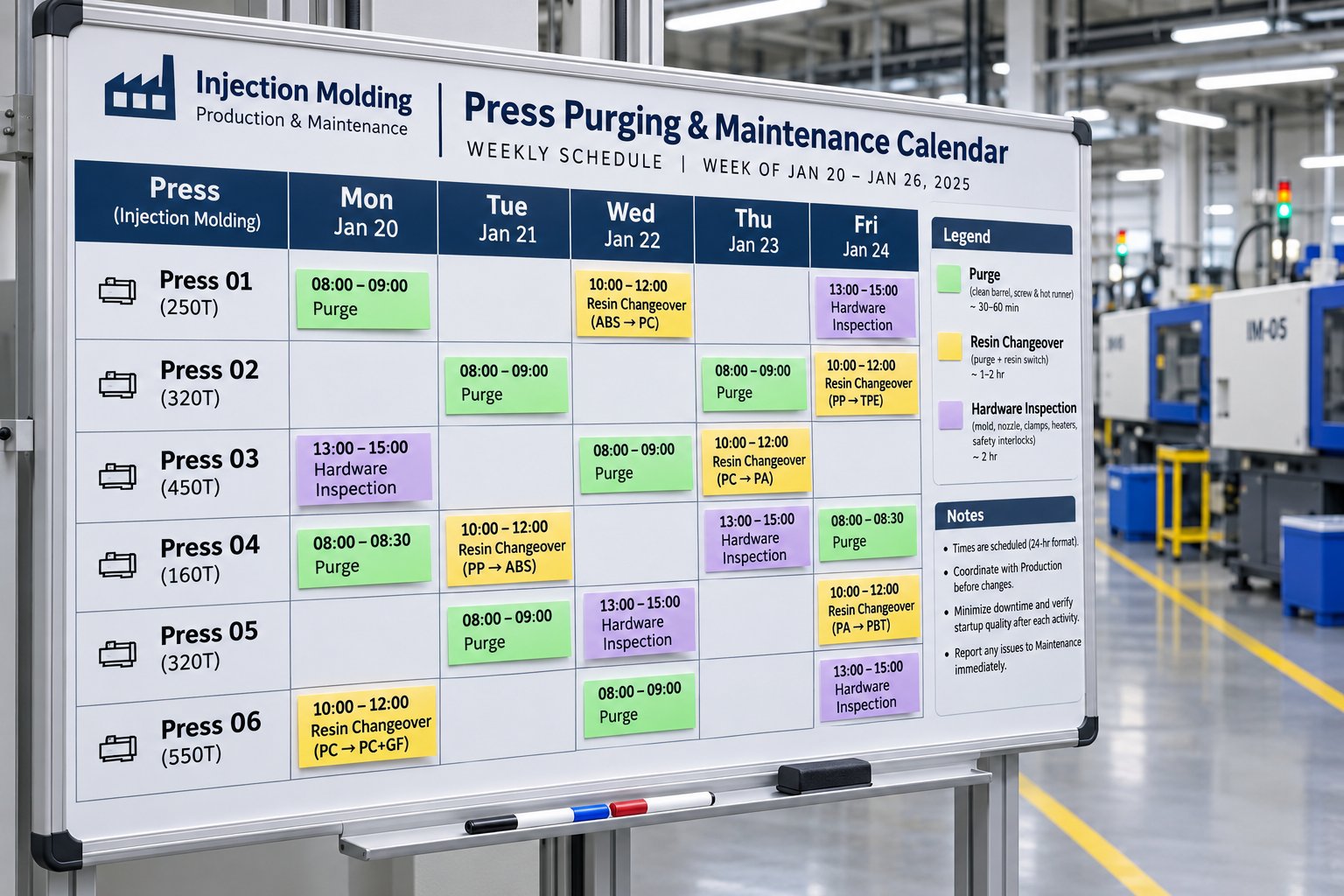
Integrating Chemical Purging into Preventive Maintenance Programs
Most plants treat purging the same way they treat a fire alarm—something you respond to only when the problem is already visible. Black specks in molded parts, color streaks after a changeover, or a growing reject pile at the end of the line finally triggers someone to grab a bag of purge compound. By then, the carbon has been building for days, the barrel walls are coated in degraded polymer, and clearing the contamination demands significantly more compound, more machine time, and more scrapped parts than it would have if the buildup had never been allowed to accumulate in the first place.
Shifting from this reactive model to a scheduled preventive purging program is one of the highest-impact process improvements a plastics operation can make—and one of the least discussed.
Scheduled Purging vs Reactive Purging
The distinction is straightforward, but the operational consequences are dramatic. Reactive purging waits for symptoms: visible contamination, failed quality checks, customer complaints. By the time those symptoms appear, carbonized deposits have had ample time to harden, layer, and spread through dead zones. Clearing heavy buildup often requires extended soak times, multiple purge cycles, and in worst-case scenarios, a full screw pull—a labor-intensive maintenance event that takes a press offline for hours.
A real-world case documented by iD Additives illustrates the pattern perfectly. A process engineer dealing with elastomer contamination tried both chemical and mechanical purges reactively. After multiple purge cycles, colors from production runs dating back ten months were still emerging from the barrel—layers of residue that had built up over time because no preventive program existed. The eventual solution was clean, but it consumed hours of press time. The engineer's immediate next step? Implementing a scheduled purge program to prevent that layering from ever recurring.
Scheduled purging, by contrast, intervenes at planned intervals—before contamination becomes visible. The chemical purging compound is introduced at shift changes, during material changeovers, or at scheduled shutdowns, keeping residue at manageable levels and preventing the compounding effect of layer-on-layer carbon accumulation. The compound quantity needed per event is smaller, soak times are shorter, and the machine returns to production faster because there is simply less to clean.
Building a Purging Schedule Around Production Cycles
There is no universal calendar that dictates "purge every 48 hours." The right schedule depends on several variables specific to your operation:
- Resin type and degradation tendency. Engineering resins like PC and nylon degrade faster at processing temperatures than commodity polyolefins. Operations running these materials benefit from more frequent purge intervals—potentially every shift change rather than every few days.
- Processing temperature. Higher barrel temperatures accelerate thermal degradation. A press running PET at 290 degrees Celsius accumulates carbon faster than one running PP at 210 degrees Celsius, even over the same run length.
- Run length and changeover frequency. Long, uninterrupted production runs allow more time for degradation to accumulate on barrel walls and in dead zones. Conversely, frequent changeovers provide natural purging opportunities—if the operation uses them deliberately rather than simply flushing with the next resin.
- Historical contamination data. This is where the documentation habit from your step-by-step purging protocol pays dividends. If your records show that black specks consistently appear after 72 hours of continuous production on a specific press, schedule a preventive purge at 48 hours—well before the threshold.
A practical starting framework, as recommended by purging compound manufacturers, structures the program into distinct tiers: a thorough mechanical or chemical barrel purge as a baseline cleaning event, intermittent purges every two to three days during production (adjusting frequency based on observed results), shutdown and startup purges that seal the barrel to prevent oxidation during idle periods, and hot runner purges after the barrel is confirmed clean. Starting with a conservative interval and gradually extending it based on contamination data is far safer than guessing at a longer interval and discovering the buildup the hard way.
Preventive maintenance extends beyond purging chemistry to the plasticizing hardware itself. Over time, screw flight wear, check-ring degradation, and increasing barrel clearance alter melt quality and create expanding dead zones—all of which increase material retention and reduce the effectiveness of even the most aggressive chemical purge. If your scheduled purge program reveals that compound consumption is trending upward on a specific press despite consistent procedures, the screw and barrel may be the root cause. NANHAIYA's custom injection molding screw barrels provide a complementary maintenance resource for this scenario. Their technical review evaluates screw geometry, wear patterns, melting and mixing behavior, and material-retention concerns to help match the plasticizing components to the application—directly impacting how effectively chemical purging compounds can clean the system over its service life.
Operations running specialized applications—including aerospace purging compounds programs where contamination tolerances are exceptionally tight—often integrate hardware inspections and purge-schedule reviews into the same maintenance window. The logic is simple: you cannot chemically purge your way out of a mechanical wear problem, and you cannot replace hardware your way out of a chemistry problem. Both elements must be addressed together.
Calculating ROI from a Preventive Purging Program
The most common objection to scheduled purging is cost: "Why would I use purge compound when the machine is running clean parts?" The answer lies in total cost, not just material cost. As Asaclean's cost-analysis framework emphasizes, the real expense of purging is not the compound itself—it is the downtime, scrap, labor, and quality failures that surround inefficient or delayed cleaning events.
A robust ROI calculation for a preventive purging program should account for every cost component that a changeover or contamination event touches:
- Purge material cost per event. Pounds of chemical purging compound consumed, multiplied by cost per pound. Preventive purges typically use 30 to 50 percent less compound per event than reactive purges addressing heavy buildup.
- Downtime cost per event. Machine-hour rate (including overhead, energy, and labor allocation) multiplied by the duration the press is nonproductive. Scheduled purges during planned transitions add minimal incremental downtime; reactive purges during production runs create unplanned stoppages that ripple through the schedule.
- Scrap value avoided. Pounds of rejected parts, transition waste, and contaminated startup material that would have been generated without effective purging. Multiply by the fully loaded material cost—resin, additives, color, and the machine time consumed producing unusable parts.
- Labor cost per event. Operator and technician time dedicated to the purge, troubleshooting, part inspection, and any rework. Reactive events tend to involve more personnel and more time than planned preventive purges.
- Screw-pull avoidance value. The cost of a full screw pull—maintenance labor, replacement parts, press downtime (often four to eight hours or more), and the production lost during that window. Even one avoided screw pull per year can offset a significant portion of an annual purge-compound budget.
- Compounding benefit of reduced carbon buildup. This is the factor most ROI models miss. Carbon accumulation is not linear—it accelerates. A thin layer of degraded polymer on a barrel wall attracts more degradation, which attracts more, creating progressively thicker deposits that become harder and more expensive to remove. Regular preventive purging resets this accumulation curve, keeping each subsequent purge faster and less material-intensive than it would be without the program.
You do not need sophisticated software to start. Track your current reactive purging events for 30 to 60 days: record compound used, downtime incurred, scrap generated, and labor hours. That baseline gives you the "cost of doing nothing differently." Then pilot a preventive schedule on one or two high-priority presses—perhaps the ones running purging compounds for extrusion blow molding Noblesville IN operations or similar high-changeover applications—and measure the same variables. The difference is your ROI. Many processors running this comparison for the first time, from large-scale facilities to smaller operations in towns like those near econo lodge inn & suites greenville or even a lebanon tn econo lodge off the interstate, discover that the preventive program pays for itself within the first quarter.
The key insight is reframing how you think about purge compound. It is not a cleaning expense—it is a productivity investment. Every dollar spent on scheduled, preventive purging is a dollar that prevents multiples of itself in downtime, scrap, labor, and emergency maintenance. Plants that track the numbers consistently find that the ROI strengthens over time as carbon buildup stays controlled and each purge event becomes shorter and less material-intensive than the last.
Of course, no preventive program eliminates every scenario where purging is inappropriate or where other considerations take priority. Certain applications, resin sensitivities, and regulatory environments impose constraints that even the best-planned purge schedule must respect—and understanding those boundaries is just as important as building the schedule itself.
When Not to Use Chemical Purging Compounds and Safety Essentials
Every previous section of this guide has built the case for what chemical purging compounds can do. This final section addresses something equally important—and far less frequently discussed: the scenarios where they are not the right tool, the safety protocols that must accompany their use, and the regulatory realities that govern food-contact and medical applications. Knowing when to reach for a different solution is just as valuable as knowing when to deploy the chemistry.
Scenarios Where Chemical Purging Is Not Recommended
No injection mold purging compound—regardless of how advanced its formulation—is universally applicable. Several well-defined situations call for a different approach:
- Extremely heat-sensitive resin transitions. When the next production material has a processing temperature significantly below the chemical purge's activation threshold, residual purge compound left in the barrel may not fully displace at the lower temperature. Worse, if the incoming resin degrades easily, the elevated temperature required to activate the purge chemistry could damage it during transition. In these cases, a mechanical purge compound with a broader, physically driven temperature range—or a carefully staged multi-step transition—is the safer path.
- Very large barrel diameters. Chemical purging compounds deliver their value through chemical activity, which requires sufficient compound volume to contact contaminated surfaces and adequate soak time across the full barrel cross-section. On machines with barrel diameters exceeding roughly 120 mm, the sheer volume of chemical purge needed to fill the plasticizing unit and maintain effective dwell time can make per-purge costs prohibitive. A high-viscosity mechanical compound that cleans through pressure and displacement often scales more economically in these large-bore applications.
- FDA-regulated food-contact or ISO 13485 medical-grade production. In operations where every material contacting the barrel must be documented, traceable, and approved, chemical purging compounds face an additional hurdle: not all formulations carry the certifications required for these regulated environments. As Asaclean's medical industry resource clarifies, no commercial purging compounds are currently "FDA approved" because the FDA does not regulate or approve purging compounds as a product category. However, third-party opinion letters and compliance documentation can support their use in non-invasive medical applications. For invasive medical applications, most purging compound suppliers recommend using purge only as part of a screw pull and manual cleaning/inspection procedure—not as a standalone barrel-cleaning step. Processors must verify compliance documentation with their specific purging compound supplier before use in any regulated application.
The broader principle is simple: chemical purging is a precision tool, not a universal one. Recognizing its boundaries prevents wasted material, avoids process complications, and keeps regulated operations in compliance.
Safety, Ventilation, and Handling Requirements
Chemical purging compounds involve active chemistry—surfactants, reactive agents, and chemical blowing agents that generate gases at processing temperatures. That chemistry demands respect. The safety considerations are not complex, but they are non-negotiable.
- Safety Data Sheet (SDS) documentation. Every chemical purging compound must have a current SDS on file and accessible to all operators who handle the material. The SDS details composition, hazard classification, exposure limits, and emergency procedures. Review it before the first use of any new purge grade—do not assume familiarity from previous products.
- Ventilation during purging. Foaming-action purges release CO2 or N2 gas during activation. Reactive purges breaking down carbonized deposits can generate fumes from the decomposition products being expelled. Adequate ventilation—whether through overhead extraction systems, localized fume hoods at the nozzle area, or open-door airflow in the purging zone—is essential. Enclosed or poorly ventilated processing areas amplify exposure risk, particularly during extended soak-and-purge cycles.
- PPE recommendations. Heat-resistant gloves, safety glasses, and face shields should be standard during any purging event. Molten purge material exits the nozzle at processing temperature and can splatter, especially when foaming agents create gas-driven surges. Long sleeves and closed-toe footwear round out the baseline protection. If the SDS identifies specific inhalation concerns, respiratory protection rated for the identified hazard class should be provided.
- Fume and off-gassing awareness. Certain resin-purge combinations produce more aggressive off-gassing than others. Purging POM residue, for example, can release formaldehyde regardless of the purge compound used—that hazard belongs to the resin, not the purge. Operators should be trained to recognize unusual odors or visible fume generation as signals to verify ventilation adequacy and adjust procedures if necessary.
- Storage and handling. Chemical purge compounds should be stored sealed, in a dry environment, away from direct heat sources. Moisture absorption—particularly in hygroscopic carrier resins—can alter performance and introduce hydrolysis-related contamination during purging. Treat purge compound storage with the same discipline you apply to production resin drying protocols.
Regulatory Compliance for Food-Contact and Medical Applications
Regulatory compliance is where many processors—from large operations to smaller facilities in communities like econo lodge creedmoor nc or elsewhere—encounter the most confusion around chemical purging compounds. The key facts cut through the noise:
The FDA does not currently approve or regulate purging compounds as a product category. That does not mean purging compounds cannot be used in food-contact or medical plastics manufacturing—it means the responsibility for material traceability, documentation, and risk assessment falls on the processor and their quality system. Some purging compound manufacturers provide third-party opinion letters, food-contact compliance documentation, or material composition disclosures that support use in regulated environments. Asaclean's medical processing resource, for instance, offers an FDA third-party opinion letter covering its product line—a useful reference point for processors building a regulatory file.
For ISO 13485-certified medical device manufacturing, the documentation requirements are even more stringent. Every material that contacts the barrel and could potentially contact the final product must be traceable and risk-assessed. Chemical purging compounds introduce reactive agents and byproducts that must be accounted for in that risk framework. Most purging compound suppliers recommend limiting purge use to non-invasive medical applications and coupling it with manual screw-pull inspection for invasive-device production—a practice that aligns with the conservative risk posture these quality systems demand.
The practical takeaway? Do not assume any purging compound is automatically compliant. Request specific compliance documentation from your supplier, review it against your quality system requirements, and document the rationale for use. If documentation is unavailable or insufficient, a mechanical purge with a simpler, non-reactive composition may present a cleaner regulatory pathway.
Debunking the Equipment Damage Myth
One persistent concern deserves direct attention: the belief that chemical purging compounds corrode or damage screws and barrels. This worry surfaces regularly—in plant-floor conversations, online forums, and even casual discussions at regional industry meetups.
The concern is understandable. Reactive agents that perform chain scission on carbonized polymer are, by definition, chemically active substances operating against metal surfaces at elevated temperatures. If those agents attacked barrel metallurgy with the same vigor they attack degraded polymer, the concern would be valid.
In practice, reputable purging compound manufacturers formulate their products to be chemically selective—targeting organic polymer residue while remaining inert to the steel, bimetallic alloys, and surface treatments used in standard plasticizing equipment. The Covestro/ENGEL AUSTRIA wear and abrasion testing methodology represents one example of a rigorous, independent evaluation framework designed specifically to measure corrosion potential, surface wear, and metallurgical impact of purging compounds on equipment surfaces under realistic processing conditions. Testing protocols like these provide third-party evidence that properly formulated chemical purges, used within their specified temperature and dwell-time parameters, do not compromise barrel or screw integrity.
The critical qualifier is "within specified parameters." Exceeding the recommended temperature ceiling, extending soak times far beyond manufacturer guidance, or using a purge compound formulated for commodity resins inside a barrel running at PEEK temperatures can push any chemistry outside its safe operating envelope. As Plastics Technology's screw and barrel maintenance guidance emphasizes, corrosive wear in plasticizing equipment is the gradual destruction of materials by chemical attack—and it is most commonly associated with processing aggressive resins like PVC or fluoropolymers, not with properly applied purging compounds. When evaluating a new chemical purge, ask the supplier for independent wear-testing data rather than relying solely on marketing claims. That evidence should be a baseline requirement alongside cleaning performance and resin compatibility.
Chemical purging compounds are powerful, versatile, and—when matched correctly to the application—remarkably effective at keeping plasticizing equipment clean and productive. They are not, however, a universal solution. The processors who extract the most value from these products are the ones who understand the chemistry, respect the boundaries, follow disciplined procedures, and integrate purging into a broader maintenance strategy that addresses both chemistry and hardware together. That combination—knowledge, discipline, and the right tools applied in the right context—is what separates a world-class purging program from an expensive guessing game.
Frequently Asked Questions About Chemical Purging Compounds
1. What is the difference between a chemical purging compound and a mechanical purging compound?
A chemical purging compound uses reactive agents—surfactants, foaming agents, and solvent-based additives—that activate at processing temperatures to chemically dissolve, loosen, and flush residual polymer and carbonized deposits. A mechanical purging compound relies on physical scrubbing through shear, pressure, and high-viscosity displacement to push contamination out. The key distinction is reach: chemical purges penetrate dead zones, check-ring gaps, and hot runner manifold channels through gas expansion and chemical reactions, while mechanical purges clean only surfaces the melt stream physically contacts. Hybrid compounds combine both strategies. The best choice depends on equipment geometry, contamination type, resin being processed, and regulatory requirements rather than one approach being universally superior.
2. How long should you let a chemical purging compound soak in the barrel?
Most chemical purging compound manufacturers recommend a soak or dwell period of two to ten minutes, depending on the specific formulation and the severity of contamination. During this time, the screw is stopped and the compound sits in the barrel so reactive agents can perform chain scission on carbonized deposits, surfactants can wet and lift residue from metal surfaces, and foaming agents can expand into dead zones. Skipping or shortening the soak period is the single most common execution error—it is analogous to spraying oven cleaner and wiping it off immediately. Always follow the manufacturer's technical data sheet for exact dwell-time recommendations, and adjust based on observed extrudate clarity after the soak cycle.
3. Can chemical purging compounds damage screws and barrels?
When used within their specified temperature range and recommended dwell times, properly formulated chemical purging compounds should not damage standard plasticizing equipment. Reputable manufacturers design their reactive agents to be chemically selective—targeting organic polymer residue while remaining inert to steel, bimetallic alloys, and common barrel surface treatments. Independent testing methodologies, such as the Covestro/ENGEL AUSTRIA wear and abrasion evaluation framework, provide third-party evidence of metallurgical compatibility. Problems arise only when processors exceed recommended temperature ceilings, extend soak times far beyond guidance, or use a compound outside its intended resin and temperature range. Always request independent wear-testing data from your supplier before introducing a new chemical purge grade.
4. Are chemical purging compounds safe for food-contact and medical plastics production?
The FDA does not regulate or approve purging compounds as a product category, so no commercial purging compound is technically "FDA approved." However, some manufacturers provide third-party opinion letters, food-contact compliance documentation, or detailed material composition disclosures that support use in regulated environments. For ISO 13485-certified medical device production, every material contacting the barrel must be traceable and risk-assessed. Most suppliers recommend limiting chemical purge use to non-invasive medical applications and pairing it with manual screw-pull inspection for invasive-device manufacturing. Processors should always request specific compliance documentation from their purge supplier and verify it against their own quality system requirements before use.
5. How do you build a preventive purging schedule instead of purging only after contamination appears?
A preventive purging schedule is built around four key variables: the resin family being processed and its degradation tendency, barrel processing temperatures, production run length, and historical contamination frequency documented from prior purge events. A practical starting framework includes a thorough baseline barrel purge, intermittent purges every two to three days during production, dedicated shutdown and startup purges to prevent oxidation during idle periods, and hot runner purges after barrel cleaning is confirmed. Track compound consumption, downtime, and scrap for 30 to 60 days under reactive purging to establish a cost baseline, then pilot the preventive schedule on high-priority presses. Additionally, monitor screw and barrel wear over time, since expanding clearances and worn flights create dead zones that reduce purging effectiveness regardless of compound quality.
Written by
Nanhaiya Technical Team
Zhoushan Nanhaiya Plastic Machinery Co., Ltd.
The Nanhaiya technical team supports screw and barrel manufacturing projects through application review, technical communication, custom manufacturing coordination, and production and quality control.
Discuss Your Application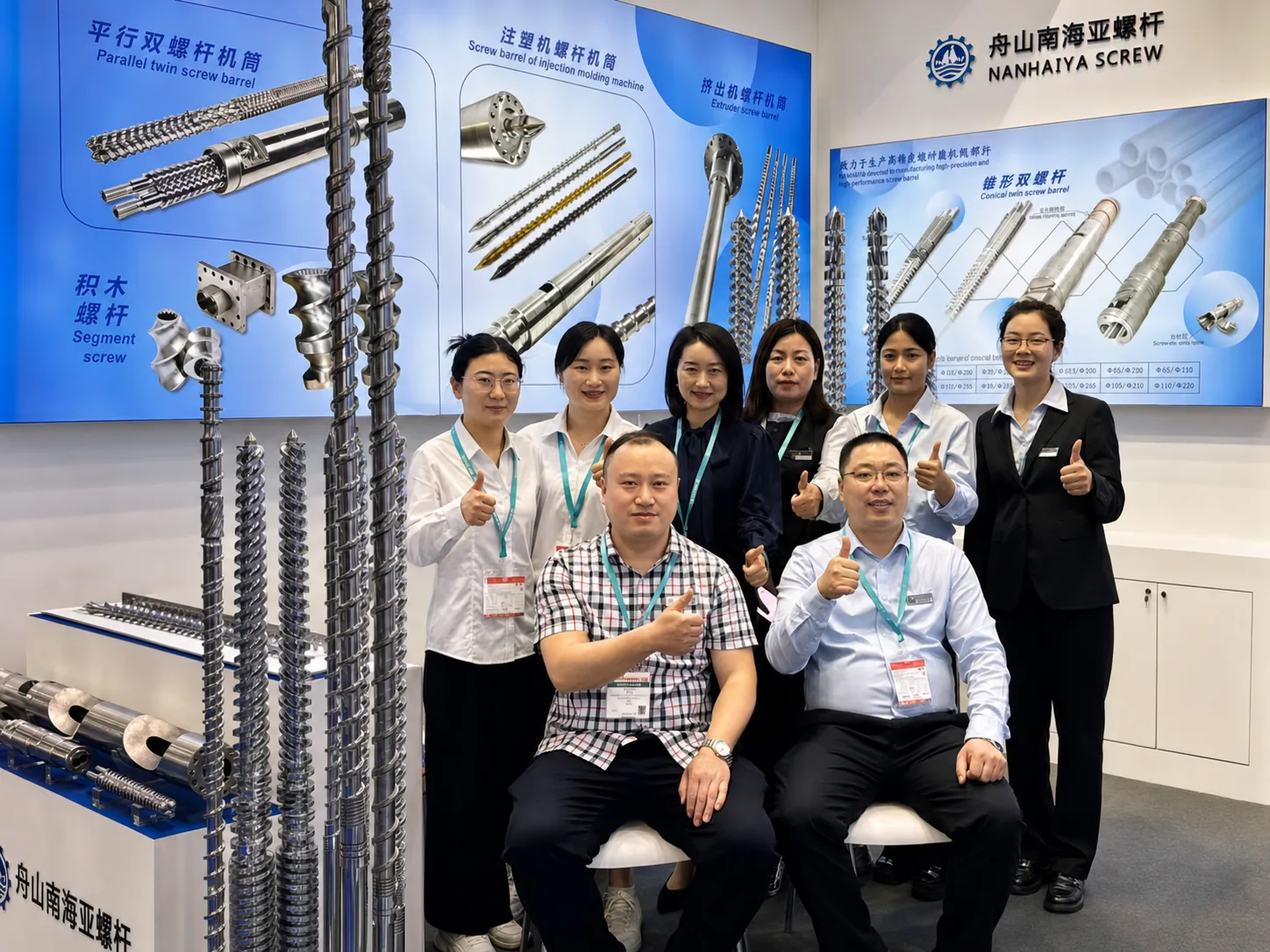
Related Articles
More insights on screw barrel technology and plastics processing.
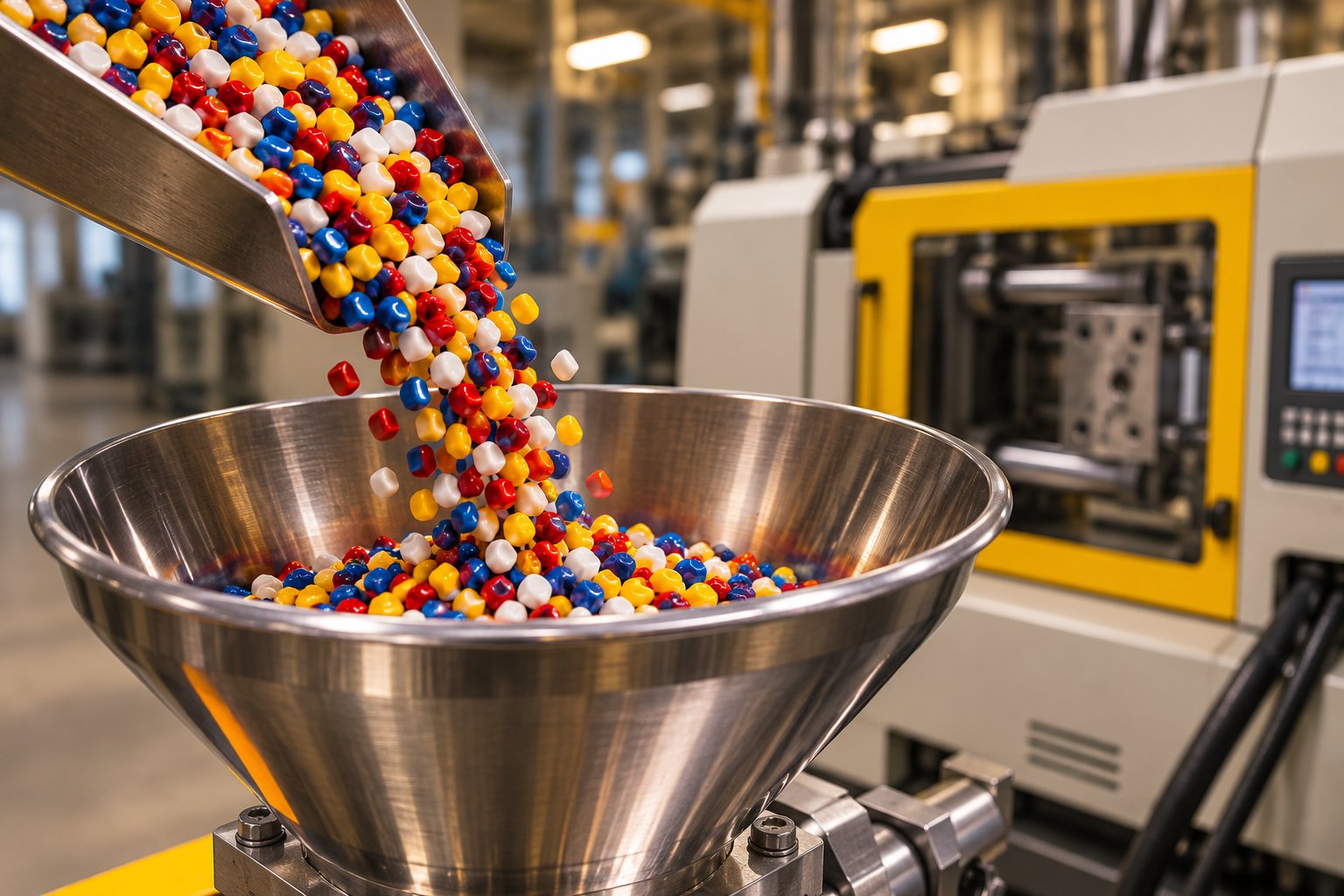
Injection Molding Color Mixing: From Streaks to Flawless Consistency
Nov 19, 2026
Master injection molding color mixing with expert guidance on colorant types, screw design, process parameters, defect troubleshooting, and Delta E QC protocols.
Read Article
Wrong Extruder Breaker Plate? Spot the Signs Before Scrap Piles Up
Nov 19, 2026
Learn how to select, size, and maintain your extruder breaker plate. Covers hole geometry, pressure drop, polymer-specific specs, and troubleshooting tips.
Read Article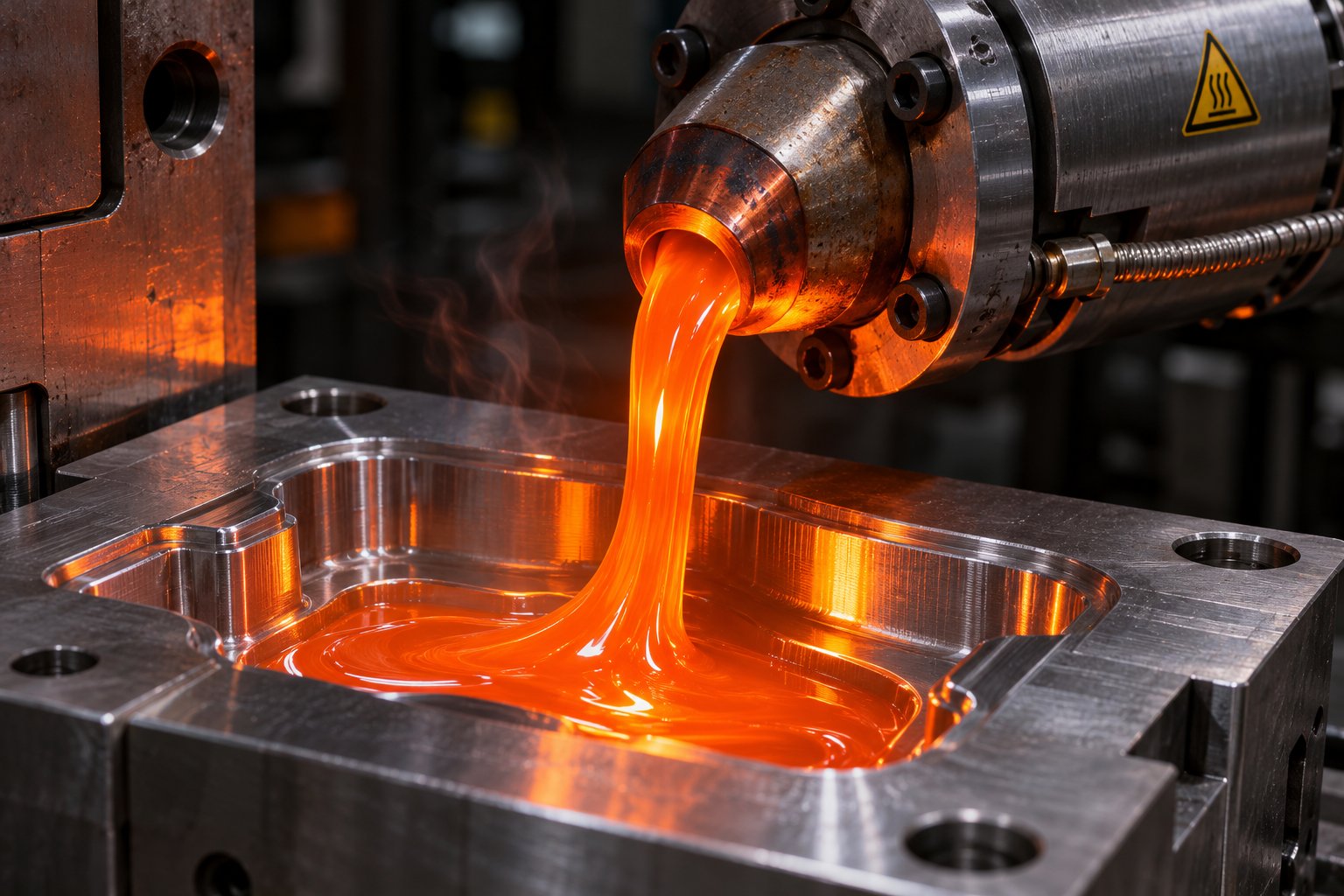
Injection Molding Melt Temperature: Why Your Barrel Settings Lie
Nov 19, 2026
Learn why barrel set points lie about injection molding melt temperature. Complete resin chart, measurement methods, defect troubleshooting, and optimization steps.
Read ArticleLooking for something else?
Search by material, symptom or product and jump straight to the relevant page.
These are navigation suggestions based on keyword matching — not a quotation, not a delivery commitment, and not a substitute for engineering review. Final specification is confirmed by our engineers against your drawings and processed material.
Need help with screw barrel selection?
Share your machine model, processed material and application. Our team can help with pricing and technical support.