

What Is an Extruder Screen Changer and Why It Matters
Imagine running a high-output extrusion line only to discover black specks scattered across the surface of your finished pipe or tiny holes punched through a blown film web. The culprit is almost always contamination that slipped past inadequate filtration. That is exactly the problem an extruder screen changer is designed to prevent.
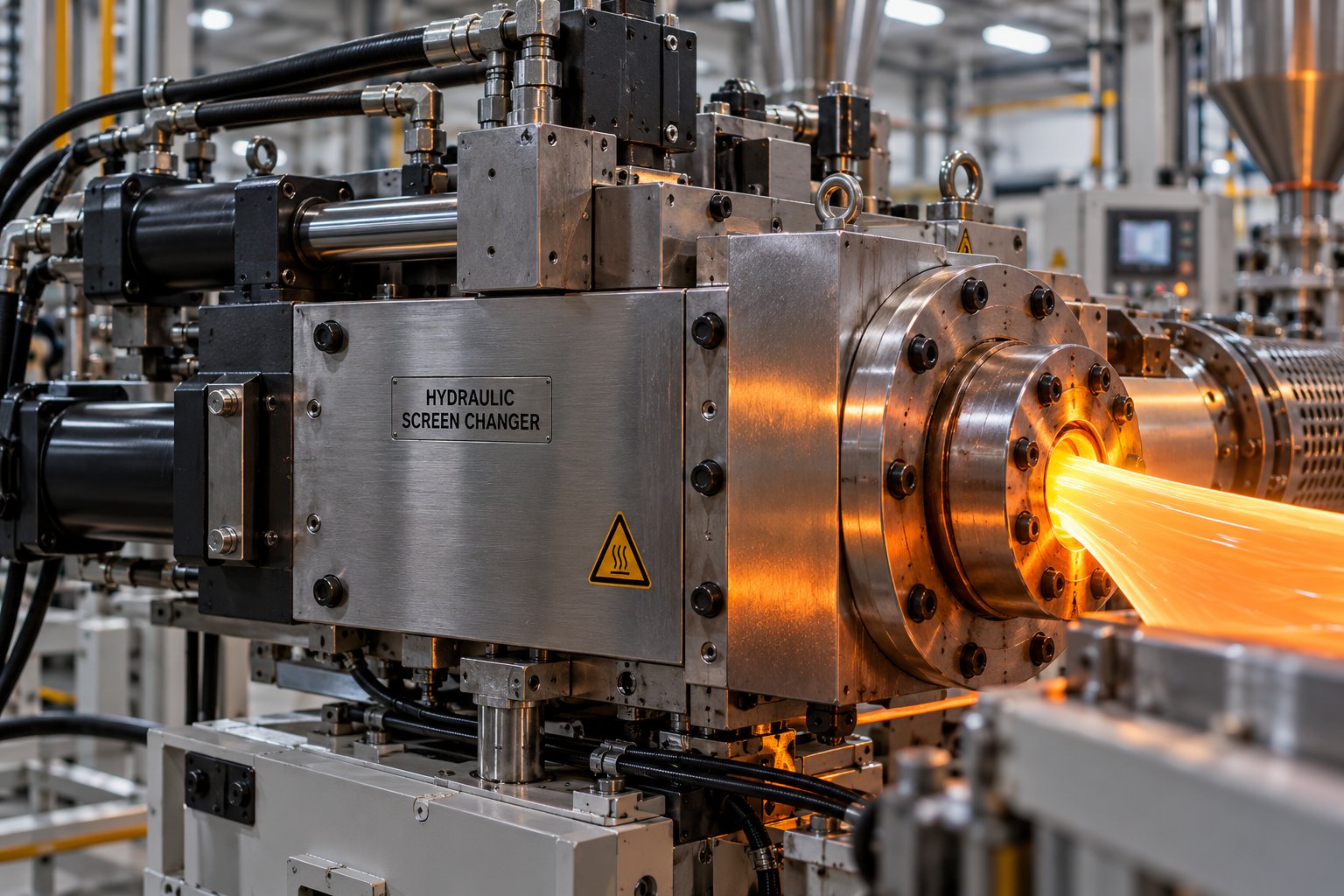
An extruder screen changer is a device mounted between the extruder barrel and the die that holds one or more filtration screens — known collectively as a screen pack — and allows operators to replace contaminated screens with minimal or no interruption to the extrusion process. Its core purpose is to remove contaminants, gels, and degraded polymer fragments from the melt stream before they reach the die and compromise product quality.
What an Extruder Screen Changer Does
In a typical extrusion line, molten polymer travels from the screw tip through a screen pack, then through a breaker plate, and finally into the die. The screen changer for extruder lines sits right at this critical junction, acting as a gatekeeper between the plasticizing section and the shaping section of the process.
The screen pack itself consists of one or more layers of woven wire mesh stacked together. These layers trap solid contaminants — metal particles, degraded char, unmelted resin fragments, paper fibers, and other foreign material — before they can reach the narrow flow channels inside the die. Supporting the screen pack is the breaker plate, a rigid perforated disc that prevents the mesh from deforming or rupturing under melt pressure. Without that structural backing, even moderate extrusion pressures could push the screen pack into the flow path and destroy its filtering ability.
The screen pack also creates backpressure upstream of the die. At a moderate level, this resistance actually improves melt homogeneity and mixing quality. However, as contaminants accumulate and block the mesh openings, that backpressure climbs. This is where the screen changer earns its name — it provides a mechanism to swap out a loaded screen pack for a fresh one. Depending on the design, this swap can happen manually during a full line stop, semi-automatically with a brief pressure disturbance, or continuously with virtually no interruption at all through an automatic screen changer extruder system.
Why Melt Filtration Matters in Extrusion
What happens when filtration falls short? The consequences show up fast and they show up everywhere along the finished product.
- Die lip buildup: Unfiltered degraded polymer gradually accumulates at the die exit, creating streaks and drag marks on the extrudate surface.
- Surface defects and black specks: Char, gels, and foreign particles that pass through a damaged or undersized screen appear as visible contamination in transparent or light-colored products.
- Blown film holes: In film extrusion, even a single hard contaminant particle can puncture the bubble, causing costly line stops and scrap.
- Pipe wall inclusions: Solid contaminants trapped inside a pipe wall create weak points that may fail under pressure testing or in service.
- Dimensional instability: A rapidly clogging screen causes pressure to climb unevenly, leading to wall thickness variation and out-of-spec product.
These are not hypothetical risks. As Allan Griff's extrusion screen guide explains, clogged screens cause a sudden pressure drop when finally changed, forcing operators to adjust screw speed or line speed just to keep dimensions stable. Every one of those adjustments costs time, material, and money.
The takeaway is straightforward: the screen changer is not an optional accessory. It is the last line of defense between your melt stream and your finished product. The real question is which type, which mesh, and which operating strategy will deliver the best balance of filtration performance, uptime, and cost for your specific line — and that is exactly what the sections ahead break down in detail.
Types of Screen Changers for Extrusion Lines
Choosing the right plastic extruder screen changer is a lot like choosing the right vehicle for a job — a compact car works fine for a short commute, but you would not haul lumber with it. The same logic applies here. Each screen changer type is engineered around a specific trade-off between simplicity, cost, and the ability to maintain uninterrupted melt flow. Understanding those trade-offs is the fastest way to narrow your options.
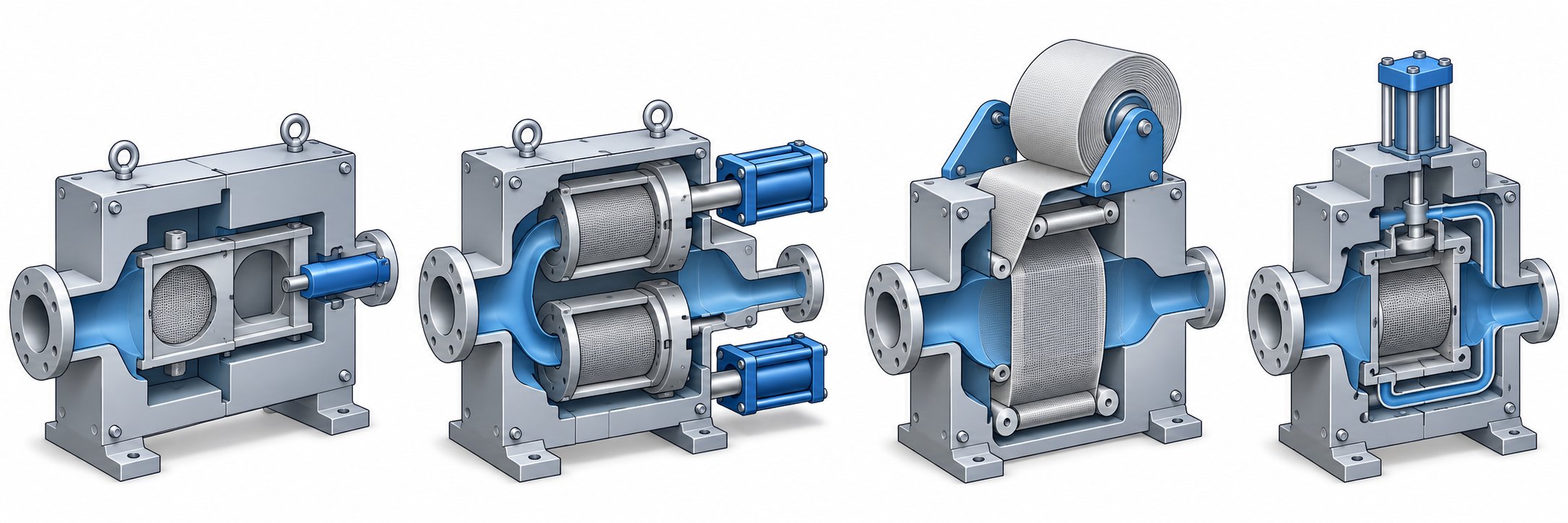
Five primary designs dominate the market. They range from bare-bones manual units that require a full line stop to sophisticated continuous systems that renew filtration area without the operator ever touching the melt stream. Let's walk through each one.
Manual and Hydraulic Slide-Plate Screen Changers
Manual slide-plate changers are the simplest and least expensive option available. A flat steel plate with one or two screen cavities slides through the melt channel. When the screen pack is loaded with contaminants, an operator physically slides the plate out, replaces or cleans the screen, and slides it back in. The catch? The extrusion line must stop — or at least slow dramatically — during the swap. Melt flow is fully interrupted, and a brief pressure transient follows once production resumes.
That sounds like a major limitation, but for low-volume lines, laboratory extruders, or operations running clean virgin pellets where screen changes happen only a few times per shift, a manual changer is perfectly adequate. The hardware is affordable, spare parts are minimal, and there is almost nothing that can fail mechanically.
A hydraulic slide-plate screen changer keeps the same basic geometry but replaces manual force with a hydraulic actuator. The result is a much faster changeover — often completed in seconds rather than minutes. That speed matters because a shorter interruption means less pressure disturbance, less scrap, and less time for the melt to degrade inside the barrel while the line sits idle.
Hydraulic slide-plate designs are the workhorse of mid-range extrusion. You will find them on pipe lines, sheet lines, and profile lines processing polyolefins, styrenics, and engineering resins at moderate throughputs. They strike a practical balance: the capital cost is reasonable, the changeover is fast enough to keep scrap manageable, and the mechanical simplicity keeps maintenance straightforward. Some models feature dual-cavity plates, allowing one screen to filter while the other is being replaced — cutting the actual flow interruption to a brief partial-flow event rather than a full stop.
Continuous and Backflush Screen Changers
When even a few seconds of flow interruption is unacceptable — think blown film, fiber spinning, or any line where pressure surges translate directly into product defects — continuous designs take over.
Piston-type continuous changers use two cylindrical pistons, each holding a screen pack. While one piston is actively filtering, the other can be retracted, cleaned, and reloaded. A hydraulic system shifts melt flow from one piston to the other in a controlled sequence, so the downstream die always sees an unbroken polymer stream. These units are common on high-throughput pelletizing lines and recycling extruders where contamination loads are heavy and frequent screen swaps are part of daily reality.
Belt-type (or ribbon-type) continuous changers take a fundamentally different approach. Instead of discrete screen discs, they use a roll of woven wire filter cloth that advances incrementally across the melt channel. As the upstream section of the belt becomes loaded with contaminants, fresh media feeds in from one side while the spent section exits the other. The beauty of this design is its near-zero operator involvement — other than replacing the filter roll itself, the system runs autonomously. As HAVER & BOECKER notes, continuous belt changers require the least maintenance of any screen changer type, making them attractive for 24/7 production environments.
Backflush screen changers add a clever twist to piston-type or slide-plate platforms. When a screen becomes partially blinded, the system temporarily reverses a small portion of clean melt flow back through the screen to dislodge trapped contaminants. This self-cleaning action extends the usable life of each screen pack significantly, reducing consumable costs and the frequency of manual intervention. Backflush capability is especially valuable on recycling lines and compounding lines where contamination loads are high and screen consumption would otherwise be expensive.
The key principle is straightforward: the dirtier your feed material and the more sensitive your end product, the more you benefit from continuous or backflush filtration. For operations processing post-consumer recycled resins or running extended campaigns without planned stops, these systems are not a luxury — they are a production necessity.
Screen Changer Comparison at a Glance
Sorting through five different designs is easier with a side-by-side view. The table below maps each type against the criteria that matter most during selection.
| Type | Flow Interruption | Best Polymer Applications | Relative Cost | Throughput Range |
|---|---|---|---|---|
| Manual Slide-Plate | Yes — full stop required | Lab lines, low-volume production, clean virgin resins | Low | Up to ~200 kg/h |
| Hydraulic Slide-Plate | Partial — brief pressure event | Pipe, sheet, profile; polyolefins, styrenics, engineering resins | Moderate | 100 – 1,500 kg/h |
| Continuous Piston-Type | None — seamless piston swap | Pelletizing, compounding, recycling, blown film | High | 300 – 5,000+ kg/h |
| Belt / Ribbon-Type Continuous | None — filter cloth advances continuously | High-contamination recycling, 24/7 production lines | High | 500 – 4,000+ kg/h |
| Backflush (Piston or Slide-Plate) | None to Partial — depends on base design | Recycling, compounding, any high-contamination feed | Moderate–High | 200 – 3,000+ kg/h |
A few patterns jump out. Cost scales directly with the level of automation and flow continuity. A manual unit might cost a fraction of a continuous hydraulic screen changer for extruder lines, but the hidden costs of downtime and scrap can quickly erode that savings on a busy production floor. Conversely, installing a high-end continuous system on a lab extruder that changes screens once a day would be overkill.
The right choice always comes back to three questions: How dirty is the material? How sensitive is the product to pressure disturbances? And how much does every minute of downtime actually cost? With those answers in hand, the comparison table above points you toward the correct category — but the specific screen mesh combination and filtration area you pair with that changer matter just as much.
Screen Mesh Selection and Filtration Sizing Guide
Picking the right screen changer type is only half the equation. The filtration performance of any screen changer extruder setup depends entirely on what is inside it — the screen pack. Choose mesh that is too coarse and contaminants sail through to the die. Go too fine and you will fight excessive pressure drop, shortened screen life, and reduced throughput. Getting the specification right from the start saves material, time, and operational cost.
Understanding Mesh Count and Micron Ratings
Mesh count simply refers to the number of wires per linear inch in a woven wire screen. A 20-mesh screen has 20 wires per inch, leaving relatively large openings between them. A 200-mesh screen packs 200 wires into that same inch, creating much smaller gaps. The practical result? Higher mesh count equals finer filtration.
The actual opening size — measured in microns (micrometers) — is what determines which particles the screen will catch. One micron equals one-thousandth of a millimeter. As PFM Screen's filtration guide points out, two screens with the same mesh count can have different aperture sizes if the wire diameters differ, so specifying the aperture in microns rather than relying on mesh count alone is always the safer approach when precision matters.
Here is a practical reference showing how mesh count translates to micron rating and where each range typically fits:
| Mesh Count (per inch) | Approx. Aperture (microns) | Filtration Class | Typical Polymer Applications |
|---|---|---|---|
| 10 – 20 | 840 – 2,000 μm | Coarse | Support/backing layer, heavy regrind pre-filtration |
| 20 – 40 | 420 – 840 μm | Coarse–Medium | PE/PP pipe, profile, recycled pelletizing |
| 40 – 80 | 200 – 420 μm | Medium | General-purpose PE/PP/PVC extrusion |
| 80 – 150 | 100 – 200 μm | Medium–Fine | Blown film, cast film, sheet extrusion |
| 150 – 200 | 75 – 125 μm | Fine | Optical film, technical film, compounding |
| 200 – 325 | 44 – 75 μm | Very Fine | PET fiber spinning, PA filament, specialty film |
| 325 – 500 | 25 – 44 μm | Ultra Fine | High-clarity optical applications, specialty polymers |
A screen pack is rarely a single layer. Think of it as a sandwich. A typical three-layer configuration stacks a coarse pre-filter layer on the upstream side to catch the largest debris first, a fine filtration layer in the middle that does the precision work, and a coarse support layer on the downstream side — pressed against the breaker plate — that prevents the delicate filtration mesh from deforming under melt pressure. For high-pressure applications, recycled feedstocks, or filtration finer than 100 mesh, moving to a four- or five-layer configuration adds intermediate distribution and support layers that significantly improve dirt-holding capacity and pack longevity.
Matching Screen Packs to Polymers and Applications
Not every polymer behaves the same way under filtration, so a one-size-fits-all mesh specification does not exist. The right starting point depends on the resin, the contamination profile, and the quality tolerance of the final product.
Polyolefins (PE, PP) are forgiving. Their relatively low melt viscosity and thermal stability mean they tolerate finer filtration — 80 to 150 mesh is common for blown film and cast film lines, while pipe and profile applications often run 40 to 80 mesh where surface quality requirements are less demanding.
Temperature-sensitive resins like PVC present a different challenge. Excessive pressure drop across a fine screen generates shear heat and extends residence time, both of which accelerate thermal degradation. Coarser filtration in the 40 to 80 mesh range is generally safer, paired with screen materials resistant to the hydrochloric acid PVC releases during processing.
Engineering plastics (PA, POM, PEEK) often call for 100 to 200 mesh to protect sensitive downstream tooling such as spinnerets and precision dies. Corrosion-resistant alloys may also be necessary at the elevated temperatures these resins require.
Recycled resins demand the most aggressive filtration strategy of all. Post-consumer regrind carries paper fibers, metal fragments, wood particles, adhesive residues, and cross-contaminated polymers — a contamination cocktail that overwhelms a screen in an extruder far faster than virgin pellets ever would. Multi-layer packs with a coarse pre-filter upstream of a finer filtration layer are essential, and screen changes will happen more frequently regardless of the mesh chosen.
Beyond mesh selection, the physical size of the filtration area inside the screen changer matters enormously. As Wenzhou Bojing's sizing guide explains, the same melt output passing through a larger effective screen area creates lower flow loading per unit of filter area — meaning contamination accumulates more gradually, pressure rises more slowly, and operators get longer intervals between changes. The general principle is straightforward: higher throughput rates and heavier contamination loads both call for more screen area. A screen changer operating close to its filtration-area limit has very little tolerance for batch-to-batch variation in feedstock cleanliness, which is why sizing should account for worst-case contamination rather than average conditions.
Choosing the right mesh and sizing the right filtration area are decisions that ripple through every aspect of line performance — from pressure stability and scrap rates to the frequency of screen changes and the labor required to keep production running. Those ripple effects become especially visible when the screen changer in extruder lines has to serve different extrusion configurations, each with its own sensitivity to pressure disturbances and contamination.
How Screen Changers Fit Different Extrusion Configurations
A screen changer that performs beautifully on a rigid PVC pipe line might be completely wrong for a cast film operation running the same polymer family. Why? Because the extrusion line itself — its screw geometry, pressure profile, throughput dynamics, and product tolerance for even slight process disturbances — shapes the filtration requirements just as much as the resin does. Matching the right screen changer to the right line configuration is where many processors stumble, and it is a gap worth closing.
Single-Screw Extrusion Lines
Single-screw extruders remain the backbone of pipe, sheet, and profile production worldwide. When processing clean virgin resin, these lines typically generate moderate and relatively predictable contamination loads. A hydraulic slide-plate screen changer handles the job well in most cases — the changeover takes only seconds, and the brief pressure disturbance it creates falls within the tolerance of most rigid product geometries. The capital cost stays reasonable, maintenance is simple, and operators can manage screen swaps without specialized training.
Blown film is a different story entirely. Picture a thin-walled bubble stretching upward from the die — any sudden pressure spike or dip translates directly into gauge variation, wrinkles, or even a burst bubble. A hydraulic slide-plate swap that barely registers on a pipe die can produce a visible band of off-spec film several meters long. For this reason, blown film lines running on single-screw extruders frequently justify a continuous screen changer for extruder configurations, particularly piston-type or belt-type designs that maintain unbroken melt flow during filtration renewal. The upfront investment is higher, but the scrap savings on a 24/7 film line pay it back quickly.
Sheet extrusion falls somewhere in between. Heavy-gauge structural sheet may tolerate a fast hydraulic changeover without visible defects, while thin optical-grade sheet demands the same pressure stability as film. The product specification — not just the extruder type — ultimately dictates how much flow interruption is acceptable.
Twin-Screw Extruder Configurations
Twin-screw extrusion raises the complexity bar significantly. Higher operating pressures, wider processing temperature windows, and the compounding applications that define these machines all place heavier demands on the filtration system.
Co-rotating twin-screw extruders are the standard for compounding masterbatch, engineering plastics, and filled or reinforced polymers. They are also the go-to platform for plastics recycling. These lines pull in diverse raw materials — pigments, mineral fillers, glass fibers, recycled flake — and the melt stream leaving the screw tips carries a substantially higher contaminant load than a single-screw line running neat pellets. As Nanjing Kelongwell's selection guide points out, twin-screw systems often handle more complex formulations and a wider variety of raw materials, meaning the screen changer must address a broader range of material characteristics. Continuous or backflush screen changers with generous screen area are the default recommendation here. The high contamination load blinds screens rapidly, and any downtime for a manual swap directly cuts into compounding throughput.
An additional challenge with co-rotating twin-screw extruders is pressure generation. Some formulations — particularly ultra-low-viscosity materials — struggle to develop sufficient melt pressure at the screw tips to push polymer through fine filtration. In those situations, processors often pair a melt pump with the screen changer, pressurizing the melt upstream of the filter to maintain consistent flow and filtration performance.
Counter-rotating twin-screw extruders occupy a different niche. As Nanjing Hundred Horse's comparison article explains, these machines are well established in direct extrusion of rigid PVC products such as pipes and profiles, where controlled conveying and careful thermal management are priorities. PVC's sensitivity to excessive shear heat and residence time means the screen changer must avoid creating unnecessary pressure drop. Coarser screen packs and appropriately sized filtration areas help keep the pressure differential low, while the changer's thermal design must withstand the hydrochloric acid PVC releases during processing. Hydraulic slide-plate changers are common on counter-rotating PVC lines, but sizing the screen area generously is critical to avoid pushing melt temperatures into the degradation zone.
Specialty Line Considerations
Some extrusion processes have essentially zero tolerance for pressure disturbances — and in those environments, a continuous screen changer is not a nice-to-have. It is a non-negotiable part of the line design.
Cast film lines produce thin, uniform webs where even a momentary pressure fluctuation shows up as a visible thickness band across the roll. Continuous piston-type or belt-type changers are standard equipment. Parkinson Technologies notes that continuous belt screen changers experience no pressure drop during a screen change, which is precisely why they are favored for film production.
Blown film lines face the same sensitivity, compounded by the fact that the bubble acts as an amplifier — a small upstream pressure event becomes a large downstream gauge variation. Continuous changers with smooth, overlap-style transitions between screen cavities are essential for maintaining bubble stability.
Fiber spinning lines push the tolerance even further. Spinnerets contain thousands of microscopic orifices, and a single contaminant particle that slips past the filter can block a hole, create a broken filament, and trigger costly downtime. Fine-mesh filtration through a continuous screen changer extruder system is standard practice, and many fiber producers add secondary candle-filter stages downstream for added insurance.
Here is a quick-reference summary of the key considerations for each line type:
- Single-screw pipe and profile: Hydraulic slide-plate changers work well for clean virgin resin; size filtration area for expected contamination to extend change intervals.
- Single-screw blown film: Continuous changers strongly recommended; prioritize zero-interruption designs to avoid gauge variation and bubble instability.
- Single-screw sheet extrusion: Match changer type to sheet thickness and optical requirements — heavy gauge tolerates hydraulic slide-plate; thin or optical-grade sheet may need continuous filtration.
- Co-rotating twin-screw compounding and recycling: Continuous or backflush changers with large screen area; consider melt pump pairing for low-viscosity formulations.
- Counter-rotating twin-screw PVC extrusion: Hydraulic slide-plate changers with generously sized screens; prioritize low pressure drop and thermal resistance to PVC degradation byproducts.
- Cast film and optical film: Belt-type or piston-type continuous changers mandatory; pressure stability is the overriding selection criterion.
- Fiber spinning: Fine-mesh continuous filtration required; consider secondary candle filters downstream for maximum contaminant protection.
The pattern is clear: the closer your end product is to its final form at the die exit — and the thinner or more optically demanding that product is — the less tolerance you have for any filtration-related pressure event. That same logic applies with even greater force when the feedstock itself is unpredictable, which is exactly the reality facing every plastics recycling operation.
Screen Changers in Plastics Recycling Applications
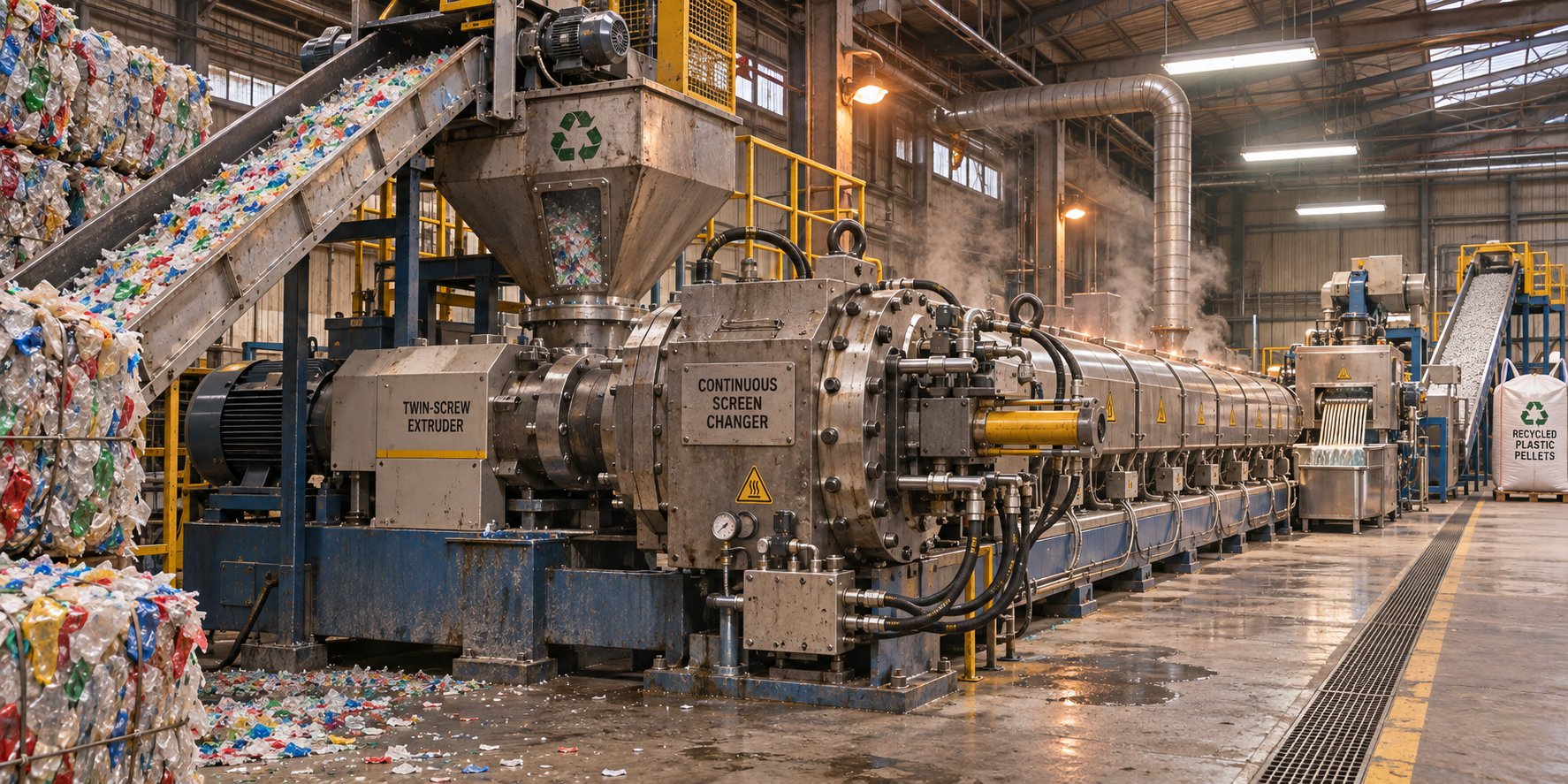
Unpredictable feedstock is not an occasional headache in plastics recycling — it is the daily operating reality. A bale of post-consumer HDPE bottles might look clean on the outside yet carry label adhesive, cap liner fragments, residual milk proteins, and traces of PET from imperfect sorting. Post-industrial regrind from a flexible packaging plant can contain ink residues, laminate layers, and tie-layer polymers that were never designed to be reprocessed. Every one of those contaminants ends up in the melt stream, and every one of them has to be stopped before it reaches the die.
That reality makes the extruder screen changer the single most production-critical component on a recycling line — not the screw, not the degassing system, and not the pelletizer. If the filtration system cannot keep pace with the contamination load, nothing downstream matters.
Why Recycling Demands More From Screen Changers
Virgin resin processing is relatively gentle on filtration. Clean compound pellets carry minimal contamination — perhaps a few carbonized specks or the occasional metal particle from upstream handling equipment. Screen changes might happen a few times per shift, or even less frequently, and a manual screen changer extruder setup can handle the workload without significant downtime penalties.
Recycled feedstocks flip that equation entirely. Post-consumer and post-industrial resins carry dramatically higher contamination loads that include:
- Paper and cardboard fibers from labels and packaging residue
- Metal fragments — aluminum foil pieces, staples, and ferrous particles missed by magnetic separators
- Wood particles and sand from agricultural film and outdoor waste streams
- Adhesive residues from pressure-sensitive labels and lamination layers
- Cross-contaminated polymers — PET in a PE stream, nylon cap liners in a PP stream, PVC fragments in mixed polyolefin bales
- Degraded polymer gels created by previous heat histories and oxidation during the waste's lifecycle
This cocktail of contaminants does not just load the screen pack faster. It loads it unpredictably. One batch of post-consumer flake might run for an hour before the pressure rises. The next batch — from a different bale, a different collection region, or a different season — might blind the screen in twenty minutes. As Robert Obermayr of Erema's Powerfil division explains, analyzing what kind of contaminants are in your material stream and optimizing the filtration solution accordingly are the keys to success.
Screen blinding — the progressive blockage of mesh openings — is the core challenge. As openings clog, upstream pressure climbs, melt temperature rises from increased shear, throughput drops, and the extruder motor draws more power. If the screen changer cannot swap or clean the filtration media fast enough, the processor faces a painful choice: slow the line down to reduce contamination arrival rate, or push forward and risk a pressure spike that trips a safety alarm or damages equipment.
The type of contaminant matters too, not just its volume. Dimensionally stable particles like wood and metal sit on the screen surface and block openings in a predictable way. Soft contaminants — foreign polymers with melting points close to the process temperature, or adhesive residues that deform under pressure — behave differently. Given enough time and differential pressure, soft particles can squeeze through the mesh openings, contaminating the downstream melt even though the screen appears to be filtering. Keeping differential pressure low and residence time short at the filter surface helps prevent this — a design consideration that directly influences which extruder screen pack changer technology works best.
Choosing Screen Changers for Recycling Lines
Given the contamination intensity and the cost of every unplanned stop, recycling operations gravitate toward filtration systems that can renew screen area without halting the line. Two proven designs dominate this space.
Large-area piston screen changers with backflush capability are the workhorse of many recycling plants. Each piston carries two filter cavities loaded with woven wire mesh packs. While one cavity filters, the other can be cleaned or replaced. Piston screen changers with backflushing provide filtration options in mesh sizes as small as 32 microns. System options scale from one piston with two screens for lower throughput requirements up to six pistons with twelve screens for high-volume lines. On a six-piston unit, only one out of twelve screens is in backflush mode at any given time while the remaining eleven stay in full production — keeping melt pressure fluctuations extremely low.
The backflush cycle itself is what makes these systems economical for recycling. Instead of discarding a loaded screen immediately, the system reverses a small volume of clean melt through the blocked screen, pushing trapped contaminants off the mesh surface and out through a discharge valve. This extends the usable life of each screen pack significantly, cutting consumable costs that would otherwise spiral out of control on a high-contamination line.
Self-cleaning continuous filters with laser-drilled screen discs represent the other major filtration path for recycling. These systems replace traditional woven mesh with hardened steel plates in which filtration orifices are cut by laser for precise, consistent hole geometry. Scrapers continuously wipe the screen surface, removing contaminants and forwarding them to a discharge system. As Erema's Powerfil documentation details, laser filters are known for continuous filtration at very stable pressure levels for uninterrupted periods lasting many days or even weeks. They can process contamination levels of 3 to 5 percent — far beyond what woven mesh systems typically handle without frequent intervention.
The choice between these two approaches depends on the contamination profile. Woven mesh with backflush excels at ultra-fine filtration (down to 32 microns) with moderate contamination loads. Laser-drilled continuous filters handle higher gross contamination volumes and offer longer unattended run times, though their finest practical screen size is around 70 microns. Many recyclers processing post-consumer HDPE, LDPE, or mixed polyolefins find that the continuous laser filter matches their needs because the contamination load is high but the particle size cutoff does not need to be as aggressive as fiber-spinning applications demand.
Twin-screw extruder lines processing post-consumer PVC, HDPE, or mixed polyolefins rely on continuous filtration to maintain consistent melt quality. The co-rotating twin-screw platform generates the intense mixing and degassing that recycled resins require, but it also delivers a melt stream with a higher and more variable contaminant load than any single-screw line. Pairing that extruder with a filtration or screen changer for extruder plant operations that cannot keep pace is a recipe for constant downtime and inconsistent pellet quality.
In recycling, screen changer throughput and change frequency are often the bottleneck that determines overall line productivity — not screw speed, not cooling capacity, and not the pelletizer.
That principle shapes every equipment decision on a recycling line. A screen changer that forces the operator to slow the extruder by 30 percent while swapping screens effectively caps the line's real-world output at 70 percent of its nameplate capacity. Multiply that loss across a full production year and the cost dwarfs the price difference between a basic hydraulic unit and a continuous system.
Emerging trends in recycling filtration are pushing the technology further. Higher-area screen designs pack more filtration surface into compact housings, allowing recyclers to handle heavier contamination without physically enlarging the line layout. Self-cleaning systems with automated discharge — where contaminants are expelled continuously without operator intervention — are reducing labor requirements and pushing toward zero-waste extrusion goals. Some advanced systems now integrate real-time pressure and throughput monitoring that automatically adjusts scraper speed, backflush frequency, or screen advance rate based on the actual contamination load detected in the melt stream.
These innovations matter because the recycling sector is not standing still. Regulatory pressure to increase recycled content in packaging, automotive components, and construction materials means recyclers are processing dirtier, more diverse feedstocks at higher volumes every year. The filtration system that was adequate for clean post-industrial regrind five years ago may already be undersized for the post-consumer streams arriving at the plant today. Choosing a screen changer with room to grow — in screen area, in backflush capability, and in automation — is one of the smartest long-term investments a recycling operation can make.
Of course, selecting the right technology for a recycling line — or any extrusion line — requires a structured evaluation process that goes beyond simply matching contamination level to changer type. A clear decision framework, one that weighs polymer sensitivity, throughput targets, product tolerances, and total cost together, turns a complex equipment choice into a manageable step-by-step analysis.
A Decision Framework for Choosing the Right Screen Changer
You know the types. You understand the mesh options. You have seen how different extrusion configurations and recycling demands shape filtration requirements. Yet when it comes time to actually place an order, many processors find themselves stuck — paralyzed by overlapping specifications, conflicting vendor recommendations, and the nagging feeling that they might be overspending or underspecifying. A structured decision framework cuts through that noise and turns a complicated equipment purchase into a series of answerable questions.
Key Decision Criteria for Screen Changer Selection
Think of these five factors as a funnel. Each one narrows your options until the right category of extruder screen changer becomes obvious. Work through them in order — skipping ahead often leads to expensive mismatches.
- Polymer type and melt sensitivity. Start here because the resin dictates the boundaries. Thermally sensitive polymers like PVC or EVOH cannot tolerate the residence time increases and shear heating that come with high-pressure-drop filtration. Stable polyolefins give you more flexibility. If your resin degrades easily, you are already biased toward lower-restriction designs with generous screen area — which may rule out undersized manual units altogether.
- Contamination level and source. Clean virgin pellets? A manual screen changer for extruder lines or a hydraulic slide-plate model will likely suffice. Post-consumer recycled flake with paper, metal, and adhesive contamination? You are looking at continuous or backflush systems with large filtration area. The dirtier the feed, the faster screens blind, and the more critical uninterrupted filtration becomes.
- Throughput requirements. Higher output means more polymer passing through the screen per minute, which accelerates pressure buildup on a partially loaded filter. A line producing 2,000 kg/h of recycled LDPE pellets will overwhelm a screen changer sized for 500 kg/h — even if the changer type is technically correct. Always size for peak throughput, not average.
- Product quality tolerance for pressure fluctuations. This is where the distinction between an offline screen changer for extruder applications and an online screen changer for extruder lines becomes practical rather than theoretical. If your product can absorb a brief pressure event without visible defects — thick-walled pipe, heavy structural profile — a hydraulic slide-plate changeover works fine. If you are producing optical film, thin-wall blown film, or precision fiber, even a momentary pressure disturbance creates scrap. Continuous filtration is not optional in those cases; it is the cost of producing sellable product.
- Budget constraints including total cost of ownership. Purchase price is just the opening number. A low-cost manual unit on a high-throughput recycling line may generate more annual cost in downtime, scrap, and labor than a continuous system costs to buy outright. Gather real operating data — screen changes per shift, scrap per changeover, labor time per swap — before comparing price tags. The cheapest changer on the quote sheet is rarely the cheapest changer to own.
Working through these five criteria in sequence typically narrows the field to one or two screen changer categories. From there, the selection shifts from what type to which manufacturer — and that landscape has its own structure worth understanding.
Navigating the Manufacturer Landscape
Screen changer manufacturers generally fall into three broad categories, each with distinct strengths and trade-offs. No single category is universally superior — the best fit depends on your application complexity, budget, and support requirements.
| Manufacturer Category | Typical Strengths | Best Applications | Considerations |
|---|---|---|---|
| European Precision-Engineering OEMs | Advanced continuous and backflush technology; tight pressure stability (some systems hold ±2% melt pressure during self-cleaning cycles); strong R&D in laser-drilled and nonwoven media; robust documentation and CE compliance | Gel-sensitive film, fiber spinning, BOPP/BOPET, high-end recycling with fine filtration requirements | Higher capital cost; lead times can be longer; spare parts and service may require regional distributor networks; best ROI on high-value or high-volume production |
| Cost-Competitive Asian Manufacturers | Competitive pricing on hydraulic slide-plate and simpler continuous designs; fast delivery; willingness to customize flanges and dimensions for retrofit projects | Pipe, profile, sheet, pelletizing; mid-range throughput lines; retrofit and replacement projects where budget is constrained | Quality varies significantly between manufacturers — request reference installations and test reports; verify seal materials and hydraulic component sourcing; aftermarket support depth may differ |
| Application-Specific Specialists | Deep expertise in a narrow segment (e.g., recycling filtration, blown film, or fiber); system designs purpose-built for extreme contamination loads or ultra-fine filtration | Post-consumer recycling with high contamination; optical film; specialty fiber and nonwoven lines | Product range may be limited — not always a fit for general-purpose extrusion; pricing reflects specialized engineering; fewer standard off-the-shelf models |
When you reach the quoting stage, resist the temptation to compare on price alone. Request detailed specifications on these critical parameters:
- Effective screen area — the actual filtration surface the melt passes through, not just the housing diameter
- Maximum operating pressure and temperature — ensure these exceed your worst-case process conditions by a comfortable margin
- Seal design and material — the seal between the slide plate or piston and the housing is the most common wear point and the most frequent source of polymer leaks
- Changeover speed — measured in seconds for the actual screen transition, not just the hydraulic stroke time
- Aftermarket support — availability of spare seals, breaker plates, and hydraulic components; typical lead time for replacement parts; whether the manufacturer stocks common wear items regionally
One detail that often gets overlooked during the selection process: evaluate the manufacturer's service infrastructure, not just the machine itself. A technically excellent screen changer becomes a production liability if replacement seals take eight weeks to arrive from overseas or if the nearest field technician is on a different continent. Ask for references from existing customers in your region, and verify parts availability before signing the purchase order.
With the right type selected and the right manufacturer engaged, the next challenge is keeping that equipment running at peak performance over its full service life. Maintenance practices and troubleshooting skills make the difference between a screen changer that delivers years of reliable filtration and one that becomes a chronic source of leaks, pressure problems, and unplanned downtime.
Maintenance, Troubleshooting, and Failure Mode Diagnostics
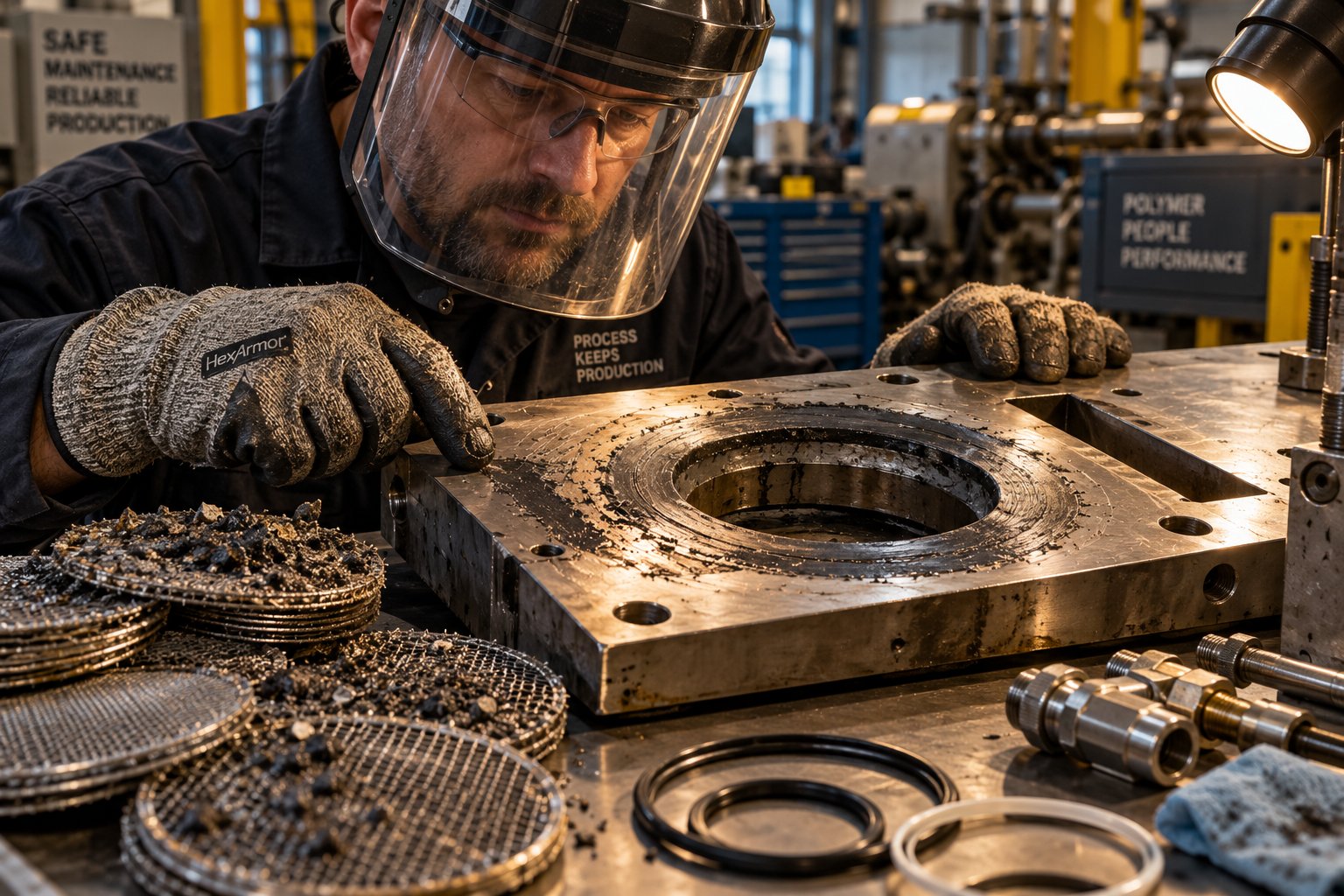
A well-chosen screen changer extruder machine can deliver years of dependable service — or it can become a recurring source of polymer leaks, mysterious pressure anomalies, and unplanned stops. The difference almost always comes down to how consistently the maintenance team follows a structured care routine and how quickly they can diagnose problems when something feels off. This section gives you both: a preventive checklist to keep things running and a root-cause guide to fix them when they don't.
Preventive Maintenance Checklist for Screen Changers
Preventive maintenance on a screen changer is not complicated, but it is easy to neglect — especially on a busy production floor where the unit sits quietly between the barrel and the die, drawing little attention until something goes wrong. A tiered schedule, broken into daily, weekly, monthly, and annual tasks, keeps the workload manageable while catching wear before it escalates into failure.
| Frequency | Task | Purpose |
|---|---|---|
| Daily | Visual inspection of all sealing surfaces for polymer leakage | Catches early-stage seal degradation before melt escapes and carbonizes on external surfaces |
| Daily | Record melt pressure upstream and downstream of the screen pack | Establishes a baseline trend; a sudden deviation signals screen blinding, seal bypass, or breaker plate damage |
| Daily | Clean any excessive melted plastic from all moving parts | Prevents carbon buildup from interfering with slide-plate travel or piston seating |
| Weekly | Check hydraulic fluid level and inspect for color change or cloudiness | Low or contaminated fluid degrades actuator response and reduces clamping pressure over time |
| Weekly | Inspect hydraulic pumps, hoses, and fittings for leaks | Even minor external leaks indicate pressure loss that can reduce slide-plate clamping force |
| Weekly | Examine O-rings and packing gaskets for visible cracking, hardening, or deformation | PTFE and FKM seals operating above 200 °C lose elasticity and carbonize faster than many operators expect |
| Monthly | Measure actuator response time (hydraulic stroke duration from start signal to full seat) | Gradual slowdown points to internal valve wear, cylinder seal leakage, or hydraulic fluid degradation |
| Monthly | Verify bolt torque on flange connections and clamping hardware (diagonal tightening pattern) | Uneven bolt load shifts stress distribution and can create partial sealing gaps |
| Monthly | Inspect slide-plate rails or piston bores for scoring, burrs, or carbon deposit buildup | Surface damage on sealing faces creates pathways for melt leakage that no O-ring can compensate for |
| Annually | Full disassembly inspection: remove slide plate or pistons, clean all internal flow channels | Exposes hidden wear patterns, carbon deposits in seal grooves, and bore-diameter changes not visible during routine checks |
| Annually | Replace all seals, O-rings, and packing gaskets regardless of visible condition | Seal materials lose compliance over time even when they look intact; preventive replacement avoids in-service blowouts |
| Annually | Measure bore diameter and slide-plate/piston clearance against OEM specifications | Excessive clearance from wear allows melt bypass and lateral plate movement that accelerates further damage |
A simple pressure-trend log — even a handwritten sheet taped to the control panel — is one of the highest-value habits a maintenance team can adopt. When you record upstream and downstream pressures at every screen change, patterns emerge. You will notice screens blinding faster on certain resin batches, or differential pressure climbing more steeply after a seal replacement that may not have seated correctly. That trend data transforms reactive firefighting into proactive scheduling.
Troubleshooting Common Screen Changer Problems
Even with diligent preventive care, problems surface. The key is matching the symptom to the right root cause quickly — before a small issue becomes a line shutdown. Here are the four most common failure modes, each with its likely causes and corrective actions.
Problem 1: Polymer leaking at the slide plate or piston seal
This is the most frequently reported issue on hydraulic and manual designs. Melt appears at the external sealing surfaces, ranging from a slow weep to a sudden burst. Common root causes include:
- Worn, aged, or carbonized seals. PTFE and FKM O-rings degrade under sustained high temperature. Long-term operation above 200 °C hardens rubber seals and eliminates elasticity, and seals wear out much faster during recycled plastic processing due to abrasive contaminants. Replace the seals and inspect the grooves for carbon deposits or burrs that prevent proper seating.
- Insufficient hydraulic clamping pressure. If the hydraulic station pressure is set too low, the slide plate slightly backs off when melt pressure rises, resulting in slow leakage or sudden spillage. Check the hydraulic system pressure setting, inspect for internal valve leakage, and verify that oil cylinder seals are intact.
- Scratched or deformed sealing surfaces. Hard impurities and broken wire fragments can score or pit the slide plate's sealing face, creating grooves that no O-ring can fully seal. If damage is minor, lapping the surface may restore flatness. Severe scoring requires professional re-machining or plate replacement.
- Thermal expansion mismatch. Rapid temperature increases cause uneven expansion of the slide plate, housing, and seals, temporarily widening gaps. Allow adequate heat-soak time before starting production, and verify that heater band placement matches OEM recommendations.
Problem 2: Plastic extruder screen changer won't build pressure after a screen change
You have just installed a fresh screen pack, but the melt pressure downstream remains abnormally low — the die is starved and the product is undersized or deformed. This frustrating scenario typically traces back to:
- Incorrect screen pack orientation. If the coarse support layer is placed upstream instead of downstream (against the breaker plate), the fine filtration mesh bears the full melt force unsupported and can deform or rupture, allowing polymer to bypass the filter.
- Oversized or misaligned screen pack. When the outer diameter of the screen stack exceeds the breaker plate recess, the mesh gets clamped between sealing surfaces and creates persistent gaps, letting melt flow around the filter rather than through it. Verify that screen disc diameters match the breaker plate pocket precisely.
- Damaged breaker plate. A cracked, warped, or heavily worn breaker plate cannot support the screen pack uniformly. Inspect for chipped edges, blocked holes, and flatness deviation — any of these conditions create a bypass path.
- Incomplete slide-plate travel. If the plate did not fully seat before production resumed, the screen cavity is not centered in the melt channel. Confirm that the position indicator shows full lock, and check hydraulic pressure and actuator stroke length.
Problem 3: Slow or incomplete slide-plate travel
The hydraulic actuator struggles to push the plate through its full stroke, or the plate stalls midway. Possible causes:
- Hydraulic system degradation. Low fluid level, contaminated oil, internal pump wear, or a failing directional valve all reduce the force available to move the plate. Check fluid level and condition first — it is the simplest and most frequently overlooked variable.
- Carbon or polymer buildup on slide rails. Residual melt that carbonizes on the plate edges or inside the guide channels creates friction that resists movement. Regular cleaning per the daily maintenance schedule prevents this accumulation.
- Misalignment between the plate and the housing bore. Long-term unilateral stress, loose flange bolts, or thermal cycling can warp the housing or shift the plate's travel path. Re-torque flange bolts in a diagonal sequence, and check alignment with a straight edge or dial indicator during the next planned shutdown.
Problem 4: Excessive pressure drop across clean screens
You installed a brand-new screen pack, yet the pressure differential is already higher than expected. Before suspecting the screen changer itself, investigate these possibilities:
- Wrong mesh selection. A screen pack that is finer than the application requires creates unnecessary resistance. Review the mesh-to-polymer guidance from the sizing section and verify that the mesh specification matches the resin's viscosity and the line's throughput rate.
- Undersized screen area. If the effective filtration area is too small for the volume of polymer passing through, even a clean screen generates high flow loading. This is especially common on screen changers for twin screw extruder lines, where compounding and recycling throughputs can exceed what a modestly sized filter housing was designed to handle. Upgrading to a larger housing or a multi-piston design may be necessary.
- Blocked breaker plate holes. Carbon deposits, retained polymer, or mechanical damage can obstruct a significant portion of the breaker plate's open area, effectively reducing the filtration surface that the melt can access. Inspect and clean — or replace — the breaker plate.
Safety During Screen Changes
Screen changes involve a combination of hazards that deserve explicit attention: high-pressure hydraulic systems, molten polymer at temperatures between 180 °C and 350 °C, and heavy metal components that can cause crush injuries if mishandled. Yet safety during screen swaps rarely gets the same procedural rigor that other maintenance tasks receive.
Start with lockout/tagout (LOTO). Before performing any manual work on a hydraulic screen changer — seal replacement, bore inspection, flange bolt torque checks, or full disassembly — the hydraulic power unit and all associated energy sources must be locked out. As OSHA's hazardous energy control standard (29 CFR 1910.147) makes clear, the unexpected startup or release of stored energy during servicing can result in serious injury or death. Hydraulic accumulators, in particular, store pressurized fluid even after the pump is switched off. Bleed all stored hydraulic pressure before opening any connections, and verify zero-energy state with a pressure gauge — never rely on the pump switch position alone.
For hot polymer handling, always assume that used screen packs, breaker plates, and slide-plate surfaces are at full melt temperature. Molten polymer dripping from a removed screen can cause severe burns on contact with skin. Use insulated gloves rated for the process temperature, wear face shields to protect against splatter, and have a designated metal catch tray positioned beneath the changer body before retracting the plate. Never attempt to clear clogged screens with bare hands or unprotected tools while the system is at operating temperature.
PPE requirements for routine screen changes should include, at a minimum:
- Heat-resistant gloves (rated to at least the maximum operating temperature of the line)
- Face shield or safety goggles with splash guards
- Long-sleeve flame-resistant clothing or apron
- Steel-toed boots (heavy breaker plates and slide plates can cause foot injuries if dropped)
Document these requirements in a written procedure, train every operator who performs screen changes, and post the procedure at the machine. Safety during screen changes is not a footnote — it is a non-negotiable standard.
Sourcing Replacement Parts for Screen Changer Maintenance
Keeping a screen changer in service over its full lifespan means periodically replacing wear items: seals, O-rings, breaker plates, slide plates, and the hydraulic components that drive them. For broader extrusion line maintenance — screw tips, check rings, non-return valves, injection nozzles, and thermocouples — maintenance teams can explore suppliers like NANHAIYA, which reviews machine details, drawings, and worn samples to assess part compatibility before quoting. While specialized items such as screen changers and breaker plates are inquiry-only and not explicitly listed on their spare parts page, the catalog provides a practical starting point for sourcing many of the barrel-end and injection-end components that support a complete maintenance program. When reaching out to any supplier, providing dimensioned drawings and photographs of worn parts upfront accelerates the quoting process and helps confirm manufacturing feasibility — a practice worth adopting regardless of which vendor you choose.
Maintenance discipline and troubleshooting skill protect your investment in the screen changer itself. But they also protect something broader: the financial return that justified the equipment purchase in the first place. Quantifying that return — and understanding the full cost of ownership beyond the initial price tag — is the final piece of the decision-making puzzle that separates informed buyers from hopeful ones.
Total Cost of Ownership and ROI Analysis
Here is a scenario that plays out in purchasing departments every day: a processor compares two screen changer quotes, picks the one with the lower price tag, and calls it a smart buy. Six months later, that "smart buy" is costing the operation thousands of dollars per week in downtime, scrap, and labor — expenses that never appeared on the original purchase order. The problem is not the equipment itself. The problem is evaluating a production-critical asset the same way you would evaluate a commodity part.
Purchase price is the most visible number in any capital equipment decision, but for an extruder screen changer, it is often the smallest share of the total financial picture. Understanding the full cost of ownership — and knowing how to build a credible ROI case for an upgrade — separates processors who control their filtration costs from those who are controlled by them.
Beyond Purchase Price — Understanding Total Cost of Ownership
Total cost of ownership (TCO) captures every dollar a screen changer will consume over its operational life, not just the check you write on day one. Five major cost categories make up that total, and ignoring any one of them distorts the comparison between competing options.
- Capital equipment cost. This is the purchase price plus installation, commissioning, and any modifications needed to integrate the unit into your existing line — new flanges, hydraulic supply connections, control wiring, and mounting hardware. A continuous piston-type changer will carry a higher figure here than a manual slide-plate unit. No surprise. But this category is also the only one that stops growing after the first year.
- Screen consumable costs. Every screen pack eventually blinds and gets replaced. Mesh packs, breaker plates, and support screens are recurring expenses. On a clean-pellet pipe line changing screens twice per shift, the annual consumable bill might be modest. On a recycling line running post-consumer HDPE flake, where a manual screen changer extruder setup demands a fresh pack every 20 to 40 minutes, consumable spending can easily exceed the original equipment cost within a single year. Backflush-capable systems reduce this category significantly by extending each screen pack's usable life through reverse-flow cleaning cycles.
- Downtime costs during screen changes. This is the category most processors underestimate — and it is usually the largest. Integrated Control Technologies reports that most extrusion operations fall in the range of $500 to $3,000 per hour of unplanned downtime when all cost factors are included. Even a planned screen change on a discontinuous changer halts output for several minutes. Multiply that by the number of changes per shift, the shifts per week, and the weeks per year, and the accumulated lost-production margin dwarfs most other cost categories. A throughput calculator from Parkinson Technologies makes this math concrete: you need only your extrusion flow rate, material cost, annual run time, screen changes per day, and average time per change to see the annual impact.
- Energy costs from pressure drop across partially blinded screens. As a screen loads with contaminants, the extruder motor works harder to push polymer through the shrinking open area. That rising backpressure translates directly into higher specific energy consumption — more kilowatt-hours per kilogram of output. On a line running 24/7, the incremental energy cost of operating with partially clogged screens for hours before each change adds up quietly across the utility bill. Continuous changers that maintain a consistently low differential pressure keep energy consumption flatter and more predictable.
- Scrap and quality-rejection costs from inadequate filtration. Material purged during a restart, out-of-spec product produced while pressures stabilize after a screen swap, and downstream quality rejections caused by contaminants that slipped through an overloaded screen — all of this is waste. Startups following an unplanned shutdown are rarely clean, and the scrap generated during restabilization can be substantial, especially on thin-film or precision-profile lines where dimensional tolerances are tight.
Imagine a twin screw extruder for PVC recycling with a screen changer rated for moderate throughput. The capital cost of the manual unit was attractive at purchase. But the post-consumer feedstock blinds screens every 30 minutes, each change takes the line down for 8 to 10 minutes, and the operator generates a slug of off-spec pellets every restart. Over a full production year, the downtime hours, scrap weight, and labor add up to multiples of what a continuous system would have cost. The manual unit was not cheap — it just looked cheap on the purchase order.
Building an ROI Case for Upgrading Screen Changers
If you suspect your current filtration setup is costing more than it should, the next step is building an ROI case that your management team can evaluate objectively. The logic is straightforward: compare the annualized savings an upgrade would deliver against the investment required to make it happen.
On the savings side, the major line items are:
- Reduced downtime. Calculate how many screen changes happen per shift now, how long each one takes, and what that lost production time costs in margin. A continuous changer that eliminates those stops recovers all of that margin.
- Lower scrap rates. Quantify the weight of off-spec material produced during and immediately after each screen change event. Multiply by the number of events per year and the material's cost per kilogram.
- Reduced labor. Fewer manual interventions mean operators can be redeployed to higher-value tasks. On a 24/7 recycling line, the labor hours consumed by screen changes alone can be staggering.
- Energy savings from consistent pressure. A filtration system that maintains a low and stable pressure differential lets the extruder motor operate closer to its efficiency sweet spot. The savings per hour are small, but they compound across thousands of operating hours per year.
- Extended screen pack life. Backflush systems can multiply the usable life of each screen pack by a factor of three to ten, depending on the contamination profile. That directly reduces consumable purchasing costs.
On the investment side, include the equipment purchase price, installation and commissioning costs, any required infrastructure upgrades (hydraulic supply, control integration), and operator training time.
Recycling lines and high-volume commodity lines typically show the fastest payback on continuous changer upgrades. Why? Because screen changes happen frequently — sometimes dozens of times per shift on heavily contaminated streams — and every single change event generates downtime and scrap. Even a modest reduction in change frequency or change duration produces outsized annual savings when multiplied across that high event count. A twin screw extruder for PVC recycling including a screen changer upgrade, for instance, often pays back in under 18 months purely on reduced downtime and scrap — well before energy savings and labor reductions are factored in.
Before you start building the spreadsheet, gather these data points from your current operation:
- Current number of screen changes per shift (and shifts per week)
- Average downtime per screen change event, in minutes
- Scrap weight generated per change event (including purge material and restabilization waste)
- Current annual screen pack and breaker plate consumption cost
- Loaded labor cost per operator-hour dedicated to screen changes
- Energy cost per unit of production (kWh per kilogram), tracked across a range of screen-loading conditions
- Hourly production margin for the product being run
With those numbers in hand, the calculation is arithmetic — not guesswork. And when requesting quotes from screen changer manufacturers, ask them to supply application-specific throughput and pressure data for your resin, your contamination profile, and your target output rate. A reputable supplier will provide projected screen life, expected pressure differential at rated throughput, and estimated change intervals for your specific operating conditions. Those projections become the inputs to your savings estimate and make your ROI case credible rather than aspirational.
Cost of ownership thinking also shapes how to change extruder manual screen changer setups strategically. Not every line justifies a jump to a fully continuous system. Sometimes the highest-ROI move is upgrading from a manual to a hydraulic slide-plate unit — cutting changeover time from minutes to seconds and recovering most of the downtime-related losses at a fraction of the cost of a continuous design. The framework is the same; only the numbers change.
Quantifying the true cost of your current filtration setup — and the true value of upgrading it — transforms the screen changer from a line item on a maintenance budget into a strategic lever for profitability. That financial clarity also sharpens every other decision downstream: which emerging technologies are worth watching, how to evaluate new suppliers, and where to invest next as your extrusion operation evolves.
Emerging Trends and Smart Sourcing for Extrusion Components
Financial clarity around total cost of ownership does more than justify an upgrade — it sharpens your ability to evaluate the next generation of filtration technology arriving on the market. The screen changer for plastic extrusion line applications is evolving rapidly, and processors who understand where the technology is heading can make purchasing decisions that stay relevant for a decade rather than just the next production cycle.
Emerging Technology Trends in Screen Changer Design
Four innovations are reshaping what extruder screen changer suppliers can offer buyers evaluating long-term capital investments.
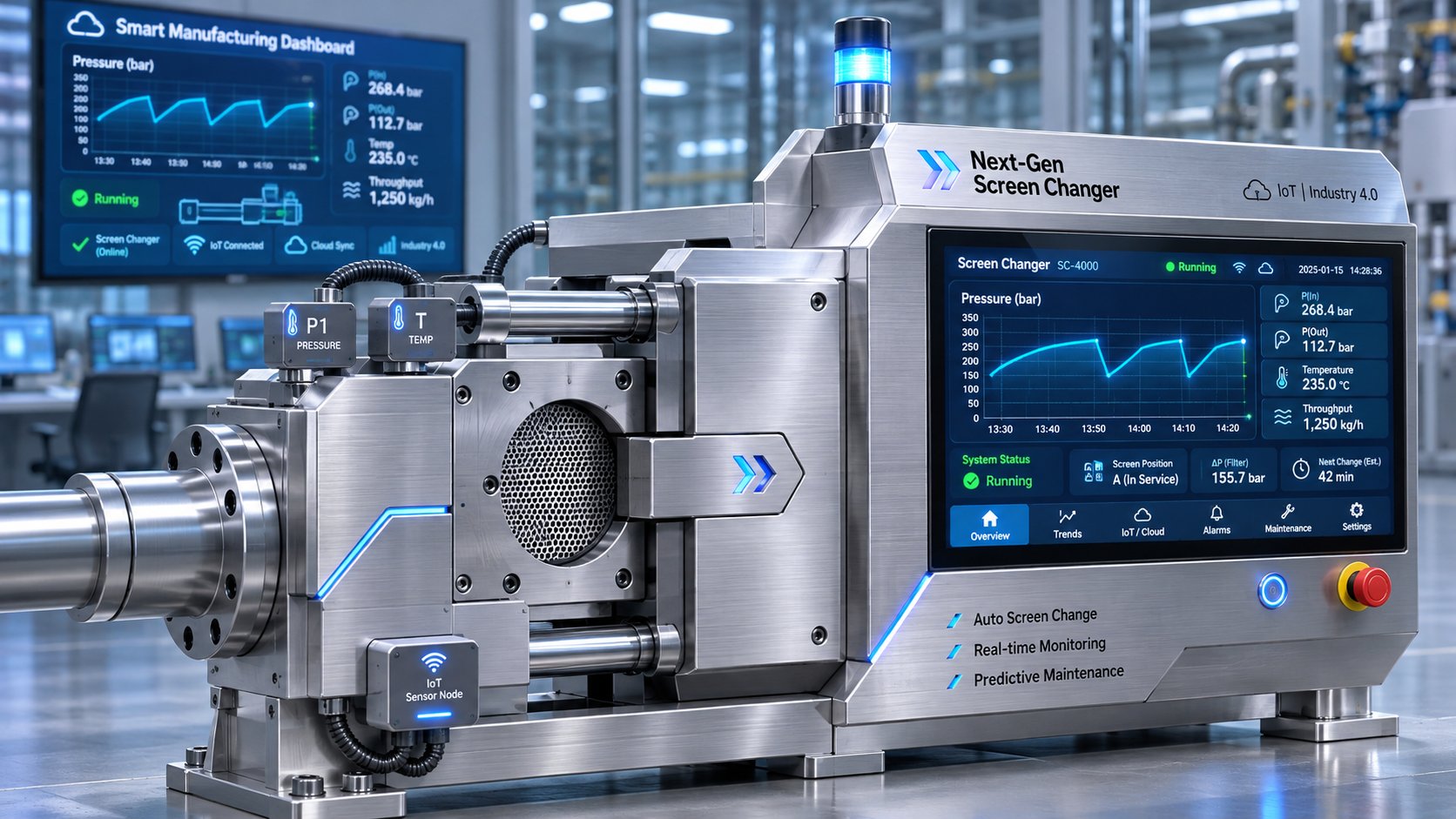
IoT-enabled pressure monitoring and predictive screen change timing. Instead of relying on fixed time intervals or operator judgment to decide when a screen pack needs replacing, modern systems use continuous pressure sensors upstream and downstream of the filter to track differential pressure in real time. AI algorithms analyze the rate of pressure rise, correlate it with resin batch data and throughput rates, and predict the optimal moment to initiate a screen change — before pressure climbs high enough to affect product quality but late enough to extract maximum useful life from the screen pack. The broader manufacturing sector is already seeing predictive maintenance platforms achieve 85-95% accuracy in forecasting equipment degradation weeks in advance. Applied to melt filtration, that same principle translates into fewer unnecessary screen changes, lower consumable costs, and more consistent product quality.
Industry 4.0 integration for automated data logging. Screen changer controllers increasingly communicate with plant-level MES (Manufacturing Execution Systems) and SCADA platforms via OPC-UA or REST APIs. Every screen change event — timestamp, differential pressure at change, screen life duration, resin batch ID — gets logged automatically and linked to product traceability records. For processors supplying automotive, medical, or food-contact markets where documentation requirements are strict, this integration eliminates manual record-keeping and strengthens audit readiness.
Laser-drilled screens for more precise and consistent filtration. Traditional woven wire mesh has served the industry for decades, but it carries inherent variability — wire diameter tolerances, weave density fluctuations, and aperture inconsistencies between batches. Laser-drilled filter media offer an alternative. Fiber lasers can produce millions of holes with diameters as small as 60-80 microns at rates of 300-500 holes per second, with outstanding uniformity across the entire filter surface. The natural taper of a laser-drilled hole — wider on the inlet side, narrower on the exit — creates a funneling effect that resists backflow and improves contaminant capture. For recycling applications producing food-grade rPET, laser-drilled filters meeting those tight tolerances are already a field-proven solution. As manufacturing costs for laser perforation continue to fall, expect this technology to expand into mainstream extrusion filtration beyond the recycling niche.
Higher screen areas in smaller footprints. Equipment floor space is precious, especially in retrofit situations where a new screen changer must fit into an existing line layout. Manufacturers are responding with compact multi-cavity and multi-piston designs that pack significantly more effective filtration area into housings that occupy the same — or even less — space as older single-cavity models. More screen area per unit of floor space means lower flow loading, slower pressure rise, longer intervals between changes, and greater tolerance for feedstock variability. For processors running recycled resins with unpredictable contamination, this trend alone can meaningfully improve line uptime.
How to Source Extruder Screen Changer Parts and Equipment
Whether you are purchasing a new screen changer, replacing a worn unit, or simply sourcing spare seals and breaker plates, the quality of information you provide to suppliers directly determines the quality of the quotes you receive in return. Best practices for sourcing extrusion components consistently emphasize one theme: the more detail you supply upfront, the faster and more accurate the response.
Before contacting any extruder screen changer suppliers, assemble the following documentation:
- Machine make and model — including the extruder manufacturer, model number, year of manufacture, and serial number if available
- Barrel diameter and L/D ratio — these define the melt output capacity and help suppliers size replacement components correctly
- Operating temperatures and pressures — specify both normal operating range and maximum peak values the system encounters
- Current screen changer specifications — housing dimensions, flange bolt pattern, screen cavity diameter, hydraulic pressure rating, and the OEM part numbers of any wear items being replaced
- Dimensioned drawings — even a hand-sketched dimensional drawing is far more useful than a verbal description when a supplier needs to verify fit
- Photos of worn or damaged parts — close-up images of seal grooves, scored slide-plate surfaces, or eroded breaker plates help suppliers assess whether repair or replacement is the better path
Reputable suppliers will review these materials carefully to assess compatibility and manufacturing feasibility before committing to a quote. If a vendor is willing to quote a replacement part based on nothing more than a phone call and a part number, treat that as a caution flag — not a convenience.
For broader extrusion and injection molding spare parts — screw tips, check rings, non-return valves, injection nozzles, and thermocouples — suppliers like NANHAIYA follow exactly this best-practice quoting process, reviewing machine details, drawings, worn samples, photos, and dimensions before providing pricing. Specialized items such as screen changers, breaker plates, shut-off nozzles, and melt-temperature probes are not explicitly listed on their spare parts page but can be discussed directly with the company as inquiry-only items. It is one practical resource among many, and the same documentation checklist above applies regardless of which supplier you approach.
The screen changer sits at the intersection of product quality, line uptime, and operating cost — three variables that define profitability in any extrusion operation. Choosing the right type, pairing it with the correct mesh, maintaining it with discipline, and understanding its true cost of ownership are not separate decisions. They are facets of a single strategy. Processors who treat melt filtration as a system-level engineering choice — rather than a commodity purchase — consistently run cleaner, faster, and more profitably than those who do not.
Frequently Asked Questions About Extruder Screen Changers
1. What is the purpose of an extruder screen changer?
An extruder screen changer holds filtration screen packs between the barrel and die, trapping contaminants such as gels, degraded polymer, metal fragments, and foreign particles from the melt stream. By filtering these impurities before they reach the die, it protects downstream tooling, prevents surface defects like black specks and film holes, and maintains dimensional consistency in the finished product. The changer mechanism also allows operators to swap clogged screens for fresh ones with minimal or zero interruption to production, depending on the design type selected.
2. What are the main types of screen changers used in plastic extrusion?
Five primary types serve the extrusion industry. Manual slide-plate changers require a full line stop and suit low-volume or lab operations. Hydraulic slide-plate changers use a hydraulic actuator for faster swaps with only a brief pressure disturbance, making them popular for pipe, sheet, and profile lines. Continuous piston-type changers alternate between two screen cavities for uninterrupted flow, ideal for pelletizing and recycling. Belt or ribbon-type continuous changers advance fresh filter media automatically and are favored for 24/7 production. Backflush changers reverse a small melt flow through the loaded screen to extend its life, significantly reducing consumable costs on contamination-heavy lines.
3. How do I choose the right screen mesh size for my extruder?
Mesh selection depends on three factors: your polymer type, contamination profile, and end-product quality requirements. Polyolefins like PE and PP tolerate finer filtration, typically 80 to 150 mesh for film applications. Temperature-sensitive resins such as PVC perform better with coarser 40 to 80 mesh to avoid excessive shear heating. Recycled feedstocks need aggressive multi-layer packs with coarse pre-filters upstream of finer filtration layers. Always specify the aperture size in microns rather than relying solely on mesh count, since wire diameter variations can change the actual opening size between different screen suppliers.
4. Why won't my extruder screen changer build pressure after a screen change?
Several root causes can prevent proper pressure buildup after installing a fresh screen pack. The most common is incorrect screen orientation, where the coarse support layer is placed on the wrong side and the fine mesh deforms under melt pressure. Oversized screen discs that get clamped between sealing surfaces create bypass gaps around the filter. A damaged or warped breaker plate fails to support the pack uniformly, allowing melt to flow around it. Incomplete slide-plate travel, where the screen cavity is not fully centered in the melt channel, also prevents proper filtration. Check position indicators, verify screen disc dimensions against the breaker plate pocket, and inspect the breaker plate for cracks or blocked holes.
5. What screen changer is best for plastics recycling lines?
Recycling applications demand continuous filtration systems that can handle high and unpredictable contamination loads without halting the line. Large-area piston screen changers with backflush capability are the most widely used, offering filtration as fine as 32 microns while extending screen life through reverse-flow cleaning cycles. Self-cleaning continuous filters with laser-drilled screen discs handle even heavier contamination levels of 3 to 5 percent and can run unattended for days or weeks. The choice between these two depends on your required filtration fineness and gross contamination volume. For post-consumer HDPE, LDPE, or mixed polyolefin streams, continuous laser filters often provide the best balance of throughput, uptime, and operating cost.
Written by
Nanhaiya Technical Team
Zhoushan Nanhaiya Plastic Machinery Co., Ltd.
The Nanhaiya technical team supports screw and barrel manufacturing projects through application review, technical communication, custom manufacturing coordination, and production and quality control.
Discuss Your Application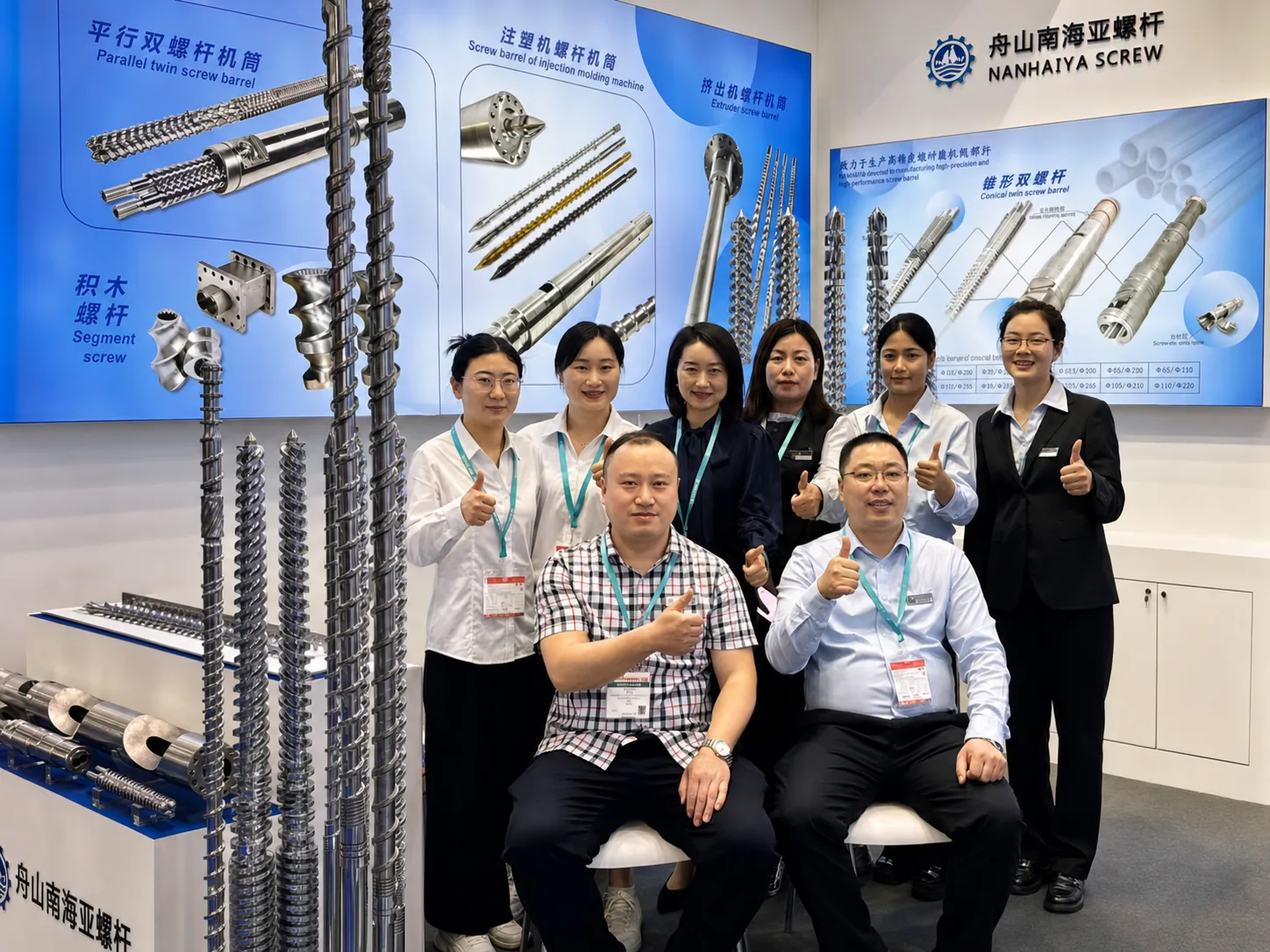
Related Articles
More insights on screw barrel technology and plastics processing.

Carbon Black Dispersion Fundamentals Every Formulator Gets Wrong
Nov 10, 2026
Learn why carbon black dispersion fails and how to fix it. Grade selection, dispersant chemistry, equipment, QC testing, and stability — all in one guide.
Read Article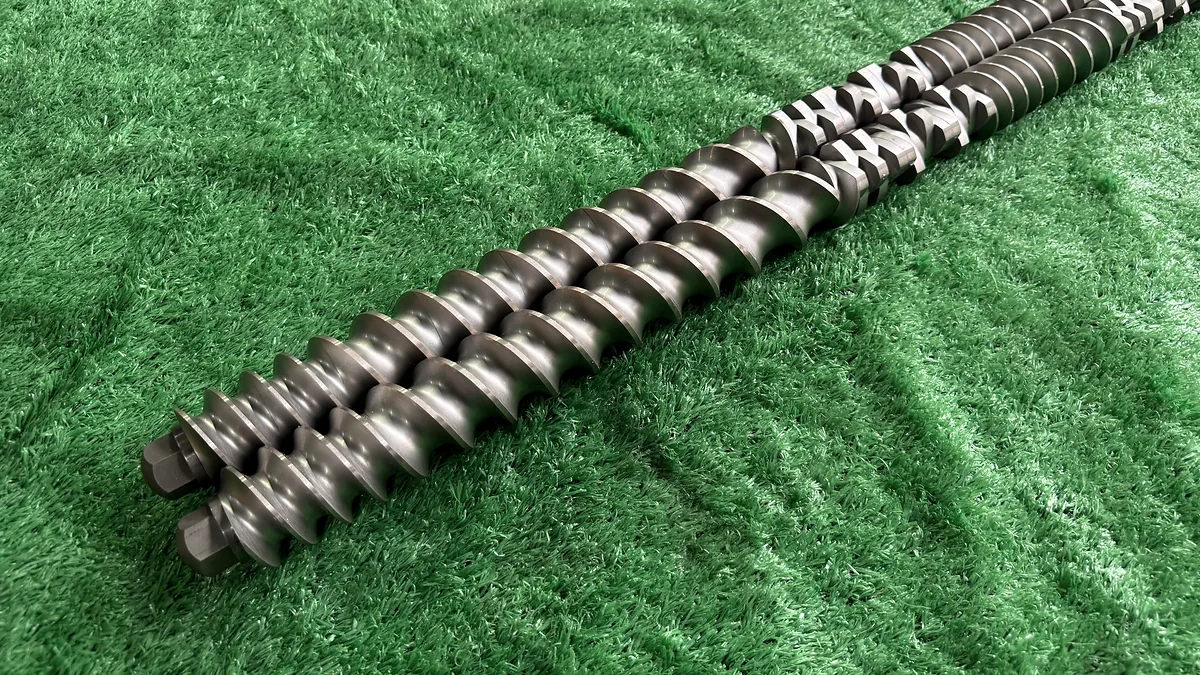
Extrusion Mixing: Why Your Screw Configuration Still Falls Short
Nov 9, 2026
Learn how extrusion mixing works, from distributive vs dispersive mechanisms to kneading block geometry, screw configuration, and SME-based quality monitoring.
Read Article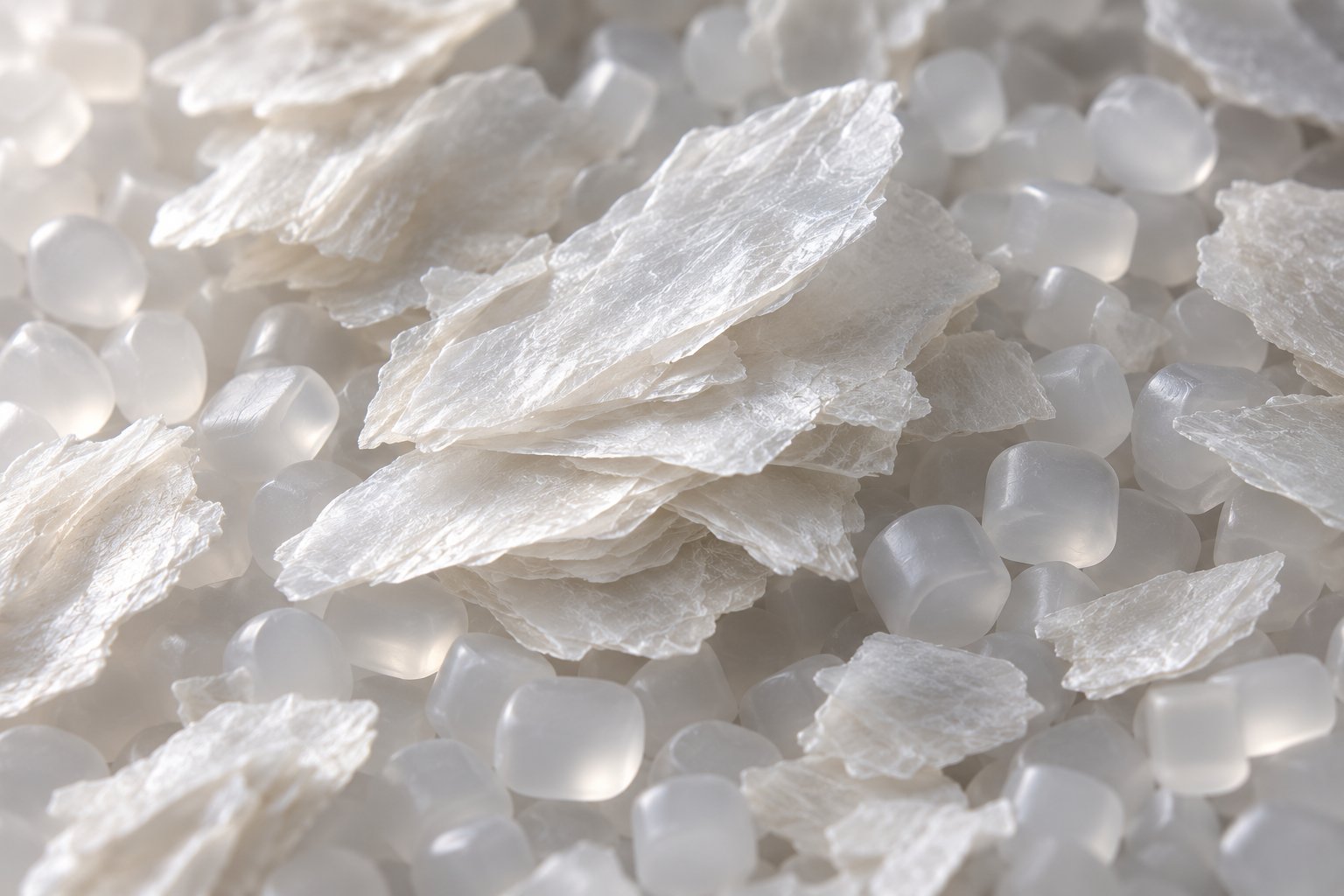
Talc Filled Polypropylene: 10% To 40% Loading Data Compared
Nov 6, 2026
Talc filled polypropylene compared at 10% to 40% loading. Property trends, processing tips, defect fixes, and a material selection guide for engineers.
Read ArticleLooking for something else?
Search by material, symptom or product and jump straight to the relevant page.
These are navigation suggestions based on keyword matching — not a quotation, not a delivery commitment, and not a substitute for engineering review. Final specification is confirmed by our engineers against your drawings and processed material.
Need help with screw barrel selection?
Share your machine model, processed material and application. Our team can help with pricing and technical support.