

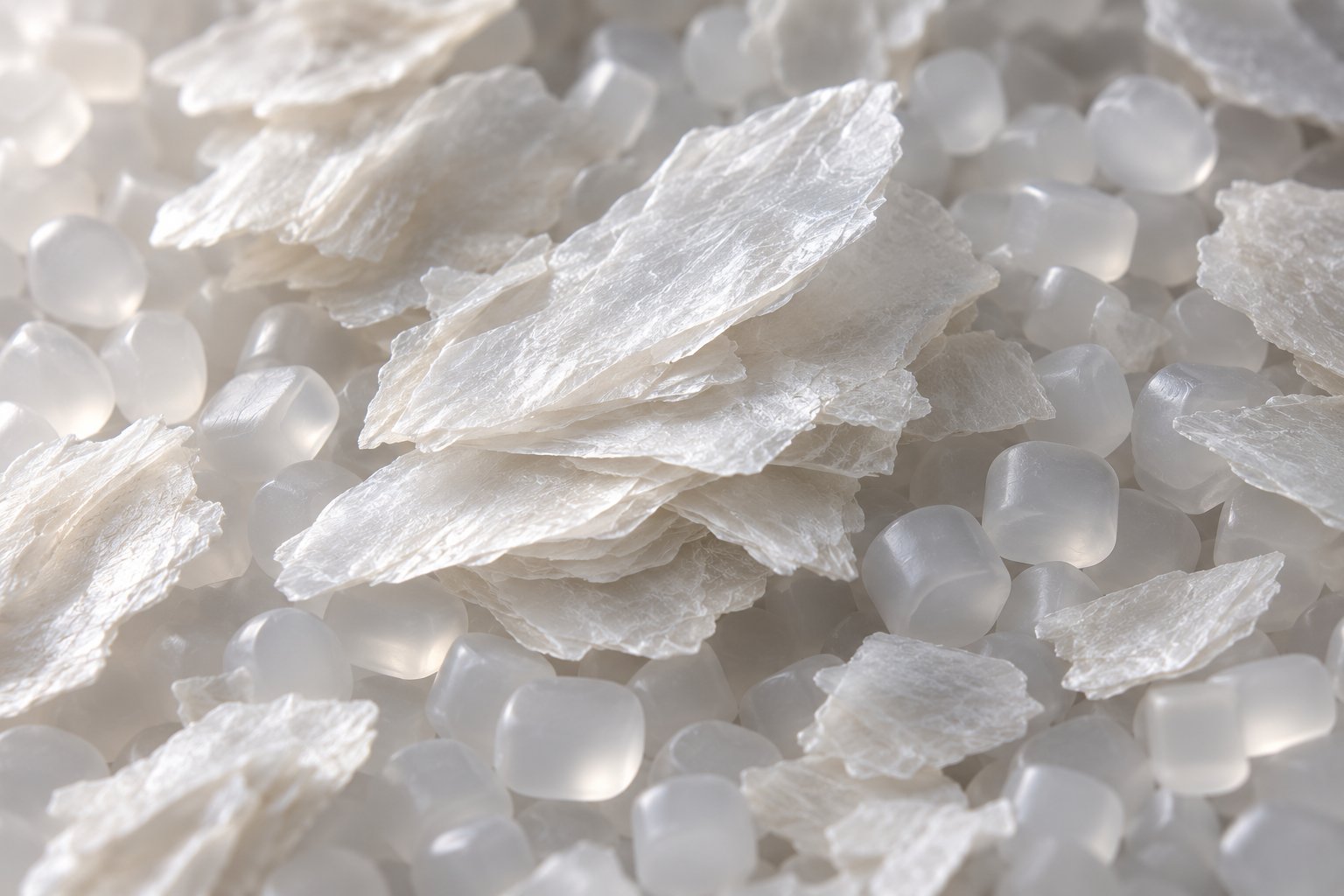
What Is Talc Filled Polypropylene and Why It Dominates Mineral-Filled Plastics
Talc filled polypropylene is a composite material created by compounding finely ground talc mineral - a naturally occurring hydrated magnesium silicate - into a polypropylene (PP) matrix at carefully controlled loading percentages, typically ranging from 10% to 40% by weight. The result is a thermoplastic compound with meaningfully improved stiffness, thermal stability, and dimensional consistency compared to unfilled PP, all while remaining cost-competitive with commodity resins.
Defining Talc Filled Polypropylene
Talc filled polypropylene is a mineral-reinforced thermoplastic composite in which platelet-shaped talc particles are uniformly dispersed within a polypropylene matrix during compounding. The talc acts simultaneously as a reinforcing filler and a nucleating agent, enhancing flexural modulus, heat deflection temperature, and shrinkage control at loading levels from 10% to 40% by weight.
Imagine you need a plastic that is stiffer than standard polypropylene but lighter and cheaper than engineering resins like nylon or ABS. That is precisely the sweet spot this material occupies. A 20 talc filled polypropylene grade, for example, delivers a substantial jump in rigidity and thermal performance over neat PP - often enough to eliminate the need for a more expensive polymer altogether. Push the loading up to a 40 talc filled polypropylene formulation, and you are approaching the stiffness territory of some engineering plastics at a fraction of their cost.
Why Talc Filled PP Matters Across Industries
The growing importance of polypropylene talc filled compounds is hard to overstate. The global polypropylene compounds market is projected to reach USD 39.21 billion by 2030, driven largely by automotive lightweighting demands and the push for high-performing yet affordable plastics. Within that landscape, talc-filled grades serve as workhorses for automotive interior panels, appliance housings, HVAC components, and thermoformed packaging - applications where the balance of performance, processability, and price is paramount.
One common source of confusion worth clearing up right away: talc-filled PP is not the same as calcium carbonate (CaCO3)-filled PP. While both are mineral-filled polypropylene systems, they behave very differently. Talc has a distinctive plate-like or lamellar particle structure. When compounded and processed, these platelets orient within the polymer matrix to create overlapping layers that actively reinforce the material. As Impact Plastics notes, this platelet geometry is what drives the superior stiffness and heat deflection improvements unique to talc-filled formulations. Calcium carbonate particles, by contrast, have a roughly spherical or cubic geometry. They increase bulk and offer modest stiffness gains, but they lack the reinforcement mechanism that makes talc so effective. If stiffness and thermal resistance are priorities, talc is the clear winner; if preserving impact strength matters more, CaCO3 may be a better fit.
This article is designed to serve multiple audiences - whether you are a design engineer evaluating material candidates, a process engineer optimizing molding parameters, or a procurement professional sourcing compounds. In the sections ahead, you will find the material science fundamentals behind talc reinforcement, a detailed property comparison across 10% through 40% loading levels, practical processing and equipment guidance, defect troubleshooting strategies, and a structured material selection framework to help you match the right talc percentage and grade to your application requirements.
The performance differences between loading levels, however, only make sense once you understand why talc works so well inside a polypropylene matrix in the first place - and that story starts at the molecular scale, with crystallization behavior and platelet geometry.
The Material Science Behind Talc Reinforcement in Polypropylene
Why does a soft mineral - one you can scratch with a fingernail - make polypropylene dramatically stiffer? The answer lies not in talc's hardness but in three interconnected mechanisms: its powerful nucleating effect on PP crystallization, the unique geometry of its platelet-shaped particles, and a surface chemistry that happens to pair remarkably well with a nonpolar polymer matrix. Understanding these mechanisms is what separates informed material selection from guesswork, especially when you are evaluating talc filled polypropylene properties across different loading levels.
Nucleating Effect on Polypropylene Crystallization
Polypropylene is a semicrystalline polymer, meaning its chains organize into ordered crystal structures - called spherulites - as the melt cools. In unfilled PP, these spherulites nucleate relatively slowly and can grow into large, unevenly distributed structures that compromise mechanical performance and extend cycle times.
Talc changes this picture fundamentally. Even at low concentrations below 3% by weight, it acts as a powerful heterogeneous nucleating agent, providing a dense population of surfaces where PP crystal growth can initiate simultaneously. Research published in the Journal of Applied Polymer Science demonstrated that delaminated talc particles with higher specific surface area are particularly efficient at nucleating isotactic polypropylene, and that the nucleation effect is closely tied to talc particle size and surface characteristics.
What does this mean in practice? You will notice several measurable changes:
- Higher crystallization temperature: DSC testing of PP compounds with 30% talc loading showed crystallization temperatures rising by approximately 8 degrees Celsius compared to unfilled PP - from roughly 120 degrees C to 128 degrees C - as documented by Ammar et al. in their study of talc-reinforced PP compounds.
- Increased crystallinity: The same study measured crystallinity increases from 34% in neat PP to values between 37% and 39% in talc-filled compounds, depending on talc type and purity.
- Finer, more uniform spherulites: The higher nuclei density creates smaller, more evenly distributed crystal structures throughout the part, leading to more consistent mechanical properties from region to region.
- Shorter molding cycle times: Faster crystallization means the part solidifies and develops structural integrity sooner, allowing earlier ejection from the mold.
There is a subtler crystallographic effect at play too. Polypropylene can crystallize in several polymorphic forms - primarily alpha, beta, gamma, and delta. Unfilled PP sometimes develops a measurable beta-phase fraction, but talc strongly promotes the more stable alpha crystalline form at the expense of the beta phase. This shift contributes to the improved stiffness and dimensional stability that engineers associate with talc-filled grades, even before considering the direct reinforcement from the filler particles themselves.
Platelet Geometry and Reinforcement Mechanisms
Picture talc at the microscopic level: its crystal structure consists of a brucite (magnesium hydroxide) layer sandwiched between two silica sheets, stacked in repeating layers held together by weak van der Waals forces. When shear forces are applied during compounding and injection molding, these layers delaminate into thin, flat platelets with high aspect ratios - meaning the particle width is many times greater than its thickness.
This lamellar geometry is the single most important factor behind talc filled polypropylene properties that set it apart from other mineral-filled systems. During injection molding, these platelets align along the flow direction, creating overlapping layers embedded throughout the PP matrix. SEM imaging of fractured talc-PP samples consistently shows talc layers aligned along the injection flow direction and uniformly dispersed within the matrix. Imagine thousands of tiny, rigid shingles layered throughout the polymer - they physically restrict the movement of polymer chains under load, which is exactly why flexural modulus climbs so substantially with increasing talc content.
This platelet orientation also delivers a critical advantage in shrinkage control. Unlike glass fibers, which are one-dimensional reinforcements that resist shrinkage primarily along the fiber axis, talc platelets are two-dimensional. Their broad, flat surfaces resist polymer contraction more uniformly across the plane of the part. The practical result? Talc-filled PP exhibits lower and more isotropic mold shrinkage than glass-fiber-filled PP - a property advantage that matters enormously for large automotive interior components where tight dimensional tolerances must be held consistently. If you are evaluating 20 talc filled polypropylene shrinkage data, for instance, you will typically find values significantly lower and more balanced between flow and cross-flow directions than the same base resin filled with glass fiber at equivalent weight percentages.
There is a trade-off, however. Those same rigid platelets act as stress concentrators under impact loading. At 30% talc loading, Charpy impact testing reveals that unfilled PP absorbs roughly three times more energy than its talc-filled counterpart - approximately 120 kJ/m squared versus 40 kJ/m squared in one published comparison. The platelets facilitate crack propagation because of the large elastic property mismatch between the rigid filler and the softer polymer matrix, particularly with high aspect ratio particles.
Surface Chemistry and PP Matrix Compatibility
Here is where talc gains another quiet advantage over competing mineral fillers. Its outermost crystal surfaces are composed of siloxane (Si-O-Si) groups, which are inherently hydrophobic. Since polypropylene is also nonpolar, talc enjoys a degree of natural chemical compatibility with the PP matrix that minerals like calcium carbonate or kaolin simply do not share. This means that in many formulations - particularly at lower loadings where the density of 10 talc filled polypropylene grades is only modestly above neat PP - acceptable dispersion and adhesion can be achieved without coupling agents.
That said, "acceptable" and "optimal" are two different things. At higher talc concentrations, the sheer volume of filler-matrix interface area increases, and interfacial adhesion becomes more critical. SEM observations of fractured 30% talc-filled PP samples reveal empty cavities at the talc-PP boundary where particles have pulled out cleanly, indicating that adhesion - while better than many filler-polymer combinations - still has room for improvement. Studies confirm that finer talc particles with higher specific surface area produce better interfacial adhesion and correspondingly stronger mechanical performance.
When stronger bonding is required, surface modification enters the picture. Common surface treatments include titanate and silane coupling agents, whose molecular structures form chemical bridges between the talc surface and the polymer chains. Surfactants and mechanochemical activation methods offer alternative pathways, each suited to different processing requirements and cost targets. For compounders producing 20 talc filled polypropylene grades destined for demanding applications - say, an automotive instrument panel with strict impact and appearance specifications - the choice of surface treatment can be the difference between a compound that merely meets spec and one that exceeds it.
These three mechanisms - nucleation, platelet reinforcement, and surface compatibility - work in concert, but their relative contributions shift as you increase the mineral loading from 10% through 40%. That shifting balance is precisely what makes comparing loading levels so valuable for engineers and specifiers working to optimize part performance and cost.
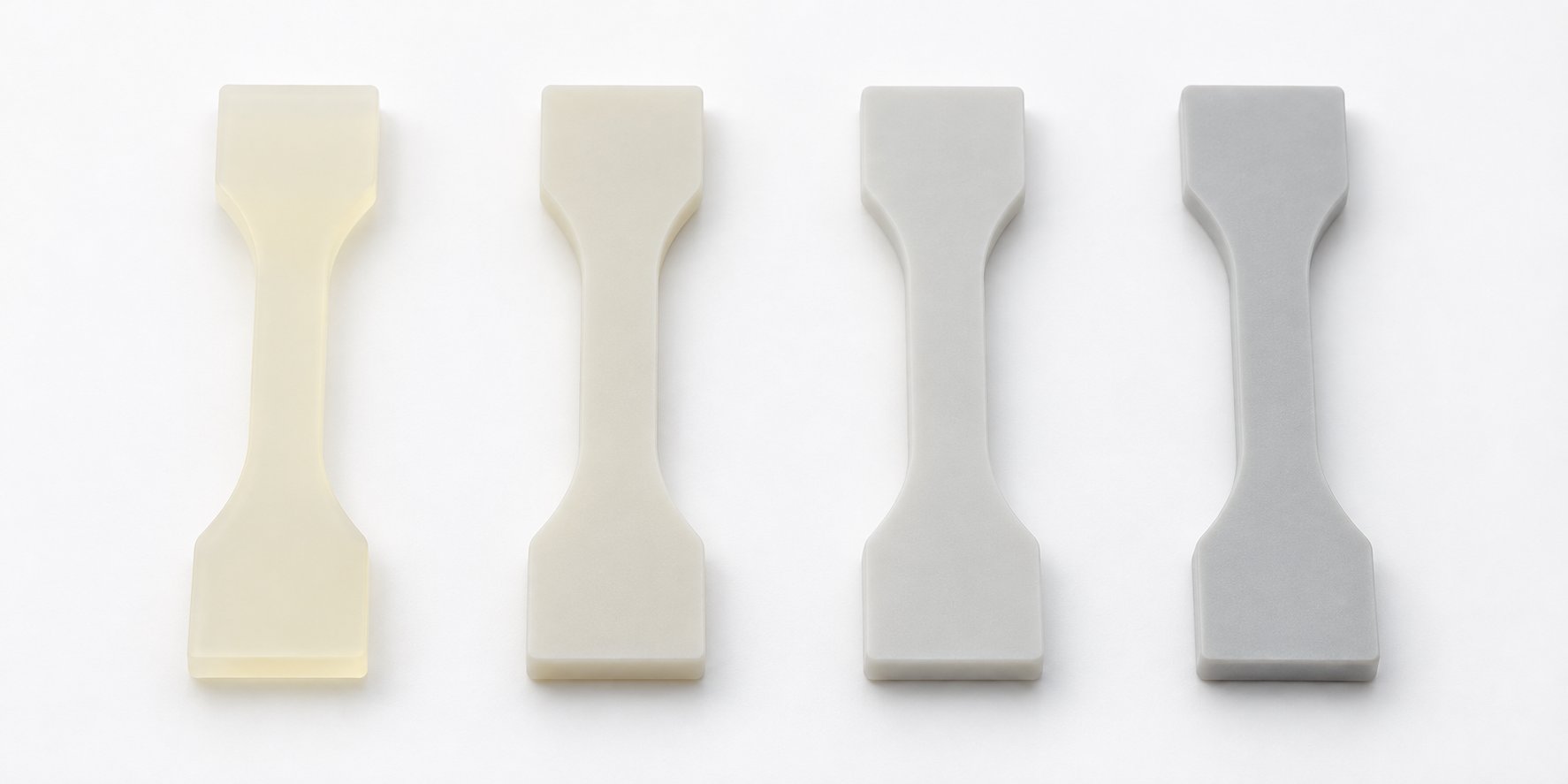
Comparing Talc Loading Percentages from 10% to 40%
The balance between nucleation, platelet reinforcement, and surface compatibility shifts in measurable ways as talc content climbs from a modest 10% by weight to an aggressive 40%. Every percentage point added changes the mechanical properties of talc filled polypropylene - some for the better, some not. The challenge for engineers and specifiers is understanding exactly where those trade-offs tip, so you can match the loading level to the demands of your specific part.
What follows is the comparison that material datasheets rarely lay out side by side: a walk through each major loading tier, followed by a consolidated reference table you can use during early-stage material selection.
How 10% and 20% Talc Loadings Affect Performance
At 10% talc, you are working at the gentle end of the reinforcement curve. Stiffness gains are real but moderate - Young's modulus rises noticeably above unfilled PP, yet the compound retains much of its original elongation and impact toughness. Research published in the Journal of Technical Education Science found that PP composites achieved their best overall balance of properties at 10% talc, where the hardness increase was already measurable while tensile and flexural strength remained close to neat PP values. For parts that need a bump in rigidity without sacrificing flexibility - think thin-wall consumer goods packaging or components subject to occasional flex loading - this is a practical starting point.
Step up to 20% talc, and you enter the most commercially popular loading range for good reason. Flexural modulus increases substantially, heat deflection temperature (HDT) rises meaningfully, and mold shrinkage becomes lower and more predictable. Flexural modulus at this level climbs steadily compared to the 10% compound, though research on isotactic PP-talc composites shows the modulus increase remains somewhat gradual between 10% and 20% before accelerating at higher loadings, as documented by Nasrin et al. in compression-molded iPP-talc composites.
The polypropylene 20 talc filled compressive strength and overall load-bearing capability make this the default choice for automotive interior panels, appliance housings, and HVAC components. Elongation at break does decrease compared to the 10% grade, but the reduction is manageable for most structural and semi-structural applications. SEM studies of fractured 20% talc composites confirm that talc particles remain well-dispersed and uniformly distributed within the matrix at this level - a sign that the filler-matrix interface is performing effectively without the agglomeration issues that plague higher loadings.
For most general-purpose applications, 20% talc loading offers the strongest combination of stiffness gain, processability, and impact retention - which is why it remains the industry's workhorse formulation.
How 30% and 40% Talc Loadings Shift the Property Balance
At 30% talc, the stiffness curve steepens dramatically. Young's modulus reaches its peak in many compound systems - one study measured a maximum of 2,024 MPa at 30 wt% talc, significantly above the values recorded at 10% and 20%. Flexural strength also peaks around this loading; the same researchers reported a maximum flexural strength of 57.15 MPa at 30% talc. The density of 30 talc filled polypropylene rises proportionally - you are adding a mineral with a specific gravity near 2.7-2.8, so the compound moves well above unfilled PP's 0.90-0.91 g/cm3 baseline.
But here is the catch that datasheets sometimes underemphasize: impact resistance drops noticeably. Tensile strength also trends downward because the increasing volume of rigid platelets disrupts polymer chain continuity. Research from the Journal of Technical Education Science measured tensile strength falling from 30.73 MPa in pure PP to 23.29 MPa at 30% talc - a roughly 24% reduction. Elongation at break decreases further as well, signaling that the material is becoming increasingly stiff but less forgiving under deformation.
Push to 40% talc, and you reach the practical ceiling for most talc-filled PP systems. Published property data for 40% talc-filled PP shows a flexural modulus of 3.2 GPa, HDT of 130 degrees C at 0.45 MPa, and mold shrinkage of just 0.7% - impressive numbers that approach engineering-plastic territory. Tensile strength holds at approximately 30 MPa in that dataset, but elongation at break drops to only 8%, and notched Izod impact resistance falls to very low levels (0.03 kJ/m).
Processing becomes more demanding at this loading too. The melt viscosity is noticeably higher, requiring elevated melt temperatures - typically in the 240-290 degrees C range for 40% talc grades versus lower ranges for lightly filled compounds. The research data paints a consistent picture: above 30% talc, interfacial adhesion between talc particles and the PP matrix weakens as filler particles begin to form agglomerates. SEM micrographs of 50% talc composites show visible cracks, voids, and large particle clusters on fracture surfaces - problems that begin emerging at 40% and accelerate beyond it.
Sounds like a clear-cut decline? Not necessarily. For applications where maximum stiffness, heat resistance, and dimensional stability matter more than toughness - automotive under-bonnet components and electrical housings, for instance - the 40% formulation delivers properties that would otherwise require a significantly more expensive resin.
Property Comparison Across Loading Levels
The table below consolidates the directional trends for each major property across the four standard loading tiers. Keep in mind that exact numerical values depend heavily on the base PP grade (homopolymer vs. copolymer), talc particle size and aspect ratio, surface treatment, and compounding quality. Always verify against your compound supplier's certified datasheet for the specific grade you are evaluating.
| Property | 10% Talc | 20% Talc | 30% Talc | 40% Talc |
|---|---|---|---|---|
| Flexural Modulus | Moderate increase | Substantial increase | High - rapid acceleration | Very high - near practical ceiling |
| Tensile Strength | Slight decrease vs. neat PP | Moderate decrease | Noticeable decrease (~24% below neat PP) | Continued decrease; offset by stiffness gains |
| Impact Strength | Minimal reduction | Moderate reduction | Significant reduction | Low - material becomes brittle |
| Elongation at Break | Moderate decrease | Further decrease | Substantial decrease | Very low (~8%) |
| HDT (Heat Deflection Temp.) | Modest increase | Meaningful increase | High increase | Very high (~130 degrees C at 0.45 MPa) |
| Density | ~1.04-1.06 g/cm3 | ~1.10-1.14 g/cm3 | ~1.17-1.21 g/cm3 | ~1.24-1.27 g/cm3 |
| Mold Shrinkage | Reduced vs. neat PP; more isotropic | Further reduced; good isotropy | Low; predictable | Very low (~0.7%); highly predictable |
| Hardness | Slight increase | Moderate increase | High (e.g., 83.8 HD reported) | Very high |
| Processability | Easy - similar to unfilled PP | Good - standard processing | Moderate - higher viscosity | Demanding - elevated temps required |
| Typical Application Fit | Balanced parts needing modest stiffness with retained flexibility | Automotive interiors, appliance housings, general structural parts | High-stiffness structural components where impact is secondary | Under-bonnet automotive, electrical housings, maximum dimensional stability |
A few patterns stand out in this comparison. Flexural modulus and HDT climb steadily and reward higher loadings, but the gains come at the direct expense of impact resistance and elongation. The density of 30 talc filled polypropylene already exceeds the 1.0 g/cm3 threshold that matters for float-sink recycling separation - a consideration that deserves attention during material specification, particularly if end-of-life recyclability is part of your design brief.
Notice too that the transition from 20% to 30% is where the most dramatic property shifts occur. Young's modulus and flexural modulus jump sharply in this range, while the onset of agglomeration-related degradation begins appearing above 30%. For most design teams, this makes the 20% to 30% window the critical decision zone - the loading range where you are choosing between a well-balanced material and one that is optimized for stiffness at the expense of toughness.
These directional trends tell you where each loading level sits on the performance spectrum, but they do not tell you whether a specific compound will meet the tensile, flexural, impact, and thermal targets printed on your part specification. That requires a deeper look at the individual mechanical and physical properties engineers evaluate during material qualification - and critically, at the strategies available to recover lost toughness without surrendering the stiffness gains that make talc-filled PP worth specifying in the first place.
Key Mechanical and Physical Properties Engineers Need to Know
Directional trends across loading tiers are a useful starting point, but when a part specification lands on your desk with hard numerical targets for stiffness, impact, shrinkage, and weight, you need a more granular understanding of how each property behaves - and how the trade-offs between them can be managed. This section unpacks the specific properties of talc filled polypropylene that show up on every material qualification checklist, along with the engineering strategies that make the stiffness-versus-toughness compromise far less painful than it first appears.
Density and Specific Gravity Across Fill Levels
Every gram of talc you add to polypropylene raises the compound's density. That is a straightforward consequence of blending a mineral with a specific gravity of approximately 2.7-2.8 into a polymer matrix that sits around 0.90-0.91 g/cm3. The increase is roughly proportional to the filler weight fraction, and it shows up directly in two places engineers care about: part weight calculations and end-of-life recyclability assessments.
Here is how density shifts across common polypropylene with talc filler formulations:
- Unfilled PP (homopolymer): ~0.90-0.91 g/cm3
- 10% talc filled PP: ~1.04-1.06 g/cm3
- 20% talc filled PP: ~1.10-1.14 g/cm3
- 30% talc filled PP: ~1.17-1.21 g/cm3
- 40% talc filled PP: ~1.24-1.27 g/cm3
Notice a critical threshold hidden in those numbers. Unfilled PP floats in water (specific gravity below 1.0), which is the basis for float-sink separation in recycling facilities. Even a 10% talc loading pushes the compound above that 1.0 threshold, meaning it sinks alongside non-polyolefin materials during conventional sorting. For design teams working under circular-economy mandates, this density consideration can influence loading-level decisions just as much as mechanical performance does. The higher you go, the harder end-of-life sorting becomes with standard equipment - a factor worth flagging early in the material selection process.
Specific gravity data also feeds directly into part weight estimates. If you are replacing a 20% talc grade with a 40% grade to gain stiffness, remember that the density jump from roughly 1.12 to 1.26 g/cm3 adds about 12% more weight per unit volume. In automotive applications where every gram counts toward lightweighting targets, that trade-off deserves careful accounting.
Stiffness, Strength, and the Impact Resistance Trade-Off
Here is the property relationship that defines virtually every talc-filled PP selection decision - and the one that competitor datasheets consistently gloss over. As talc loading increases, flexural modulus and tensile modulus climb steadily, but notched Izod and Charpy impact values decline. Understanding why this happens, and what you can do about it, is what separates a smart material choice from one that creates problems downstream.
The stiffness gains are easy to explain. Rigid talc platelets embedded throughout the PP matrix physically restrict polymer chain movement under load. Research on mineral-filled PP copolymer composites has shown that Young's modulus increases in direct correlation with filler content - a study published in the International Journal of Molecular Sciences documented a roughly 55% increase in Young's modulus at 40 wt% mineral filler loading compared to unfilled PP copolymer (rising from approximately 1,400 MPa to 2,200 MPa). Flexural modulus follows the same upward trajectory, with the most dramatic jumps occurring between 20% and 40% loading.
The impact decline, though, is equally consistent. Those same rigid platelets that stiffen the matrix act as stress concentration points when the material is subjected to sudden, high-speed loading. Under impact, cracks initiate at the filler-matrix interface and propagate along the platelet boundaries. The same research measured Izod impact resistance dropping from 7.6 kJ/m2 in unfilled PP copolymer to just 3.1 kJ/m2 at 40 wt% filler - a reduction of more than 59%. At high loadings, particle agglomeration worsens the problem by creating larger stress-concentration zones where cracks can nucleate more easily.
Sounds like an unavoidable penalty? It is not. The most widely used mitigation strategy is the incorporation of impact modifiers - elastomeric phases such as ethylene-propylene rubber (EPR), ethylene-propylene-diene monomer (EPDM), or styrene-ethylene-butylene-styrene (SEBS) block copolymers - to create talc-filled impact-modified polypropylene compounds. These rubber phases disperse as microscopic nodules throughout the PP matrix, where they absorb impact energy through elastic deformation and crazing mechanisms that blunt crack propagation.
The results are striking. Impact PP copolymers, which contain an inherent EPR phase produced during polymerization, retain significantly higher toughness when filled with mineral. In the study cited above, a PP copolymer filled with 40 wt% mineral still maintained an impact resistance above 4 kJ/m2 when proper surface treatment was applied to the filler - a value that remained nearly double the impact strength typical of filled PP homopolymers. Further ionomeric modification boosted the value to 4.7 kJ/m2, recovering much of the lost toughness while preserving the full stiffness gain.
For engineers specifying polypropylene 40 talc filled properties, the practical takeaway is clear: do not evaluate stiffness and impact in isolation. A well-formulated impact-modified talc-filled compound can deliver 80-90% of the stiffness benefit while recovering a substantial share of the toughness penalty. The key variables are the type and concentration of the elastomeric modifier, the talc particle size and surface treatment, and the quality of dispersion achieved during compounding.
Shrinkage and Dimensional Stability
If stiffness and impact resistance dominate the mechanical conversation, shrinkage and dimensional stability dominate the tooling and design conversation. And this is where talc-filled PP has an advantage that is genuinely difficult to replicate with other reinforcement types.
Mold shrinkage in unfilled polypropylene is relatively high - typically in the range of 1.5% to 2.0% - and it varies significantly between the flow direction and the transverse direction, creating anisotropic shrinkage that complicates mold design and can produce warped parts. Adding talc reduces both the magnitude and the directionality of that shrinkage. A study published in Materials directly compared talc-reinforced and glass-fiber-reinforced PP composites across multiple loading levels and found that incorporating 20 wt% talc into PP reduced shrinkage while keeping the differential shrinkage between flow and transverse directions comparable to or better than neat PP. In quantitative terms, the researchers measured PP/talc differential shrinkage values between 0.041% and 0.073% at various loadings - numbers that were roughly on par with unfilled PP and dramatically lower than the 0.186% to 0.321% differential shrinkage recorded for glass-fiber-reinforced PP.
Why such a stark difference? It comes back to particle geometry. Glass fibers are one-dimensional reinforcements that align strongly along the melt flow direction, resisting shrinkage in that axis far more than in the transverse direction. The result is large differential shrinkage and a high risk of warpage. Talc platelets, being two-dimensional, spread their restraining effect more uniformly across both in-plane directions. The same research confirmed through micro-CT imaging that talc particles distribute randomly throughout the part cross-section, whereas glass fibers exhibit distinct skin-core orientation layers that drive anisotropic behavior.
The practical implications are significant:
- Tighter tolerances on large parts: Automotive instrument panels, door panels, and pillar trims are among the largest injection-molded components in a vehicle. With spans exceeding 1,000 mm, even a small percentage difference in directional shrinkage translates to millimeters of warpage. Talc-filled PP's more isotropic shrinkage makes it far easier to hold the tight fit-and-finish tolerances these parts demand.
- Simpler mold compensation: Because shrinkage is more uniform and predictable, mold designers can apply more straightforward scaling factors rather than complex directional adjustments.
- Reduced post-mold warpage: Lower differential shrinkage means fewer residual stresses locked into the part after ejection, which reduces the risk of delayed warpage during storage, shipping, or end-use temperature cycling.
Shrinkage values do depend on more than just talc loading, of course. Part geometry, wall thickness, gate location, melt temperature, mold temperature, and packing pressure all play roles. At 40% talc, published shrinkage values can drop below 0.7%, but the material's higher viscosity requires careful processing to ensure uniform filler distribution - and any non-uniformity in distribution will show up as localized shrinkage variation.
This sensitivity to processing conditions is exactly why understanding how to mold and compound these materials matters just as much as understanding their datasheet properties. The stiffness, impact balance, and dimensional precision that talc-filled PP promises on paper only materialize when the compound is processed correctly - a topic that spans everything from barrel temperatures and screw design to the management of defects that are unique to mineral-filled systems.

Automotive and Industrial Applications Driving Talc Filled PP Adoption
Stiffness numbers, shrinkage percentages, and impact curves on a datasheet only matter when they translate into real parts solving real engineering problems. And few materials have found as many real-world homes as talc filled polypropylene. Its adoption spans nearly every sector where rigid, dimensionally stable, and cost-effective thermoplastics are needed - but the depth of penetration varies dramatically by industry, and the specific property requirements driving selection in each sector are often misunderstood or oversimplified.
So where exactly does this material end up, and why does it keep winning specifications over alternatives that might look better on paper?
Automotive Interior and Exterior Components
Walk into any modern vehicle and you are surrounded by talc-filled PP. Instrument panels, door panels, pillar trims, glove box housings, center consoles, and HVAC ductwork - these components collectively represent the single largest consumption volume for mineral-filled polypropylene compounds. The material dominates here not because of any single property advantage but because of how its properties align as a package with what automotive interiors demand.
Consider what an instrument panel substrate requires. It must deliver a flexural modulus above 2,500 MPa to maintain structural rigidity across spans that can exceed one meter. It must hold tight dimensional tolerances - gaps between adjacent panels are typically specified at fractions of a millimeter. It needs a heat deflection temperature above 100 degrees C because dashboard surface temperatures during summer sun exposure can approach or exceed that threshold. Industry formulation data shows that TPO compositions with 20-30% talc, 40-60% PP homopolymer, and 15-25% ethylene-octene elastomer satisfy these requirements while enabling cost savings of 20-30% relative to polycarbonate-ABS blends. That cost advantage, multiplied across the hundreds of thousands of units a single vehicle platform produces, is enormous.
The specific gravity of 20 talc filled polypropylene - typically around 1.10-1.14 g/cm3 - also plays a direct role in why this loading level dominates interior trim. Compare that to ABS at roughly 1.05 g/cm3 or PC/ABS blends at 1.10-1.20 g/cm3. The weight penalty is minimal, but the stiffness-to-cost ratio tilts heavily in favor of the talc-filled PP system. Door panels and quarter panel trim components follow a similar logic, though they add requirements for scratch resistance and paint adhesion. Formulations incorporating 15-25% talc with 5-10% HDPE address these needs while maintaining flexural modulus values of 2,200-2,800 MPa.
Exterior applications tell a different but equally compelling story. Bumper fascias increasingly rely on impact-modified talc-filled PP to replace heavier glass-fiber-reinforced compounds and metal substrates. Imagine a front bumper assembly: it needs to absorb parking-speed impacts without cracking, maintain its shape across temperature swings from -30 degrees C to 80 degrees C, accept paint or maintain in-mold color, and weigh as little as possible. Impact-modified talc-filled PP compounds - where the specific gravity of talc filled polypropylene is carefully managed to stay competitive with lighter unfilled grades - deliver weight savings of 10-15% compared to glass-fiber PP while providing adequate energy absorption. Every kilogram saved on a bumper assembly contributes directly to fuel efficiency targets and, for electric vehicles, to range extension.
Appliances, Packaging, and Consumer Goods
Step outside the automotive world and talc-filled PP's footprint remains substantial, though the property requirements shift. In major appliances, you will find it in washing machine tubs, dishwasher inner doors, refrigerator liners, and structural housings for dryers and air conditioning units. The driving requirements here are stiffness sufficient to handle mechanical loads during operation, heat resistance to survive elevated operating temperatures (particularly in dishwashers and dryers), and cost competitiveness against alternatives like ABS or glass-filled nylon.
A dishwasher inner door panel, for example, sees repeated exposure to water temperatures above 60 degrees C, mechanical stress from latching cycles, and occasional impact from dropped dishes. A 20-25% talc-filled PP compound handles this combination comfortably - its HDT sits well above the water temperature, its flexural modulus provides the structural backbone, and its relatively isotropic shrinkage keeps the panel dimensionally true across its full area. The specific gravity of 20 talc filled polypropylene keeps the part weight manageable compared to engineering-resin alternatives.
In packaging and consumer goods, talc-filled PP sheet finds applications in thermoformed food containers, industrial packaging trays, and rigid consumer goods like storage bins. Here, the stiffness improvement allows thinner walls while maintaining container rigidity - effectively reducing material usage per part. Research on talc with lamellarity index above 1.4 shows a minimum 4% improvement in crush resistance-to-weight ratio for thermoformed containers, translating directly into material savings and faster thermoforming cycles.
Ranked by consumption volume, the major application sectors for talc-filled PP break down as follows:
- Automotive: The largest consumer by a wide margin. Primary property drivers are stiffness-to-weight ratio, low isotropic shrinkage for large parts with tight tolerances, surface appearance quality for grained textures, and cost competitiveness versus engineering resins.
- Appliances: The second-largest sector. Selection is driven by heat resistance (HDT), structural stiffness under operating loads, dimensional stability across temperature cycling, and cost advantages over ABS and nylon.
- Packaging: Growing steadily. The primary driver is increased stiffness-to-weight ratio, allowing material reduction (down-gauging) in thermoformed containers and trays while maintaining rigidity and crush resistance.
- Industrial and other applications: Includes electrical housings, furniture components, garden equipment, and construction profiles. Selection criteria vary but generally center on stiffness, weather resistance, and the favorable economics of a mineral-filled polyolefin system compared to engineering plastics.
Industry Trends Driving Adoption
Three converging forces continue to expand talc-filled PP's market position. The first is automotive lightweighting. With plastics now comprising roughly 50% of a vehicle's volume but only about 10% of its weight, the push to replace heavier engineering plastics and metals with mineral-filled polyolefin compounds is accelerating. Every instrument panel or bumper fascia converted from PC/ABS or glass-fiber PP to talc-filled PP shaves grams from the vehicle, and those grams compound across millions of units produced annually.
The second force is sustainability-driven material substitution. Talc-filled PP remains within the polyolefin family, making it mechanically recyclable and compatible - at least conceptually - with circular economy frameworks. Compared to multi-polymer blends or thermoset composites, a PP-based compound is far simpler to reprocess. Automakers have publicly committed to increasing recycled content, and formulations based on recycled PP with controlled talc additions are already entering production for non-critical interior components.
The third is straightforward cost optimization pressure. In consumer goods and appliances, margin pressures push specifiers toward materials that deliver acceptable performance at the lowest possible compound cost. Talc is one of the least expensive mineral fillers available, and replacing a portion of the polymer matrix with talc simultaneously lowers raw material cost and improves mechanical properties - a rare combination in materials engineering where performance gains typically come at a price premium.
These trends point in the same direction: growing demand for talc-filled PP compounds across loading levels. Yet translating that demand into consistently high-quality parts requires more than selecting the right formulation on a datasheet. The processing parameters and equipment used to compound and mold these materials play an equally decisive role - and this is where many production teams encounter challenges that no amount of material selection optimization can solve on its own.
Processing Parameters and Equipment for Talc Filled Polypropylene
Selecting the right talc filled polypropylene compound is only half the equation. The other half - the half that determines whether your parts actually deliver the datasheet properties you specified - lives in the processing. Melt temperatures, mold temperatures, screw geometries, dispersion quality, and even how you handle the raw material before it reaches the hopper all influence the final outcome. And yet, detailed processing guidance for mineral-filled PP remains one of the most consistently overlooked topics in technical literature.
Whether you are injection molding a 20% talc-filled automotive door panel or compounding a 40% talc filled polypropylene compound from raw ingredients, the parameters below provide a practical framework for getting it right.
Injection Molding Temperature and Mold Recommendations
When you add talc to polypropylene, the melt viscosity increases - sometimes substantially, especially above 30% loading. That higher viscosity means the compound does not flow as easily as unfilled PP, and if you try to mold it at the same temperatures you use for neat resin, you are likely to encounter short shots, poor surface finish, and inconsistent packing.
The general rule: melt temperatures for talc filled polypropylene composites run higher than those for unfilled grades. For lightly filled compounds in the 10-20% range, a melt temperature of 200-230 degrees C is often sufficient. At 30-40% talc, you will typically need to push into the 230-270 degrees C window, and some heavily filled commercial grades specify processing temperatures as high as 290 degrees C. Always cross-reference your compound supplier's datasheet - these ranges are directional, not universal.
Mold temperature, meanwhile, influences two things simultaneously: surface finish quality and crystallization behavior. Higher mold temperatures - typically 40-60 degrees C rather than the 20-30 degrees C sometimes used for unfilled PP - allow the melt to fill textured surfaces more completely, improving gloss and reducing the visibility of surface imperfections. They also promote more uniform crystallization at the part surface, which contributes to better dimensional stability.
Research on filled PP composites supports this directly. A study published in Polymer Engineering & Science evaluated the effects of injection molding parameters on polypropylene with talc and glass fiber reinforcement. The researchers found that specimens molded at 210 degrees C melt temperature and 50 degrees C mold temperature consistently outperformed those molded at 190 degrees C melt and 20 degrees C mold temperature across multiple mechanical properties, including tensile modulus and ultimate tensile strength. The warmer parameter set produced better weld-line performance as well - a detail that matters enormously for complex parts with multiple gate locations.
A practical checklist for dialing in injection molding parameters on talc-filled PP:
- Start with the supplier's recommended melt temperature range and aim for the middle initially. If flow or fill issues appear, move toward the upper end.
- Set mold temperature at 40-50 degrees C minimum for talc-filled grades, especially when surface appearance or texture replication matters.
- Adjust injection speed profiles carefully. Faster injection speeds can help fill thin sections but may worsen flow lines on textured surfaces - a balance that often requires trial runs.
- Increase packing pressure relative to unfilled PP. The higher filler content compresses slightly during cooling, and adequate packing compensates for this to reduce sink marks and dimensional variation.
- Expect shorter cooling times than with unfilled PP at equivalent wall thicknesses. Talc's nucleating effect accelerates crystallization, which means the part reaches ejection stiffness sooner - a cycle time benefit that partially offsets the slower fill caused by higher viscosity.
Compounding and Screw Design Considerations
Every talc filled polypropylene application starts with compounding - the step where talc mineral and polypropylene resin are melt-blended into a homogeneous compound. The quality of this step determines everything that follows. Poorly dispersed talc produces agglomerates that act as stress concentrators in molded parts, reducing impact strength, creating surface blemishes, and introducing inconsistency from pellet to pellet. Well-dispersed talc, by contrast, delivers the full property potential that the formulation promises.
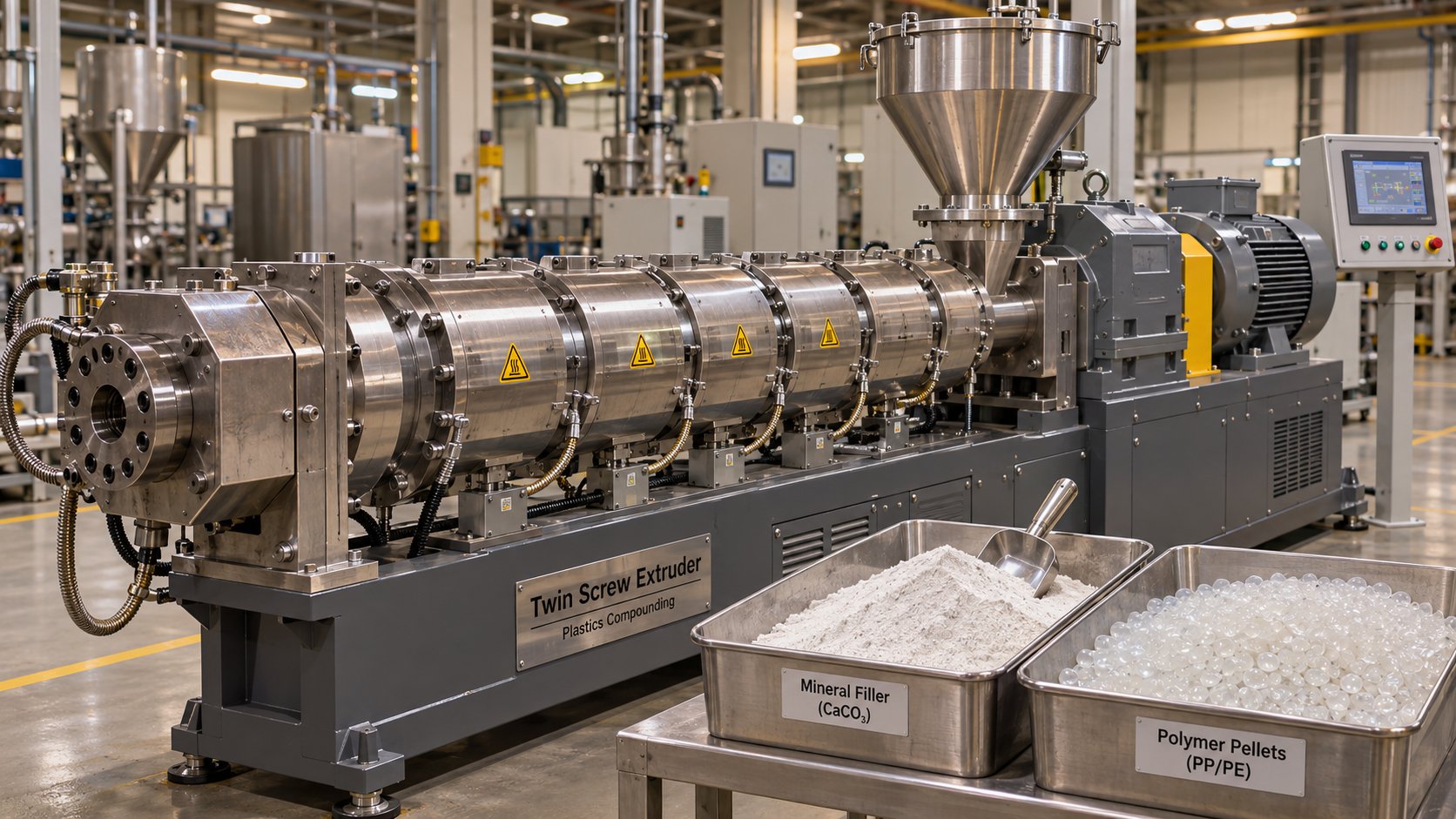
Twin screw extruders are the industry standard for talc-PP compounding, and for good reason. Their intermeshing, co-rotating screw geometry provides both distributive mixing (spreading talc particles uniformly throughout the polymer) and dispersive mixing (breaking apart talc agglomerates and delaminating stacked platelets into individual particles). As industry compounding guides note, wetting and dispersing mineral powders at loadings up to 80% without agglomeration requires the combination of high torque, modular screw design, and strategic feeding configurations that twin screw extruders deliver.
Screw configuration matters at a detailed level. Kneading block elements provide the intensive shearing needed to delaminate talc platelets, while conveying elements move material forward and control residence time. The arrangement, stagger angle, and number of kneading blocks must be tailored to the specific talc loading and particle size. Too little shear leaves agglomerates intact; too much can degrade the PP matrix through excessive melt temperature rise. For high-loading talc filled polypropylene compounds at 30-40%, a common approach is a split-feeding strategy where a portion of the talc is introduced downstream via side feeders, reducing the peak shear demand in the melting zone and improving overall dispersion uniformity.
Here is the processing reality that often catches production teams off guard: abrasive mineral fillers accelerate wear on barrel and screw surfaces. Talc, despite being the softest mineral on the Mohs hardness scale (Mohs 1), is still harder than the polymer melt surrounding it, and at high throughput rates the cumulative abrasive effect is significant. Industry experts in screw and barrel technology identify abrasive wear as perhaps the most common type of wear in plastics machinery, noting that glass-filled and mineral-filled resins can reduce useful screw and barrel life by 50% or more compared to processing unfilled polymers. The wear mechanism is straightforward: as pellets and filler particles are transported, compressed, and sheared, they gradually erode the flight lands and barrel interior surface, increasing the clearance between screw and barrel wall.
As that clearance grows, mixing efficiency degrades. Melt leaks backward over the flight lands instead of being pushed forward, reducing the shear and distributive forces that keep talc particles properly dispersed. The result is a slow, often unnoticed decline in compound quality - until surface defects, inconsistent mechanical properties, or increased scrap rates force an investigation. Process engineers frequently compensate by raising screw speed or adjusting barrel temperatures, but these are temporary fixes that mask the underlying problem.
Managing this wear requires attention to three factors:
- Metallurgy: Barrel liners and screw flight lands must be manufactured from wear-resistant materials. Bimetallic barrel liners with high tungsten carbide content, nickel-based or cobalt-based alloys, and hardened flight land surfaces all extend useful life when processing abrasive talc-filled compounds.
- Surface hardening: Beyond base metallurgy, surface treatments matched to the specific filler type and loading level provide an additional wear barrier. A barrel running 40% talc-filled PP faces significantly more abrasion than one processing a 10% grade, and the surface treatment should reflect that difference.
- Timely component replacement: Even with premium materials, wear is progressive and inevitable. Establishing measurement baselines and tracking screw and barrel dimensions against production hours allows maintenance teams to predict when replacement is needed - avoiding both premature changeouts and the compound quality degradation that comes from running worn components too long.
For compounders and masterbatch producers processing mineral-filled plastics, evaluating replacement screw barrel components from specialized suppliers is a practical step toward maintaining consistent compound quality. NANHAIYA's parallel twin screw barrels, for example, are available with material and surface-treatment options matched to specific filler types, loading levels, and abrasive wear conditions. Their custom manufacturing approach - based on machine details, drawings, samples, or measured dimensions - helps production teams match replacement components precisely to the mixing demands and throughput requirements of their specific talc-filled PP formulations, rather than settling for generic off-the-shelf replacements that may not provide optimal wear life.
Drying and Material Handling
Polypropylene itself is not hygroscopic - it does not absorb moisture into its molecular structure the way nylon or PET does. So why bother with drying? Because talc can.
Talc particles have a large surface area, and in humid environments they adsorb moisture onto their surfaces. When that moisture-laden compound enters the barrel and encounters melt temperatures, the water vaporizes and creates splay marks, silver streaks, and surface blemishes on finished parts. Industry processing references specifically flag moisture as a common source of bubbles and surface defects when processing fillers like talc and calcium carbonate, recommending multi-stage vacuum degassing during compounding to remove volatiles efficiently.
For injection molders receiving pre-compounded talc-filled PP pellets, the moisture risk is lower than during compounding but not zero - particularly if pellets have been stored in open or poorly sealed containers in humid conditions. Best practice recommendations include:
- Use hopper dryers or desiccant dryers set to 80-90 degrees C for 2-4 hours before processing, especially in facilities with ambient humidity above 50%.
- Keep bags sealed until ready for use. Moisture pickup occurs primarily on the pellet surface and on exposed talc at cut pellet faces.
- Monitor for splay during startup. If silver streaks appear on the first few shots after a material change, moisture is the most likely culprit before more complex causes are investigated.
- During compounding, ensure the extruder's vacuum degassing ports are functioning properly. For high talc loadings, multi-stage venting is particularly effective at removing both surface moisture and any volatiles released during melt processing.
Material handling also deserves a mention for higher talc loadings. At 30-40% mineral content, talc-filled PP pellets are denser and more abrasive than unfilled grades. Pneumatic conveying systems may experience accelerated wear on elbows and transition points, and pellet breakage during conveying can generate fines that affect feeding consistency. Gravity-fed systems and gentle-handling conveying designs minimize these issues.
Getting the processing right - from compounding dispersion to injection molding parameters to material handling - puts you in position to produce parts that genuinely reflect the material's capability. But even with optimized parameters, certain defects are characteristic of mineral-filled PP systems and require their own targeted troubleshooting strategies. Knowing what to look for, and why it happens, saves hours of trial-and-error on the production floor.
Troubleshooting Common Defects in Talc Filled PP Parts
You have selected the right talc loading, dialed in your melt and mold temperatures, and confirmed that your compounding equipment is delivering uniform dispersion. The first parts come off the press - and something does not look right. Flow lines streak across the textured surface near the gate. A weld line cracks during a drop test at barely half the expected load. A large panel bows after sitting on the rack overnight.
These are not random failures. Each defect traces back to how talc platelets interact with polymer flow, cooling, and solidification inside the mold cavity. And because mineral-filled systems behave differently from unfilled PP in predictable ways, the troubleshooting path is far more targeted than general injection molding trial-and-error. Here is what to look for - and how to fix it.
Surface Appearance Defects and Flow Lines
If you have ever molded a textured part from talc filled polypropylene granules and noticed alternating bands of glossy and matte finish radiating outward from the gate, you have encountered flow marks - sometimes called tiger striping. This defect is one of the most frustrating surface quality issues in mineral-filled PP processing because it is visible, cosmetically unacceptable, and difficult to eliminate entirely without understanding its root cause.
The mechanism is tied directly to the platelet geometry that makes talc such an effective reinforcement. As the melt front advances through the cavity, talc platelets continuously align and re-orient in response to the fountain flow pattern. At the flow front's leading edge, the melt periodically hesitates and surges - especially when it encounters changes in cavity thickness, direction, or restriction. Each hesitation allows the surface layer to partially solidify with talc platelets locked in one orientation. When flow resumes, a fresh melt layer with a different platelet alignment covers that surface. The result is visible bands where platelet orientation - and therefore light reflectance - alternates across the part surface.
Tiger striping tends to be most severe in three situations: near the gate where flow instabilities are strongest, on large flat surfaces where the melt front travels long distances, and at higher talc loadings where the sheer volume of platelets amplifies the orientation contrast. Talc filled polypropylene density increases with loading, and that denser, more viscous melt is more prone to the intermittent flow behavior that produces these marks.
Mitigation strategies that target the root cause rather than masking symptoms include:
- Optimize gate location and size. Larger gates reduce shear at the entry point and produce a more stable initial flow front. Relocating the gate to a less visible area of the part does not eliminate the defect but moves it where it matters less.
- Increase melt temperature. A hotter melt flows more easily and with fewer hesitations. Moving toward the upper end of the supplier's recommended range often reduces the severity of flow marks noticeably.
- Raise mold temperature. Higher mold surface temperatures - 50 to 60 degrees C rather than 20 to 30 degrees C - keep the advancing melt front fluid for longer, allowing better surface replication before the skin layer freezes. Research published in Polymer Engineering & Science confirmed that warmer mold and melt conditions consistently improved surface quality and mechanical performance in filled PP systems.
- Adjust injection speed profiles. A profiled injection strategy - starting slower through the gate region and then accelerating as the flow front stabilizes - can reduce the initial flow instabilities that trigger the worst striping. Uniform high-speed injection sometimes helps on simpler geometries but may worsen marks on complex parts.
- Consider talc particle size distribution. Finer talc particles with narrower size distributions tend to produce less visible flow marks than coarser grades, because the smaller platelets create less contrast when their orientations differ.
Weld Line Weakness in Talc Filled Parts
Every injection molded part with multiple gates, holes, or flow obstructions contains weld lines - regions where two or more melt fronts meet and must fuse together. In unfilled polypropylene, weld lines are a known nuisance but typically retain a reasonable fraction of the bulk material's strength. In talc-filled PP, the problem is significantly worse.
The reason is platelet orientation at the interface. When two melt fronts converge head-on, the fountain flow pattern forces talc platelets to align parallel to the weld plane rather than bridging across it. Instead of interlocking layers that reinforce the bond, you get a neat stack of platelets lying flat along the weakest possible orientation - creating a plane of mechanical weakness right where you need structural integrity. A detailed study by Purgleitner et al. examining weld-line characteristics in reinforced polypropylene found that talc-filled specimens exhibited some of the most pronounced V-notch geometries at the weld line surface. These notches, formed by the collision of opposing fountain flows, act as built-in stress concentrators that dramatically reduce impact performance.
The numbers are sobering. Charpy impact testing in that same research showed talc-filled PP specimens with weld lines suffering a 90% or greater reduction in impact strength compared to specimens without weld lines - with virtually no improvement possible through process parameter optimization alone. Even tensile strength dropped 40-60% at the weld line, and elongation at yield fell by 60-75%. Microscopic examination revealed why: the small talc particles orient tightly along the flow pattern and create a smooth, well-defined fracture plane that offers almost no resistance to crack propagation.
Glass-fiber-filled PP fares somewhat better in weld-line impact tests because the longer fibers occasionally bridge across the interface, creating mechanical interlocking. Talc platelets, being flat and two-dimensional, lack this bridging capability entirely. When talc and glass fiber are combined in the same compound, the talc actually reduces the mobility of the glass fibers, limiting their ability to span the weld line and resulting in compromised tensile and impact strength compared to glass-fiber-only formulations.
Since processing adjustments alone cannot fully solve the problem, the most effective countermeasures focus on part and mold design:
- Relocate gates to move weld lines away from high-stress areas. If a weld line must exist, position it where the part experiences minimal mechanical loading during service.
- Use overflow wells. Small sacrificial cavities placed just past the expected weld line location force the initial, weakest weld material out of the functional part geometry, allowing fresher melt with better molecular entanglement to form the actual weld.
- Increase packing pressure and time. Higher packing forces push more melt across the weld interface after the fronts meet, improving - though not eliminating - the bond strength.
- Favor warmer processing conditions. The research data showed that specimens molded at 210 degrees C melt and 50 degrees C mold temperature outperformed those produced at 190 degrees C melt and 20 degrees C mold temperature, even if the improvement was modest for filled grades.
- Design structural reinforcement (ribs, bosses, or thickness increases) around known weld line locations to compensate for the locally reduced material strength.
Warpage and Uneven Shrinkage
Talc-filled PP's more isotropic shrinkage is one of its headline advantages over glass-fiber-reinforced alternatives. But "more isotropic" does not mean "immune to warpage." Parts still warp, sometimes significantly, when other factors overwhelm the inherent shrinkage balance that talc provides.
Warpage is the dimensional distortion that occurs after a part is ejected from the mold and cools to ambient temperature. It signals that different regions of the part shrank at different rates, building internal stresses that deform the geometry once the rigid mold cavity no longer constrains it. In talc-filled PP, the three most common root causes are uneven cooling, variable wall thickness, and inconsistent filler distribution.
Uneven cooling is often a mold design issue. If cooling channels are closer to one face of the part than the other, or if one half of the mold runs at a different temperature, the two sides solidify and shrink at different rates. The side that cools last shrinks more, pulling the part into a bow or twist. This effect is amplified in talc-filled compounds because the nucleation-accelerated crystallization is sensitive to the local cooling rate - regions that cool faster develop different crystal structures than slower-cooling regions, adding another layer of differential shrinkage.
Variable wall thickness compounds the problem. Thicker sections take longer to solidify, shrink more during cooling, and develop higher residual stresses. When thick and thin sections are adjacent, the differential shrinkage creates bending forces that warp the part after ejection. Designing for uniform wall thickness - or at minimum, providing gradual transitions between different thicknesses - is the most effective preventive measure.
Inconsistent filler distribution is a factor unique to mineral-filled systems. If talc is not uniformly dispersed throughout the compound - whether due to compounding quality issues, screw wear, or improper feeding - some regions of the part will have higher effective talc content than others. Since talc concentration directly affects local shrinkage rate, these concentration gradients create internal shrinkage differentials that manifest as warpage. This is one more reason why compounding quality and equipment maintenance matter so directly to final part performance.
Quick-Reference Defect Guide
When a defect appears on talc-filled PP parts, narrowing down the root cause quickly saves hours of unstructured experimentation. The list below maps the most common defects to their primary causes:
- Flow lines / tiger striping: Intermittent melt front advancement causing alternating talc platelet orientations at the part surface. Aggravated by low melt temperature, low mold temperature, and abrupt flow-path transitions.
- Weld line weakness: Talc platelets aligning parallel to the weld interface instead of bridging across it, creating a fracture plane. Inherent to mineral-filled systems; managed through part design and gate placement rather than process tuning alone.
- Splay or moisture marks: Silver streaks caused by moisture vaporizing from talc particle surfaces during melt processing. Resolved by pre-drying material and ensuring vacuum degassing during compounding.
- Warpage: Differential shrinkage from uneven cooling, non-uniform wall thickness, or inconsistent talc distribution across the part cross-section. Addressed through mold cooling optimization, uniform wall design, and consistent compound quality.
- Surface roughness: Visible talc particles protruding at the surface or poor texture replication. Related to low mold temperature, insufficient packing, or excessively coarse talc particle size. Higher mold temperatures and finer talc grades improve surface quality.
Each of these defects has a solution, but notice a recurring theme: many of the root causes trace back to decisions made long before the injection molding machine cycles for the first time. Gate placement, wall thickness uniformity, compound quality, talc particle size selection - these are choices locked in during design and compounding, not variables you can easily adjust on the production floor. That reality makes a structured material selection framework - one that matches talc loading, particle characteristics, and formulation choices to the specific demands of your application before tooling begins - an essential step in avoiding defects rather than chasing them after the fact.
Material Selection Guide for Choosing the Right Talc Percentage and Grade
Preventing defects is far more efficient than troubleshooting them - and prevention starts with choosing the right formulation for the right application. Yet this is exactly where many engineering teams stumble. With talc loadings available from 10% to 40%, particle sizes ranging from sub-micron to 10+ microns, and dozens of compound suppliers offering different base resin and modifier combinations, the decision space can feel overwhelming.
The framework below cuts through that complexity. It maps your application's primary performance priority directly to a recommended loading range and formulation strategy, then compares talc-filled PP against the most common alternative filled systems to help you confirm - or challenge - your initial material direction.
Choosing Talc Loading Based on Property Priorities
Every part has a dominant performance requirement. Maybe it is stiffness. Maybe it is impact survival at -30 degrees C. Maybe it is holding a dimensional tolerance across a 1,200 mm instrument panel. Identifying that top priority - and accepting the trade-offs that come with optimizing for it - is the fastest path to a sound material choice.
Use this decision guide as your starting point:
- If maximum stiffness with acceptable brittleness is the priority → consider 30-40% talc. Flexural modulus climbs into the 2,500-3,500 MPa range, and HDT can reach 130 degrees C. Impact resistance drops significantly, so this range suits structural components, electrical housings, and under-bonnet automotive parts where toughness is secondary to rigidity and thermal performance.
- If balanced stiffness and impact resistance are the priority → consider 15-20% talc with an impact modifier (EPR, EPDM, or ethylene-octene elastomer). This is the sweet spot for automotive interior panels, appliance housings, and any application where the part must be stiff enough to hold shape yet tough enough to survive assembly impacts, drop tests, or sub-zero service temperatures.
- If cost reduction with modest property improvement is the priority → consider 10-15% talc. Every kilogram of talc replacing PP resin lowers compound cost while still delivering measurable gains in stiffness, HDT, and shrinkage control. This range works well for consumer goods, packaging, and non-critical structural parts where performance expectations are moderate.
- If tight dimensional tolerances and low warpage are critical → talc-filled PP outperforms glass-fiber-filled PP. The platelet geometry delivers more isotropic talc filled polypropylene shrinkage, with differential shrinkage values one-third to one-fifth those of glass-fiber systems at comparable loadings. For large parts like door panels or instrument panel substrates, this advantage directly reduces tooling iterations and scrap rates.
- If surface aesthetics are paramount → lower talc loadings (10-15%) with optimized particle size distributions give the best results. Finer talc grades (D50 below 3 microns) minimize surface roughness and reduce the visibility of flow marks. Higher loadings push more platelet edges to the surface, degrading texture replication and increasing the risk of tiger striping on grained finishes.
- If recyclability is a design constraint → keep in mind that talc filled polypropylene recyclability float-sink separation becomes problematic as loading increases. Even 10% talc pushes compound density above 1.0 g/cm3, routing the material to the sink fraction alongside non-polyolefins. If end-of-life sorting compatibility matters, the lowest talc loading that meets your mechanical requirements is the most recyclability-friendly choice.
Notice that several of these priorities can be combined. A 20% talc-filled impact-modified PP, for example, simultaneously addresses stiffness, toughness, dimensional stability, and cost - which is exactly why that formulation dominates commercial volumes. The decision guide helps most when priorities conflict: when you need maximum stiffness and good impact resistance, or when you want the lowest possible talc filled polypropylene prices and tight dimensional control, and the compromises between those goals need to be made explicit rather than discovered after tooling is cut.
Selecting Between Talc-Filled PP and Alternative Filled Systems
Sometimes the right answer is not a different talc loading - it is a different filler system entirely. Before finalizing a talc-filled PP specification, it is worth benchmarking against the three most common alternatives: calcium carbonate (CaCO3)-filled PP, glass-fiber-reinforced PP, and unfilled engineering plastics.
Each system occupies a different position on the performance-cost map, and understanding where they overlap - and where they diverge sharply - prevents both over-specification and under-specification.
| Property | Talc-Filled PP | CaCO3-Filled PP | Glass-Fiber PP |
|---|---|---|---|
| Stiffness (Flexural Modulus) | High | Low to moderate | Very high |
| Impact Resistance | Moderate (declines with loading) | Moderate to good (better retention) | Moderate (declines with loading) |
| Shrinkage Isotropy | Good - near-isotropic | Moderate | Poor - highly anisotropic |
| Surface Quality | Good (low gloss, matte finish) | Good | Poor (fiber read-through, roughness) |
| HDT Improvement | Significant | Modest | Significant |
| Density | Moderate increase | Moderate increase | Moderate increase |
| Relative Compound Cost | Low to moderate | Lowest | Moderate to high |
| Best Fit | Stiffness + dimensional stability + cost balance | Cost reduction with modest property needs | Maximum strength and modulus where shrinkage anisotropy is acceptable |
A few patterns emerge immediately. CaCO3-filled PP is the lowest-cost option, but its spherical particle geometry limits the stiffness and HDT gains it can deliver. If your application can tolerate lower modulus values - think non-structural consumer goods or packaging where rigidity is a secondary concern - it is a viable cost play. But for anything requiring meaningful reinforcement, talc's platelet morphology delivers substantially more performance per percentage point of loading.
Glass-fiber PP sits at the opposite end: maximum tensile strength and modulus, but with highly anisotropic shrinkage that makes it poorly suited for large, flat parts with tight tolerances. Talc filled polypropylene sheet and panel applications almost universally favor talc over glass for exactly this reason. Glass-fiber grades also produce rougher surfaces with visible fiber read-through - a non-starter for Class A automotive interior surfaces or any application where appearance matters.
Engineering plastics like ABS, PC/ABS, or nylon deliver higher absolute performance but at significantly higher cost and, in many cases, higher density. Automotive industry data shows that well-formulated talc-filled TPO compositions enable cost savings of 20-30% relative to PC/ABS blends for instrument panels and door panels, while meeting the same stiffness, HDT, and impact specifications. Unless the application demands properties that talc-filled PP simply cannot reach - chemical resistance profiles unique to nylon, transparency requirements, or extreme temperature performance - the polyolefin-based system typically wins the cost-performance trade-off.
Sourcing Considerations
Selecting a talc loading percentage and formulation direction on paper is one thing. Sourcing a compound that consistently delivers those properties in production is another. Several factors deserve attention during procurement - factors that can mean the difference between a compound that performs to spec batch after batch and one that introduces variability into your process.
- Talc particle size and purity: Not all talc is equivalent. Median particle diameter (D50), the 95th percentile diameter (D95), and the lamellarity index all influence mechanical performance and surface quality. Technical data indicates that automotive-grade TPO compositions perform best with talc D50 values between 2.0 and 6.0 microns and D95 below 18 microns. Purity matters too - high-purity talc (above 95% mineral content) with low levels of carbonates, chlorites, and iron oxides avoids discoloration, odor generation, and processing defects that lower-grade talc can introduce.
- Compound supplier consistency: Lot-to-lot variation in talc loading, particle size distribution, and dispersion quality shows up directly as variation in part properties and process stability. Request certified test data for each delivery lot, not just a single qualification report. Suppliers who provide statistical process control data - not just pass/fail certificates - are demonstrating the kind of consistency that high-volume production demands.
- Regional availability: Talc-filled PP compounds are produced globally, with major supply concentrated in North America, Europe, and Asia. Talc filled polypropylene in China, India, and Southeast Asia has grown significantly to serve regional automotive and appliance manufacturing. Proximity to your molding operations reduces lead times and freight costs, but always verify that regional sources meet the same particle size, purity, and compounding quality standards as your qualified grade.
- Datasheet verification: Perhaps the most important sourcing principle: never rely on generic property values from a material family datasheet. Actual performance depends on the specific PP grade (homopolymer vs. impact copolymer), the talc source and particle characteristics, any coupling agents or impact modifiers in the formulation, and the compounding process used to produce the pellets. Request the supplier's certified datasheet for the exact grade you intend to use, and validate critical properties through independent testing on molded specimens before committing to production tooling.
Price naturally enters the equation too. Talc filled polypropylene prices vary based on talc loading level, talc purity and particle size, the type and amount of impact modifier, the base PP resin grade, and supplier volume pricing. As a general rule, higher talc loadings reduce the resin fraction and lower raw material cost per kilogram - but only up to the point where processing difficulty and compound quality demands offset those savings. A 40% talc compound costs less per kilogram in resin content than a 20% grade, but it may require more sophisticated compounding equipment, tighter process control, and more frequent screw and barrel replacement due to abrasive wear. Evaluating the total cost of ownership - compound price plus processing cost plus scrap rate - provides a far more accurate picture than comparing pellet prices alone.
With the right loading level selected, the formulation benchmarked against alternatives, and the sourcing details locked in, you have a material specification built on engineering rationale rather than habit or guesswork. What remains is understanding how that specification interacts with two increasingly important considerations: the compound's behavior at end of life when it enters the recycling stream, and the long-term equipment maintenance strategy needed to keep compound quality consistent across months and years of production.
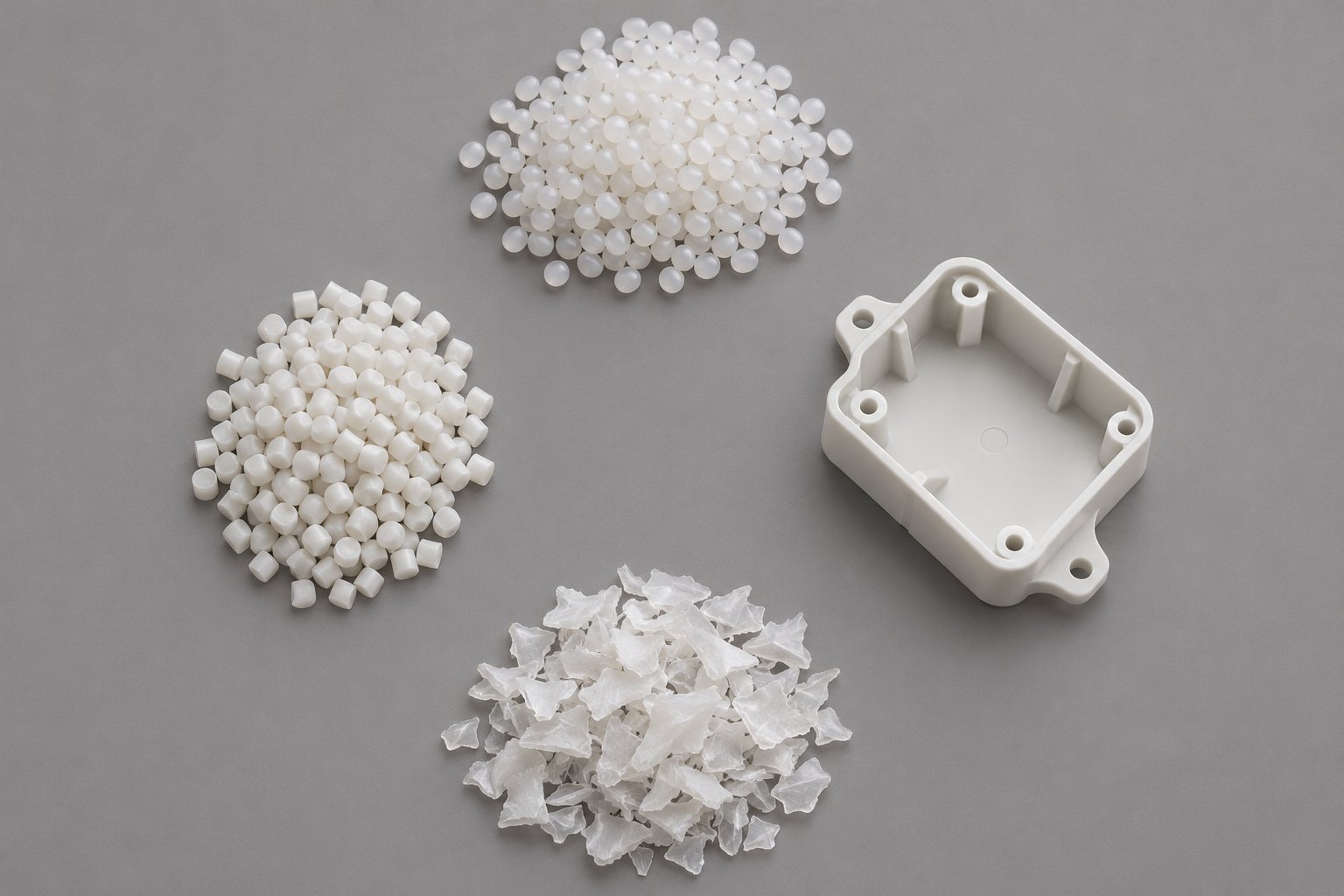
Recyclability and Long-Term Production Optimization for Talc Filled PP
A well-specified compound, a properly designed mold, and optimized injection parameters can deliver outstanding parts today. But two questions increasingly shape material decisions for tomorrow: What happens to talc-filled PP when the part reaches end of life? And how do you keep compound quality consistent across tens of thousands of production hours when abrasive mineral filler is slowly wearing down your compounding equipment from the inside out?
Both questions deserve far more attention than they typically receive. Recyclability affects whether your material choice aligns with tightening regulatory and OEM sustainability mandates. Equipment maintenance quality directly determines whether the mechanical properties and surface finish you validated during material qualification still hold true six months or two years into production. Here is what engineers, compounders, and procurement teams need to know.
Recyclability of Talc Filled Polypropylene
Talc-filled PP remains a polypropylene-based compound. It is not a thermoset, not a multi-polymer blend, and not chemically crosslinked. In principle, it is mechanically recyclable - you can grind it, re-melt it, and process it into new parts or pellets. That straightforward recyclability is one of the reasons polyolefin-based mineral-filled systems are favored over multi-material engineering plastic blends in applications where circular economy goals matter.
In practice, though, the mineral filler introduces a complication that sits right at the heart of how plastics recycling facilities sort materials: density.
Float-sink separation is the workhorse sorting technology in plastics recycling. It exploits a simple physical principle: polyolefins like unfilled PP and PE have specific gravities below 1.0, so they float in water, while non-polyolefins like ABS, PVC, and nylon sink. This clean separation works beautifully for unfilled polymers - but the moment you add talc, the math changes. Even at 10% loading, compound density rises above the 1.0 g/cm3 water threshold, routing the material into the sink fraction alongside the very non-polyolefins it should be separated from.
Real-world recycling data illustrates this clearly. A study on plastics recovery from WEEE found that while virgin PP floated completely in tap water (achieving 100% recovery in the float fraction), PP from waste electrical equipment behaved very differently - only 55.85% floated, while the remaining 44.15% sank. The researchers attributed this to talc filler, identifying magnesium and silicon signatures consistent with talc (H2Mg3(SiO3)4) in the sunken PP fraction. They estimated the talc loading in that fraction at approximately 40% by weight, pushing the compound's specific gravity into the 1.12-1.25 g/cm3 range - well above water's density and indistinguishable from many non-polyolefin plastics during conventional float-sink sorting.
This is not a hypothetical problem. It means that heavily filled talc PP parts entering mixed-waste recycling streams are systematically misrouted. They end up in the sink fraction with ABS, PVC, and nylon, contaminating those streams or - worse - being sent to landfill or incineration because the sorting process cannot identify them as recyclable polyolefins.
Several developments are improving the picture:
- Advanced sorting technologies: Near-infrared (NIR) spectroscopy can identify polymer type regardless of density, enabling correct classification of filled PP even when it sinks. However, NIR systems struggle with dark-colored plastics - a limitation the same WEEE recycling research highlighted - meaning black talc-filled PP parts (common in automotive and appliance applications) may still evade correct identification.
- Multi-stage density separation: Rather than relying on a single water bath, advanced facilities use multiple separation stages with solutions of increasing density to isolate filled polyolefins from true non-polyolefins. The WEEE study demonstrated that a staged approach using progressively denser solutions could recover the talc-filled PP fraction separately from PVC and nylon.
- Design-for-recyclability choices: Compound designers can improve end-of-life outcomes by limiting talc loading to the minimum level that meets application requirements. If a 15% talc compound satisfies stiffness and HDT targets, specifying it over a 30% grade keeps compound density lower and closer to the sorting thresholds that recycling facilities are calibrated around. This is a tangible design decision with real downstream consequences.
For talc-filled PP, recyclability is not a binary yes-or-no question - it depends on loading level, part color, and the sorting capabilities of the recycling facility processing it.
Procurement teams evaluating talc filled polypropylene suppliers should ask specifically about recyclability compatibility. Some compound producers now offer grades formulated with recycling-optimized talc levels and lighter colorants that improve NIR sortability - a meaningful differentiator as OEM sustainability requirements tighten.
Lightweighting and Circular Economy Contributions
Recyclability challenges at end of life are only one side of the sustainability equation. The other side - the lifecycle benefits that talc filler polypropylene delivers during its service life - often outweighs the sorting complications at disposal.
Consider an automotive instrument panel. The traditional material for this component was a polycarbonate-ABS blend, with a density around 1.10-1.20 g/cm3 and a compound cost substantially higher than talc-filled PP. Replacing that PC/ABS panel with a 20% talc-filled impact-modified PP compound delivers comparable stiffness and HDT at roughly similar density but at 20-30% lower material cost - and critically, the PP-based system is a mono-material polyolefin that is far simpler to recycle than a multi-polymer blend. You are not just saving cost and weight; you are simplifying the end-of-life material stream from a multi-component blend into a single polymer family.
The lightweighting contribution extends further when talc-filled PP replaces metals. Steel brackets, aluminum housings, and zinc die-cast components are increasingly being redesigned in 30-40% talc-filled PP where mechanical loads permit. A talc-filled impact-modified polypropylene compound at 1.20 g/cm3 weighs roughly one-sixth as much as the steel part it replaces per unit volume. Over the lifetime of a vehicle, every gram of weight reduction translates to reduced fuel consumption or extended electric range, compounding the environmental benefit across millions of units.
The circular economy case is built on three pillars:
- Mono-material simplicity: Unlike thermoset composites or multi-polymer blends, talc-filled PP is a thermoplastic that can be re-melted and reprocessed. The talc remains in the recycled compound, continuing to provide reinforcement in subsequent lives - though with some property degradation from thermal history and potential contamination.
- Closed-loop potential: Automotive OEMs and appliance manufacturers are increasingly establishing closed-loop recycling programs where production scrap and end-of-life parts are collected, reground, and recompounded into new parts. Talc-filled PP's processability and property retention through multiple reprocessing cycles make it a strong candidate for these programs.
- Reduced lifecycle carbon footprint: Replacing heavier materials with talc-filled PP reduces energy consumption during both manufacturing (lower processing temperatures than engineering resins) and use phase (lighter vehicles consuming less fuel). These lifecycle benefits accumulate at scale and contribute measurably to corporate sustainability targets.
The sustainability story is nuanced - talc-filled polypropylene shrinkage and density characteristics that make it so effective in service also create sorting challenges at end of life. Smart material specification balances both: selecting the lowest talc loading that meets performance requirements, designing parts in lighter colors when possible for NIR compatibility, and engaging with recycling infrastructure providers to ensure recovery pathways exist.
Optimizing Compounding Operations for Consistent Quality
Every property value discussed in this article - every flexural modulus data point, every shrinkage measurement, every impact curve - assumes that the talc-filled PP compound was manufactured correctly. Uniform talc dispersion, consistent loading accuracy, and proper platelet delamination during compounding are the foundation on which all downstream performance depends. And that foundation erodes progressively when abrasive mineral filler wears down the very equipment producing the compound.
Imagine running a twin screw extruder at 500 kg/hour, compounding a 30% talc-filled PP grade. Every kilogram of output carries 150 grams of mineral particles through the barrel, past the screw flights, and across the mixing elements. Over a single 24-hour production day, that adds up to more than 1,800 kg of abrasive mineral sliding against hardened steel surfaces under high pressure and temperature. Over a month, over a quarter, the cumulative wear is substantial.
The wear pattern is well understood. Industry analysis of twin screw extruder wear identifies mineral fillers like calcium carbonate and glass fiber as particularly aggressive abrasives that wear down metal surfaces far faster than molten polymers alone. The most vulnerable zones include the feeding section (where solid talc particles first contact the barrel wall), the kneading zones (where intensive shear forces press particles hard against metal surfaces), the mid-barrel region (where axial pressure causes screw deflection and barrel scraping), and the discharge section (where the cantilevered screw end sags under gravity and its edges rub against the barrel bore).
As screw flight lands wear down, the clearance between the flight tip and the barrel wall increases. That growing gap has direct consequences for compound quality:
- Reduced dispersive mixing: The narrow clearance between flight tip and barrel wall is where the highest shear rates occur - the shear that breaks apart talc agglomerates and delaminates stacked platelets into individual reinforcing particles. Worn clearances reduce this shear intensity, allowing more agglomerates to pass through intact.
- Reduced distributive mixing: Widened clearances allow melt to leak backward over the flight lands instead of being pushed forward in a controlled, uniform flow. This backflow reduces the number of effective mixing passes the compound experiences, leading to regions of higher and lower talc concentration within the same pellet batch.
- Potential metal contamination: Progressive abrasion removes metal from screw and barrel surfaces, and those metal particles can end up embedded in the compound. In applications with strict contamination specifications - food-contact packaging, medical device components, or Class A automotive surfaces - this is a disqualifying defect.
- Gradual property drift: The compound still looks the same coming out of the die. The pellets still weigh the same. But the dispersion quality inside those pellets has degraded, and parts molded from them will show lower impact strength, higher surface defect rates, and more variability in dimensional behavior. This drift is often invisible until quality issues reach a critical threshold - making proactive monitoring far more cost-effective than reactive troubleshooting.
Managing this reality requires a two-pronged approach: selecting barrel and screw materials matched to the abrasive demands of your specific formulation, and establishing a measurement-based replacement schedule rather than running components until failure.
On the materials side, the options range from standard nitrided tool steels to bimetallic barrel liners with tungsten carbide or boron-based alloys, and screw elements manufactured from powder metallurgy steels with finer grain structures and superior hardness. The right choice depends on your talc loading level, throughput rate, and the specific abrasive characteristics of your talc source. A compounder running 10% talc at moderate throughput has very different wear demands than one pushing 40% talc at maximum capacity.
This is where working with a barrel and screw supplier who understands mineral-filled compounding pays dividends. Production teams evaluating replacement twin screw barrels can work with manufacturers like NANHAIYA, whose parallel twin screw barrels are available with material and surface-treatment combinations reviewed for specific filler types, loading levels, and operating conditions. Their custom manufacturing approach - accepting machine details, drawings, samples, or measured dimensions as the basis for production - enables compounders to match barrel metallurgy and surface hardening precisely to the abrasive demands of their talc-filled PP formulations. Rather than settling for a one-size-fits-all replacement that may underperform in demanding mineral-filled applications, this tailored approach helps maintain the mixing efficiency and compound consistency that high-quality talc-filled PP production requires over the long term.
On the monitoring side, best practice involves periodic measurement of screw flight outer diameters and barrel bore inner diameters at key positions along the extruder length. Plotting these dimensions against production hours creates a wear trend line that predicts when clearances will reach the threshold where compound quality begins to degrade. Most experienced compounders set replacement triggers at specific clearance values rather than waiting for visible quality problems - because by the time defects are obvious in molded parts, the compound has been suboptimal for weeks or months.
Consistent compound quality, sustainable material design, and informed loading-level selection are not separate topics - they are interconnected facets of the same challenge. The talc filled polypropylene compound that performs best in service is the one specified at the right loading for the application, compounded on well-maintained equipment that delivers uniform dispersion batch after batch, and designed with enough foresight that the part can be identified, sorted, and recycled when its first useful life ends. Getting all three right is what separates a good material choice from an excellent one.
Frequently Asked Questions About Talc Filled Polypropylene
1. What is talc filled polypropylene used for?
Talc filled polypropylene is widely used in automotive interior and exterior parts such as instrument panels, door panels, bumper fascias, and HVAC ductwork. It also serves appliance housings like washing machine tubs and dishwasher doors, thermoformed packaging trays, electrical housings, and consumer goods. The material is chosen in each sector because it delivers a compelling combination of stiffness, heat deflection temperature, low isotropic shrinkage, and cost competitiveness that bridges the gap between commodity PP and pricier engineering resins like ABS or PC/ABS blends.
2. How does talc loading percentage affect polypropylene properties?
Increasing talc content from 10% to 40% progressively raises flexural modulus, heat deflection temperature, and hardness while reducing mold shrinkage. However, impact strength, elongation at break, and tensile strength decline as loading increases because rigid talc platelets act as stress concentrators. At 10% talc, stiffness gains are moderate and toughness is largely preserved. At 20%, the most commercially popular level, stiffness and HDT improve substantially with manageable impact loss. At 30-40%, stiffness approaches engineering-plastic territory, but the compound becomes noticeably brittle and demands higher processing temperatures. Impact modifiers such as EPR or EPDM elastomers can recover much of the lost toughness at any loading level.
3. Is talc filled polypropylene recyclable?
Talc filled PP is mechanically recyclable because it remains a thermoplastic polyolefin that can be reground and re-melted. The practical challenge lies in float-sink sorting at recycling facilities. Even 10% talc pushes compound density above 1.0 g/cm3, causing the material to sink in water alongside non-polyolefins like ABS and PVC. Advanced NIR spectroscopy can identify the polymer type regardless of density, though dark-colored parts may still evade detection. Keeping talc loading at the minimum level needed for performance and choosing lighter colorants improves end-of-life sortability and supports circular economy goals.
4. Why does talc-filled PP warp less than glass-fiber-filled PP?
The key difference is particle geometry. Glass fibers are one-dimensional and align strongly along the melt flow direction, resisting shrinkage mainly in that axis. This creates large differential shrinkage between flow and transverse directions, leading to warpage. Talc platelets are two-dimensional, spreading their restraining effect more uniformly across both in-plane directions. Published research measured differential shrinkage in talc-filled PP at 0.041% to 0.073%, compared to 0.186% to 0.321% for glass-fiber PP at similar loadings. This near-isotropic behavior makes talc-filled PP the preferred choice for large, dimensionally critical parts like automotive instrument panels.
5. How does abrasive talc filler affect compounding equipment over time?
Talc particles progressively erode twin screw extruder flight lands and barrel liner surfaces during compounding. As screw-to-barrel clearance increases, dispersive and distributive mixing efficiency drops, allowing more talc agglomerates to pass through and reducing compound consistency. Metal contamination from worn surfaces is also a risk. Production teams manage this by selecting wear-resistant barrel metallurgy - such as bimetallic liners with tungsten carbide alloys - and tracking screw and barrel dimensions against production hours. Suppliers like NANHAIYA offer custom-manufactured parallel twin screw barrels with material and surface-treatment options matched to specific filler types and loading levels, helping compounders maintain mixing quality over extended production runs.
Written by
Nanhaiya Technical Team
Zhoushan Nanhaiya Plastic Machinery Co., Ltd.
The Nanhaiya technical team supports screw and barrel manufacturing projects through application review, technical communication, custom manufacturing coordination, and production and quality control.
Discuss Your Application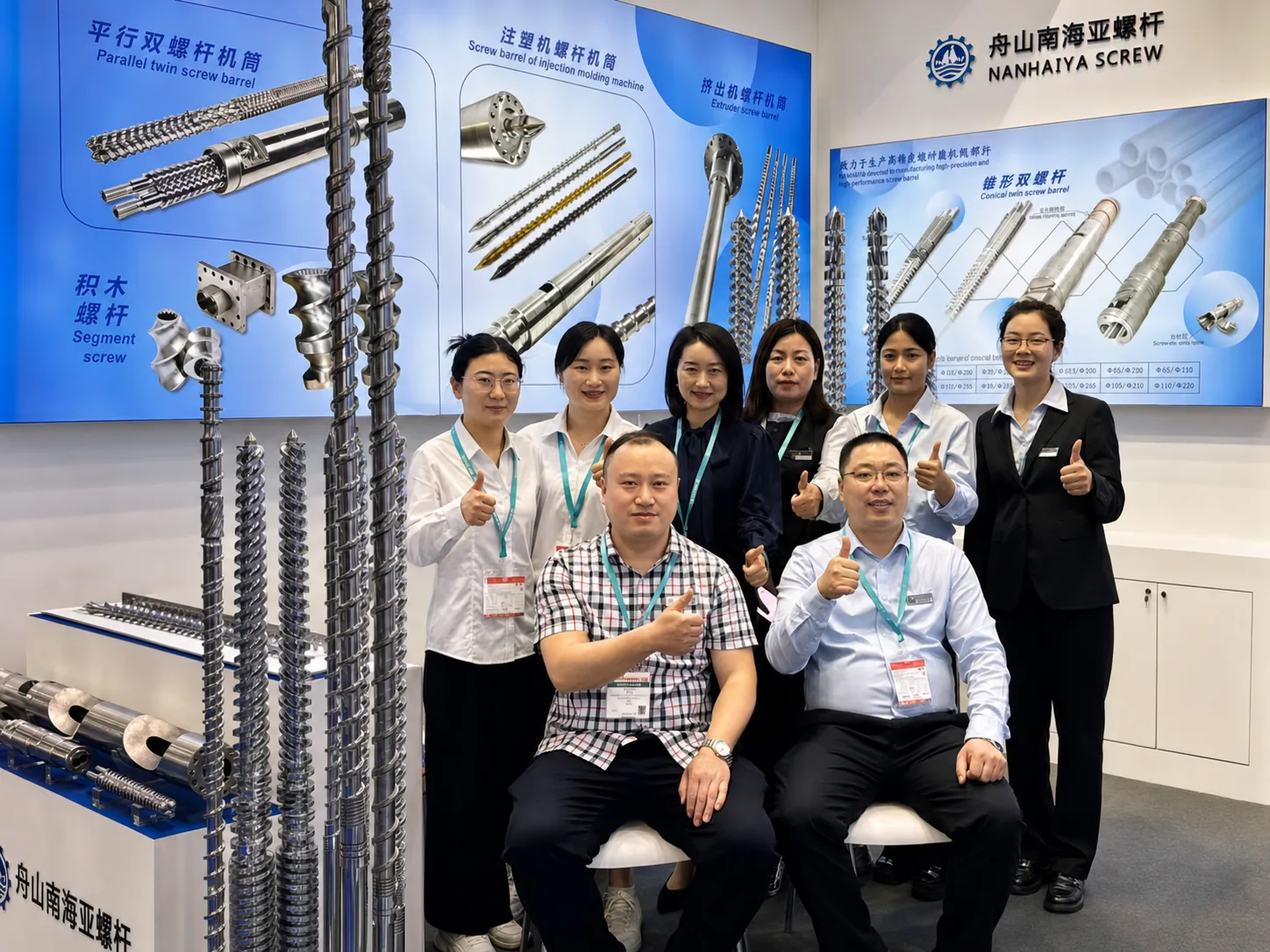
Related Articles
More insights on screw barrel technology and plastics processing.
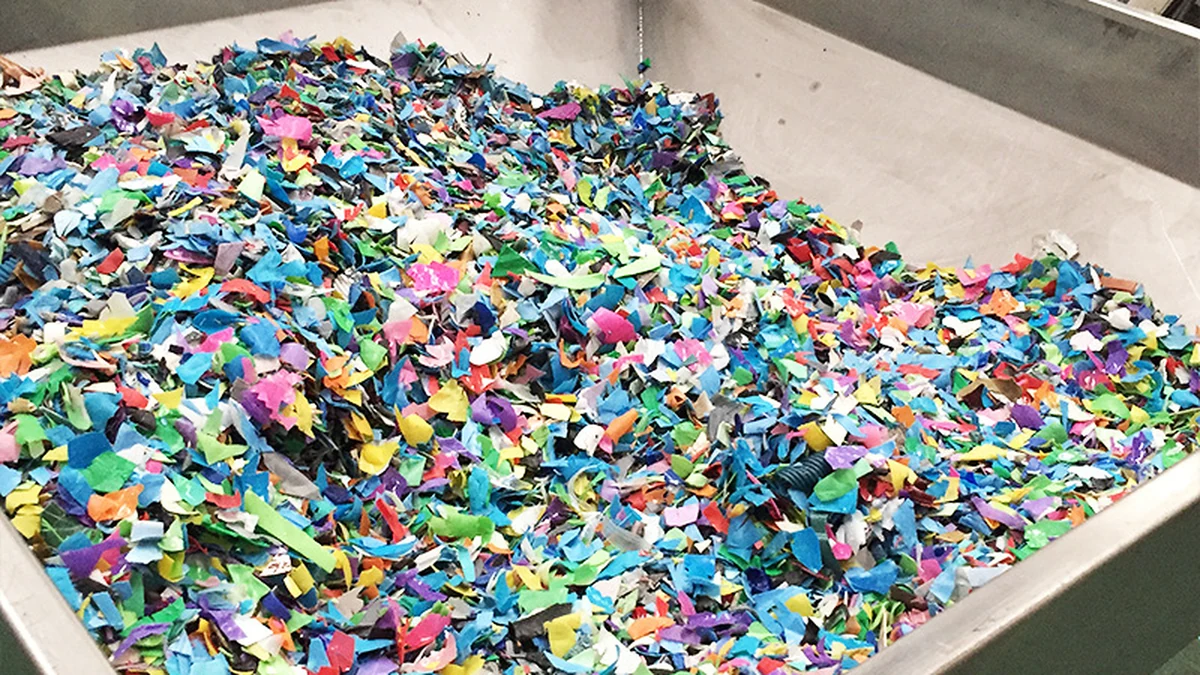
Recycling Pelletizing Line: From Raw Flake to Premium Pellet
Nov 4, 2026
Learn how a recycling pelletizing line converts plastic waste into premium pellets. Full guide covers components, extruder types, pelletizing methods, and more.
Read Article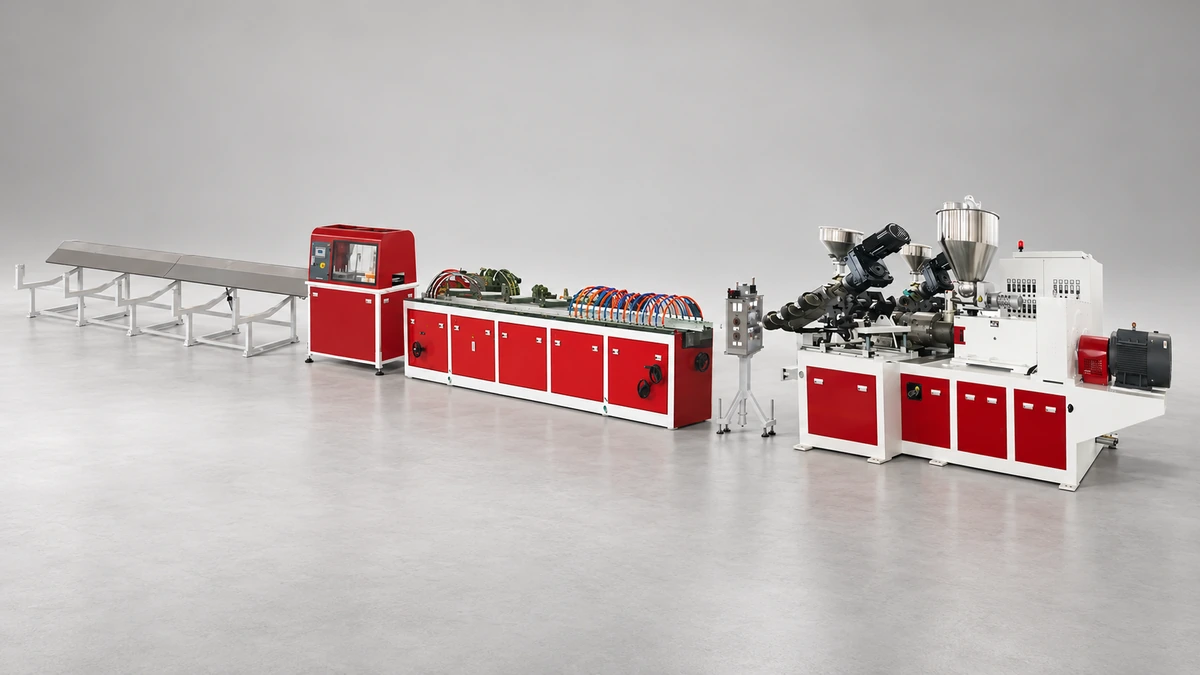
PVC Window Profile Making Machine Demystified: Resin In, Frames Out
Nov 3, 2026
Learn how a PVC window profile making machine works — from extruder configurations and downstream equipment to factory layout, maintenance, and buyer selection tips.
Read Article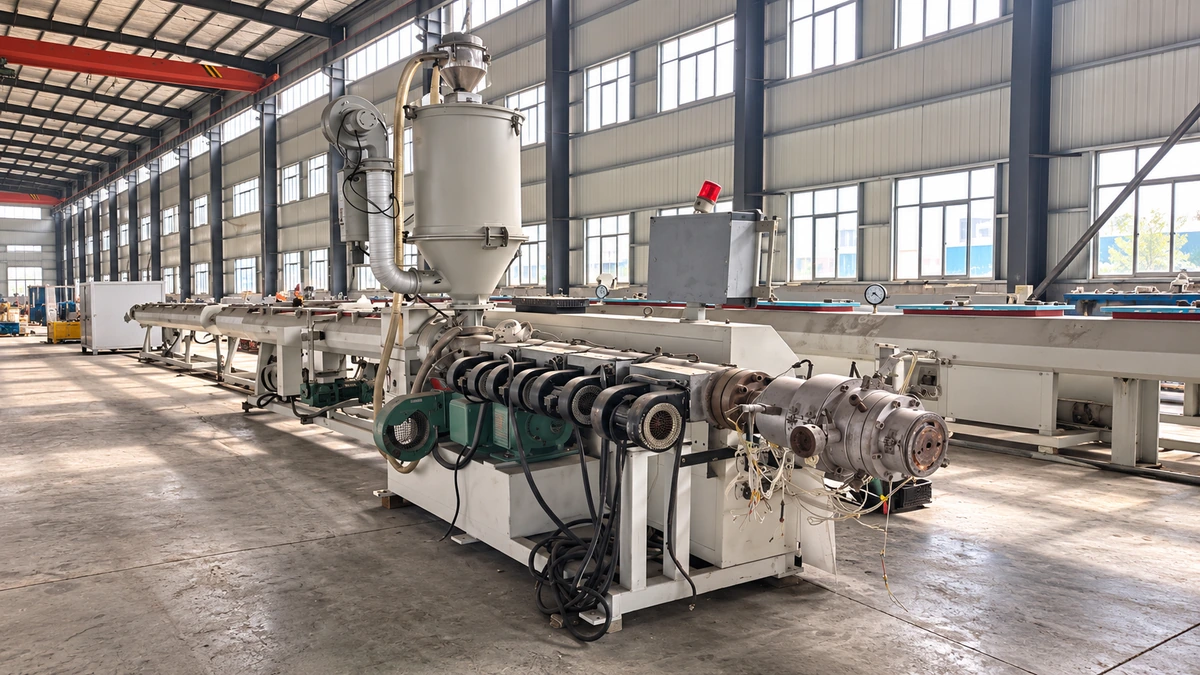
HDPE Pipe Extruder Machine: What Most Buyers Learn Too Late
Nov 3, 2026
Learn how HDPE pipe extruder machines work, compare single vs twin screw types, decode key specs, and get actionable maintenance tips to cut costs and boost output.
Read ArticleLooking for something else?
Search by material, symptom or product and jump straight to the relevant page.
These are navigation suggestions based on keyword matching — not a quotation, not a delivery commitment, and not a substitute for engineering review. Final specification is confirmed by our engineers against your drawings and processed material.
Need help with screw barrel selection?
Share your machine model, processed material and application. Our team can help with pricing and technical support.