

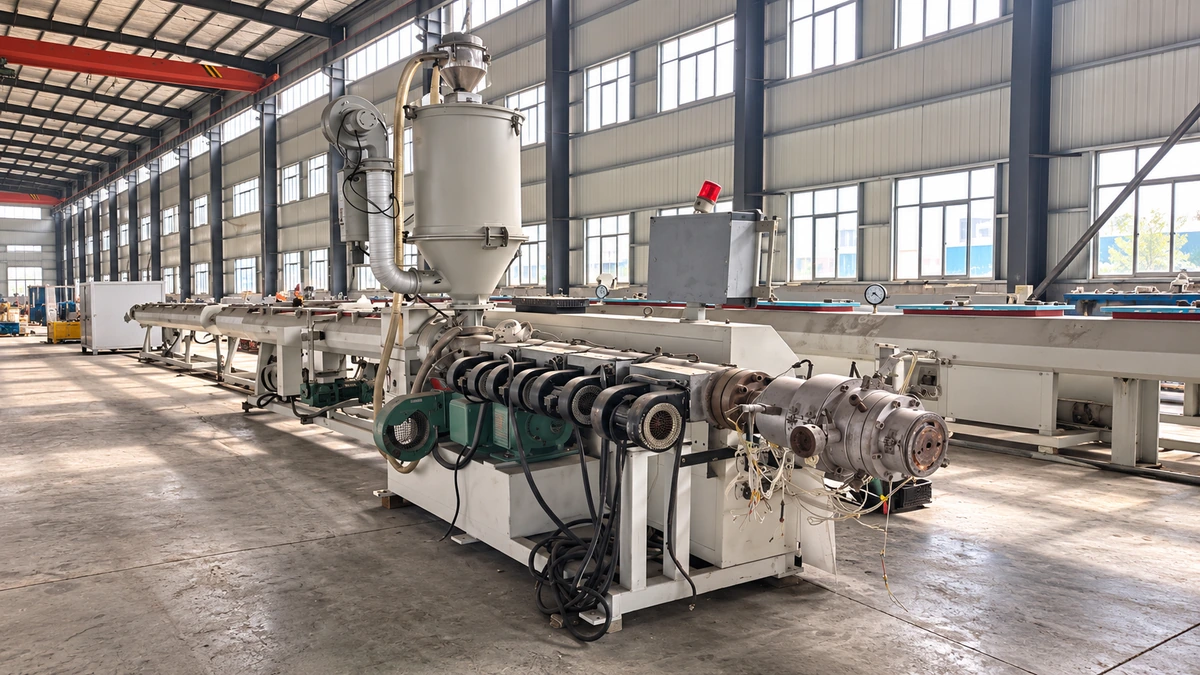
What Is an HDPE Pipe Extruder Machine and Why It Matters
Imagine you're tasked with sourcing the one piece of equipment that determines whether your pipe factory produces consistent, standards-compliant product — or burns through resin, energy, and time. That machine is the extruder, and most buyers underestimate just how much rides on understanding it before signing a purchase order.
Defining the HDPE Pipe Extruder Machine
An HDPE pipe extruder machine is a thermoplastic processing system designed to melt high-density polyethylene resin pellets and force the molten polymer through a shaped annular die, producing continuous hollow pipe profiles in a range of diameters and wall thicknesses. It serves as the central production unit within a broader extrusion line — feeding, melting, pressurizing, and shaping the raw material before downstream equipment handles sizing, cooling, and cutting.
An HDPE pipe extruder machine converts solid polyethylene resin pellets into continuous, dimensionally precise pipe by combining controlled heat, mechanical shear from a rotating screw, and pressure through a forming die — making it the core component that dictates throughput, quality, and energy efficiency of the entire production line.
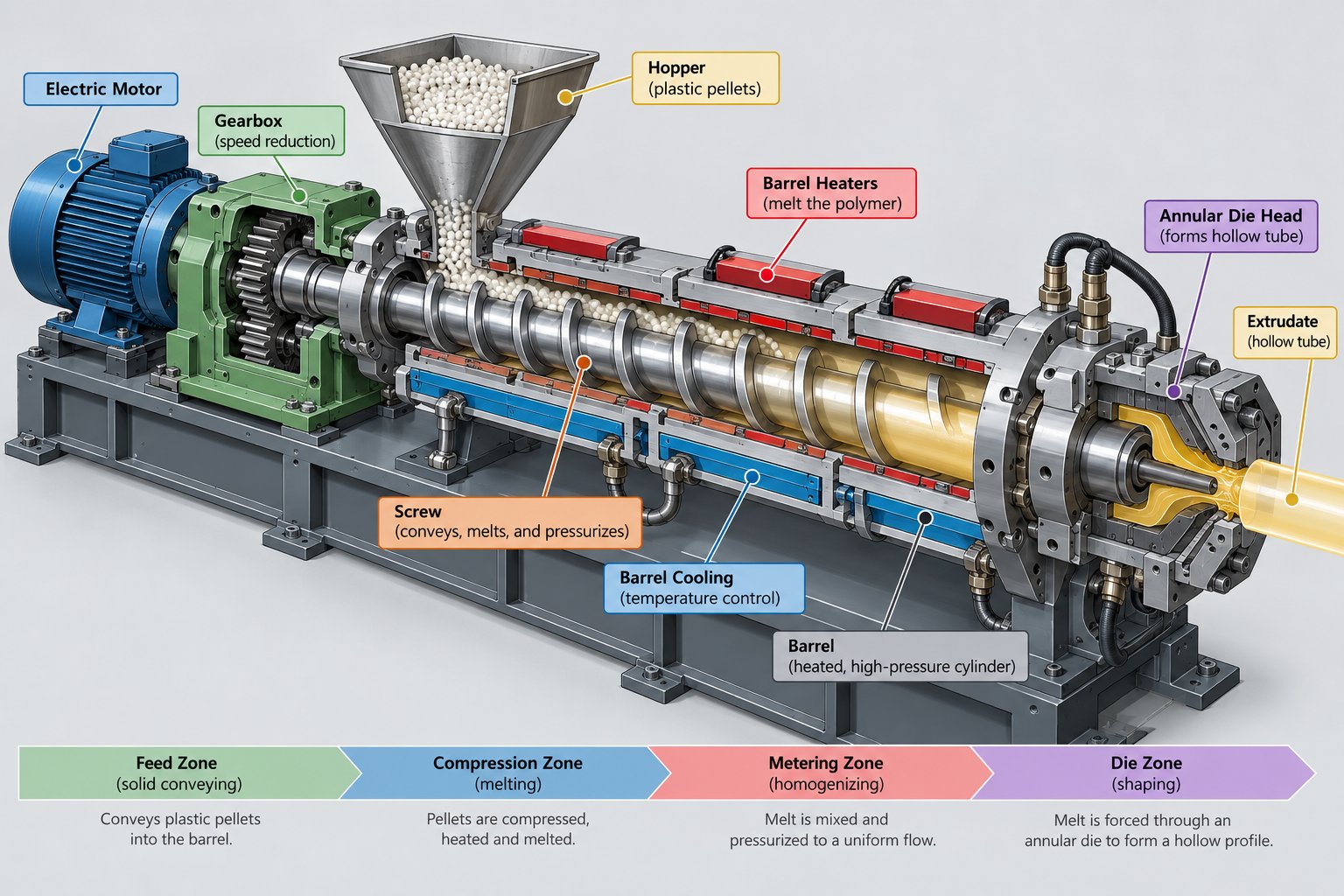
At its simplest, the system consists of a hopper for resin feeding, a heated barrel housing a precision-machined screw, a drive motor and gearbox, and a die head that shapes the melt into a pipe profile. Yet each of these elements involves engineering choices — screw geometry, barrel metallurgy, temperature zoning, motor type — that directly affect the pipe you'll produce. Understanding what this machine actually does, component by component, separates informed buyers from those who learn expensive lessons after installation.
Why HDPE Pipe Extrusion Matters Across Industries
The global appetite for HDPE pipes is not slowing down. The HDPE pipes market was valued at USD 22.46 billion in 2025 and is projected to reach USD 31.68 billion by 2031, growing at a 5.98% CAGR. What's fueling this? Municipal water supply and distribution alone accounted for 30.68% of global market value in 2025, while telecom and power ducting is expanding at an even faster 7.33% CAGR as fiber-to-the-home and 5G rollouts accelerate worldwide.
Water infrastructure investment tells an especially compelling story. The U.S. EPA identified USD 625 billion in 20-year drinking-water investment needs — a 30% increase from its 2018 assessment. In Asia-Pacific, which held nearly 45% of the global HDPE pipe market in 2025, India's Jal Jeevan Mission and China's urban pipeline modernization programs are generating enormous procurement demand. Gas distribution, agricultural irrigation, mining slurry transport, and cable ducting round out a demand picture that spans virtually every continent and climate.
Here's the critical connection most articles miss: surging pipe demand doesn't just mean more orders — it means manufacturers need pipe extruders that run faster, waste less material, consume less energy, and switch between product specifications without lengthy downtime. The machine itself becomes the competitive differentiator. A well-chosen extruder line operating at optimized parameters can be the difference between winning infrastructure contracts and watching margins evaporate. That's why understanding HDPE extrusion at the machine level — not just the process level — matters so much for anyone involved in pipe production.
Who This Resource Is For
This guide is built for three audiences on different points of the same journey. If you're new to pipe extruders and need a clear foundation — how the machine works, what each component does, and what the specifications actually mean — you'll find that grounding in the early sections. If you're an experienced operator or plant engineer looking for deeper clarity on screw geometry, resin-grade impacts, or quality control technologies, the mid-sections deliver specification-level detail that most resources skip entirely. And if you're a buyer or procurement professional evaluating a highspeed extrusion machine supplier or comparing equipment proposals, the later sections offer structured frameworks for selection, maintenance planning, and total cost of ownership.
Each section builds on the last, moving from fundamentals through technical depth to practical decision-making. The goal is straightforward: by the time you finish, you'll understand not just what an HDPE pipe extruder machine is, but exactly what makes one perform better than another — and how to avoid the costly surprises that catch unprepared buyers off guard.
How the HDPE Pipe Extrusion Process Works Step by Step
Knowing what's inside the machine is one thing. Seeing how every component works together — from the moment resin pellets drop into the hopper to the instant a finished pipe rolls off the line — is where the real understanding begins. The polyethylene extrusion process is continuous, and each stage places specific demands on the equipment. A bottleneck or mismatch at any point ripples through the entire line.
From Resin Pellets to Molten Polymer
Everything starts at the feed throat. HDPE resin pellets enter the barrel through a hopper equipped with either volumetric or gravimetric dosing. Volumetric feeders are simpler and less expensive, delivering material by volume. Gravimetric feeders weigh the pellets in real time, adjusting feed rate to maintain a precise mass flow — a meaningful advantage when consistent wall thickness and minimal material waste matter.
Once inside the barrel, the rotating screw takes over. It conveys pellets forward through progressively shallower channel depths, generating intense shear heat as the material compresses. External barrel heaters — arranged across multiple temperature zones — supplement this mechanical energy. The interaction between melt temperature, screw speed, and back pressure is delicate. Push the screw too fast, and excess shear heat can degrade the polymer. Set barrel temperatures too low, and you'll get an uneven melt with cold spots that show up as surface defects in the finished pipe. A high-efficiency single-screw extruder with an L/D ratio of 30:1 to 33:1 provides the residence time needed for thorough plasticization — turning solid pellets into a completely homogeneous melt ready for shaping.
Die Forming and Downstream Sizing
The molten HDPE exits the barrel under pressure and flows into an annular die head — the component that converts a cylindrical melt stream into a hollow pipe profile. Die geometry determines the pipe's target diameter and wall thickness, so the relationship between die gap, land length, and melt distribution must be precisely engineered for each product specification.
But shaping alone doesn't produce a usable pipe. The still-soft extrudate immediately enters a vacuum calibration tank, where negative pressure pulls the hot pipe wall against a calibration sleeve while water cooling locks in the outer diameter and roundness. Think of it as freezing the shape before gravity or internal stress can distort it. Spray cooling tanks downstream continue removing heat from the pipe wall until it's fully solidified.
The haul-off unit — typically a caterpillar-style puller with rubber-padded tracks — controls the pull speed relative to the extruder's output rate. This speed ratio is one of the most direct levers operators have over wall thickness. Pull faster, and the wall stretches thinner. Pull slower, and material accumulates into a thicker wall. Even minor speed oscillations can create repeating thickness variations, which is why stable, steplessly adjustable haul-off drives are non-negotiable for quality extruded HDPE pipe production.
Cutting and Stacking for Final Output
Extrusion is a continuous process, but customers need discrete lengths. Once the pipe exits the cooling section, a cutting station takes over. Planetary saws rotate around the pipe circumference and are the standard for large-diameter cuts — they travel with the moving pipe, cut cleanly, and return to their start position without interrupting the line. Chipless cutters serve a similar purpose for small- to medium-diameter pipes, delivering clean end faces without debris that could contaminate the product.
After cutting, automatic stacking frames or dump tables collect rigid pipe lengths, while coilers wind smaller-diameter pipes — generally those under 160 mm — into transportable rolls. The coiling speed must synchronize precisely with the extrusion rate; any mismatch introduces tension that can deform the pipe or loosen the coil.
Every one of these downstream stations — calibration, cooling, haul-off, cutting, stacking — depends on the extruder's output consistency. Fluctuations in melt pressure or temperature at the barrel ripple forward into dimensional errors at the saw. That's the practical reality of pipe extrusion machinery: the extruder is the heartbeat of the line, and every downstream unit is only as good as the melt it receives.
Understanding the full process also reveals something important for buyers: you're not purchasing a single machine — you're investing in a synchronized production system. And the specifications of the extruder at its core determine what the rest of that system can achieve.
Core Components of an HDPE Pipe Extrusion Line Explained
A synchronized production system is only as reliable as its weakest link. You've seen how the pipe extrusion process flows from raw pellets to finished product — but when something goes wrong on the line, you need to know exactly which component is responsible, what it's supposed to do, and which specification on that component's data sheet actually matters. This is where most equipment guides fall short. They list the parts without explaining the engineering logic connecting them.
Let's break down each major component of the hdpe extrusion line in the order the material encounters it, focusing on function, critical specifications, and how each unit interacts with its neighbors.
Extruder Unit — Screw, Barrel, and Drive System
The hdpe extruder is the heart of the entire operation. Strip away the control panels and safety covers, and you're looking at three core elements working in concert: a helical-flighted screw rotating inside a hardened cylindrical barrel, powered by a motor-and-gearbox drive system.
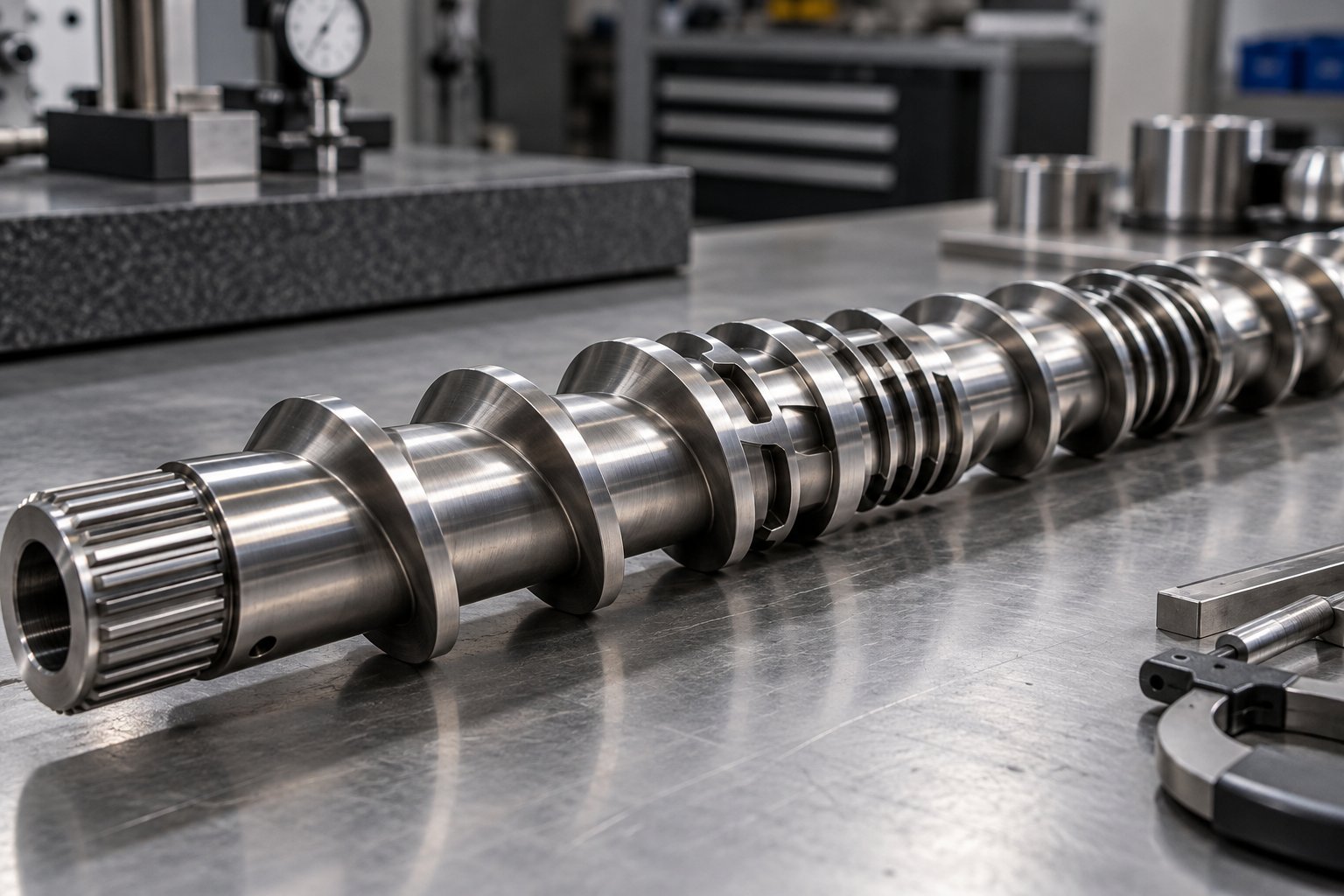
The screw does the heavy lifting. As it rotates, it conveys HDPE pellets forward from the feed throat, generates shear heat through friction and compression, and builds the melt pressure needed to push homogeneous polymer through the die. Screw design is not one-size-fits-all. For HDPE pipe, screws typically feature barrier flights and mixing sections that separate the solid bed from already-molten material — improving melt quality and reducing the gel particles that create weak spots in pressure-rated pipe walls.
The barrel houses the screw and provides the external heat input through multiple independently controlled temperature zones. Barrel metallurgy matters more than most buyers realize. Standard nitrided steel barrels handle clean virgin HDPE adequately, but lines processing recycled or mineral-filled feedstocks benefit from bimetallic barrel liners — centrifugally cast wear-resistant alloy layers that dramatically extend service life.
Three specifications dominate the conversation when evaluating an extruder unit:
- Screw diameter — Typically 45 mm to 120 mm or larger for pipe applications. Diameter determines throughput capacity: a bigger screw moves more material per revolution but requires a proportionally larger drive and consumes more energy at idle. Matching screw size to your target pipe range avoids both the excessive shear of an undersized screw running at maximum RPM and the poor mixing of an oversized screw barely turning.
- L/D ratio (length-to-diameter) — Commonly 30:1 to 36:1 for HDPE pipe extruders. This ratio governs how much barrel length the resin has for melting, mixing, and pressure stabilization. A 30:1 ratio suits most standard pipe production, while 33:1 or 36:1 provides longer melting and homogenization zones for high-speed lines or demanding PE100 grades.
- Motor power — Measured in kilowatts, the motor must deliver sufficient torque at the target screw speed without overloading the gearbox. An undersized motor limits your maximum throughput. An oversized motor wastes capital and runs inefficiently at partial load. The right motor is the one matched to your screw's torque demand at 60% to 75% of rated RPM — the operating sweet spot for consistent melt quality.
Here's the takeaway most catalogs won't state plainly: barrel and screw quality directly determine melt consistency, energy consumption per kilogram of output, and how many months you'll run before wear degrades your pipe dimensions. These aren't accessories — they're the components that define whether your extruder performs to spec or slowly drifts out of tolerance.
Die Head and Mandrel Assembly
Picture the melt stream exiting the barrel — it's a cylindrical column of pressurized, molten HDPE. The die head's job is to convert that solid cylinder into a hollow annular profile that becomes your pipe. It does this through a carefully engineered flow channel that splits the melt around a central mandrel, then reunites it into a seamless tube shape before it exits through the die lips.
Die geometry is matched precisely to your target pipe diameter and wall thickness. The annular gap between the die ring (outer wall) and the mandrel (inner wall) defines the initial pipe dimensions, while the die land length — the parallel section just before the melt exits — influences surface finish and melt pressure stability. For HDPE pipe, spider die designs are gaining popularity because they offer short residence time and low back pressure, which suits high-molecular-weight PE100 grades that are sensitive to prolonged heat exposure.
Why should buyers care about die-change systems? Because production flexibility depends on them. Switching from 110 mm to 200 mm pipe means swapping the die ring, mandrel, and often the calibration tooling. A quick die-change system — with pre-aligned mounting, hydraulic clamping, and minimal bolt connections — can cut changeover time from several hours to under one. For manufacturers running multiple pipe sizes across shifts, that time savings directly translates into higher annual output from the same extrusion line.
One detail that often gets overlooked: the die head must be thermally balanced. Uneven heating around the die circumference creates thicker walls on the hot side and thinner walls on the cool side. Quality die heads feature individually controlled heating zones and insulated outer shells to eliminate these temperature gradients — a detail worth verifying in any equipment proposal.
Vacuum Sizing Tank, Haul-Off, and Cutter
The moment molten HDPE leaves the die, gravity and internal stress start working against you. Without immediate downstream control, the soft pipe would sag, distort, and lose every dimension the die just established. The downstream equipment trio — sizing, haul-off, and cutting — locks in those dimensions and delivers a finished product. Each unit must be precisely synchronized with the extruder's output rate, because even small mismatches in speed or pressure ripple into dimensional defects.
Here's what each component does and the key specification to evaluate:
- Vacuum sizing tank — Uses negative pressure (vacuum) to pull the hot, still-pliable pipe wall outward against a precision calibration sleeve, establishing the target outside diameter and roundness. Water sprays inside the tank cool the outer surface simultaneously, freezing the shape in place. Key spec to evaluate: vacuum control range and stability. As process engineers emphasize, even small swings in vacuum level show up as gradual OD movement or roundness changes that are difficult to correct downstream. Look for tanks with closed-loop vacuum regulation rather than simple manual valves.
- Spray cooling tanks — Extend the cooling process started in the sizing tank, removing residual heat from the pipe wall until the material is fully solidified through its entire cross-section. Larger-diameter, thicker-wall pipes require longer cooling sections — sometimes multiple tanks in series. Key spec to evaluate: total cooling length relative to your maximum pipe diameter and wall thickness. Insufficient cooling length forces you to slow the line, directly limiting throughput.
- Haul-off (caterpillar puller) — Grips the cooled pipe with rubber-padded caterpillar tracks and draws it through the line at a controlled, constant speed. The ratio between haul-off speed and extruder output is the primary lever for wall thickness control. Key spec to evaluate: drive type and speed stability. Servo-driven haul-offs with encoder feedback maintain pull speed within tight tolerances, preventing the wall thickness oscillations that cheaper, less responsive drives allow.
- Cutting saw — Sections the continuous pipe into specified lengths. Planetary saws orbit around the pipe and travel with it during the cut, so the line never stops. Chip-free cutters use a blade that pinches through the wall without generating debris — ideal for clean-room or potable-water pipe production. Key spec to evaluate: cutting speed and travel length, which must match your maximum line speed and pipe diameter. A saw that can't keep pace forces line slowdowns.
The coordination between these units deserves emphasis. Imagine the extruder pushing melt at a steady 300 kg/hr, but the haul-off speed drifts by just 2%. That small change alters the wall thickness across every meter of pipe produced during the drift. Multiply that by a 24-hour production run, and you've generated hundreds of meters of out-of-spec product. Modern extrusion lines address this with centralized PLC control that links extruder speed, haul-off speed, vacuum level, and cutting timing into a single coordinated system — ensuring the pipe extrusion process runs as one integrated machine rather than a collection of independent stations.
Grasping these components individually is essential. But the performance you'll actually get depends heavily on a design choice made before any of them come into play — whether the extruder at the line's core uses a single-screw or twin-screw configuration, and what that choice means for your specific HDPE pipe application.
Single-Screw vs Twin-Screw Extruders for HDPE Pipe Production
That design choice — single screw or twin screw — shapes everything from your capital outlay to your daily energy bill. Yet most equipment brochures present both options without clearly explaining which architecture actually suits HDPE pipe and why. The answer is more straightforward than the marketing suggests, but the details matter.
How Single-Screw Extruders Handle HDPE Pipe
For the vast majority of HDPE pipe applications, single-screw extruders are the workhorse. They dominate the landscape for a practical reason: HDPE arrives as uniform, pre-pelletized resin — exactly the feedstock single-screw systems handle best. The screw relies on friction-based drag flow to convey, compress, and plasticize pellets as they move down the barrel. It's a mechanically simpler architecture with fewer moving parts, which translates directly into lower capital cost, easier operator training, and reduced maintenance overhead.
That simplicity doesn't mean limited capability. Modern single-screw pe pipe extrusion machines equipped with optimized screw geometry — barrier flights that separate the solid bed from the melt pool, and dispersive mixing sections near the metering zone — process PE80 and PE100 resins with excellent melt homogeneity. Grooved feed bushings further improve conveying stability, building the consistent melt pressure that pressure-rated pipe demands. For mono-layer HDPE pipe in any diameter from small-bore irrigation tubing to large-bore water mains, a well-engineered single-screw extruder delivers reliable, repeatable results shift after shift.
Here's the part buyers often overlook: the performance and service life of any single-screw extruder depend heavily on the quality of its screw and barrel. These are the wear components — the parts in direct contact with abrasive polymer flow under extreme heat and pressure. A precision-engineered barrel with the right metallurgy extends uptime and maintains output quality far longer than a generic replacement. For operators sourcing custom or replacement components, specialists like NANHAIYA manufacture single screw barrels specifically for pipe extrusion lines, offering tailored solutions that match the exact screw geometry and wear profile your application demands.
When Twin-Screw Configurations Make Sense
Twin-screw extruders use two intermeshing screws — either co-rotating or counter-rotating — to provide forced material displacement, superior mixing intensity, and tighter thermal control. Sounds like an upgrade across the board, right? Not exactly. Their strengths are most relevant in scenarios where single-screw machines genuinely struggle.
Twin-screw configurations earn their place in an hdpe plant when the production scope includes:
- Multi-layer pipe co-extrusion — where a secondary extruder feeds a barrier or marking stripe layer into the die head alongside the main HDPE melt stream.
- Heavily filled compounds — HDPE blended with high percentages of mineral fillers or reinforcing agents that require intensive distributive mixing to achieve uniform dispersion.
- Recycled HDPE blends — post-consumer or post-industrial regrind with variable melt flow index, contamination, or moisture content that benefits from the twin-screw's superior venting and mixing capabilities.
Counter-rotating twin screws, in particular, are the standard for PVC dry-blend pipe production — a different polymer family entirely. For straight HDPE pipe from virgin pellets, the added complexity and cost of a twin-screw system rarely justify the marginal processing advantage. As industry selection guides consistently note, single-screw extruders remain the default for polyolefin pressure pipe, while twin screws serve specialized or multi-material applications.
Side-by-Side Comparison for Buyers
When you're evaluating proposals and trying to understand how hdpe is manufactured on each platform, a structured comparison cuts through the noise. The table below maps the key decision factors buyers encounter most often:
| Evaluation Criteria | Single-Screw Extruder | Twin-Screw Extruder |
|---|---|---|
| Output Capacity Range | Moderate to high (varies with screw diameter; well-suited for standard HDPE pipe throughput targets) | Moderate to very high (output less dependent on screw speed; advantageous for filled or blended materials) |
| Typical Pipe Size Range | 16 mm to 1600 mm+ (full range of HDPE pipe diameters) | Typically used for specialty or multi-layer pipe; less common for standard large-bore HDPE |
| Energy Consumption per kg | Lower for pelletized HDPE; efficient drag-flow conveying minimizes wasted energy | Potentially higher due to dual-drive system; energy advantage appears mainly with powder or dry-blend feeds |
| Material Versatility | Best for pre-pelletized polyolefins (HDPE, PP, PE-RT); limited with powders or high-filler blends | Handles pellets, powders, dry blends, recycled flake, and heavily filled compounds |
| Maintenance Complexity | Simpler — single screw and barrel to inspect, replace, and align; fewer gearbox components | More complex — two screws, tighter tolerances, specialized gearbox; higher spare-part inventory needed |
| Typical Price Tier | Lower capital investment for equivalent pipe output capacity | Higher upfront cost; justified when processing demands exceed single-screw capability |
A few things stand out in this comparison. For buyers focused on standard HDPE pipe — water, gas, telecom ducting — the single-screw extruder wins on cost, simplicity, and fitness for purpose. The twin-screw earns its premium only when your product mix or feedstock demands capabilities that a single screw physically cannot deliver.
The practical takeaway? Don't let feature-rich twin-screw proposals distract you from matching machine architecture to your actual production requirements. A single-screw line with high-quality wear components, optimized screw geometry, and proper downstream equipment will outperform a more expensive twin-screw setup that's overbuilt for the job.
Of course, choosing between single and twin screw is just one layer of the specification puzzle. The numbers on the data sheet — screw diameter, L/D ratio, motor power, output capacity — carry equally important implications that most buyers struggle to decode without a clear framework.
Technical Specifications Decoded for HDPE Pipe Extrusion Machine Buyers
You've narrowed the architecture down to a single-screw or twin-screw platform. The supplier sends over a spec sheet. And suddenly you're staring at a grid of numbers — screw diameter, L/D ratio, motor kW, output kg/hr, maximum RPM — with no clear sense of which figures actually matter for your production goals and which are just catalog filler.
This is where many buyers make costly mistakes. They chase the biggest output number or the most impressive motor rating without understanding how these specifications interact — and how mismatching even one parameter can quietly undermine pipe quality, energy efficiency, or throughput for years. Let's decode the key specs on any hdpe pipe extrusion machine data sheet so you can read them the way an experienced process engineer would.
Screw Diameter and L/D Ratio — What They Really Mean
These two numbers appear at the top of virtually every extruder specification table, and they deserve that prominence. Together, they define the machine's fundamental processing capability.
Screw diameter is the straightforward one. Measured in millimeters, it refers to the outer diameter of the screw flight — the helical ridge that conveys and compresses resin inside the barrel. Larger diameter means a bigger channel volume per revolution, which translates directly into higher potential throughput. A 65 mm screw physically moves less material per turn than a 120 mm screw, regardless of how fast you spin it. So when you see screw diameter on a spec sheet, think of it as the machine's ceiling for output capacity.
But raw capacity doesn't guarantee good pipe. That's where the L/D ratio — length-to-diameter — comes in. This ratio tells you how much barrel length the resin has available for melting, mixing, and pressure stabilization relative to the screw's size. A 65 mm screw with a 30:1 L/D has an effective working length of 1,950 mm. The same screw at 36:1 stretches to 2,340 mm — an extra 390 mm of processing zone that gives the polymer more time and thermal exposure to reach a fully homogeneous melt.
Why does that matter practically? Because HDPE, especially high-molecular-weight PE100 grades, is notoriously difficult to plasticize uniformly. Incomplete melting produces gel particles and inconsistent melt viscosity — both of which show up as surface defects or weak spots in pressure-rated pipe walls. A higher L/D ratio provides longer melting and mixing zones that improve melt quality, particularly at elevated screw speeds where the resin spends less time in the barrel per revolution.
Here's a useful framework for pe extrusion line buyers:
- 30:1 L/D — Adequate for standard HDPE pipe production at moderate line speeds. This is the traditional baseline and handles PE80 and PE100 resins under normal operating conditions.
- 33:1 to 36:1 L/D — Preferred for high-speed extrusion or when processing demanding resins. The extended barrel length improves homogeneity and reduces the risk of unmelted particles reaching the die, which becomes critical when you're pushing throughput to maximize output.
- 38:1 to 42:1 L/D — Emerging as a performance tier for processors who need superior melt quality, effective venting, and the ability to handle recycled or modified polyolefin blends. Industry data indicates that extruders in the 42:1 L/D class can deliver 20-30% higher production capacity under the same screw diameter compared to shorter-ratio machines, while also broadening the processing window for variable-quality feedstocks.
The takeaway? Don't evaluate screw diameter and L/D ratio in isolation. A smaller-diameter screw with a higher L/D ratio can sometimes outperform a larger screw with a short barrel on melt quality — even if the bigger machine boasts a higher peak throughput number on paper. Match both specs to your target pipe quality and production speed requirements, not just to whichever number looks most impressive.
Motor Power, Screw Speed, and Output Capacity
If screw diameter sets the ceiling, the motor is the engine that decides how close you actually get to it. Motor power, measured in kilowatts, must deliver enough torque at the target screw RPM to overcome the shear resistance of the HDPE melt — and that resistance is substantial. HDPE has a higher melt viscosity than many thermoplastics, which means the drive system works harder per kilogram of output compared to processing polypropylene or PVC.
Screw speed, expressed in RPM, controls how fast the screw turns and therefore how quickly material moves through the barrel. The relationship between RPM and output is roughly linear: increase screw speed by 25%, and throughput rises by approximately 25%. Sounds simple enough — just crank up the RPM for more pipe, right?
Not so fast. Higher screw speed generates proportionally more shear heat inside the barrel. Engineering calculations show that a 25% increase in RPM can raise melt exit temperature by 8-15 degrees Celsius and increase power draw by 35-45%. That extra thermal energy doesn't just waste electricity — it risks degrading the HDPE, reducing the polymer's long-term stress-crack resistance and creating processing instability that ripples through every downstream unit. The barrel's cooling system has to work harder, the vacuum calibration tank sees a hotter, softer extrudate, and wall thickness control becomes more difficult.
This is why output capacity — measured in kg/hr — is the ultimate productivity metric, not screw speed alone. Output capacity represents the actual mass of pipe-grade melt your extruder can deliver at a stable, sustainable operating point. Two machines with identical screw diameters can have very different practical output capacities if one has better screw geometry, a higher L/D ratio, or a more efficient drive system that maintains melt quality at higher speeds.
When comparing extrusion pipe machine proposals, focus on these relationships:
- Motor power must match screw torque demand. Ask the supplier for the torque curve, not just the peak kW rating. An undersized motor limits your maximum sustainable throughput. An oversized motor wastes capital and runs inefficiently at low load percentages.
- Sustainable output matters more than peak output. Any extruder can hit a high kg/hr number for a short burst. The spec that matters is what the machine delivers continuously over an 8- or 24-hour shift without melt temperature excursions or pressure instability.
- Specific energy consumption (SEC) — expressed as kWh per kg of processed HDPE — ties motor power and output together into a single efficiency metric. Well-optimized lines achieve SEC values below 0.35 kWh/kg, while older or poorly matched systems may consume 0.45 kWh/kg or more. Over a 6,000-hour annual production cycle, that difference translates into tens of thousands of dollars in energy costs.
Pipe Diameter Range and Machine Sizing
Here's the buyer question that ties everything together: which extruder size do I actually need for the pipes I want to produce?
The answer depends on your target pipe diameter range — and it's important to understand that different diameter classes don't just require different die heads. They demand fundamentally different extruder frames, screw sizes, motor classes, and downstream equipment scales. You cannot simply swap a die on a small extruder and expect it to produce large-bore municipal pipe. The melt volume required, the cooling length needed, and the mechanical forces involved scale dramatically.
The table below maps general pipe diameter tiers against typical extruder specifications. These correlations are drawn from industry production data and represent common configurations — specific values vary by manufacturer, screw design, resin grade, and target wall thickness, so always confirm against the supplier's datasheet for your exact application.
| Pipe Diameter Tier | Pipe OD Range | Typical Screw Diameter | Typical L/D Ratio | Approximate Motor Power Class | Approximate Max Throughput (HDPE) |
|---|---|---|---|---|---|
| Small Diameter | 16 - 110 mm | 45 - 65 mm | 30:1 - 33:1 | 30 - 90 kW | Up to 350 kg/hr |
| Medium Diameter | 110 - 450 mm | 65 - 90 mm | 33:1 - 38:1 | 90 - 250 kW | 350 - 750 kg/hr |
| Large Diameter | 450 - 1200 mm | 90 - 150 mm | 36:1 - 40:1 | 250 - 500 kW | 750 - 1,800 kg/hr |
| Extra-Large Diameter | 1200 mm+ | 150 mm+ | 38:1 - 40:1 | 500 kW+ | 1,800 kg/hr+ |
A few patterns emerge from this data that are worth highlighting for buyers in extruded pipe manufacturing:
- Screw diameter scales with pipe size, but not linearly. Jumping from small to medium pipe diameters might mean moving from a 65 mm to a 90 mm screw — a manageable step. Moving from medium to large pipe often requires a 120 mm or 150 mm screw, which represents a substantially larger machine frame, heavier gearbox, and higher foundation requirements.
- L/D ratios trend upward for larger machines. Bigger extruders processing thicker-wall, large-diameter pipe benefit from longer barrels that provide more thorough plasticization at the higher melt volumes involved. A 40:1 ratio on a 150 mm screw gives the resin 6,000 mm of effective barrel length — plenty of processing distance for even the most demanding PE100 formulations.
- Motor power jumps are significant. The difference between a 90 kW and a 500 kW motor isn't just a bigger number on the nameplate — it means different electrical infrastructure, higher cooling demands, and a different class of gearbox entirely. Make sure your factory's power supply and utility layout can accommodate the machine tier you're specifying.
One common buyer mistake deserves a direct callout: purchasing a machine sized only for today's product range. If your current orders are all in the 110-315 mm range but you anticipate moving into 450 mm or larger pipe within a few years, a modular line designed for future capacity upgrades will cost less in the long run than buying a second complete extrusion line later.
The specifications on an extruder data sheet are not isolated numbers — they form an interconnected system where screw diameter, L/D ratio, motor power, and output capacity must all align with your target pipe range and resin grade to deliver consistent quality and efficient production.
Speaking of resin grades — the spec sheet might tell you what the machine can do mechanically, but the HDPE resin you feed into it introduces an entirely different layer of variables. PE80 and PE100 don't just differ in pressure rating; they behave differently inside the barrel, and those differences demand specific adjustments to the very parameters you've just learned to decode.
HDPE Resin Grades and Their Impact on Extruder Settings
Two resins can both be labeled "HDPE" and still behave like entirely different materials inside the barrel. PE80 melts more easily, flows at lower pressures, and forgives sloppy temperature profiles. PE100 resists plasticization, demands higher energy input, and punishes operators who copy-paste settings from one grade to the other. Yet a surprising number of hdpe pipe extruder machine operators run the same barrel profile regardless of which resin is in the hopper — and then wonder why surface quality, wall thickness consistency, or energy consumption shifts unpredictably between production runs.
The resin grade you process isn't just a pipe design variable. It's an extruder setup variable, and ignoring that reality costs real money in scrap, energy, and wear.
Understanding PE80, PE100, and PE4710 Resin Grades
The classification system for HDPE pipe resins is built around one central metric: Minimum Required Strength, or MRS. This value represents the extrapolated 50-year hydrostatic strength of the material at 20 degrees Celsius, expressed in megapascals. It's the number that determines what pressure rating a given pipe wall thickness can achieve.
Here's how the three grades you'll encounter most often stack up:
- PE80 (MRS 8.0 MPa) — The earlier-generation pipe resin. PE80 grades have a broader molecular weight distribution and a relatively higher melt flow index, typically 0.3 to 0.7 g/10min at 190 degrees Celsius and 2.16 kg load. That translates to lower melt viscosity and easier processing — the resin flows more readily through the barrel and die. PE80 is still widely used for low-pressure water distribution and irrigation, particularly in markets where cost sensitivity outweighs the need for maximum pressure performance.
- PE100 (MRS 10.0 MPa) — The modern standard for pressure-rated HDPE pipe. PE100 resins achieve their higher strength through bimodal molecular weight distribution — a carefully engineered blend of high-molecular-weight chains (providing toughness and stress crack resistance) and low-molecular-weight chains (providing processability and stiffness). This bimodal architecture gives PE100 a lower melt flow index, typically 0.2 to 0.4 g/10min, which means higher melt viscosity and greater resistance to flow inside the extruder. PE100 dominates global specifications for potable water, natural gas, and industrial pressure piping.
- PE4710 — The North American designation under ASTM D3350, roughly equivalent to PE100 in performance class but with specific additional requirements for slow crack growth resistance and hydrostatic design basis validation. Research presented at the Plastic Pipes Conference highlights that newer bimodal PE4710/PE100 resins offer enhanced sag resistance — a critical property when extruding large-diameter, thick-wall pipe where the still-molten pipe wall must hold its shape against gravity during post-extrusion cooling. These advanced grades place even higher demands on melt homogeneity and temperature control within the extruder.
What ties these distinctions together for the hdpe pipe production line operator? Molecular weight distribution and melt flow index aren't abstract lab metrics — they directly determine how much energy the screw must input, how high the barrel temperatures need to climb, and how aggressively the cooling system must work. A resin that flows reluctantly requires a fundamentally different machine setup than one that flows readily.
How Resin Properties Dictate Machine Parameters
Imagine loading PE100 pellets into a barrel still set up for PE80. The screw starts turning, the motor works harder than expected, and within minutes you notice higher current draw on the HMI, rougher pipe surface, and erratic melt pressure at the die head. What happened? The machine is trying to plasticize a more viscous, higher-molecular-weight polymer with settings calibrated for an easier-flowing grade. Every zone in the barrel is now slightly wrong for the material it's processing.
The practical differences are measurable and well-documented. Factory commissioning data from production lines shows that PE100 requires barrel zone temperatures approximately 10 to 15 degrees Celsius higher than PE80 across all zones. In the metering zone specifically, PE100 typically operates at 210 to 230 degrees Celsius compared to 195 to 215 degrees Celsius for PE80 — a significant gap that affects energy consumption, melt stability, and die pressure.
Temperature is just one parameter that shifts. Here are the key machine settings affected by resin grade selection:
- Melt temperature profile — PE100's higher viscosity demands elevated zone setpoints from feed throat through die lip. Running PE100 at PE80 temperatures produces incomplete melting, gel particles, and surface roughness. Running PE80 at PE100 temperatures wastes energy, risks thermal degradation, and causes die drool from excessively low melt viscosity.
- Screw speed range — Because PE100 generates more shear heat per revolution due to its higher viscosity, operators often need to run the screw at slightly lower RPM compared to PE80 to avoid exceeding the target melt temperature. This means the sustainable output rate for PE100 may be lower than for PE80 on the same machine — a factor that directly impacts production planning.
- Back pressure target — The die head sees higher melt pressure with PE100 because the more viscous melt resists flow through the annular die gap. Die geometry that works well for PE80 may need adjustment — wider die gaps or modified land lengths — to process PE100 without excessive pressure buildup that stresses the die and gearbox.
- Cooling rate in the sizing tank — PE100's higher crystallinity means it releases more latent heat during solidification. Cooling water temperatures and tank lengths may need adjustment to prevent residual heat from causing post-extrusion warping or ovality, particularly in thick-wall hdpe extrusions above 20 mm wall thickness.
Beyond the temperature profile, screw geometry itself can matter. Higher-density PE100 resins benefit from deeper feed zone channels that accommodate the resin's resistance to compaction, and modified barrier flight designs that provide more gradual compression. A screw optimized for PE80's processing characteristics may underperform — or wear faster — when running PE100 continuously. Operators managing both grades on a single line should discuss screw compatibility with their equipment supplier or screw manufacturer to confirm the geometry handles both materials within acceptable performance bounds.
Practical Tips for Resin Changeovers
Production schedules rarely allow the luxury of running a single resin grade indefinitely. Switching between PE80 and PE100 — or between standard PE100 and a specialty PE100-RC grade — is a routine reality on most hdpe pipe production lines. Doing it efficiently, with minimal scrap and downtime, requires a structured approach rather than ad hoc adjustments.
Start with temperature. When transitioning from a lower-viscosity grade (PE80) to a higher-viscosity one (PE100), raise barrel zone temperatures in stages before the new resin reaches the compression zone. A good practice is to increase setpoints by 5 degrees Celsius per zone every three to five minutes, starting from the die end and working back toward the feed zone. This prevents a sudden viscosity mismatch where the new, stiffer melt encounters zones still calibrated for the previous grade — a common cause of pressure spikes and motor overloads during changeover.
Purging matters, too. Residual PE80 left clinging to barrel and screw surfaces can create inconsistent melt blending during the transition, producing out-of-spec pipe for the first several minutes of the new run. Extrusion purging research from Plastics Technology demonstrates that higher-viscosity resins displace lower-viscosity resins more effectively than the reverse — meaning a PE80-to-PE100 transition purges relatively quickly, while a PE100-to-PE80 change can leave persistent high-viscosity residue in low-flow zones. For the tougher direction, consider running a few minutes at elevated screw speed to boost shear stress at the barrel wall and accelerate displacement of the resident material. Dynamic purging — cycling screw speed between low and high RPM in one-minute intervals — disrupts established flow patterns and flushes stagnant material from dead spots more effectively than a constant-speed purge.
Finally, don't skip the screw inspection step. If you're changing between significantly different resin families — say, moving from a standard PE100 to a mineral-filled or recycled HDPE blend — inspect the screw flights and barrel bore for accelerated wear patterns before resuming production. Abrasive fillers or contaminants in recycled material can score the screw surface during even a short run, and those scores become initiation points for accelerated wear that degrades melt quality over time. Consult your resin supplier's datasheet for recommended processing windows, and confirm that your specific screw and barrel configuration falls within those parameters before committing to a full production run.
The resin grade determines the processing rules. Every temperature setpoint, screw speed limit, and cooling parameter on your hdpe pipe extruder machine should be validated against the specific HDPE grade you're running — not carried over from the last job.
Resin grade selection and machine parameter matching represent one side of the optimization equation. The other side — equally important for buyers — is understanding which machine configuration best serves a given pipe application. Pressure-rated water mains, gravity-flow drainage, and high-speed irrigation tubing each place distinctly different demands on the extrusion line, and those demands should drive your equipment choices from the start.
Matching Pipe Applications to the Right Machine Setup
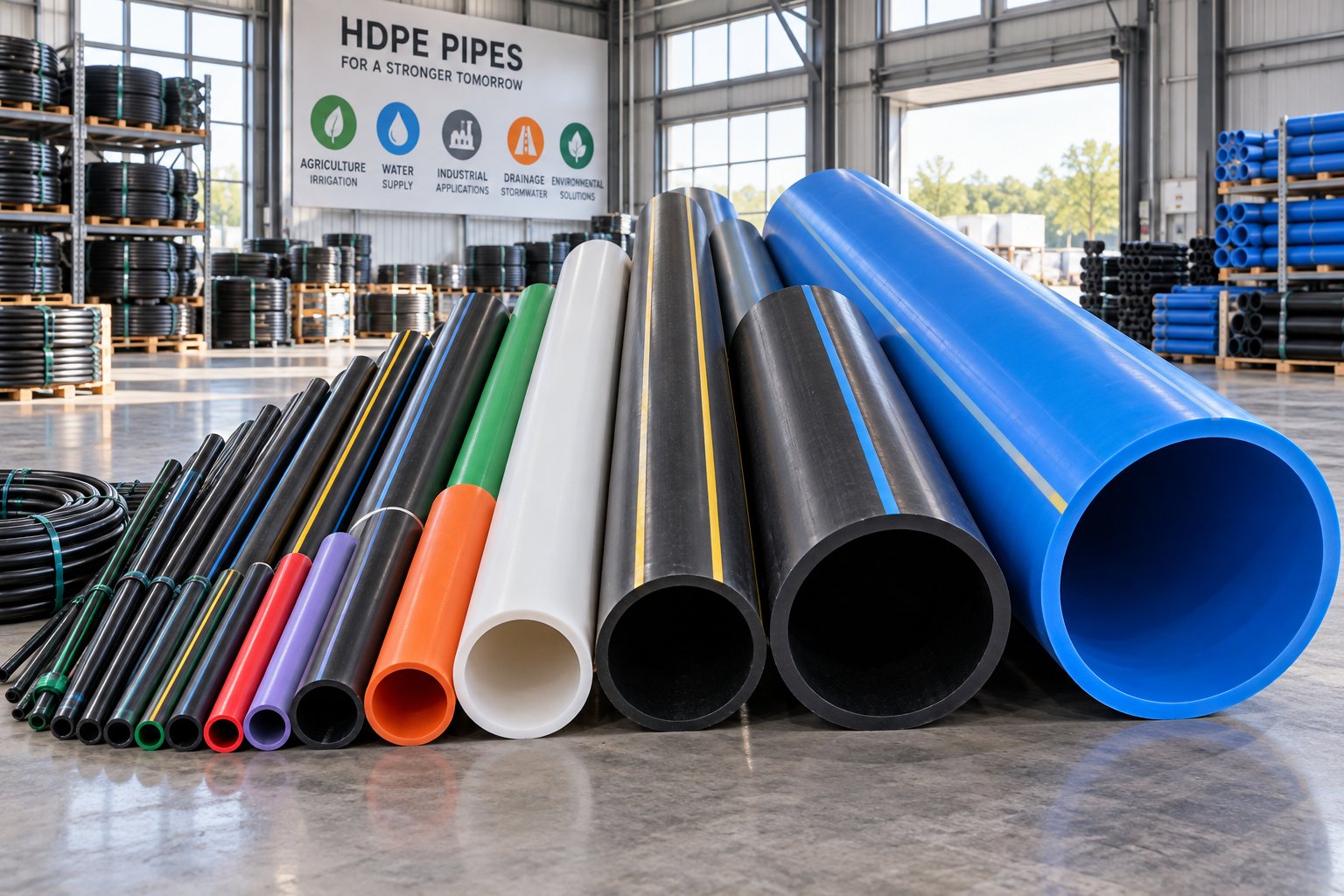
Think about it this way: you wouldn't spec a sports car engine for a freight truck. The same logic applies to HDPE pipe extrusion — yet buyers routinely select an hdpe pipe manufacturing machine based on its maximum diameter capability or peak throughput number, then try to back-fit it to whatever pipe product their customers actually order. That approach works until it doesn't. A line optimized for high-speed irrigation tubing will struggle with thick-wall gas pipe. A heavy-duty municipal water line running small-bore cable conduit wastes energy and capital on capacity it never uses.
The smarter path is to start with the application — the end-use pipe standard, the resin grade it demands, the dimensional tolerances it requires — and let those requirements dictate the extruder configuration, die design, and downstream setup. Here's how that plays out across the major polyethylene pipe extrusion categories.
Water Supply and Gas Distribution Pipes
Pressure-rated pipe is the most demanding application an extrusion line will face. Potable water mains produced to ISO 4427 or ASTM D3035 typically use PE100 resin in SDR 11 to SDR 17 configurations — meaning wall thicknesses that range from moderate to genuinely thick relative to the pipe diameter. Gas distribution pipe under ISO 4437 adds another layer of criticality: the slightest wall thickness variation or melt inconsistency can create a stress concentration point in a pipe carrying methane at 4 to 7 bar operating pressure.
What does this demand from the machine? Excellent melt homogeneity, first and foremost. Bimodal PE100's high melt viscosity and sensitivity to thermal history mean the extruder needs a high L/D ratio — typically 33:1 to 36:1 — to provide enough barrel length for thorough plasticization without excessive screw speed. Precision gravimetric dosing replaces volumetric feeding because mass-flow accuracy translates directly into consistent wall weight per meter. And the vacuum sizing system must hold extremely tight diameter tolerances, since even minor OD deviations compound into pressure-rating failures during hydrostatic testing.
Haul-off stability is equally critical. SDR-based dimensional planning shows that a 315 mm SDR 11 pipe carries roughly 24.6 kg per meter — meaning even small fluctuations in pull speed create measurable wall thickness changes over every few meters of pipe. Servo-driven caterpillar haul-offs with encoder feedback are non-negotiable for this application class. If you're producing hdpe water pipe for municipal tenders, the inspection protocol will catch what a basic haul-off lets slip through.
Cooling capacity deserves special attention here, too. Thick-wall pressure pipe — especially SDR 9 and SDR 11 in diameters above 200 mm — carries enormous thermal mass. The pipe's core may still be semi-molten long after the outer surface has solidified. Insufficient cooling tank length forces you to slow the line, capping throughput well below the extruder's rated output. Thermal load calculations, not rule-of-thumb tank lengths, should drive your cooling section specification.
Drainage, Sewage, and Cable Ducting
Step away from pressure-rated applications, and the processing window opens considerably. Drainage and sewage pipe — gravity-flow products operating at minimal or zero internal pressure — tolerate broader dimensional tolerances and faster line speeds. Cable ducting for telecommunications and electrical conduit follows a similar pattern: the pipe needs to be round, smooth-bored, and dimensionally consistent, but it doesn't face the hydrostatic stress demands of a pressurized water main.
This relaxed tolerance window creates an opportunity for high-speed extrusion setups. Smaller-diameter drainage pipe (110 to 315 mm) in SDR 21 or SDR 26 carries substantially less mass per meter than the same diameter in SDR 11. That lower mass means the extruder feeds less material per meter of pipe, the cooling demand drops, and the line can run faster — sometimes dramatically so. Haul-off speeds of 5 to 20 m/min become achievable for small-bore ducting, compared to the 0.5 to 2 m/min typical for thick-wall pressure pipe in larger diameters.
Large-diameter drainage introduces a different complexity. Corrugated and structured-wall sewer pipe — diameters from 300 mm up to 2400 mm — typically requires specialized die heads and, in many cases, dual-extruder configurations. A double-wall corrugated line uses one extruder to form the corrugated outer shell and a second to create the smooth inner bore, with a coextrusion die and forming corrugator synchronizing both melt streams. This is a fundamentally different machine architecture from a smooth-wall pipe extrusion line — buyers targeting this segment need purpose-built equipment, not retrofitted standard lines.
For cable ducting, surface quality and bore smoothness matter more than extreme wall thickness accuracy. Fiber-optic micro-duct, for instance, demands a polished inner wall to reduce friction during cable blowing operations. Lines serving this market often include inner-surface lubrication systems and specialized die designs that prioritize bore finish over raw throughput.
Mining, Irrigation, and Specialty Applications
Beyond the mainstream categories, several growing niches place unique demands on the extrusion line — and buyers entering these segments often discover that their general-purpose equipment falls short.
Mining slurry pipe faces abrasive internal flows that erode standard HDPE over time. Producers use specialized high-molecular-weight or abrasion-resistant PE grades that are tougher to plasticize. Larger extruder frames with high-torque drives become necessary to process these stiffer resins without overheating, and die designs must accommodate the thicker walls (often SDR 9 or lower) that the mining sector demands for service life.
Drip irrigation tubing sits at the opposite extreme — small diameters (12 to 25 mm), thin walls, and extremely high production speeds. Lines producing drip tape or thin-wall irrigation tubing can run at 50 to 150+ m/min, requiring small-diameter extruders with rapid response, high-speed haul-offs, and precision inline drip-emitter insertion systems. The extruder's output consistency at high speed is everything; even brief melt pressure fluctuations create visible wall thickness bands in such thin-wall products.
Multi-layer pipes with barrier layers — combining HDPE with EVOH or adhesive tie layers for chemical resistance or oxygen barrier properties — demand coextrusion setups with two or three extruders feeding a multi-channel die head. Each layer must maintain precise thickness ratios, which requires coordinated control of multiple extruder outputs, melt temperatures, and die flow channels simultaneously. This is among the most technically complex polyethylene pipe extrusion configurations available.
The table below maps these application categories against their key machine requirements, giving buyers a practical starting framework for equipment discussions:
| Application Category | Typical Pipe Size Range | Common Resin Grade | Key Machine Features Required |
|---|---|---|---|
| Potable Water Supply | 20 - 1600 mm | PE100 (SDR 11 - 17) | High L/D ratio extruder, gravimetric dosing, precision vacuum sizing, servo haul-off |
| Gas Distribution | 20 - 630 mm | PE100 (SDR 11) | Tight melt homogeneity, advanced wall thickness monitoring, striping co-extruder |
| Drainage and Sewage | 110 - 2400 mm | PE80 / PE100 (SDR 17 - 26+) | High-speed capability or dual-extruder corrugated line; extended cooling sections |
| Cable Ducting | 32 - 200 mm | PE80 / PE100 | High line speed, smooth bore die design, optional inner lubrication system |
| Mining Slurry Pipe | 110 - 1000 mm | PE100 / PE100-RC (SDR 9 - 11) | High-torque drive, heavy-duty extruder frame, extended cooling for thick walls |
| Drip Irrigation Tubing | 12 - 25 mm | PE80 / LLDPE blends | High-speed small-diameter extruder, inline emitter insertion, rapid-response controls |
A critical note: these are general configurations. Specific machine sizing — extruder screw diameter, motor power, cooling tank length, haul-off torque — depends on your exact production targets, resin supplier recommendations, and the pipe standards governing your market. Use this table as a conversation starter with equipment suppliers, not as a final specification.
The pattern across all these applications is consistent: the pipe's end use defines the processing demands, and the processing demands define the machine. Buyers who reverse that sequence — choosing a machine first and hoping it fits the application — tend to discover the mismatch during commissioning or, worse, during a failed quality audit on the production floor.
Getting the configuration right for a specific application solves the first challenge. Keeping it running efficiently day after day introduces the next one — and that's where energy consumption, inline quality monitoring, and intelligent process controls separate a productive line from one that slowly bleeds margin through waste, rework, and unplanned downtime.
Energy Efficiency and Quality Control in Modern Extruder Lines
A perfectly configured extrusion line matched to its target application can still hemorrhage profit if it wastes energy on every kilogram of resin it processes — or if quality defects slip past operators undetected until hundreds of meters of out-of-spec pipe have already been produced. These two issues — hdpe extrusion line efficiency and pipe extrusion quality control — are the silent margin killers that rarely make it into equipment brochures. Yet they're the factors that separate a line delivering competitive cost-per-meter from one that looks great on paper but underperforms on the production floor.
The good news? The technology to address both has advanced dramatically. Modern energy efficient extruder machine designs and inline monitoring systems offer measurable, documentable improvements — if you know what to look for and what to specify.
Energy-Efficient Drive and Heating Technologies
Energy is the single largest variable operating cost on an HDPE pipe extrusion line, and the extruder drive consumes the biggest share. Traditional AC induction motors run at near-constant power draw regardless of actual load, which means the motor pulls significant energy even when the screw isn't working at full capacity — during startup, slow-speed runs, or lighter-wall product changes. That wasted energy goes straight to the bottom line as cost without output.
The shift to servo-driven motor systems changes this equation fundamentally. Servo motors adapt power output to real-time torque demand — delivering full power when the screw needs it during thick-wall, high-viscosity PE100 processing, and pulling back automatically during lighter-load conditions. Direct-drive configurations eliminate the gearbox entirely in some designs, removing a mechanical efficiency loss of 3% to 5% and reducing a significant maintenance item. The result is a drive system that responds dynamically to process variations rather than burning electricity at a fixed rate regardless of what's happening inside the barrel.
How much difference does this actually make? Industry benchmarks from equipment manufacturers suggest that upgrading from conventional AC drives to servo-driven systems can reduce energy consumption by up to 35%, though actual savings depend on machine generation, operating patterns, and how far the previous system was from optimal. For a line running 6,000 hours annually at 500 kg/hr throughput, even a 20% reduction in specific energy consumption translates into meaningful annual savings — easily five figures in electricity cost alone.
Drive technology is only part of the picture. Barrel heating represents the second major energy draw, and traditional mica band heaters radiate a surprising amount of thermal energy into the factory air rather than into the barrel wall where it's needed. Two technologies address this directly:
- Ceramic infrared band heaters — Deliver heat more efficiently to the barrel surface with less radiant waste. Their higher surface-contact efficiency means the heater reaches setpoint faster and cycles less frequently, reducing both energy consumption and thermal cycling stress on the barrel.
- Insulation jackets — Wrap around existing barrel heaters to trap radiant heat that would otherwise escape. These are among the simplest and most cost-effective energy upgrades available — a retrofit that typically pays for itself within months on a continuously operating line.
There's a third energy variable that gets overlooked because it lives inside the barrel rather than on it: screw design efficiency. A well-engineered screw with optimized barrier flight geometry, appropriate compression ratio, and effective mixing sections converts mechanical energy into melt preparation more efficiently. That means the motor doesn't need to supply as much energy to achieve the same melt quality and throughput. Process optimization research confirms that when less energy is wasted through excessive cooling or inefficient melt preparation, more of the available motor power goes directly into productive material throughput — enabling higher output from the same extruder size without increasing the electricity bill.
The practical implication for buyers? Don't evaluate energy efficiency by looking at the motor nameplate alone. Ask suppliers for the specific energy consumption (SEC) figure — kWh per kilogram of HDPE processed — measured under your target operating conditions. That single metric captures drive efficiency, heating efficiency, and screw design efficiency in one comparable number.
Inline Quality Control and Monitoring Systems
Energy waste drains your budget gradually. Quality defects drain it suddenly — through scrapped pipe, failed inspections, customer complaints, and production halts. Traditional quality control in pipe extrusion relied on periodic manual measurements: an operator pulling a sample every 30 or 60 minutes, cutting a ring, measuring wall thickness with calipers, and checking diameter with a pi tape. Sounds reasonable until you calculate how many meters of pipe pass through the line between those checks — and how much of that pipe could be out of spec without anyone knowing.
Modern inline quality control systems eliminate that blind spot by monitoring pipe dimensions continuously and automatically, catching deviations in real time rather than after the fact. These technologies are increasingly standard on well-specified lines, and their absence should raise a red flag for any buyer producing pipe to standards like ISO 4427 or ASTM D3035.
Here are the key pipe extrusion quality control technologies and what each one does for your production:
- Ultrasonic wall thickness measurement — Continuous, non-contact sensors mounted around the pipe circumference measure wall thickness at multiple points simultaneously. These systems detect eccentricity (uneven wall distribution), gradual thickness drift, and sudden changes caused by melt pressure fluctuations — all without touching the pipe or interrupting the line. Multi-point measurement at eight or more positions around the pipe catches localized thin spots that single-point gauges miss entirely.
- Laser diameter gauges — Mounted after the vacuum sizing tank, these measure the pipe's outer diameter in real time using shadow-casting or triangulation methods. Continuous OD data allows operators — or automated systems — to detect sizing drift before it exceeds tolerance, rather than discovering it during a downstream check.
- Gravimetric dosing with feedback control — Weighing the resin feed in real time and adjusting the feeder output to maintain precise mass flow. This ensures consistent material usage per meter of pipe, directly supporting wall weight compliance and reducing the resin waste that comes from over-feeding. The mass-flow data also serves as an early indicator: if the feeder has to increase output to maintain target pipe weight, something downstream — haul-off speed drift, die wear, or temperature change — has shifted.
- Automatic line speed control — The most advanced systems close the loop entirely: wall thickness and diameter measurements feed directly into the haul-off drive controller, which adjusts pull speed in real time to compensate for upstream variations. If the ultrasonic gauge detects a slight wall thickness increase, the system accelerates the haul-off fractionally to thin the wall back to target — all without operator intervention. This closed-loop approach maintains tighter dimensional tolerances than any manual adjustment can achieve.
The collective impact of these systems is substantial. Leading pipe manufacturers report that continuous inline monitoring — including ultrasonic wall thickness gauges inspecting all 360 degrees of the pipe during extrusion — catches deviations that periodic manual checks routinely miss. The result is lower scrap rates, fewer failed hydrostatic tests, and documented compliance data for every meter of pipe produced. For producers supplying municipal water or gas contracts, that traceability isn't a luxury — it's a contractual requirement that inline QC systems fulfill automatically.
The Role of Intelligent Process Control
Individual monitoring technologies are valuable on their own. They become transformative when integrated into a unified intelligent control platform — and this is where the extrusion industry is heading rapidly.
Centralized PLC/HMI systems now serve as the digital backbone of modern extrusion lines, connecting the extruder drive, barrel heaters, gravimetric feeder, vacuum tank, haul-off, cutting station, and inline gauges into a single coordinated network. Instead of operators adjusting each unit independently, the system manages the entire line through stored recipe profiles — pre-validated parameter sets for each pipe size and resin grade. When production switches from a 200 mm SDR 11 PE100 water pipe to a 110 mm SDR 17 PE80 drainage pipe, the operator selects the recipe, and the PLC adjusts every temperature zone, screw speed, haul-off rate, vacuum level, and cutter timing automatically. Changeover time drops, startup scrap decreases, and the risk of human error during manual parameter entry shrinks dramatically.
Industry 4.0 integration extends this further with capabilities that were unavailable even a few years ago:
- Data logging and traceability — Every process parameter is recorded continuously and linked to the pipe's print-line identification. If a quality issue surfaces months after installation, the production data for that specific pipe section can be retrieved and analyzed. This is particularly valuable for producers supplying gas distribution pipe, where regulatory bodies may require historical process documentation.
- Predictive maintenance alerts — By tracking trends in motor load, barrel pressure, gearbox vibration, and heater current draw, intelligent systems identify equipment degradation before it causes unplanned downtime. A gradual increase in motor current at constant screw speed, for example, often signals screw or barrel wear — giving maintenance teams advance notice to schedule a replacement during planned downtime rather than during a production run.
- Remote monitoring and diagnostics — Connected extrusion platforms allow equipment suppliers or engineering teams to view line performance data remotely, diagnose issues, and recommend parameter adjustments without a site visit. For plants operating in remote locations — common in mining and agricultural markets — this connectivity can mean the difference between a quick software adjustment and days of lost production waiting for a technician.
The trend is clear: extrusion lines are evolving from collections of independently operated machines into integrated, data-driven production systems. Buyers specifying new equipment should evaluate the control architecture as seriously as the mechanical components — because the smartest screw design and most efficient motor deliver diminishing returns if the control system can't coordinate them effectively or capture the data needed to optimize and maintain performance over time.
An energy efficient extruder machine paired with inline quality monitoring and intelligent process control doesn't just reduce costs today — it generates the operational data that drives continuous improvement tomorrow.
Technology, of course, only delivers value if the machine is selected wisely and maintained consistently. The most advanced control system can't compensate for an extruder that was wrong for the application from day one, or for worn components that have been allowed to degrade unchecked. That reality brings the entire discussion back to where it matters most for buyers — structured evaluation criteria, lifecycle maintenance planning, and the component quality decisions that determine total cost of ownership.
Selecting and Maintaining Your HDPE Pipe Extruder Machine
Every section of this guide has pointed toward one practical reality: the value of an hdpe pipe extruder machine isn't determined the day it ships from the factory — it's determined over the years that follow, through thousands of operating hours, dozens of resin changeovers, and countless meters of pipe. Buyers who focus exclusively on purchase price and peak throughput specs learn this the hard way. The ones who build selection criteria around lifecycle performance and plan maintenance from day one are the ones still running profitable lines a decade later.
So how do you translate everything covered so far — components, specifications, resin behavior, application matching, energy efficiency, quality control — into a structured buying decision and a sustainable operating plan? Let's break it down.
Key Criteria for Evaluating an HDPE Pipe Extruder Machine
When proposals start landing on your desk, the temptation is to compare headline numbers: biggest screw diameter, highest kg/hr output, lowest quoted price. Resist that impulse. Pipe extruder machine selection that holds up over time follows a priority-ordered evaluation framework — one that starts with your production requirements and works backward to the machine specifications that satisfy them.
- Target pipe diameter range and production volume — This is the non-negotiable starting point. Your maximum and minimum pipe diameters determine the extruder size class, die head configuration, and downstream equipment scale. Your annual production target — expressed in meters or tons per year — determines whether you need a single line running two shifts or multiple lines running continuously. Size the machine to your three-to-five-year production forecast, not just today's order book.
- Resin grade compatibility and screw geometry — If you're processing PE100 for pressure-rated pipe, confirm that the screw design handles bimodal HDPE's higher viscosity and thermal sensitivity. Ask the supplier whether the screw geometry includes barrier flights and mixing sections appropriate for your target resins. If you plan to run both PE80 and PE100 — or anticipate processing recycled HDPE blends in the future — verify that the screw compression ratio and barrel temperature range accommodate both ends of that spectrum without requiring a screw swap.
- Energy efficiency and specific energy consumption — Request the SEC (kWh/kg) figure for your target operating conditions, not just the motor nameplate rating. A servo-driven or direct-drive motor system, ceramic barrel heaters, and an optimized screw design collectively determine your electricity cost per meter of pipe — a number that compounds into tens of thousands of dollars annually. Two machines with identical throughput ratings can differ by 30% or more in energy consumption.
- Inline quality control capability — For producers supplying pressure-rated pipe to standards like ISO 4427 or ASTM D3035, ultrasonic wall thickness gauges, laser diameter measurement, and closed-loop haul-off speed control should be standard — not optional extras. Evaluate whether the control architecture supports automatic line speed adjustment based on real-time measurement data, and whether the system logs process parameters for traceability.
- Available floor space and utility infrastructure — An often-overlooked constraint. Large-diameter extrusion lines can stretch 40 to 60 meters or more, including cooling tanks and stacking equipment. Confirm that your factory floor accommodates the full line length, that the electrical supply handles the motor power class, and that your cooling water system delivers the flow rate and temperature the vacuum and spray tanks require. Discovering an infrastructure gap after the equipment arrives is an expensive lesson.
- After-sales support and spare parts availability — A machine is only as good as the support behind it. Evaluate the supplier's response time for technical assistance, the availability of spare parts (especially wear components like screws, barrels, heater bands, and die components), and whether they offer remote diagnostic capability. Production teams report that the most common causes of extended unplanned downtime aren't catastrophic failures — they're delayed spare parts for routine wear items that should have been stocked or sourced proactively.
- Control system sophistication and recipe management — Lines that store validated parameter recipes for each pipe size and resin grade reduce changeover time, minimize startup scrap, and lower the skill threshold for operators. Ask whether the PLC/HMI supports recipe storage, data logging, alarm history, and — increasingly important — remote monitoring connectivity.
Print this list. Bring it to every supplier meeting. The proposals that score well across all seven criteria — not just on price or throughput — are the ones that deliver buying hdpe extrusion equipment decisions you won't regret.
Preventive Maintenance and Wear Part Replacement
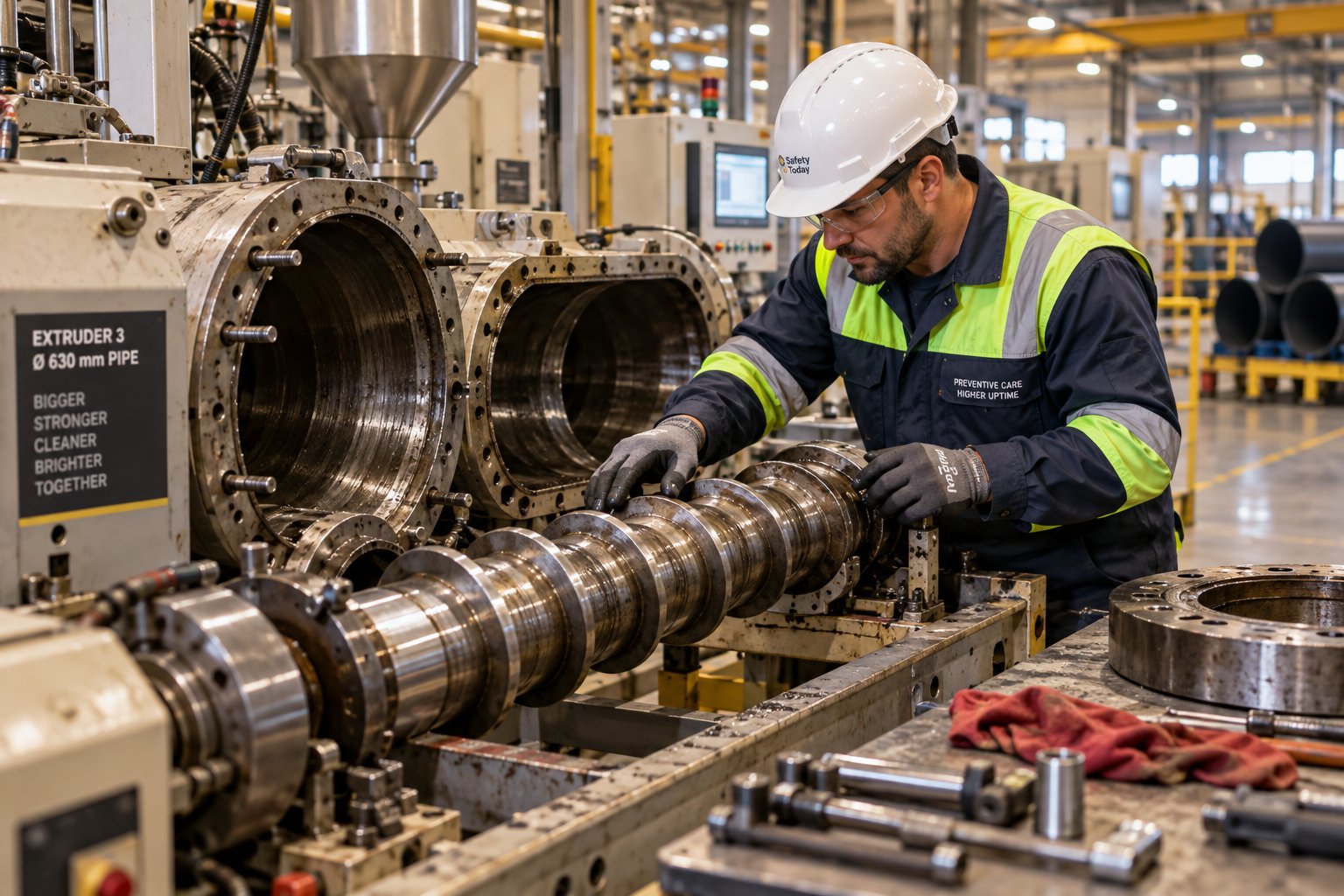
You've selected the right machine, commissioned it successfully, and started producing pipe that passes every quality check. The next challenge is keeping it there. Every hour of operation wears the extruder's internal components by microscopic increments — flight land surfaces lose material, barrel bores develop clearance, heater terminals oxidize, gearbox oil degrades. Individually, each change is negligible. Collectively, over months of continuous production, they erode output quality, inflate energy consumption, and eventually force unplanned shutdowns that cost far more than the preventive work that would have avoided them.
Effective hdpe pipe extruder maintenance follows a structured rhythm. Drawing from whole-line maintenance frameworks, the most productive approach separates checks into daily, weekly, and monthly tiers:
| Frequency | Focus Areas | Key Actions |
|---|---|---|
| Daily (10-15 min per shift) | Process stability confirmation | Record melt pressure at fixed screw speed; verify barrel zone temperatures match setpoints; check feed-throat cooling flow; inspect die lip for buildup; confirm haul-off speed and grip; review alarm history |
| Weekly (during planned stops) | Wear point inspection | Check gearbox oil level and color; inspect heater band terminals for discoloration; verify die bolt torque; clean water filters and spray nozzles; inspect vacuum tank seals; check haul-off belt wear and encoder accuracy |
| Monthly | Trend data recording | Measure screw/barrel clearance at feed, compression, and metering zones; record gearbox oil temperature under stable load; test motor insulation resistance; evaluate vacuum pump performance against baseline; back up PLC/HMI parameters |
The monthly clearance measurements deserve special emphasis. Predictive maintenance data from operating extrusion lines shows that when screw flight clearance exceeds approximately 0.010 inches, output at rated RPM drops below 85% of the new-screw baseline, melt temperature rises more than 15 degrees Fahrenheit above setpoint, and motor current draw increases by over 10%. At that point, the extruder is consuming significantly more energy to produce less — and lower — quality pipe. The wear hasn't announced itself with a dramatic failure; it's been slowly stealing output and inflating costs for weeks or months before anyone notices the trend.
This is why worn screws and barrels are the single most common cause of declining output quality and rising energy consumption on HDPE pipe extrusion lines. They're also the components most directly in your control. Timely replacement restores melt consistency, recovers throughput capacity, and returns energy consumption to near-new levels — often delivering an ROI measured in weeks rather than months.
The key to timely replacement is having a reliable source for precision-engineered wear components that match your extruder's exact specifications. For single-screw pipe extrusion lines — which represent the vast majority of HDPE pipe production, as covered earlier — NANHAIYA manufactures custom and replacement single screw barrels engineered for the demanding thermal and abrasive conditions of HDPE processing. Their barrel portfolio covers pipe, film, sheet, pelletizing, recycling, and general-purpose extrusion applications, making them a practical resource for operators managing diverse lines who need consistent component quality across multiple machine types. When your monthly trend data shows clearance moving into the marginal zone, having a component supplier who can deliver precision-matched replacements on a reasonable timeline means you schedule the swap during planned downtime — not during a production emergency.
Beyond screw and barrel wear, a complete hdpe pipe extruder maintenance program covers:
- Die head cleaning schedules — Polymer degradation builds up gradually on die land surfaces and flow channels, creating streaks, surface roughness, and dimensional drift. Regular disassembly and cleaning — frequency depends on resin type and run length — prevents contamination from compounding into a quality problem.
- Gearbox oil analysis — Monthly temperature readings under stable load detect lubrication degradation or internal wear early. Dark, foaming, or metallic-particle-laden oil signals developing problems that will escalate into bearing failure and unplanned shutdowns if ignored.
- Thermocouple calibration — Drifting thermocouples feed incorrect temperature data to the control system, causing the barrel to over- or under-heat zones without the operator realizing the displayed temperature no longer matches reality. Periodic calibration checks — or replacement on a scheduled cycle — maintain the accuracy that consistent melt quality depends on.
- Vacuum pump and cooling system maintenance — Worn vacuum pump vanes reduce sizing stability; fouled cooling water filters restrict flow and degrade cooling capacity. Both create pipe dimensional issues that are frequently misdiagnosed as extruder or die problems because operators don't associate downstream equipment condition with upstream-looking defects.
The pattern across all these items is consistent: preventive maintenance costs a fraction of the reactive repair it prevents. Industry maintenance benchmarks place preventive maintenance costs at roughly 70% less than reactive repairs for extrusion equipment, with a well-maintained machine achieving a service life of 10 to 15 years compared to just 3 to 4 years under neglect. That difference isn't subtle — it's the gap between amortizing your capital investment over a profitable decade and replacing the entire line in under half that time.
Planning for Long-Term Production Success
Maintenance keeps your current machine running. Long-term planning ensures your operation adapts as markets, materials, and pipe standards evolve. Three forward-looking strategies separate factories that scale profitably from those that plateau.
First, prioritize modular machine designs. Production requirements change. A line purchased for 110 to 315 mm pipe may need to accommodate 450 mm or larger within a few years as your customer base expands. Extruders built on modular platforms — where barrel sections can be extended, die heads swapped without frame modifications, and downstream equipment added incrementally — allow capacity upgrades at a fraction of the cost of purchasing a second complete line. Ask suppliers about upgrade paths during the initial evaluation, not after you've outgrown the machine.
Second, invest in operator training on process parameter optimization. The most sophisticated extruder in the world underperforms if the person running it doesn't understand how screw speed, barrel temperature, and haul-off ratio interact — or how to adjust settings when switching resin grades. Operational data from extrusion facilities shows that untrained operators cause nearly half of all equipment faults, while structured training programs deliver the fastest return on investment of any maintenance-related expenditure — typically paying back within one to two months through reduced scrap, fewer operator-induced faults, and more efficient changeovers. Training isn't a one-time event; it's an ongoing program that keeps pace with new materials, updated standards, and evolving machine capabilities.
Third, build relationships with component suppliers who can provide fast turnaround on wear parts. Supply chain delays for core extrusion components — screws, barrels, heater bands, drive elements — can stretch to eight to twelve weeks during peak demand periods. Stocking critical spares and maintaining a relationship with specialized manufacturers like NANHAIYA for screw and barrel replacements ensures that when your monthly trend data flags a wear threshold, the replacement component arrives on your timeline — not on the supply chain's.
The total cost of ownership of an HDPE pipe extruder machine is determined less by the purchase price and more by the quality of its wear components, the consistency of its maintenance, and the foresight built into its selection — decisions that compound over every year of the machine's operating life.
The buyers who learn these lessons before signing a purchase order — rather than after the first quality audit failure or unplanned shutdown — are the ones who turn their extrusion investment into a durable competitive advantage. Every section of this guide has been designed to make sure you're one of them.
Frequently Asked Questions About HDPE Pipe Extruder Machines
1. What is the typical output capacity of an HDPE pipe extruder machine?
Output capacity depends primarily on screw diameter and pipe size. Small-diameter lines (16-110 mm pipe) with 45-65 mm screws typically produce up to 350 kg/hr, while medium-diameter lines (110-450 mm) reach 350-750 kg/hr. Large-diameter machines with 90-150 mm screws can deliver 750-1,800 kg/hr or more. However, sustainable output — what the machine consistently delivers over a full shift without melt temperature excursions — matters more than peak figures. Factors like L/D ratio, screw geometry, resin grade viscosity, and drive efficiency all influence the practical throughput you can maintain while keeping pipe quality within spec.
2. What is the difference between single-screw and twin-screw extruders for HDPE pipe?
Single-screw extruders are the standard for most HDPE pipe production. They handle pre-pelletized polyethylene efficiently, cost less upfront, and require simpler maintenance — making them ideal for mono-layer pressure pipe, drainage, and ducting applications. Twin-screw extruders excel in specialized scenarios: multi-layer co-extrusion, processing heavily filled compounds, or running recycled HDPE blends that need intensive mixing and venting. For standard PE80 or PE100 virgin-resin pipe, a single-screw machine with optimized barrier-flight screw geometry and quality wear components — such as precision-engineered barrels from suppliers like NANHAIYA — typically outperforms a more expensive twin-screw setup that exceeds the application's actual requirements.
3. How does HDPE resin grade affect extruder machine settings?
Resin grade significantly changes how the extruder must be configured. PE100, the modern standard for pressure pipe, has higher melt viscosity than PE80 due to its bimodal molecular weight distribution. This means PE100 requires barrel zone temperatures roughly 10-15 degrees Celsius higher than PE80, particularly in the metering zone (210-230°C vs. 195-215°C). Screw speed often needs to be reduced slightly for PE100 to avoid excess shear heat, which can degrade the polymer. Back pressure at the die head also increases. Operators switching between grades should adjust temperatures in stages, use dynamic purging techniques, and confirm that their screw compression ratio accommodates both materials to avoid surface defects and inconsistent wall thickness.
4. How often should screws and barrels be replaced on an HDPE pipe extruder?
Replacement timing should be driven by measured wear data rather than a fixed calendar schedule. Monthly screw-to-barrel clearance measurements at the feed, compression, and metering zones provide the most reliable indicator. When flight clearance exceeds approximately 0.010 inches, output at rated RPM typically drops below 85% of baseline, melt temperature rises beyond setpoint, and motor current increases over 10%. At that threshold, the machine is consuming more energy to produce lower-quality pipe. Timely replacement with precision-engineered components — available from specialists like NANHAIYA who manufacture custom single screw barrels for pipe extrusion — restores melt consistency, throughput, and energy efficiency, often delivering ROI within weeks.
5. What inline quality control systems should an HDPE pipe extrusion line include?
A well-specified line should include four core QC technologies: ultrasonic wall thickness gauges that measure at multiple points around the pipe circumference for continuous, non-contact thickness monitoring; laser diameter gauges positioned after the vacuum sizing tank for real-time OD tracking; gravimetric dosing systems that weigh resin feed to ensure consistent mass flow per meter; and automatic line speed control that adjusts haul-off speed based on live measurement data, closing the loop without operator intervention. Together, these systems catch dimensional deviations in real time, reduce scrap rates, and generate the documented compliance data required for standards like ISO 4427 and ASTM D3035 — essential for municipal water and gas distribution contracts.
Written by
Nanhaiya Technical Team
Zhoushan Nanhaiya Plastic Machinery Co., Ltd.
The Nanhaiya technical team supports screw and barrel manufacturing projects through application review, technical communication, custom manufacturing coordination, and production and quality control.
Discuss Your Application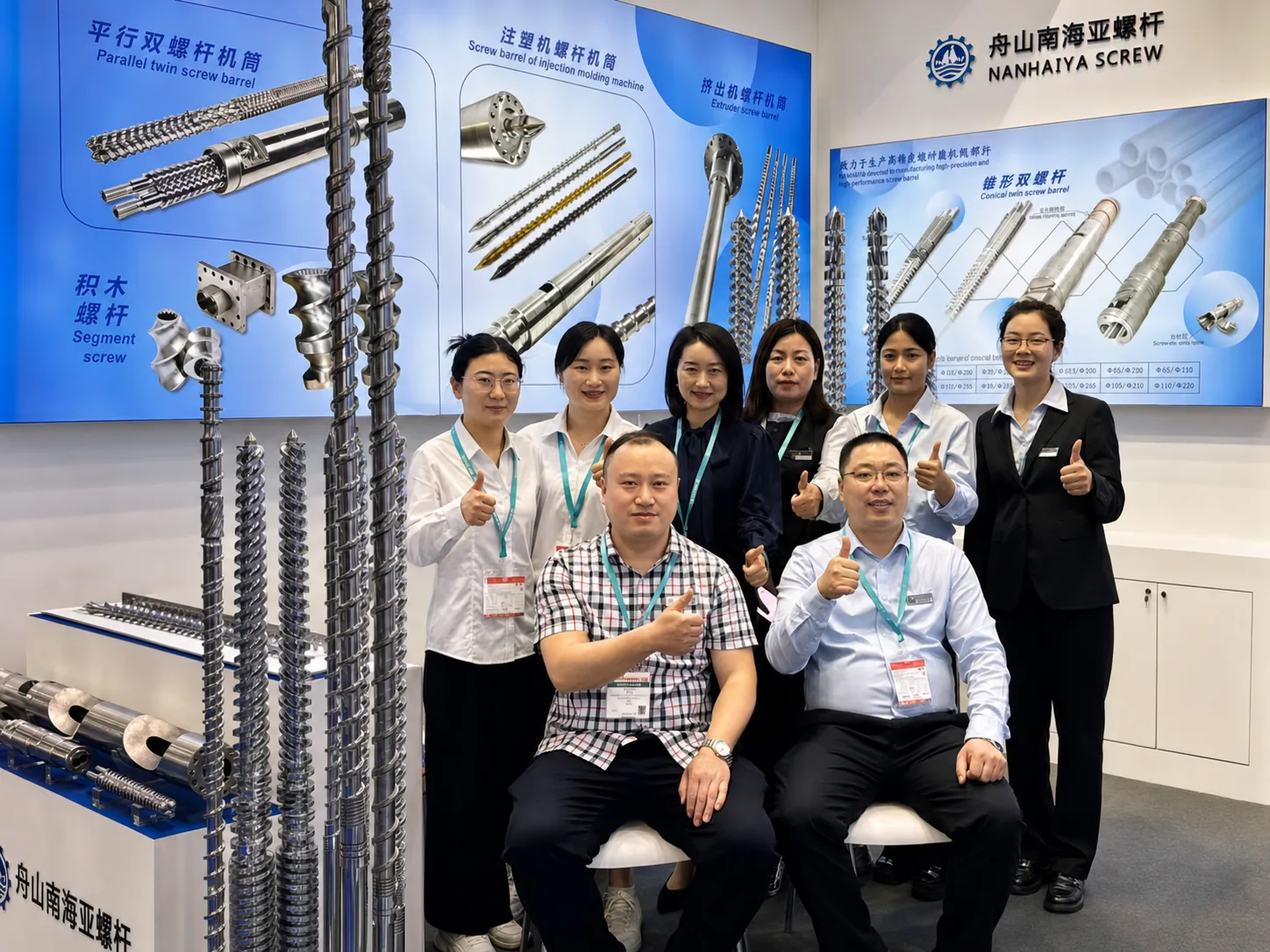
Related Articles
More insights on screw barrel technology and plastics processing.
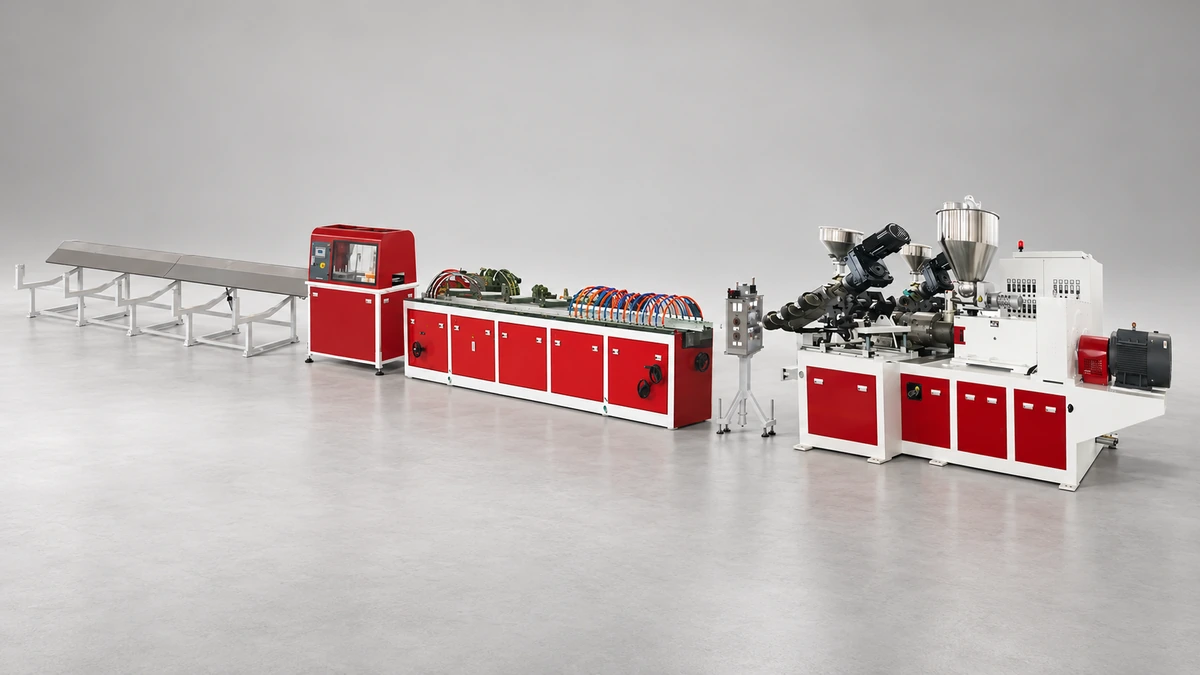
PVC Window Profile Making Machine Demystified: Resin In, Frames Out
Nov 3, 2026
Learn how a PVC window profile making machine works — from extruder configurations and downstream equipment to factory layout, maintenance, and buyer selection tips.
Read Article
PET Hydrolysis: Recycle Plastics Or Ruin Them—Chemistry Decides
Nov 3, 2026
PET hydrolysis breaks ester bonds into TPA and ethylene glycol. Learn the chemistry, acid vs alkaline vs neutral methods, enzymatic advances, and prevention tips.
Read Article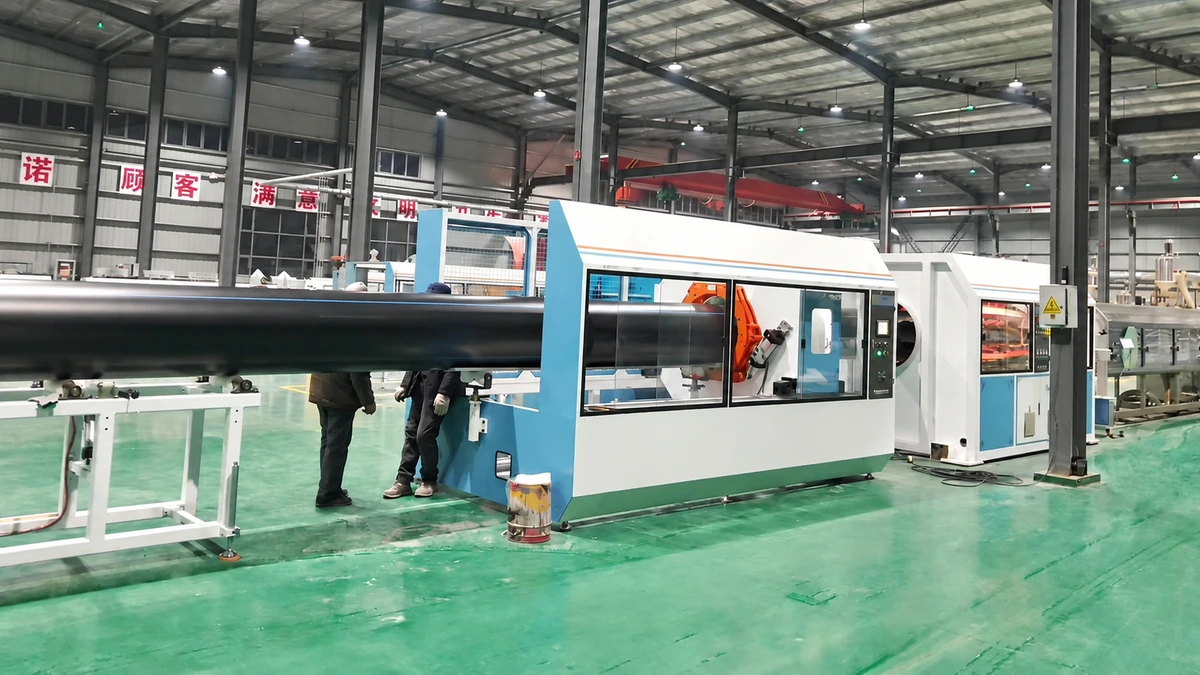
PVC Conduit Pipe Extrusion Line: What No Supplier Tells You
Nov 2, 2026
Complete guide to PVC conduit pipe extrusion lines — components, extruder types, temperature profiles, defect troubleshooting, standards, and buyer decision framework.
Read ArticleLooking for something else?
Search by material, symptom or product and jump straight to the relevant page.
These are navigation suggestions based on keyword matching — not a quotation, not a delivery commitment, and not a substitute for engineering review. Final specification is confirmed by our engineers against your drawings and processed material.
Need help with screw barrel selection?
Share your machine model, processed material and application. Our team can help with pricing and technical support.