

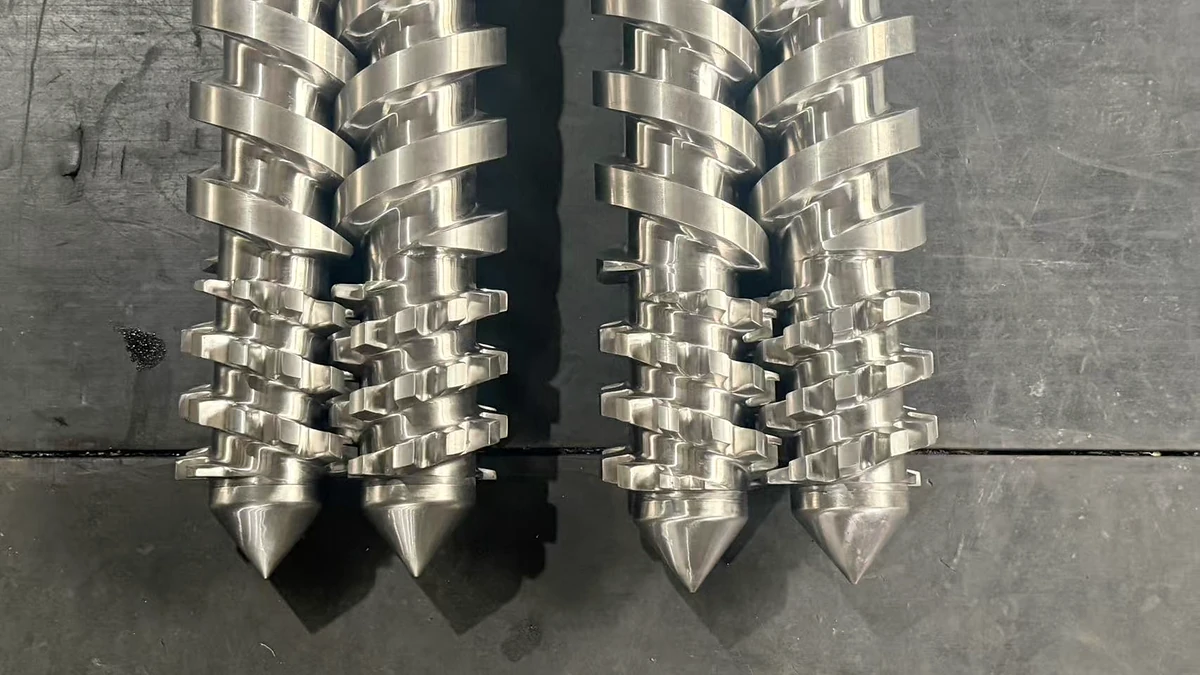
What Is a Nitrided Screw and Why Does It Matter
When you shop for extruder or injection molding screws, the term "nitrided" appears everywhere, yet clear definitions are surprisingly hard to find. Most suppliers assume you already know what it means, or they bury the explanation in vague marketing language. Let's fix that right now.
Defining the Nitrided Screw
A nitrided screw is a precision steel screw whose surface has been thermochemically hardened through the diffusion of nitrogen atoms into its outer layer. This process forms an extremely hard case while the core remains tough and ductile, giving the component a wear-resistant exterior backed by a shock-absorbing interior.
In practical terms, nitrogen atoms penetrate the steel at elevated temperatures, typically between 500 and 550 degrees Celsius, and react with alloying elements already present in the metal, such as chromium, aluminum, and molybdenum. These reactions create hard nitride compounds like CrN, AlN, and MoN directly within the steel's surface structure. The result is a case layer that can approach surface hardness values of 1000 HV, or roughly 70 HRC equivalent in optimized conditions.
Three key parameters define every nitrided screw you will encounter throughout this article:
- Case depth - the measurable thickness of the hardened zone, typically ranging from 0.1 to 0.7 mm depending on the process and duration.
- Surface hardness - reported in Vickers (HV) or Rockwell C (HRC), indicating how well the surface resists indentation and material removal.
- Compound-layer composition - the specific nitride compounds formed (CrN, AlN, MoN), which determine the balance between hardness, corrosion resistance, and brittleness.
Why Nitriding Is Not a Coating
Imagine painting a wall versus staining wood. Paint sits on the surface and can chip, peel, or flake. Stain soaks into the wood grain and becomes part of the material itself. Nitriding works like the stain.
This is a critical distinction that separates a nitrided screw from chrome-plated or coated alternatives. Because nitrogen diffuses directly into the steel lattice and bonds with alloying elements at the atomic level, the hardened layer is not a separate material sitting on top. It is the original steel, transformed. There is no interface where a coating meets a substrate, which means there is no weak boundary that can delaminate under thermal cycling or mechanical stress. As industry research notes, chromium plating, for example, has a different coefficient of thermal expansion than the base steel and may exfoliate from the surface at elevated temperatures. A nitrided surface simply cannot fail in this way.
This permanence matters enormously for screws operating inside heated barrels at hundreds of degrees, rotating under high torque, and pushing abrasive material forward for thousands of hours at a stretch.
Why Plastics Processing Relies on Nitrided Screws
Plastic extrusion and injection molding environments are punishing. The screw is the heart of the machine, and it faces a triple threat every production cycle:
- Abrasive wear - fillers like glass fiber, calcium carbonate, and mineral reinforcements physically grind against the screw surface, eroding flight edges and root diameters over time.
- Corrosive attack - certain polymers release acidic gases during processing. PVC, for instance, generates hydrochloric acid as it degrades, and flame-retardant compounds off-gas corrosive byproducts.
- Dimensional drift - as the screw wears, the clearance between the screw flight and the barrel wall increases, reducing output consistency, melt quality, and energy efficiency.
A nitrided screw addresses all three challenges simultaneously. The hard nitride case resists abrasive material removal. Chromium nitrides within the surface offer a degree of chemical resistance. And because the nitriding process occurs at relatively low temperatures compared to other hardening methods, it causes minimal thermal distortion, preserving the tight dimensional tolerances essential for efficient screw-barrel fit.
For a nitrided screw manufacturer, the goal is straightforward: deliver a component that runs longer, processes more consistently, and costs less over its lifetime than an untreated or poorly treated alternative. Hardfaced nitrided screws take this a step further by adding specialized alloy protection to high-wear zones like flight tips, creating a dual-defense system against the most demanding filled compounds.
Yet the real engineering value depends on what happens at the atomic level during the nitriding process itself, and the specific method used to get nitrogen into the steel makes a measurable difference in performance.
The Metallurgical Science Behind Screw Nitriding
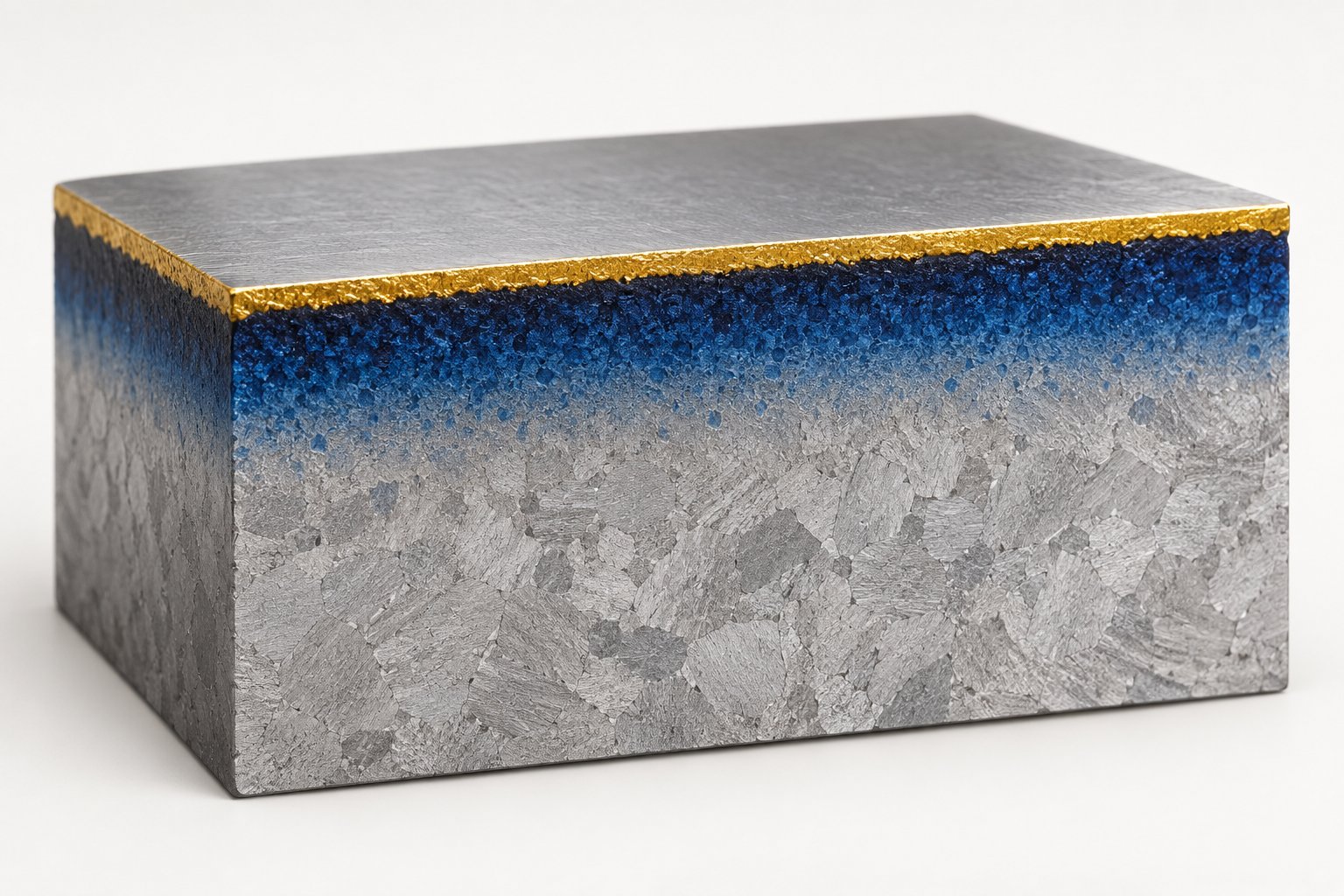
Picture a steel screw sitting inside a sealed furnace at around 500 to 550 degrees Celsius. The atmosphere is rich in reactive nitrogen, either from dissociated ammonia or an ionized gas mixture. At these temperatures, something remarkable happens: individual nitrogen atoms begin migrating into the steel's crystal lattice, squeezing into tiny gaps between iron atoms in a process metallurgists call interstitial diffusion. The nitrogen doesn't just sit there. It actively seeks out alloying elements already present in the steel, and when it finds them, it reacts to form extremely hard nitride precipitates throughout the surface layer.
This atomic-level transformation is what separates a properly nitrided screw from one that has merely been surface-coated. The steel itself changes character from the outside in, building a graduated armor that no external layer can replicate.
How Nitrogen Atoms Transform the Steel Surface
The chemistry is straightforward once you break it down. Nitrogen atoms diffuse inward from the screw's surface over treatment durations that can range from 10 hours to well over 100 hours, depending on the target case depth and the specific process parameters. As these atoms encounter chromium, aluminum, and molybdenum within the steel matrix, they bond to form distinct nitride compounds, each contributing something different to the finished surface:
- Chromium nitride (CrN) - delivers hardness values in the range of 1,000 to 1,100 HV along with meaningful corrosion resistance, making it especially valuable in screws processing chemically aggressive polymers.
- Aluminum nitride (AlN) - the hardest of the common nitride precipitates, reaching up to 1,200 HV. Steels with aluminum content between 0.85% and 1.5% produce the densest AlN distributions, which is why dedicated nitriding steels are formulated with elevated aluminum levels.
- Molybdenum nitride (Mo2N) - contributes hardness from 900 to 1,000 HV while helping to refine the overall nitride distribution, reducing brittleness and improving toughness within the hardened case.
The combined effect of these precipitates creates a surface that resists plastic deformation under contact loading, meaning abrasive fillers like glass fiber or calcium carbonate have a far harder time grinding away the screw's flight edges. You'll sometimes see this result referenced in products described as a black nitride screw, where the darkened surface appearance reflects the nitrogen-rich compound layer formed during treatment.
The White Layer and the Diffusion Zone
Every nitriding process creates two distinct zones beneath the screw's surface, and understanding both is essential for making informed procurement decisions.
The outermost zone is the compound layer, often called the "white layer" because it appears white under a microscope when etched with standard metallographic reagents. This layer is extremely thin, typically just 0.01 to 0.03 mm thick, but it is also extremely hard and brittle. It consists primarily of epsilon-phase iron nitrides (Fe2-3N) and gamma-prime iron nitrides (Fe4N), packed densely at the very surface. The compound layer is what gives nitrided components their exceptional wear and corrosion resistance.
Beneath the compound layer sits the diffusion zone, a much thicker region extending from roughly 0.1 mm to 0.65 mm into the steel. Here, nitrogen atoms are dispersed more gradually, forming the alloy nitride precipitates (CrN, AlN, Mo2N) discussed above. The diffusion zone provides the bulk of the fatigue strength improvement and serves as a supportive foundation for the harder compound layer above it. Metallographic cross-sections and microhardness testing are the standard methods for verifying the depth and quality of both zones.
Here's where things get practical. The white layer's brittleness can be a liability in certain screw barrel applications. When processing sensitive polymers, a brittle surface layer risks micro-fracturing under the repeated mechanical stresses of screw rotation, potentially contaminating the polymer melt with tiny metallic particles. For this reason, manufacturers of nitriding screw barrels in China and globally sometimes grind off the compound layer after treatment, retaining only the tougher diffusion zone beneath. Conversely, applications demanding maximum surface wear resistance, such as processing heavily mineral-filled compounds, benefit from keeping the white layer intact. The decision to retain or remove it is an engineering choice driven by the specific polymer and filler combination the screw will encounter.
Compound layer thickness exceeding 0.05 mm is a red flag. As process data confirms, overnitriding produces an excessively thick white layer that fractures under cyclic loading, initiating surface cracks that can propagate into the diffusion zone. Proper process control keeps this layer within its functional range.
Why Low-Temperature Processing Preserves Dimensional Accuracy
If you've ever dealt with a warped or distorted screw after heat treatment, you already appreciate why process temperature matters so much. Traditional through-hardening and carburizing processes push steel to temperatures between 850 and 950 degrees Celsius, well above the austenitizing threshold where the steel's crystal structure transforms. That transformation, followed by rapid quenching, is what causes the dimensional distortion that drives up post-treatment machining costs and can compromise screw-barrel fit.
Nitriding sidesteps this problem entirely. Operating at 480 to 590 degrees Celsius, the process stays below the steel's phase-transformation temperature. No austenite forms. No quenching is required. The screw cools slowly inside the furnace, and its dimensions remain stable, typically within 0.025 mm of pre-treatment measurements. For a long extruder screw that must maintain precise clearance against the barrel wall along its entire length, this level of dimensional stability isn't a luxury. It's a functional requirement.
This temperature advantage also explains why nitriding is the preferred hardening method across much of the screw barrel industry. Imagine machining a complex barrier-flight screw to final dimensions and then sending it for surface treatment. With carburizing, you'd need to leave grinding stock and perform expensive post-treatment finishing. With nitriding, the screw can be machined to its finished dimensions first, treated, and installed with confidence that tolerances haven't shifted.
There is one prerequisite, however, that too many buyers overlook. The base steel must be properly heat-treated before nitriding. The screw's core should be in a quenched-and-tempered condition, typically yielding a core hardness in the HRC 28 to 35 range depending on the steel grade. This pre-nitriding heat treatment establishes the core toughness that supports the hard nitrided case above. Without it, you're building a hard shell on a weak foundation. The surface may test well for hardness, but the screw won't withstand the compressive and torsional loads of real-world extrusion.
Think of it as a partnership: the core absorbs impact and resists bending, while the nitrided surface handles abrasion and chemical attack. One without the other is an incomplete solution. When evaluating a gold tite nitride screw or any other nitrided product for industrial use, always ask about the base material's pre-treatment condition. It's the hidden variable that separates a screw that lasts from one that fails prematurely.
The specific steel grade chosen for the screw determines not just the core properties, but also which nitride compounds form and how hard the surface ultimately becomes, a topic that varies dramatically depending on the alloy's composition.
Three Nitriding Methods Compared Side by Side
Alloy composition tells you what nitride compounds the steel can form. The nitriding method you choose determines how efficiently those compounds actually develop, how thick the case grows, and whether the finished nitrided screw retains a brittle white layer or emerges with a clean, ductile surface ready for immediate service. Yet most technical resources discuss only one method in isolation. Here, you'll see all three primary approaches, gas, plasma (ion), and salt bath, evaluated against the parameters that matter most for screw barrel applications.
Before diving into specifics, the table below consolidates the key differences. Keep in mind that actual values shift depending on the steel grade, treatment duration, and furnace configuration. The ranges below reflect published process data and established industry practice for screw and barrel components.
| Parameter | Gas Nitriding | Ion (Plasma) Nitriding | Salt Bath (Liquid) Nitriding |
|---|---|---|---|
| Process Temperature Range | 500 - 600°C | 260 - 600°C (can operate below 400°C) | 500 - 600°C |
| Typical Case Depth | 0.1 - 0.7 mm | 0.1 - 0.5 mm | 0.1 - 0.3 mm |
| Achievable Surface Hardness | 900 - 1,100 HV (grade-dependent) | 900 - 1,100 HV (grade-dependent) | 800 - 1,000 HV (grade-dependent) |
| Typical Cycle Time | 10 - 100 hours | 4 - 40 hours | 1 - 4 hours |
| Compound Layer Control | Moderate; longer cycles build thicker white layers | Excellent; can minimize or eliminate white layer | Limited; produces a well-defined but less controllable compound layer |
| Environmental Considerations | Ammonia handling and exhaust treatment required | Low gas consumption; minimal emissions | Cyanate-containing salts require regulated waste disposal |
| Equipment Cost | Moderate; large retort furnaces accommodate bulk loads | High; vacuum chamber and power supply investment | Low to moderate; simpler bath infrastructure |
| Best-Use Scenario for Screw Barrels | Large-batch production of long extruder screws requiring uniform case depth | Precision applications where white-layer thickness must be tightly controlled | Smaller components or rapid turnaround when environmental compliance permits |
With these benchmarks in view, let's look at what each method actually involves and why the screw barrel industry overwhelmingly gravitates toward one of them.
Gas Nitriding for Screw Barrel Production
Gas nitriding dominates the production of nitrided screws and barrels for a practical reason: it handles long, heavy components in bulk. The process places screws inside a sealed retort furnace and introduces anhydrous ammonia (NH3). As the furnace reaches operating temperature, ammonia molecules decompose into hydrogen gas and free nitrogen atoms, which then diffuse into the steel surface and bond with alloying elements to form nitride precipitates.
Why does this suit long extruder screws so well? Think about a nitrided single screw barrel assembly where the screw itself might measure over two meters in length. The retort furnace can accommodate these components in their full length, and because ammonia gas contacts every exposed surface simultaneously, the resulting case depth is remarkably uniform from feed section to metering tip. Batch sizes are limited only by furnace volume and gas flow capacity, making the process economical for manufacturers treating dozens of screws per cycle.
The trade-off is time. Achieving a deep, well-developed diffusion zone on a screw made from a dedicated nitriding steel like 38CrMoAlA might require 40 to 80 hours of treatment. Pushing beyond that yields diminishing returns, as case depth increases at a progressively slower rate past 100 hours. Longer cycles also thicken the compound (white) layer, which may need to be ground off before the screw enters service, adding post-treatment labor and cost.
Despite these time constraints, gas nitriding remains the backbone of screw barrel surface treatment. Its uniformity, scalability, and relatively moderate equipment cost make it the default choice for everything from standard single-flight conveying screws to complex barrier-design geometries.
Ion and Plasma Nitriding Advantages
Imagine being able to control not just whether a white layer forms, but exactly how thick it gets, or whether it forms at all. That level of precision is the core advantage of plasma nitriding.
The process works differently from gas nitriding at a fundamental level. The screw is placed on a cathode plate inside a vacuum chamber, and the chamber walls serve as the anode. A mixture of nitrogen and hydrogen gases fills the chamber, and when a DC voltage of several hundred volts is applied between cathode and anode, the gas ionizes into a glowing plasma. Positively charged nitrogen ions accelerate toward the cathodic screw surface and diffuse into the steel to form nitrides.
This ionization-driven mechanism offers several distinct benefits for screw barrel applications:
- Faster cycle times - plasma nitriding can develop comparable case depths in roughly half the time gas nitriding requires, because the energized ion bombardment accelerates nitrogen uptake into the surface.
- Minimal or zero white layer - by adjusting the gas mixture and voltage parameters, metallurgists can suppress compound layer formation almost entirely. For nitrided screws destined to process sensitive polymers where surface micro-fractures risk contamination, this is a significant advantage.
- Lower gas consumption - the process uses a fraction of the gas volume that a retort furnace consumes, reducing both operating costs and the environmental footprint.
- Selective treatment - sections of the screw that should remain untreated, like thread roots or coupling interfaces, can simply be masked with metal covers rather than painstakingly painted with masking compound, as gas nitriding requires.
The main limitation is equipment cost and chamber size. Vacuum chambers large enough to hold full-length extruder screws represent a substantial capital investment, and batch sizes tend to be smaller than what a gas nitriding retort can accommodate. This makes plasma nitriding more common for shorter screws, precision components, or situations where compound-layer control justifies the price premium. If you've ever seen a gold tite nitride screw order specified with tight white-layer tolerances, there's a good chance plasma nitriding was selected for exactly this reason.
Salt Bath Nitriding and Its Trade-Offs
Salt bath nitriding, also called liquid nitriding, takes an entirely different approach. Instead of gas or plasma, the screw is submerged directly in a molten bath of nitrogen-based salts, typically containing cyanate compounds. At temperatures between 500 and 600 degrees Celsius, nitrogen from the molten salts decomposes and diffuses into the steel surface on contact.
Speed is the primary selling point. Salt bath nitriding can achieve a functional compound layer in just one to four hours, a fraction of the time gas nitriding demands. The liquid medium contacts every surface uniformly, making it effective for components with complex geometries, bores, and recessed features. For smaller screw components or situations where turnaround time outweighs all other considerations, this method has practical appeal.
However, the process carries meaningful drawbacks that limit its adoption in mainstream screw barrel manufacturing:
- Shallow case depth - the rapid cycle times that make salt bath nitriding attractive also mean the diffusion zone doesn't develop as deeply as gas or plasma methods allow. For extruder screws that must withstand thousands of hours of abrasive wear, a 0.1 to 0.3 mm case depth may be insufficient.
- Environmental and regulatory concerns - the cyanate-containing salt chemistries used in liquid nitriding generate hazardous waste that requires careful treatment and regulated disposal. Facilities with sustainability mandates or strict environmental compliance requirements may find this process difficult to justify.
- Limited white-layer control - unlike plasma nitriding, salt bath processes offer less flexibility in tailoring compound layer characteristics. The resulting white layer is generally well-defined but not easily minimized.
- Component size constraints - immersing a two-meter extruder screw in a molten salt bath demands an impractically large tank, making this method better suited to smaller parts rather than full-length extrusion screws.
You may also encounter trade names like Tufftride, Tenifer, Meloniting, and QPQ (Quench-Polish-Quench) when researching salt bath processes. These names reflect proprietary salt chemistries or multi-step sequences rather than fundamentally different metallurgical outcomes. QPQ, for instance, adds an intermediate polishing step and a second oxidation bath to improve surface finish and corrosion resistance, but the core mechanism remains ferritic nitrocarburizing via liquid salt.
For the production of nitrided screws in plastics processing, the practical reality is straightforward: gas nitriding handles the vast majority of full-size extruder and injection molding screws, plasma nitriding fills the precision niche where compound-layer control is paramount, and salt bath nitriding serves specific applications where speed and simplicity outweigh case-depth and environmental concerns.
Choosing the right method is only half the equation, though. Even the most precisely controlled nitriding cycle can underperform if the wrong steel grade sits underneath, because the alloying elements present in the base material dictate the type and density of nitride compounds that form in the first place.
Steel Grades That Deliver the Best Nitriding Performance
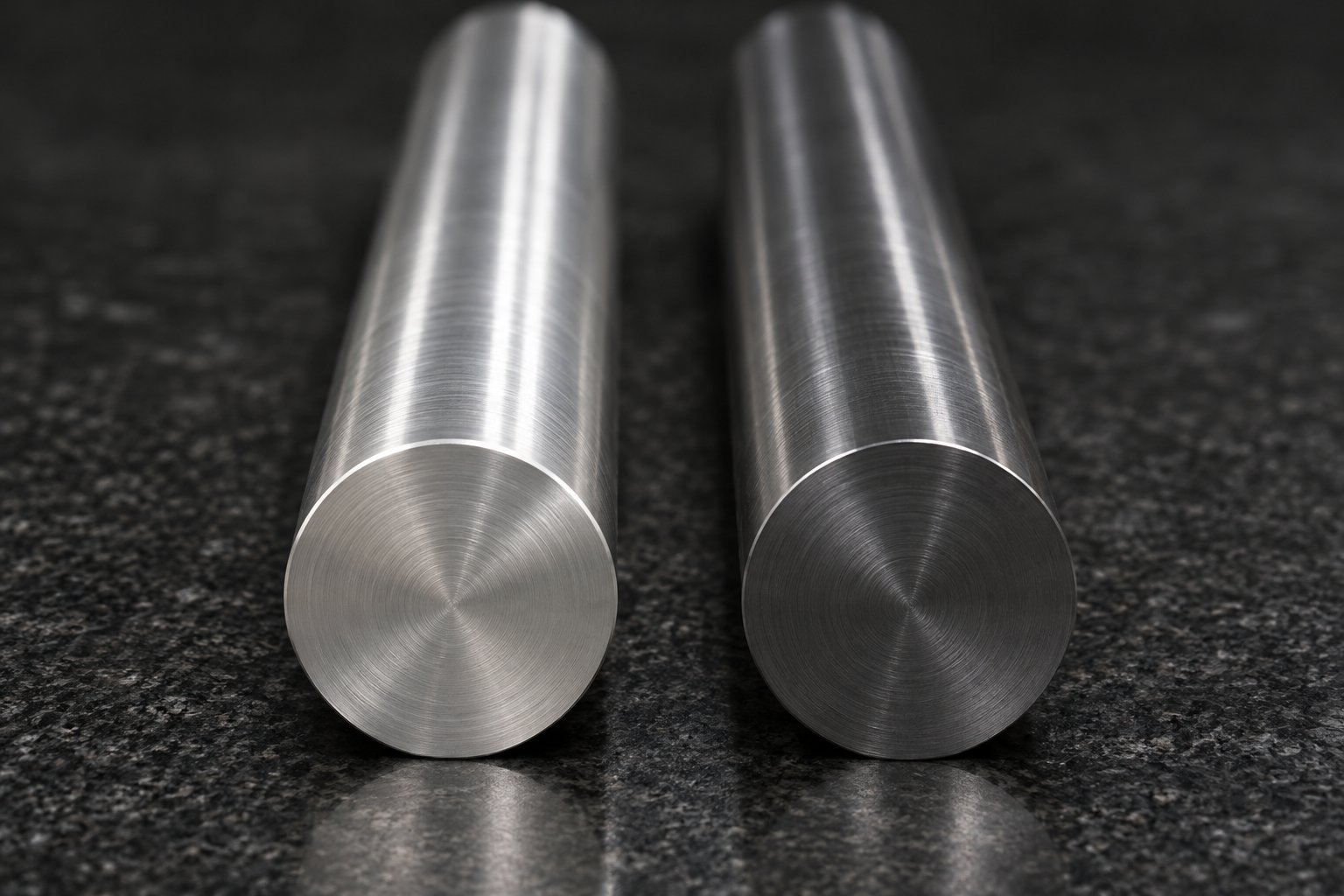
You could run a flawless gas nitriding cycle, hold temperatures precisely at 520 degrees Celsius for 60 hours, and still end up with a disappointing result. Why? Because the steel underneath wasn't designed to respond. Not every alloy forms the same nitride compounds, and not every composition produces the same surface hardness. The alloying elements locked inside the base material act as the raw ingredients for the nitriding reaction, and if those ingredients are missing or present in the wrong proportions, the finished nitriding screw will underperform regardless of how expertly the surface treatment was executed.
This section consolidates the fragmented steel-grade data you'll encounter across supplier datasheets into one clear comparison, so you can match the right base material to your specific extrusion demands.
Why Alloy Composition Determines Nitriding Results
Recall from the metallurgical discussion that nitrogen atoms diffuse into the steel and bond with specific alloying elements to form hard precipitates. Three elements drive the majority of the nitriding response:
- Aluminum (Al) - forms aluminum nitride (AlN), the hardest common precipitate in nitrided steels. Even small concentrations of aluminum dramatically boost surface hardness, which is why purpose-built nitriding steels contain 0.70 to 1.10% aluminum by weight.
- Chromium (Cr) - forms chromium nitride (CrN), contributing both hardness and a measure of chemical resistance to corrosive polymer off-gassing. Chromium content in nitriding steels typically ranges from 1.0 to 1.65%.
- Molybdenum (Mo) - forms molybdenum nitride (MoN/Mo2N), which refines the nitride distribution, improves high-temperature stability, and enhances the overall toughness of the hardened case.
A steel grade rich in all three elements will produce a dense, evenly distributed network of hard nitride precipitates throughout the diffusion zone. A grade with lower concentrations, or one that substitutes other alloying elements, will still nitride, but the resulting surface hardness and wear life will be measurably lower. This is why specifying the right grade is just as important as specifying the right nitriding method.
The table below compares the key grades you'll encounter when sourcing a nitrided screw or nitriding screw barrel for plastics extrusion.
| Steel Grade | Standard / Origin | Key Alloying Elements | Typical Nitrided Surface Hardness | Core Hardness (After Q&T) | Recommended Applications |
|---|---|---|---|---|---|
| 38CrMoAlA (38CrMoAl) | Chinese GB standard | Cr 1.35–1.65%, Mo 0.15–0.25%, Al 0.70–1.10% | 900–1,050 HV | 28–32 HRC (285–321 HBS) | Glass-filled engineering plastics, mineral-filled compounds, high-wear extrusion lines |
| SACM645 | Japanese JIS standard | Cr ~1.5%, Mo ~0.2%, Al ~1.0% | 900–1,050 HV | 28–32 HRC | Equivalent to 38CrMoAlA; used by Japanese OEMs and exported machinery |
| EN41B (also 34CrAlMo5-10) | British BS / European EN 10085 | Cr 1.0–1.3%, Mo 0.15–0.25%, Al 0.80–1.20% | Up to 950 HV | 28–33 HRC | European-sourced extrusion equipment, demanding wear applications |
| 42CrMo (AISI 4140 equivalent) | Chinese GB / international | Cr ~1.0%, Mo ~0.2%, Al trace only | 550–750 HV | 28–35 HRC | Standard polyolefins (PE, PP), unfilled resins, cost-sensitive production |
38CrMoAlA vs 42CrMo for Screw Applications
If you're sourcing screws from a nitrided single screw barrel factory, chances are 38CrMoAlA and 42CrMo will be the two grades presented most frequently. Understanding the gap between them prevents costly mismatches.
38CrMoAlA is a purpose-built nitriding steel. Its elevated aluminum content, ranging from 0.70 to 1.10%, is the key differentiator. Aluminum forms extremely stable AlN precipitates during nitriding, and these precipitates are among the hardest compounds achievable through thermochemical diffusion. Combined with chromium and molybdenum, the result is a surface layer that routinely reaches 900 to 1,050 HV, a hardness range that resists abrasive fillers like glass fiber, talc, and calcium carbonate far more effectively than softer alternatives. Research on SACM645, the Japanese equivalent of 38CrMoAlA, confirms that these aluminum-chromium-molybdenum steels produce a strong nitriding response where hardness in the diffusion layer correlates directly with local nitrogen content, regardless of treatment duration. In other words, the alloy's chemistry consistently converts available nitrogen into measurable hardness.
The grade also delivers strong mechanical properties in its quenched-and-tempered core condition, with tensile strength exceeding 980 MPa and yield strength above 835 MPa. This core toughness is essential because the nitrided case, no matter how hard, depends on a resilient substrate to absorb the bending and torsional loads inherent in extrusion.
42CrMo, by contrast, is a general-purpose alloy steel widely available and significantly less expensive. It contains chromium and molybdenum in similar proportions to 38CrMoAlA, but it lacks the critical aluminum addition. Without aluminum, no AlN precipitates form during nitriding. The surface still hardens through CrN and MoN formation, but peak hardness typically tops out between 550 and 750 HV, roughly 30 to 40% lower than what 38CrMoAlA delivers.
Does that make 42CrMo a bad choice? Not at all. For processing unfilled polyolefins like PE and PP, or other non-abrasive resins like PS and ABS, that hardness range provides perfectly adequate protection at a lower material cost. The screw will still outlast an untreated equivalent by a wide margin. The mistake is using 42CrMo where 38CrMoAlA is needed, running a glass-filled nylon through a nitrided 42CrMo screw, for example, and expecting the same service life. The abrasive filler will chew through the softer nitride case far faster than it would erode an AlN-rich surface.
Pre-Nitriding Heat Treatment Requirements
Here's a detail that separates a reliable nitriding screw from a premature failure: the quench-and-temper cycle performed before nitriding ever begins. Both 38CrMoAlA and 42CrMo must be properly heat-treated to establish the right core microstructure, a fine, uniform tempered structure that provides the mechanical backbone for the nitrided case above.
For 38CrMoAlA, the standard process involves austenitizing at 930 to 970 degrees Celsius, quenching in oil, and then tempering at 580 to 620 degrees Celsius. This sequence produces a core hardness of approximately 28 to 32 HRC with high toughness, ensuring the screw can handle the sustained torsional and bending stresses of extrusion without risk of fatigue cracking beneath the hardened surface. The tempering temperature is critical for another reason: it sets the upper limit for the subsequent nitriding cycle. If nitriding occurs at a temperature higher than the original temper, the core softens, undermining the entire foundation. Standard practice keeps the nitriding temperature at least 20 to 30 degrees Celsius below the tempering temperature to preserve core integrity.
For 42CrMo, a similar quench-and-temper sequence applies, typically yielding core hardness in the 28 to 35 HRC range depending on the exact tempering parameters chosen. The process is well-established and forgiving, which contributes to 42CrMo's popularity as a cost-effective screw material.
Skipping or improperly executing this pre-treatment step is one of the most common manufacturing shortcuts, and one of the hardest to detect after the fact. A hardness test on the finished surface might read perfectly, but if the core was never properly tempered, the screw lacks the ductility to flex under load. It becomes a hard shell on a brittle foundation, vulnerable to catastrophic fracture rather than gradual, predictable wear. When evaluating any supplier's nitriding screw barrel, always request documentation of both the pre-nitriding heat treatment and the final surface hardness verification.
With the right steel grade selected and properly heat-treated, the nitrided surface is engineered to resist the specific types of degradation, abrasive, adhesive, and corrosive, that plastics processing inflicts on every screw it touches. How each wear mechanism attacks the surface, and how the nitride case fights back, reveals why material selection alone isn't the full picture.
How Nitriding Combats the Three Types of Screw Wear
A perfectly selected steel grade and a flawlessly executed nitriding cycle mean nothing in a vacuum. Their value shows up only when the screw meets real material under real processing conditions, and those conditions are rarely gentle. Every polymer, filler, and additive combination attacks the screw surface through one or more distinct wear mechanisms. Understanding exactly how each mechanism operates, and how the nitrided case responds, turns abstract metallurgy into practical engineering decisions.
Three categories cover virtually every wear scenario a plastic extruder nitride screw barrel will encounter: abrasive wear, adhesive wear, and corrosive wear. Most real-world applications involve a blend of all three, but one mechanism usually dominates depending on the compound being processed. Identifying the dominant threat is the first step toward specifying the right level of surface protection.
Fighting Abrasive Wear from Filled Compounds
Abrasive wear is the most straightforward mechanism to visualize. Hard particles suspended in the polymer melt physically grind against the screw surface as material is conveyed, compressed, and mixed along the barrel length. Each particle acts like a microscopic cutting tool, removing tiny amounts of steel with every pass. Over thousands of operating hours, those tiny losses accumulate into measurable dimensional changes: flight edges lose height, root diameters deepen, and screw-barrel clearance opens up, reducing melting efficiency and output consistency.
The severity depends on three variables: the hardness of the filler particles relative to the screw surface, their concentration in the polymer matrix, and their shape. Sharp, angular particles cause more severe wear than rounded particles, and higher filler concentrations accelerate material removal proportionally. Glass fibers, for example, measure roughly 450 to 600 HV on the Vickers scale. An untreated 42CrMo screw surface at 280 to 350 HV is substantially softer than those fibers, meaning the glass cuts into the steel with little resistance. A nitrided surface on 38CrMoAlA, reaching 900 to 1,050 HV, flips that relationship entirely. The screw surface is now harder than the filler, dramatically reducing the rate of material removal.
Common abrasive fillers and their appropriate nitriding response include:
- Glass fiber (30-40% loading) - hardness around 450-600 HV. Requires nitriding on 38CrMoAlA or equivalent aluminum-bearing nitriding steel. Flight tips benefit from additional hardfacing alloys for dual-layer protection.
- Calcium carbonate (CaCO3) - softer than glass fiber but processed at very high filler loadings (sometimes 60-80%). Standard nitriding on 42CrMo or 38CrMoAlA provides adequate protection depending on concentration.
- Talc and mica - platelet-shaped mineral fillers that cause moderate abrasive wear. Nitriding on 38CrMoAlA is recommended for loadings above 20%.
- Titanium dioxide (TiO2) - hard pigment particles commonly used in masterbatch production. Nitrided surfaces resist wear effectively at typical pigment loadings (1-5%), but high-concentration TiO2 masterbatch lines benefit from premium nitriding steels.
- Carbon black - relatively soft, but processed at high volumes. Standard nitriding is typically sufficient.
- Glass beads and mineral reinforcements (wollastonite, kaolin) - variable hardness. Nitriding on aluminum-bearing steels with hardfaced flight tips provides the best lifecycle economics.
Where does hardfacing fit into the picture? Even a well-nitrided screw has limits when processing highly abrasive compounds at aggressive throughput rates. Flight lands are usually hardfaced with alloys that are abrasion resistant because the flight tips experience the highest contact pressure against the barrel wall and the most intense abrasive particle interaction. For an OEM nitrided screw barrel, applying a cobalt-based (Stellite) or nickel-based (Colmonoy) hardfacing alloy to the flight tips before or after nitriding creates a dual-layer defense. The hardfacing protects the highest-wear zone, while the nitrided diffusion zone shields the root, flanks, and transitions where particle contact is less severe but still damaging over time.
How Nitriding Reduces Adhesive Wear
Adhesive wear operates through an entirely different mechanism, one that's less obvious but equally destructive. When two surfaces slide against each other under pressure and elevated temperature, localized micro-welding can occur at contact points. In the context of screw barrel operation, this manifests as polymer melt bonding to the screw surface and then being torn away, removing material from the screw in the process. Polymers with high melt adhesion to metal, including polyamides (PA), PVC, and certain engineering plastics, are particularly prone to causing this type of damage.
Imagine the cycle: a thin film of molten polymer sticks to the screw's channel wall, builds up under shear, and eventually fractures. If the adhesive bond between the polymer and the steel is stronger than the cohesive strength of the polymer itself, the polymer tears cleanly and no screw damage occurs. But if localized conditions create a bond strong enough to pull metal particles away from the surface, each separation event leaves a tiny pit or gouge. Over millions of rotations, these micro-events create visible surface roughness, galling, and progressive material loss.
The nitrided case counters adhesive wear in two ways. First, the high surface hardness, approaching 1,000 HV in optimized conditions, means the surface resists plastic deformation at contact points. Softer, untreated steel deforms under localized pressure, creating larger contact patches that increase the likelihood of adhesive bonding. A harder surface maintains its geometry under load, keeping contact areas small and adhesive forces low. Second, the smooth, dense nitride layer presents a chemically stable surface that resists wetting by molten polymers. The iron nitride and alloy nitride compounds that make up the compound layer have lower surface energy than bare steel, reducing the thermodynamic drive for polymer chains to bond with the metal.
For screws processing sticky materials, this translates directly into longer intervals between shutdowns for cleaning and reduced risk of the galling damage that can send a screw to the rebuild shop prematurely.
Corrosion Resistance and Its Limits
Corrosive wear is the most insidious of the three mechanisms because it amplifies the other two. Corrosion is the gradual destruction of materials by chemical attack, and in plastics processing, the chemical attackers are the decomposition products released when certain polymers degrade at elevated temperatures. The breakdown roughens the steel surface at a microscopic level, creating fresh areas of exposed metal that are immediately vulnerable to further abrasive or adhesive damage. The combined assault, chemical weakening followed by mechanical removal, can accelerate total wear rates far beyond what either mechanism would produce alone.
Chromium nitrides (CrN) within the nitrided case provide a meaningful first line of defense. These compounds are chemically stable across a wide range of temperatures and resist attack from mild acids and many industrial gases. For screws processing polyolefins with standard stabilizer packages, or engineering plastics that off-gas small quantities of irritants during processing, the nitrided CrN layer handles the chemical environment effectively.
The real question is where that protection runs out. Here are the most common corrosive polymer families and what you should expect from a nitrided surface:
- PVC (polyvinyl chloride) - releases hydrochloric acid (HCl) during thermal degradation. HCl is highly aggressive toward iron-based alloys. A nitrided surface offers partial protection and extends service life compared to untreated steel, but corrosion-resistant materials or bimetallic solutions are recommended for dedicated PVC extrusion lines running continuously.
- Fluoropolymers (PTFE, PVDF, FEP) - generate hydrofluoric acid (HF) at processing temperatures, one of the most corrosive substances any screw will encounter. Nitriding alone is insufficient for sustained fluoropolymer processing. Nickel-based alloy liners or specialized corrosion-resistant screws are essential.
- Flame-retardant compounds - halogenated flame retardants release HBr or HCl during processing. The severity depends on the specific retardant chemistry and concentration. Nitriding provides a workable buffer for low-concentration formulations but may need supplementation for heavily flame-retarded compounds.
- Acetals (POM) - release formaldehyde gas during degradation, which is mildly corrosive. Standard nitriding handles acetal processing effectively in most conditions.
- Polycarbonate (PC) - can generate trace corrosive byproducts at elevated temperatures. Nitrided surfaces typically provide adequate protection for standard processing windows.
The honest engineering answer is that nitriding extends corrosion resistance but does not make a steel screw immune to chemical attack. When the dominant wear mechanism is corrosive rather than abrasive, the solution often involves pairing a nitrided screw with a bimetallic barrel that features a corrosion-resistant alloy liner, or specifying a stainless-steel-based screw altogether. Stainless steel screws offer excellent corrosion resistance but reduced wear resistance compared to tool steel, so the choice always involves a trade-off between chemical durability and mechanical hardness.
Recognizing which wear mechanism dominates your specific application is only the starting point. The next practical challenge is translating that knowledge into a polymer-by-polymer selection guide, matching the right combination of steel grade, nitriding specification, and supplemental protection to the exact material running through your extruder.
Matching Nitrided Screws to Specific Polymer Applications
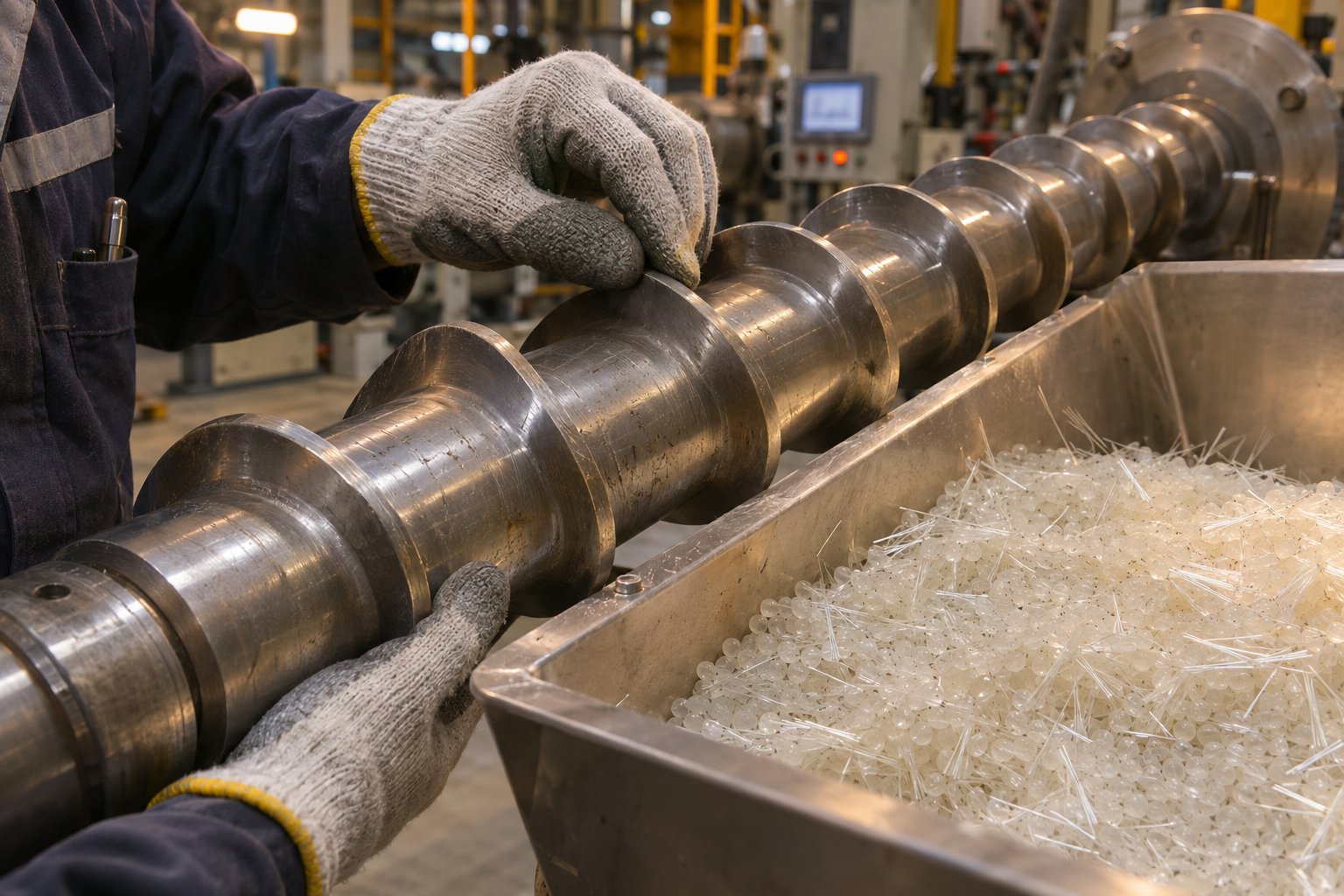
Knowing how abrasive, adhesive, and corrosive wear mechanisms attack a screw surface is valuable. Knowing which mechanism dominates for the exact polymer running through your extruder is where that knowledge becomes money. Yet polymer-specific selection guidance for nitrided screws is almost nonexistent in supplier literature. Most datasheets list hardness numbers and case depths without ever connecting those specs to a real processing scenario.
That gap leaves engineers guessing and procurement teams over-specifying, or worse, under-specifying. The table below maps common polymer families directly to their dominant wear threat, recommended steel grade, and the appropriate level of surface treatment. Use it as a starting framework, then read the detailed breakdowns that follow for the reasoning behind each recommendation.
| Polymer Family | Primary Wear Mechanism | Recommended Steel Grade | Recommended Surface Treatment |
|---|---|---|---|
| PE, PP (unfilled) | Mild abrasion, minimal corrosion | 42CrMo | Standard gas nitriding |
| PS, ABS (unfilled) | Mild abrasion, adhesive wear | 42CrMo | Standard gas nitriding |
| PA-GF, PBT-GF (glass-filled) | Severe abrasion from glass fiber | 38CrMoAlA / SACM645 | Nitriding + hardfaced flight tips |
| PP-GF, PA-mineral filled | Moderate to severe abrasion | 38CrMoAlA | Nitriding; hardfacing for loadings above 30% |
| PVC (rigid and flexible) | Corrosive (HCl) + mild abrasion | 38CrMoAlA or corrosion-resistant alloy | Nitriding paired with bimetallic barrel; specialized alloy screw for continuous PVC lines |
| PEEK, PEI, PSU | Adhesive wear, thermal stability demands | 38CrMoAlA or high-alloy tool steel | Nitriding with verified thermal stability; plasma nitriding preferred for white-layer control |
| Fluoropolymers (PTFE, PVDF, FEP) | Severe corrosion (HF) | Nickel-based alloy or stainless steel | Bimetallic construction; nitriding alone insufficient |
| POM (acetal) | Mild corrosion (formaldehyde), adhesive wear | 42CrMo or 38CrMoAlA | Standard gas nitriding |
| Food-grade resins (PE, PP, PA) | Application-dependent | Application-dependent | Nitriding acceptable; verify regulatory compliance for direct food contact |
Standard Polyolefins and Unfilled Resins
Polyethylene and polypropylene without fillers are the gentlest materials a screw will ever process. The melt is non-abrasive, chemically inert under normal processing temperatures, and generates no corrosive decomposition byproducts. Similarly, unfilled PS and ABS present only mild adhesive wear concerns and minimal abrasive threat.
For these applications, a gas-nitrided screw on 42CrMo steel provides a reliable, cost-effective solution. The 550 to 750 HV surface hardness this grade achieves after nitriding is more than sufficient to resist the gentle contact forces of unfilled polymer melt. Specifying a premium 38CrMoAlA screw for a standard HDPE pipe extrusion line, for instance, adds material cost without delivering a proportional improvement in service life.
This brings up a misconception worth addressing directly: higher hardness does not automatically mean better performance. A surface hardened to 1,000 HV processing unfilled polypropylene gains no practical advantage over one at 650 HV, because the wear forces involved are too low to challenge either surface. You're essentially paying for armor against a threat that doesn't exist. Some buyers even ask whether titanium nitride screws or a titanium nitride screw bit would be worth it for standard polyolefins. In industrial plastics extrusion, the answer is almost always no. Titanium nitride (TiN) coatings deliver impressive hardness, around 2,000 HV, but they are thin PVD deposits prone to adhesion failure under the sustained mechanical loading and thermal cycling of screw rotation. For cutting tools and drill bits that experience short-duration, high-speed contact, TiN excels. For a screw rotating inside a barrel for months at a time, the thermochemically diffused nitride case is the more durable and economical solution.
Save your budget for the applications that genuinely need it, and you'll find the overall cost of ownership across your extrusion fleet drops significantly.
Glass-Filled and Mineral-Filled Engineering Plastics
This is where material selection starts to matter intensely. A nitrided screw for glass filled plastic faces a fundamentally different challenge than one processing neat resin. Glass fibers at 30 to 40% loading are harder than most untreated steel surfaces. Every fiber that slides across a flight edge or channel wall acts as a cutting tool, and at high screw speeds, those fibers break into shorter segments with sharp, jagged ends that increase friction and accelerate surface damage.
For PA-GF (glass-filled nylon), PBT-GF, and similar engineering compounds, the recommendation is clear: specify 38CrMoAlA or its equivalent (SACM645, EN41B) as the base steel, and add hardfaced flight tips for dual-layer protection. The nitrided diffusion zone, reaching 900 to 1,050 HV on these aluminum-bearing steels, shields the screw root, channel walls, and flight flanks. The hardfacing alloy on the flight lands, typically a cobalt-based or nickel-based composition, protects the highest-wear contact zone against the barrel wall where abrasive particle concentration is greatest.
Mineral-filled compounds, such as PP with 40% talc or PA with 30% wollastonite, fall into a similar category. While individual mineral particles are generally softer than glass fiber, the high filler loadings mean more total abrasive contact per revolution. For loadings above 20 to 30%, 38CrMoAlA with nitriding outperforms the softer nitride case that 42CrMo produces.
One practical detail that often goes overlooked: screw speed plays a significant role in abrasive wear severity. Higher RPMs increase shear forces, break fibers into sharper fragments, and accelerate the rate at which hard particles pass over the screw surface. If your production goals push you toward higher throughput, the investment in premium nitriding steel and hardfaced flights pays back faster, because wear rates scale nonlinearly with speed and filler aggression.
Corrosive Polymers and High-Temperature Resins
PVC processing presents a unique challenge because the dominant wear mechanism is chemical, not mechanical. During thermal degradation, PVC releases hydrochloric acid (HCl), and even under well-controlled processing conditions, some degree of degradation is unavoidable, especially in dead zones, at barrel joints, or during startup and shutdown sequences. The hydrogen chloride gas generated during decomposition increases both screw and barrel corrosion, attacking the iron matrix and accelerating surface breakdown.
A nitrided screw barrel for PVC extrusion provides a meaningful upgrade over untreated steel. The chromium nitrides in the case layer resist mild acid exposure and extend service intervals. For intermittent PVC runs or lines processing rigid PVC with good temperature control, nitriding on 38CrMoAlA may provide adequate protection. For dedicated, continuous PVC extrusion, however, the corrosive severity typically demands more: pairing a nitrided screw with a bimetallic barrel featuring a corrosion-resistant alloy liner, or specifying a specialized alloy screw designed to withstand sustained HCl exposure. The trade-off between nitriding and bimetallic construction becomes a direct cost-versus-lifetime calculation, and for high-volume PVC pipe or profile lines, the bimetallic option usually wins on total cost of ownership.
High-temperature engineering plastics raise a different set of concerns. PEEK, with a melting point around 343 degrees Celsius, processes at melt temperatures that push toward the limits of standard nitriding stability. PEI (Ultem) and PSU (polysulfone) also require sustained barrel temperatures well above 300 degrees Celsius. At these elevated temperatures, the nitrided case must retain its hardness without softening or accelerated nitrogen diffusion deeper into the core, which could alter screw dimensions over extended campaigns.
For PEEK and similar high-temperature resins, two factors matter most. First, the pre-nitriding tempering temperature of the base steel must exceed the processing temperature by a comfortable margin, otherwise the screw core softens during operation. Second, plasma nitriding may be preferred over gas nitriding for these applications because it allows tighter control over the compound layer, minimizing the brittle white layer that could fracture under the high melt pressures and adhesive forces these polymers generate.
Food-grade applications deserve a brief but important note. Nitriding itself does not introduce foreign materials onto the screw surface, since it is a diffusion process rather than a coating. This generally makes nitrided screws acceptable for food-contact polymer processing, including food-grade PE, PP, and PA. However, regulatory requirements vary by jurisdiction and end-use application. Always verify compliance with applicable food-contact regulations (FDA, EU 1935/2004, or equivalent) before specifying any surface treatment for a food-packaging extrusion line. The surface treatment is rarely the regulatory bottleneck, but confirming it early avoids costly surprises during qualification audits.
Matching the right screw specification to each polymer is the foundation of smart purchasing. Yet even a perfectly matched nitrided screw eventually faces competition from alternative surface treatment technologies, and understanding how those alternatives compare on a level playing field is essential before committing to any specification.
Nitrided Screws vs Bimetallic and Chrome-Plated Alternatives
Every polymer-specific recommendation in the previous section boils down to a practical question: is a nitrided screw the right surface treatment for your application, or should you be looking at a bimetallic build or chrome plating instead? Suppliers often present their preferred option as universally superior, but the engineering reality is more nuanced. Each approach has a performance window where it excels, and a threshold beyond which it becomes either insufficient or unnecessarily expensive.
The comparison table below puts all three nitrided screw surface treatment options side by side across the parameters that influence both performance and cost of ownership. Use it as a decision-making framework, not a ranking.
| Parameter | Nitrided Screw | Bimetallic Screw | Chrome-Plated Screw |
|---|---|---|---|
| Surface Hardness Range | 550 - 1,050 HV (grade-dependent) | 68 - 72+ HRC (alloy-dependent) | 850 - 1,000 HV |
| Case / Layer Thickness | 0.1 - 0.7 mm (diffusion zone) | 1.5 - 3.0 mm (alloy liner) | 0.02 - 0.25 mm (electrodeposit) |
| Resistance to Abrasion | Good to excellent (grade-dependent) | Excellent; best for severe abrasion | Moderate; thin layer wears through quickly under abrasive fillers |
| Resistance to Corrosion | Moderate (CrN provides partial protection) | Good to excellent (alloy-dependent; Ni-based alloys excel) | Good in mild environments; microcracks expose base metal under thermal cycling |
| Dimensional Impact | Minimal; low-temperature process preserves tolerances | Requires machining after liner application; adds process complexity | Adds material to the surface; must be ground to final dimensions |
| Delamination Risk | None; diffused into the base steel | Very low; metallurgically bonded liner | Moderate to high; coating can peel or spall under stress |
| Re-Treatability | Yes; re-nitriding possible (1-2 cycles) | Limited; liner cannot be reapplied economically | Yes; can be stripped and re-plated, but with diminishing returns |
| Relative Cost | Moderate (1x baseline) | High (2.5 - 3x baseline) | Low to moderate (0.7 - 1.2x baseline) |
| Typical Lead Time | Moderate; treatment cycle 10 - 80 hours | Longer; centrifugal casting + machining + finishing | Short; electroplating process is relatively fast |
Nitriding vs Bimetallic Construction
When you compare a nitrided screw vs bimetallic barrel setup, you're really comparing two fundamentally different engineering philosophies. Nitriding transforms the existing steel surface. Bimetallic construction replaces the working surface entirely with a centrifugally cast alloy liner, typically a nickel-based, cobalt-based, or tungsten-carbide-bearing composition metallurgically bonded to a structural steel shell.
The bimetallic approach wins on raw protective capability. That 1.5 to 3.0 mm alloy liner is several times thicker than any nitrided diffusion zone, which means wear must consume substantially more material before reaching the softer substrate underneath. For operations continuously processing highly abrasive compounds, 30% glass-filled nylon or 60% calcium-carbonate-loaded polyolefins, that extra depth translates directly into extended intervals between replacements. Industry data suggests bimetallic components can last three to five times longer than their nitrided equivalents in aggressively abrasive applications.
Corrosion resistance follows the same pattern. Nickel-based bimetallic alloys shrug off hydrochloric acid from PVC degradation and resist the halogenated byproducts of flame-retardant compounds far more effectively than chromium nitrides in a nitrided case. If your extrusion line runs rigid PVC at high volumes, or processes fluoropolymer compounds that release hydrofluoric acid, the bimetallic option provides protection that nitriding simply cannot match.
So why doesn't everyone simply specify bimetallic? Cost is the straightforward answer. A bimetallic barrel typically runs 2.5 to 3 times the price of its nitrided equivalent, and bimetallic screws carry similar premiums. For operations running virgin polyolefins or unfilled commodity resins, that investment generates no return because the wear environment is too mild to challenge even a standard nitrided surface. The bimetallic premium only pays for itself when wear severity is high enough to cause premature failure of nitrided components, cutting their expected three-to-five-year service life down to 12 to 18 months.
The smart approach treats this as a lifecycle cost calculation, not a spec-sheet comparison. Evaluate the actual polymer, filler percentage, and production intensity before defaulting to the most expensive option.
Why Chrome Plating Has Practical Limitations on Screws
Chrome plating looks attractive on paper: relatively low cost, fast turnaround, and a hard surface layer. In the chrome plated screw barrel comparison, however, the practical limitations become apparent quickly, particularly for screws that operate under sustained mechanical and thermal stress.
The core problem is thickness. Chrome plating is an electrodeposited layer that sits on top of the base steel rather than diffusing into it. When the layer is thin, around 0.02 to 0.05 mm, it wears through rapidly under abrasive polymer compounds, exposing the untreated substrate in high-contact zones like flight tips within months. Making the layer thicker seems like the obvious fix, but exceeding the ideal thickness introduces a cascade of failure modes: internal stresses in the chromium deposit increase, microcracks propagate through the plating, and adhesion between the chrome layer and the base metal deteriorates. The result is peeling, spalling, or flaking, exactly the kind of delamination failure that a diffusion-based nitrided surface is immune to.
Thermal cycling compounds the issue. A screw operating inside a heated barrel experiences constant temperature fluctuations, especially during startup, shutdown, and material changeovers. Hard chrome has a different coefficient of thermal expansion than the underlying steel. As the screw heats and cools, the plating and substrate expand at different rates, generating interfacial stresses that eventually crack or lift the chrome layer. Hydrogen embrittlement from the electroplating process itself further weakens high-strength steel substrates, creating a hidden risk of sudden, brittle fracture under torsional load.
None of this means chrome plating has no place in plastics processing. For barrels, where the cylindrical bore geometry allows more uniform plating and the substrate remains relatively static thermally, thin chrome layers can extend bore life for non-abrasive applications. For screws, where complex flight geometry, rotational stress, and direct filler contact converge, chrome plating struggles to deliver the durability that either nitriding or bimetallic construction provides.
Combining Surface Treatments for Maximum Protection
In many demanding production environments, the best answer isn't choosing one treatment over another. It's combining them strategically. A common pairing in the extrusion industry is a nitrided screw running inside a bimetallic barrel. The nitrided screw provides a hard, delamination-proof working surface at moderate cost, while the bimetallic barrel's alloy liner handles the most aggressive abrasive and corrosive contact along its bore. This combination captures the strengths of both approaches without doubling the cost of a fully bimetallic system.
Another layered approach involves hardfacing the flight tips of a nitrided screw with a cobalt-based or nickel-based weld alloy. The hardfacing protects the highest-wear zone, the narrow band where the flight tip rides against the barrel wall, while the nitrided diffusion zone defends the broader screw body. This dual-layer strategy is particularly popular for processing glass-filled engineering plastics, where flight-tip wear is the primary failure mode.
The key principle? Treat the screw and barrel as a matched pair rather than selecting each component in isolation. Replacing only one component also requires checking the condition of the other, because installing a new wear-resistant screw inside a severely worn barrel won't restore the original clearance or process performance. Match the surface treatment level to the actual wear severity at each location in the system, and you'll achieve the longest service life at the lowest total cost.
Surface treatment selection puts the right armor on the screw. Keeping that armor intact over thousands of operating hours, knowing when it's wearing thin, and deciding whether to re-treat, rebuild, or replace, is an entirely different discipline that most suppliers never discuss.
Maintenance and Lifecycle Management for Nitrided Screws
Selecting the right surface treatment and matching it to the right polymer is the first half of the equation. The second half, the part almost no supplier bothers to explain, is what happens after the screw has been running for six months, twelve months, or three years. How do you know when the nitrided case is wearing thin? Can you re-treat a worn screw to extend its life? At what point is refurbishment a waste of money compared to ordering a replacement? These are the questions that determine whether your nitrided screw barrel maintenance strategy is a cost-saving discipline or an expensive guessing game.
Monitoring Wear on Nitrided Screws
A nitrided screw doesn't announce the end of its service life with a dramatic failure. Instead, it whispers through subtle changes in process data that most operators compensate for without realizing they're masking a deeper problem. Tracking the right indicators, both during production and during scheduled shutdowns, is the only reliable way to catch wear before it becomes a crisis.
Effective nitrided screw wear monitoring combines two approaches: indirect measurement from process data collected during operation, and direct physical measurement taken when the screw is pulled from the barrel.
Indirect indicators you can track without stopping the line:
The most sensitive single metric is specific rate, your extruder's output (lb/hr or kg/hr) divided by screw speed (RPM). As the nitrided case wears and flight clearance increases, polymer melt leaks backward over the flights instead of moving forward. The main signs of wear include a reduction in specific rate and higher discharge temperatures. When operators quietly bump up RPM to maintain throughput, they're compensating for wear, and each RPM increase accelerates the damage further.
Use the following checklist as a structured nitrided screw wear monitoring program. Review these parameters at a consistent interval, weekly for high-volume lines, monthly for standard production:
- Record output rate at a fixed screw RPM. Compare against the baseline established when the screw was new. A decline of 5 to 10% signals marginal wear; beyond 15%, performance degradation becomes operationally significant.
- Monitor melt temperature versus barrel zone setpoints. Worn flights reduce heat transfer efficiency at the barrel wall and generate more shear heat from material slipping over the widened clearance. A progressive rise of 8 to 15 degrees Fahrenheit above baseline indicates meaningful wear.
- Track motor amperage at constant screw speed. Changes in motor load at the same RPM reflect altered melting behavior or increased back-pressure from wear compensation. An increase exceeding 8 to 10% warrants investigation.
- Watch for melt pressure instability. A widening spread in melt pressure readings, even if the average stays stable, signals inconsistent melting from solid bed breakup caused by worn screw geometry. Rhythmic melt pressure oscillation often precedes visible product defects like wall thickness variation.
- Calculate specific energy (kWh/lb). This integrates motor power and throughput into one number. As screws wear, specific energy may initially decrease, reflecting lower pumping efficiency, then increase as higher RPMs are needed to compensate.
- Inspect product dimensions and quality. Increasing variation in wall thickness, surface finish, or dimensional consistency often indicates the screw-barrel clearance has opened beyond acceptable limits.
- Visually inspect flight edges during every scheduled shutdown. Look for rounding, polishing, or visible metal loss on flight tips, especially in the metering section and at any barrier flight transitions. Use brass cleaning tools and copper gauze to avoid scratching the nitrided surface during inspection.
Direct measurement during screw pulls:
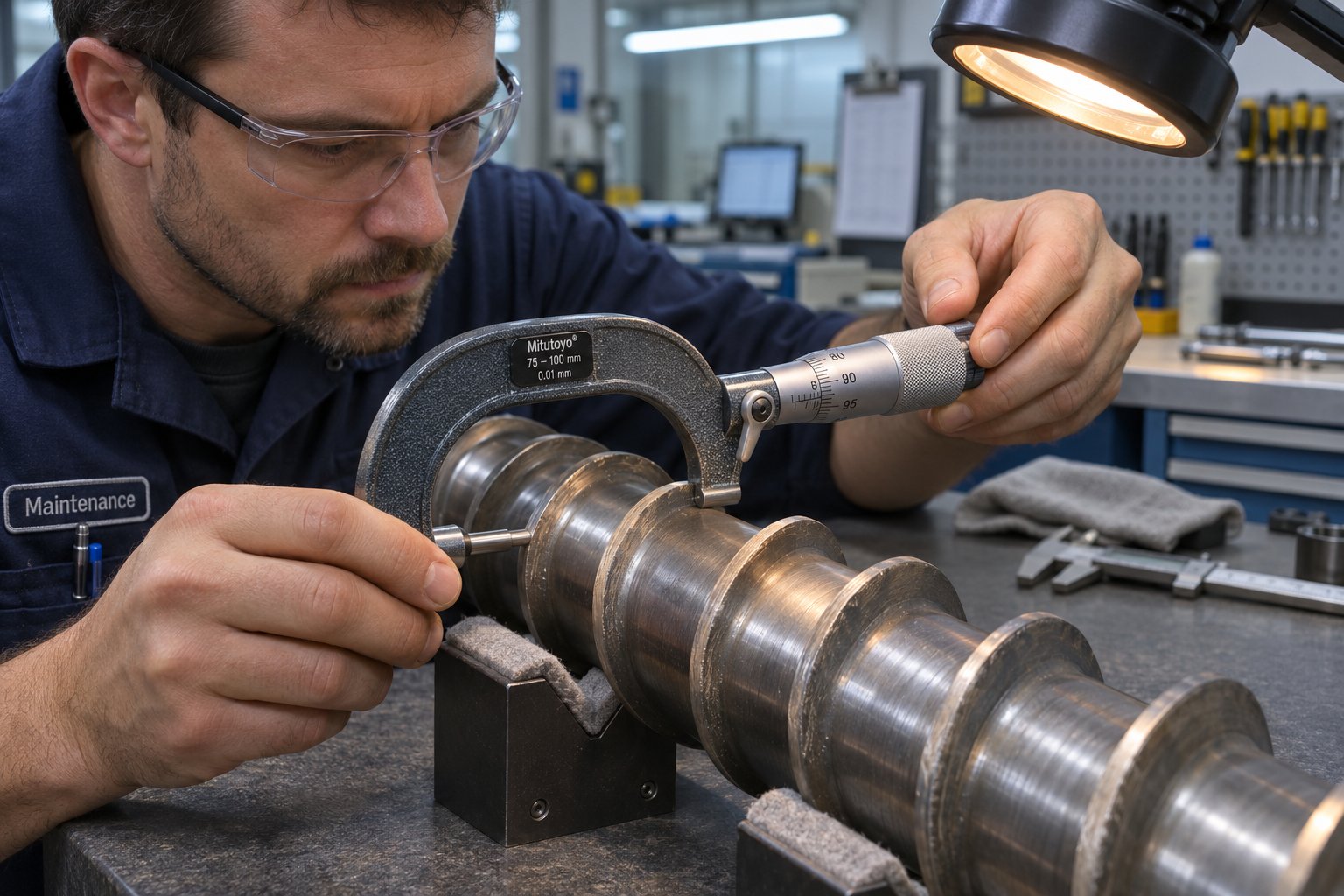
When the screw is pulled from the barrel, measure flight outside diameter (OD) at multiple positions along the screw's length using a micrometer. Compare each reading against the as-new dimensions on the original inspection report. For a typical single-screw extruder, the flight clearance when new is approximately the nominal screw diameter divided by 1,000 per side. When that clearance doubles to roughly 0.008 to 0.010 inches per side, performance degradation becomes noticeable. Beyond 0.010 to 0.012 inches, most processes show unacceptable output loss and melt quality problems.
While the screw is out, measure the barrel bore ID as well. A barrel with a bimetallic liner will typically last three times the service life of a screw, but confirming the barrel condition prevents the mistake of installing a fresh screw into a severely worn barrel and wondering why performance doesn't recover.
Re-Nitriding and Its Practical Limits
Here's where things get interesting for lifecycle economics. A re-nitriding extruder screw, running the worn component through a second nitriding cycle, can restore surface hardness and extend useful life at a fraction of the cost of a new screw. But this strategy comes with caveats that many buyers don't hear about until it's too late.
When a worn screw re-enters the nitriding furnace, nitrogen atoms again diffuse into the surface. The existing diffusion zone deepens slightly as fresh nitrogen pushes further into the steel matrix, and the compound layer reforms at the surface. Surface hardness measurements after re-treatment often approach the original specification, which makes the process look like a straightforward win.
The hidden cost is dimensional. Each nitriding cycle causes a slight volumetric expansion of the surface layer, typically on the order of a few microns. On the first treatment, this change is accounted for in the original manufacturing tolerances. On the second treatment, the cumulative expansion adds to whatever dimensional change occurred during the first cycle. For a screw that must maintain precise clearance against a barrel wall along its entire length, these incremental changes matter. The flight OD may grow slightly, while the root diameter shifts in ways that alter channel depth and compression ratio by small but measurable amounts.
The practical limit for re-nitriding is typically one to two retreatments, depending on the original case depth, the degree of wear, and the precision demands of the application. After a second re-nitriding cycle, the cumulative dimensional changes often push screw-barrel clearance outside acceptable tolerances. The diffusion zone also becomes progressively deeper with each cycle, and at some point, the case depth may exceed what the remaining core properties can adequately support, particularly if the screw has experienced thermal aging during years of service.
Before authorizing re-nitriding, always verify two things: first, that the screw's flight OD and root dimensions still fall within a range where the post-treatment dimensional shift won't push clearances beyond limits; and second, that the base steel's core hardness hasn't degraded from prolonged high-temperature exposure during operation. A quick Rockwell hardness test on an exposed cross-section, such as the drive end, can confirm whether the core is still in the expected HRC 28 to 35 range.
When to Refurbish vs Replace
When a screw has worn past the point where re-nitriding alone can restore acceptable performance, two options remain: flight rebuilding or full replacement.
Flight rebuilding involves welding new hardfacing material onto the worn flight tips, re-machining the flights to the original OD and geometry, and then re-nitriding the entire screw. It's a cost-effective approach when the screw's root diameter and channel geometry are still within specification and only the flight lands have worn significantly, which is the most common wear pattern for screws processing abrasive fillers.
There's a hard limit on this approach, though. A screw should never be refurbished more than three times, because each time new hardfacing is welded onto the base material, the base material deteriorates and delamination between the hard facing and the base metal becomes likely. The repeated thermal cycles from welding degrade the heat-affected zone in the underlying steel, weakening the bond between the rebuilt flight and the screw body. A delaminated hardfacing fragment breaking free inside a running extruder isn't just a maintenance problem, it's a potential safety hazard and a guaranteed source of product contamination.
Full replacement becomes the right call when any of the following conditions exist:
- The screw has already been refurbished two or more times.
- Root diameter wear has altered channel depth enough to change the compression ratio and melting behavior.
- Core hardness has dropped below the minimum specification, indicating thermal degradation of the base steel.
- The screw design itself is outdated, and a modern barrier or mixing geometry would improve process performance beyond what restoring the original design can achieve.
A spare screw should be kept in storage so that when the current screw reaches end of life, the swap can happen during a planned shutdown window rather than an emergency scramble. That single practice, keeping a dimensionally verified spare on the shelf, turns a potential multi-day unplanned outage into a half-day scheduled maintenance event.
Proper storage and handling also extend the life of both active and spare nitrided screws. A few practical rules go a long way:
- Never clean a nitrided surface with steel wire brushes or abrasive pads. Use brass or copper tools only. Steel tools can scratch through the compound layer and initiate localized corrosion or accelerated wear at the damage site.
- Avoid thermal shock. Pulling a screw from a 400-degree-Fahrenheit barrel and exposing it to cold water or ambient winter air creates rapid thermal gradients that can crack a brittle compound layer. Allow gradual cooling whenever possible.
- Apply a light coat of rust-preventive oil before storage. Even a nitrided surface can develop surface corrosion if stored in humid environments for extended periods, especially if the compound layer has been ground off and only the diffusion zone remains.
- Store screws horizontally on padded V-blocks or cradles. Leaning a long screw vertically against a wall risks bending under its own weight over time, introducing straightness errors that compromise barrel fit.
A disciplined maintenance cycle, monitoring wear through process data, verifying dimensions during scheduled pulls, re-nitriding when the numbers justify it, and replacing when they don't, extracts maximum value from every screw you purchase. That value, though, starts with specifying the right component in the first place, which brings the conversation full circle to how you build a procurement specification that captures everything you've learned about steel grades, nitriding methods, wear mechanisms, and application matching.
Selecting the Right Nitrided Screw Barrel for Your Extrusion Line
Every chapter up to this point has armed you with the metallurgical knowledge, wear science, polymer-matching logic, and lifecycle management strategy that most suppliers never share. The final challenge is translating all of that into a purchasing specification that actually gets you the right component, not just the cheapest quote or the fastest delivery. Engineers and procurement professionals who approach this step methodically will find that the time invested in building a thorough nitrided screw barrel specification checklist pays back in fewer unplanned shutdowns, longer service intervals, and lower total cost of ownership across their extrusion fleet.
Building Your Nitrided Screw Specification Checklist
When you request a quote for a custom nitrided screw for extrusion, vague specifications invite vague results. A purchase order that reads "nitrided screw, 90mm diameter, 30:1 L/D" leaves the supplier to fill in every critical detail, and their default choices may not align with your application. The checklist below captures every parameter that should appear on a properly defined specification. Treat it as your quality gate before any quote leaves your desk.
- Steel grade - Specify 38CrMoAlA (or equivalent SACM645/EN41B) for abrasive or demanding applications, 42CrMo for unfilled commodity resins. Request material certification with the chemical composition verified against the relevant standard.
- Pre-nitriding heat treatment condition - Confirm the screw will be quenched and tempered before nitriding. Request documentation of core hardness (typically HRC 28-35 depending on grade) to verify the foundation is sound.
- Nitriding method - Specify gas nitriding for standard production, plasma nitriding when compound-layer control is critical (e.g., sensitive polymers or high-temperature resins). Include any requirements for white-layer retention or removal.
- Case depth - Define the minimum acceptable diffusion zone depth (commonly 0.3-0.7 mm for extruder screws). This parameter directly determines how many operating hours the hardened surface can sustain before wearing through to softer substrate.
- Surface hardness - State the minimum acceptable Vickers hardness (HV) with the test method specified. Request a hardness test report with readings taken at multiple positions along the screw length.
- Dimensional tolerances - Provide the screw diameter, L/D ratio, flight OD, root diameter, flight clearance, and straightness tolerance. These as-manufactured dimensions become your baseline for all future wear measurements.
- Flight geometry and screw configuration - Specify whether you need a standard single-start conveying screw, multi-start design, barrier screw, or vented screw with decompression and vent-port zones. Each configuration changes melting behavior, mixing intensity, and pressure development.
- Hardfacing requirements - For abrasive applications, define whether flight tips need hardfacing alloy (Stellite, Colmonoy, or equivalent), the alloy specification, and the minimum overlay thickness.
- Inspection documentation - Request an as-new inspection report with dimensional measurements, hardness readings, and straightness verification. This document becomes the reference standard for every future wear assessment throughout the screw's service life.
Missing even one of these items leaves a gap that the supplier will fill with their own default, which may or may not match your production reality. A complete specification also makes it straightforward to compare quotes from multiple nitrided screw barrel suppliers on equal terms, rather than trying to reconcile apples-to-oranges proposals after the fact.
Evaluating Manufacturers and Custom Options
A detailed specification only delivers value if the manufacturer on the other end can execute it. Not every supplier has the metallurgical capability, machining precision, or application experience to produce a screw that meets all the parameters above. Here's what separates a capable partner from a commodity vendor.
Configuration range. Your extrusion line may need a straightforward single-start metering screw today and a barrier design with grooved feeding next quarter. A manufacturer who offers barrier, vented, single-start, multi-start, and grooved-feeding configurations under one roof can support your evolving needs without forcing you to re-qualify a new supplier every time the application changes. As extrusion design guidance emphasizes, the right screw configuration depends on the polymer, the output target, and the die resistance, so flexibility in geometry options matters more than a single flagship product.
Surface treatment options. Look for suppliers who offer nitriding as one option within a broader surface treatment portfolio that includes bimetallic construction, hardfacing, and potentially chrome plating. A supplier invested in multiple treatment technologies is better positioned to recommend the genuinely optimal solution for your application rather than defaulting to the only process they happen to own.
Engineering support. Can the supplier's technical team discuss your polymer, filler content, and production targets, then recommend a specific steel grade, nitriding specification, and screw geometry to match? Or do they simply ask for dimensions and ship what you order? The difference between order-takers and application engineers becomes apparent when you're processing a challenging compound and need guidance that goes beyond a catalog.
OEM and replacement compatibility. If you're replacing a worn screw on an existing machine, the new component must match the original barrel dimensions, drive coupling, and feed section geometry precisely. Replacement screws can only be built right with complete information, including machine make and model, screw diameter and L/D, the material being processed, and any existing wear measurements. Manufacturers experienced in replacement and aftermarket production will ask for this data upfront rather than discovering compatibility issues at installation.
Matching Configurations to Your Production Line
Imagine two extrusion lines running in the same plant. Line A processes unfilled HDPE pipe at moderate throughput. Line B runs 35% glass-filled nylon profiles at high speed. Ordering the same nitrided screw specification for both lines would mean overspending on Line A and underprotecting Line B. The entire value of the knowledge built through this article collapses if it isn't applied at the individual-line level.
For each extrusion line, match the screw specification to three realities:
- The polymer and filler combination - determines the dominant wear mechanism (abrasive, adhesive, or corrosive) and therefore the minimum steel grade and surface treatment level.
- The production intensity - higher screw speeds and longer continuous run times demand deeper case depths and more aggressive hardfacing on flight tips.
- The existing machine geometry - barrel bore diameter, L/D ratio, feed section design, and drive coupling dictate the physical envelope the screw must fit within.
For readers looking to explore available configurations alongside their own machine specifications, NANHAIYA's single screw barrel page provides a practical starting point. Their listed options include barrier, vented, single-start, multi-start, and optional grooved-feeding designs, with nitrided and other surface treatment options available for review. Specific flight geometry, vent-port details, and machine compatibility will still require engineering confirmation with their team, but browsing the configuration range against your own requirements helps narrow the conversation before a formal quote request.
The broader principle holds regardless of which supplier you choose: never order a generic replacement when a tailored specification costs the same to quote and delivers measurably better results. Every parameter on the checklist above exists because it affects real-world performance, output consistency, service life, or maintenance cost. Fill in every line, compare suppliers on substance rather than price alone, and the nitrided screw that arrives on your dock will be engineered for your process, not just manufactured to a catalog default.
Frequently Asked Questions About Nitrided Screws
1. What is the difference between a nitrided screw and a chrome-plated screw?
A nitrided screw undergoes a thermochemical diffusion process where nitrogen atoms bond with alloying elements inside the steel itself, creating a hardened case that cannot chip or peel. Chrome plating, by contrast, is an electrodeposited layer sitting on top of the base metal. This fundamental difference means nitrided surfaces are immune to delamination, while chrome plating can crack, spall, or lift under thermal cycling and mechanical stress. Chrome plating also struggles with thickness trade-offs: too thin and it wears through quickly under abrasive fillers, too thick and internal stresses cause peeling. For extruder screws facing sustained rotational loads and temperature fluctuations, nitriding generally delivers superior long-term durability. Chrome plating may still serve in barrel bores for non-abrasive applications where its lower cost and fast turnaround are advantageous.
2. How long does a nitrided screw last in plastic extrusion?
Service life varies significantly based on the polymer being processed, filler type and loading, screw speed, and the steel grade used. A nitrided screw on 38CrMoAlA processing unfilled polyolefins can last three to five years or longer under normal conditions. The same screw processing 30-40% glass-filled nylon at high RPMs may see meaningful flight-tip wear within 12 to 24 months without hardfaced flight lands. Monitoring specific rate (output divided by RPM), melt temperature deviation, and flight OD measurements during scheduled pulls provides the most reliable wear tracking. Re-nitriding can extend service life by one to two additional cycles when dimensional changes remain within tolerance, making total lifecycle management a key factor in maximizing the return on each screw investment.
3. Can a worn nitrided screw be re-nitrided to restore its hardness?
Yes, re-nitriding is a viable lifecycle extension strategy, but it has practical limits. When a worn screw re-enters the nitriding furnace, nitrogen diffuses into the surface again, deepening the diffusion zone and reforming the compound layer. Surface hardness readings often approach original specifications after retreatment. However, each cycle causes slight volumetric expansion at the surface, and these cumulative dimensional changes can push screw-barrel clearance outside acceptable tolerances after one to two retreatments. Before authorizing re-nitriding, verify that flight OD and root dimensions still allow for post-treatment dimensional shift, and confirm that core hardness has not degraded from prolonged high-temperature exposure during years of operation.
4. Which steel grade is best for a nitrided screw processing glass-filled plastics?
38CrMoAlA (and its equivalents SACM645 and EN41B) is the preferred choice for glass-filled and mineral-filled engineering plastics. Its elevated aluminum content, ranging from 0.70 to 1.10%, produces extremely hard aluminum nitride (AlN) precipitates during nitriding, pushing surface hardness to 900-1,050 HV. This exceeds the hardness of glass fibers (approximately 450-600 HV), meaning the screw surface resists abrasive material removal far more effectively. For additional protection on flight tips, hardfacing alloys such as Stellite or Colmonoy can be applied before or after nitriding. The more economical 42CrMo grade lacks aluminum and tops out at 550-750 HV after nitriding, making it suitable for unfilled resins but insufficient for sustained glass-fiber abrasion.
5. What is the difference between gas nitriding and plasma nitriding for screw barrels?
Gas nitriding uses dissociated ammonia inside a sealed retort furnace to deliver nitrogen atoms to the steel surface. It handles long extruder screws in large batches with uniform case depth, making it the industry standard for most screw barrel production. Cycle times range from 10 to 100 hours. Plasma (ion) nitriding ionizes a nitrogen-hydrogen gas mixture inside a vacuum chamber using DC voltage, accelerating nitrogen uptake and cutting cycle times roughly in half. Its standout advantage is precise control over the compound (white) layer, allowing manufacturers to minimize or eliminate this brittle surface zone for screws processing sensitive polymers. Plasma nitriding equipment costs more and accommodates smaller batch sizes, so it is typically reserved for precision applications or situations where white-layer control justifies the price premium.
Written by
Nanhaiya Technical Team
Zhoushan Nanhaiya Plastic Machinery Co., Ltd.
The Nanhaiya technical team supports screw and barrel manufacturing projects through application review, technical communication, custom manufacturing coordination, and production and quality control.
Discuss Your Application
Related Articles
More insights on screw barrel technology and plastics processing.
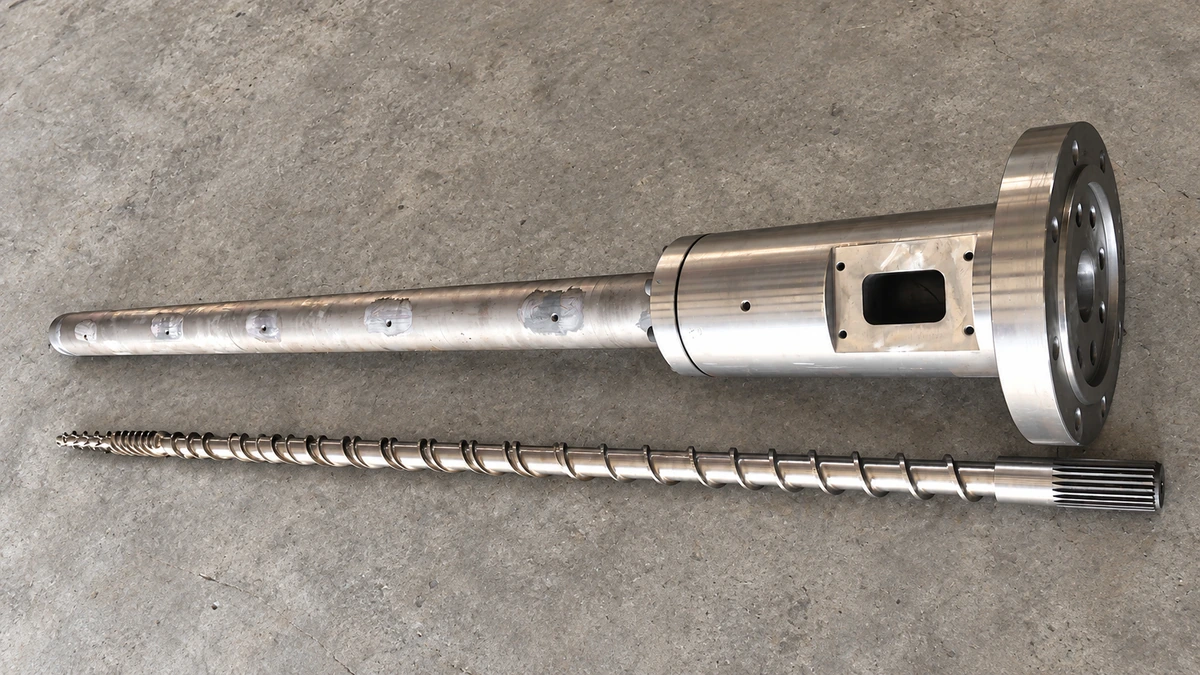
Why Your Single Screw Extruder Design Causes Extrusion Defects
Nov 13, 2026
Learn how single screw extruder design parameters—L/D ratio, compression ratio, channel depth, and mixing elements—affect melt quality, throughput, and defects.
Read Article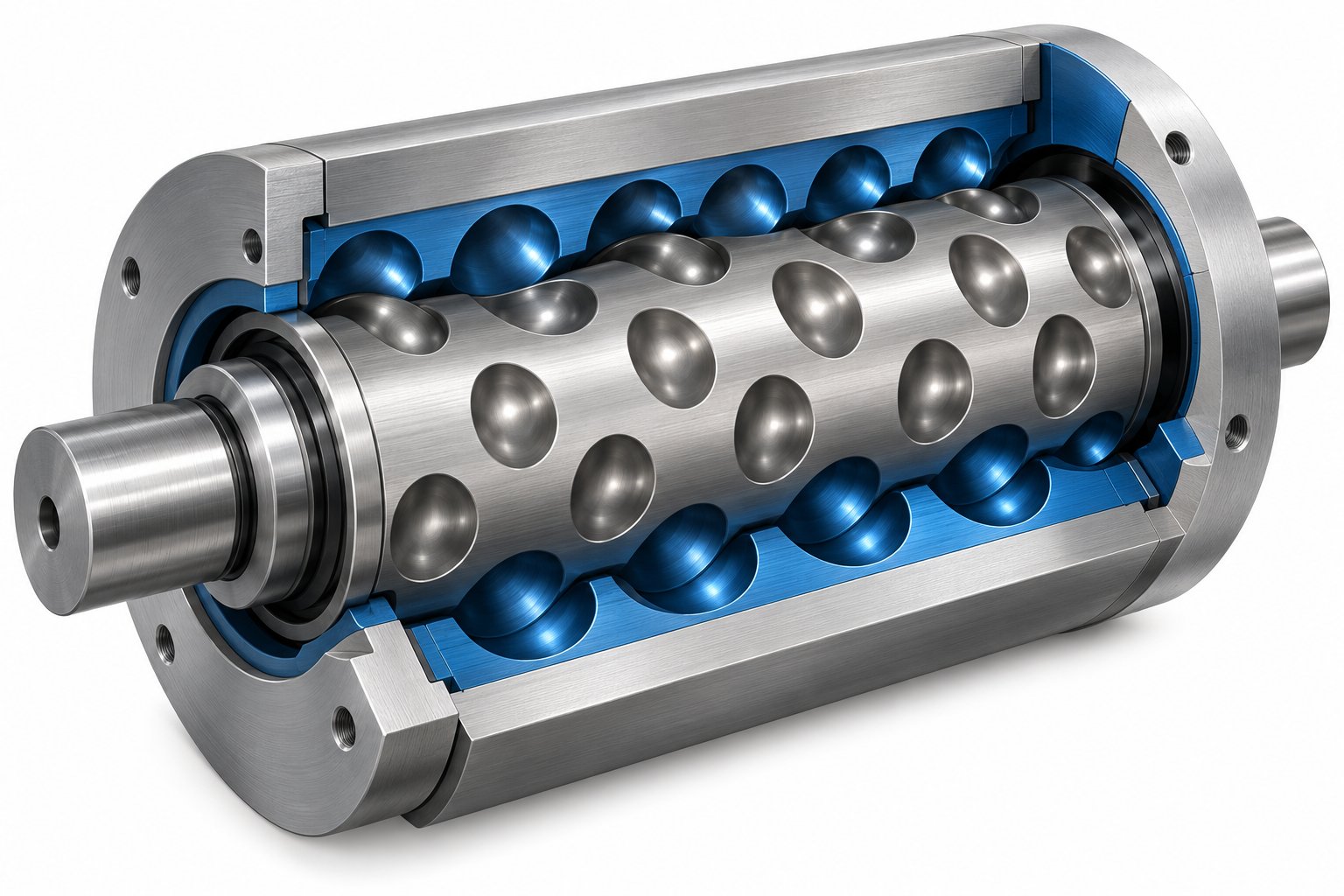
Cavity Transfer Mixer: The Blender Your Extruder Didn't Know It Needed
Nov 13, 2026
Learn how a cavity transfer mixer (CTM) upgrades single-screw extruder mixing. Covers working principles, key parameters, integration, applications, and comparisons.
Read Article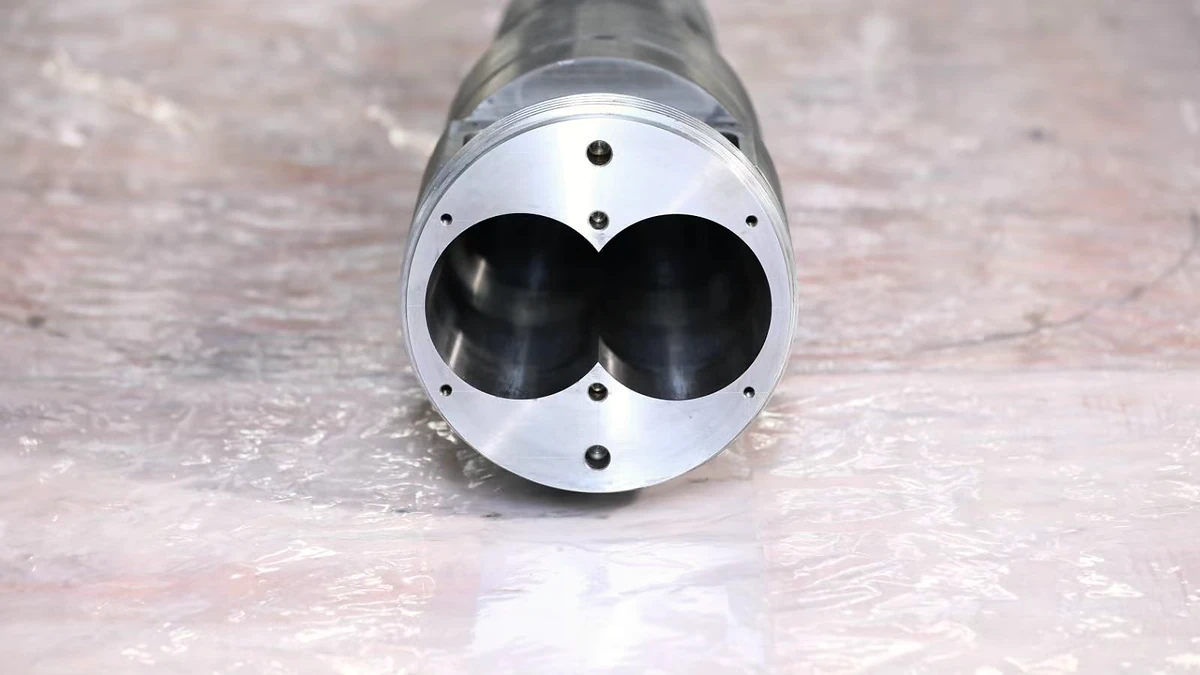
Extruder Barrel Alignment Decoded: Tolerances Most Plants Miss
Nov 13, 2026
Learn extruder barrel alignment tolerances, laser procedures, thermal offsets, and proactive schedules most plants miss — for single-screw and twin-screw lines.
Read ArticleLooking for something else?
Search by material, symptom or product and jump straight to the relevant page.
These are navigation suggestions based on keyword matching — not a quotation, not a delivery commitment, and not a substitute for engineering review. Final specification is confirmed by our engineers against your drawings and processed material.
Need help with screw barrel selection?
Share your machine model, processed material and application. Our team can help with pricing and technical support.