

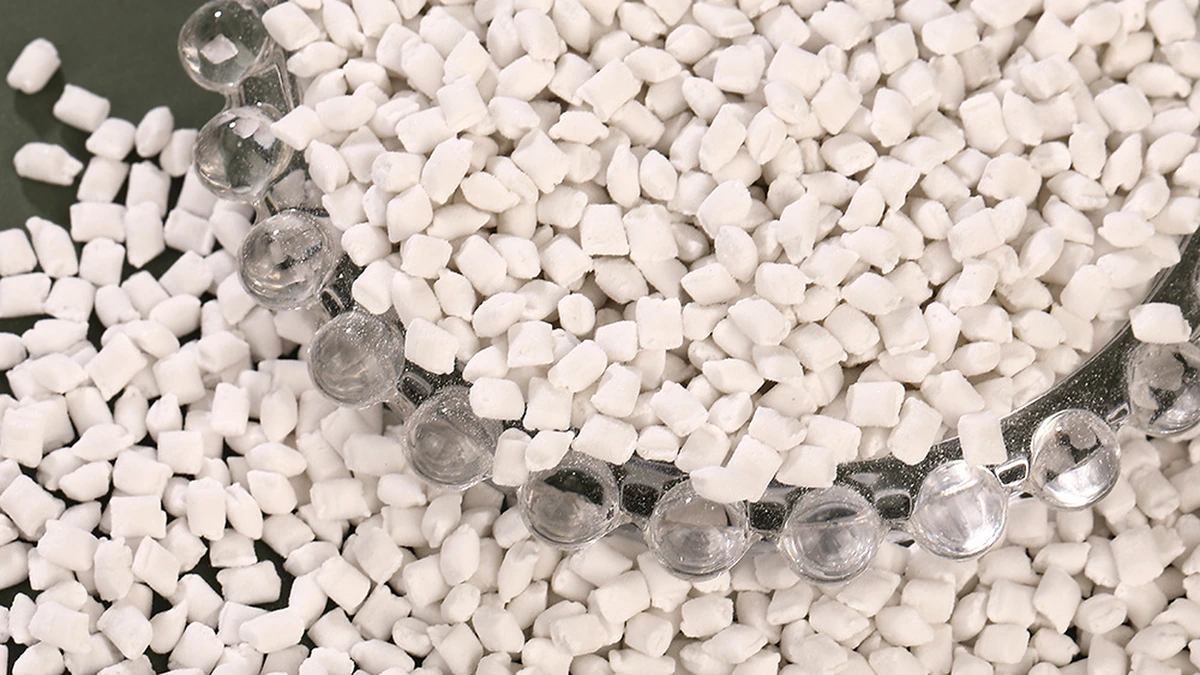
What Is Nylon Moisture Content and Why It Matters
Imagine molding a batch of nylon parts only to find silver streaks, bubbles, and brittle failures across every piece. The culprit? Water you could not see, locked deep inside the polymer itself. Nylon moisture content is not a minor spec-sheet footnote — it is the single most influential variable separating reliable nylon parts from costly rejects.
Nylon moisture content refers to the percentage of water, by weight, that has been absorbed into the polyamide polymer matrix through hydrogen bonding with amide groups. Unlike surface wetness, this internally absorbed moisture directly alters mechanical properties, dimensional stability, and melt-processing behavior.
What Moisture Content Means in Nylon Polymers
Nylon, or polyamide, is inherently hygroscopic — it actively pulls moisture in the air into its molecular structure. Standard nylon materials can absorb upward of 8% moisture by weight at full saturation, a figure that dwarfs the 0.8% typical of acetal. This absorption is a completely reversible physical reaction: expose dry nylon to a humid warehouse and it soaks up water; move it into a climate-controlled room and it gradually releases that water back.
Here is the critical distinction most people miss. Surface wetness — the kind you can wipe off a pellet or blow away with compressed air — is trivial. The real concern is water molecules that have diffused deep into the amorphous regions of the polymer, bonding at the molecular level between chains. This internally absorbed moisture cannot be removed by a quick pass under a hot-air blower. It requires dedicated drying equipment and hours of controlled heat to break those hydrogen bonds and coax the water back to the surface. Think of it less like a puddle sitting on plastic and more like how does water get inside a house through microscopic cracks — slowly, invisibly, and relentlessly driven by a humidity gradient.
Why Nylon Moisture Content Deserves Dedicated Attention
Most engineering thermoplastics tolerate small amounts of absorbed water without dramatic consequences. Nylon is fundamentally different. Water molecules wedge themselves between polymer chains and act as a plasticizer, increasing chain mobility and causing the material to swell and soften. As Bamberger Amco Polymers' engineering team notes, this plasticizing effect reduces strength and stiffness while boosting elongation and toughness — and it can drop the glass transition temperature by 20 degrees Celsius or more.
What makes nylon moisture content uniquely tricky is its dual nature:
- During melt processing, excess moisture is destructive. Water reaches boiling point at typical barrel temperatures, expands into steam, and causes splay marks, flash, drooling, and irreversible hydrolytic chain degradation.
- After molding, a controlled amount of moisture is actually desirable. Freshly molded parts are bone-dry and brittle. Allowing them to condition — absorbing moisture back to equilibrium — restores the toughness and ductility the designer intended.
This paradox catches processors off guard. You need to reduce humidity in house-keeping of your resin storage to keep pellets dry before molding, yet you may deliberately expose finished parts to moisture afterward. No other common engineering plastic demands this kind of bidirectional moisture management. Products as different as a moisture barrier carpet pad, an Avene soothing moisture mask, and a Kirkland Signature moisture shampoo bottle all may rely on nylon components — and every one of those applications requires the processor to master this balance between too wet and too dry.
The stakes are high. At roughly 50% relative humidity, unfilled nylon equilibrates near 2% moisture by weight, which corresponds to dimensional growth of about 0.5 to 0.6%. For precision parts, that shift alone can push tolerances out of spec. Understanding exactly how much water nylon absorbs — and why — starts with the chemistry happening at the molecular level.
The Science Behind Nylon Hygroscopy and Hydrogen Bonding
Why does nylon soak up water so aggressively when polyethylene, sitting on the same warehouse shelf, stays virtually bone-dry? The answer lives in the chemistry of nylon's backbone — specifically, the amide groups that give polyamide its name and its remarkable affinity for water.
The Role of Amide Groups in Water Absorption
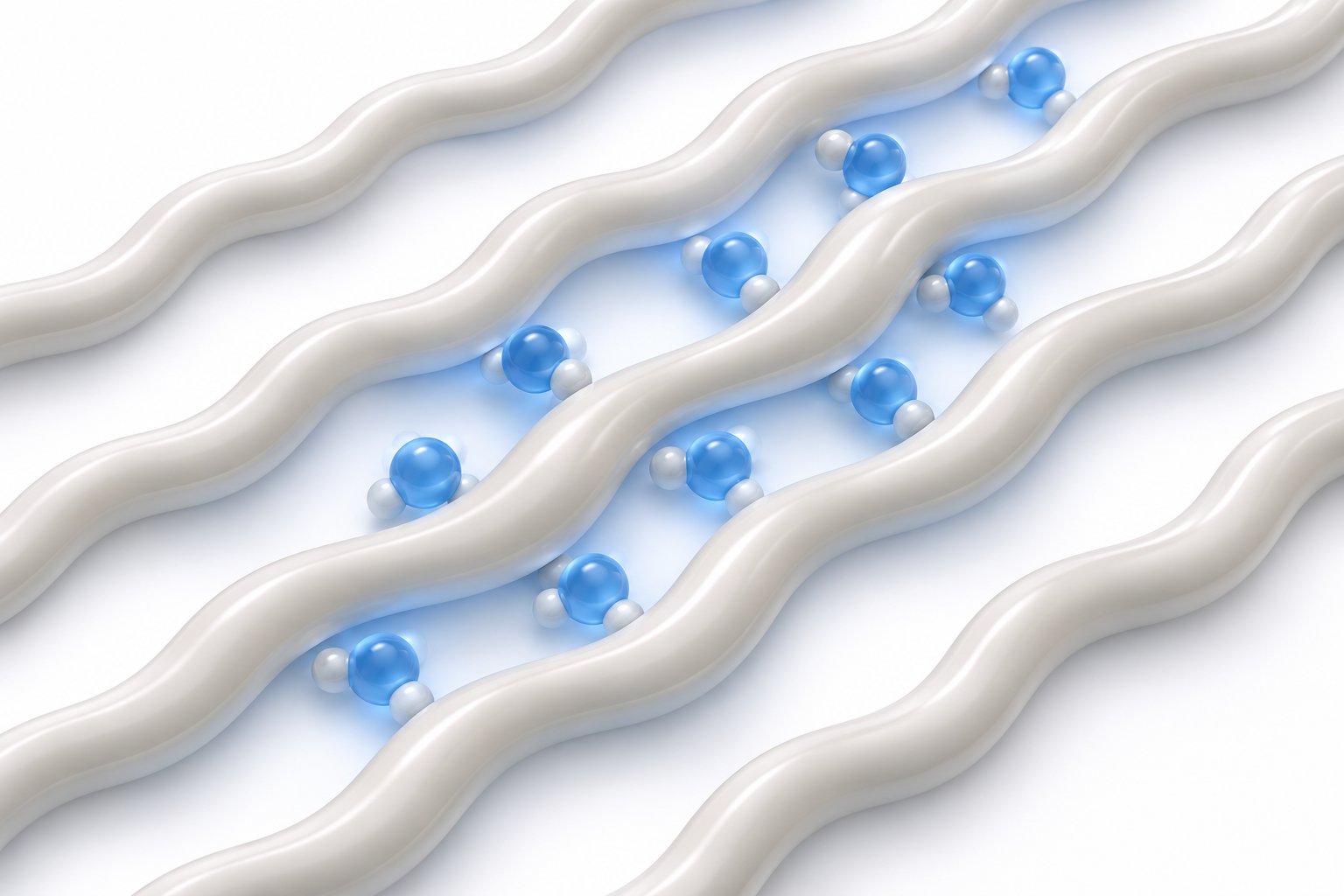
Every nylon chain is built from repeating units linked by amide bonds, written as -CO-NH-. Each of these linkages contains a carbonyl oxygen (C=O) and a nitrogen-bound hydrogen (N-H), and both are eager participants in hydrogen bonding. Under normal conditions, these amide groups form strong hydrogen bonds between adjacent polymer chains, which is a big part of why nylon has such impressive thermal and mechanical properties.
Here is where water enters the picture. A water molecule is perfectly shaped to interact with those same amide sites. The hydrogen atoms in water bond to the carbonyl oxygen on one chain, while the oxygen in water bonds to the N-H hydrogen on a neighboring chain. In effect, water molecules wedge themselves between polymer chains and replace some of the chain-to-chain hydrogen bonds with chain-to-water bonds.
Imagine two strips of hook-and-loop fastener pressed tightly together. They are rigid and locked in place. Slide thin spacers between the hooks and loops, and suddenly the strips move more freely past each other. That is essentially what absorbed water does inside nylon — it increases chain mobility, softens the material, and causes measurable swelling. In polymer science terms, water acts as a plasticizer. The effect is powerful enough to drop the glass transition temperature by 20 degrees Celsius or more, shifting properties like impact strength, elongation, and stiffness in ways that designers must anticipate.
Critically, this absorption happens in the amorphous regions of the polymer — the disordered zones between crystalline domains. Crystalline regions resist being pulled apart because the bonds between amide groups there are stronger than the attraction to water. If this were not the case, nylon would simply dissolve. Instead, you get a controlled but significant uptake concentrated in the amorphous phase, which is why the humidity inside a home warehouse, a production floor, or even the ambient conditions during shipping all matter so much for nylon resin storage.
How Molecular Structure Controls Absorption Capacity
If amide groups are the docking stations for water, then the number of those stations per unit of chain length determines how much water a given nylon grade can absorb. This is the single most important structural variable controlling hygroscopy.
Consider two extremes. Nylon 4/6 packs amide groups closely together — short carbon segments between each linkage mean a high density of hydrogen-bonding sites. The result is a polymer that absorbs a large amount of moisture at equilibrium. On the other end of the spectrum, Nylon 12 has long hydrocarbon stretches between its amide groups, which dilutes the concentration of bonding sites and dramatically reduces water uptake. Nylon 6 and Nylon 6/6 fall in between, with amide group densities that produce moderate but still significant absorption — enough to demand careful drying and storage protocols.
This mechanism is also why nylon stands apart from most other engineering plastics. Polymers like polyethylene and polypropylene have no polar groups at all — their carbon-hydrogen backbones offer water nothing to bond with. Polycarbonate and ABS contain some polar character but far fewer hydrogen-bonding opportunities than a polyamide chain. The practical takeaway is clear: nylon absorbs far more moisture than nearly any other common thermoplastic, and the grade you choose determines how aggressively it will do so.
To put nylon's position in perspective, here is how common engineering plastics rank by relative moisture absorption capacity:
- Nylon 4/6 — Very high (highest amide density among common nylons)
- Nylon 6 — High (up to approximately 2.5–3.0% at 50% RH; saturation near 9–10%)
- Nylon 6/6 — High (equilibrium around 2.0–2.5% at 50% RH; saturation near 8%)
- Nylon 12 — Low for a nylon (roughly 0.25% at 50% RH)
- Polycarbonate (PC) — Very low (approximately 0.15%)
- ABS — Very low (approximately 0.2–0.4%)
- Acetal (POM) — Minimal (approximately 0.2%)
- Polyethylene (PE) and Polypropylene (PP) — Essentially zero
You'll notice a dramatic gap between even the lowest-absorbing nylon grade and the rest of the field. This is precisely why processors who switch from polycarbonate or ABS to nylon often underestimate how quickly moisture problems emerge — and why questions like "why is the humidity so high in my house?" have a direct analog on the production floor when ambient conditions go unchecked.
Understanding this hydrogen-bonding mechanism is more than academic. It explains why different nylon grades behave so differently under identical storage conditions, why glass-filled variants absorb less moisture overall (the non-hygroscopic filler dilutes the concentration of amide groups), and why products formulated with shea moisture body lotion or a byoma milky moisture cleanser are designed to deliver moisture — the exact opposite of what a nylon processor must do before melting the resin. The chemistry also sets the stage for a practical question every material selector needs answered: exactly how much moisture does each nylon grade absorb, and what are the real numbers?
Moisture Absorption Compared Across Common Nylon Grades
The hydrogen-bonding mechanism explains why nylon absorbs water, but the real question for product designers and processors is how much. The answer varies dramatically from one grade to the next — and picking the wrong nylon without understanding these differences is like ignoring the forecast before building a roof. You will get wet.
Equilibrium Moisture Levels for Major Nylon Grades
Every sentence with moisture in a nylon datasheet should specify the test condition: temperature, relative humidity, and whether the sample was at equilibrium or freshly molded. Without that context, a single absorption number is almost meaningless. The table below compiles well-established values from polymer engineering literature and resin manufacturer references for the most commonly specified grades. Use it as a starting point for material selection, then verify against the specific supplier datasheet for your chosen compound.
| Nylon Grade | Equilibrium Moisture at 50% RH, 23 °C (%) | Saturation Moisture at 100% RH / Immersion (%) | Max. Recommended Moisture for Processing (%) | Key Notes |
|---|---|---|---|---|
| Nylon 4/6 (PA46) | 3.5 – 3.8 | ~13 – 15 | ≤ 0.10 | Highest amide density; greatest dimensional change; best high-temperature stiffness dry |
| Nylon 6 (PA6) | 2.5 – 2.7 | ~9 – 10 | ≤ 0.20 (≤ 0.10 for cosmetic parts) | Tensile strength drops ~35% at 50% RH; impact toughness increases ~200–300% |
| Nylon 6/6 (PA66) | 2.0 – 2.5 | ~8 – 8.5 | ≤ 0.20 (≤ 0.10 for cosmetic parts) | Slightly lower uptake than PA6 due to higher crystallinity (40–50%) |
| Nylon 11 (PA11) | 0.8 – 1.0 | ~1.6 – 1.9 | ≤ 0.10 | Bio-based; low absorption makes it strong for fuel-system and hydraulic-line applications |
| Nylon 12 (PA12) | 0.20 – 0.25 | ~1.4 – 1.5 | ≤ 0.10 | Lowest moisture uptake among common aliphatic nylons; excellent dimensional stability |
| PA66-GF30 (30% glass-filled) | 1.5 – 1.7 | ~5 – 6 | ≤ 0.114 (adjusted for polymer fraction) | Glass displaces absorbent polymer volume; linear growth only 0.2–0.3% at 50% RH |
| PA6-GF30 (30% glass-filled) | 1.6 – 1.9 | ~6 – 7 | ≤ 0.14 (adjusted for polymer fraction) | Reinforcement constrains dimensional change and stiffness loss |
| MXD6 (semi-aromatic) | ~0.5 | ~2.5 – 3.0 | ≤ 0.10 | Aromatic ring reduces amide group frequency; often used as a moisture eliminator in barrier packaging |
| PPA (polyphthalamide) | 0.15 – 0.30 | ~1.0 – 2.5 (varies by chemistry) | ≤ 0.10 | Very low absorption; high-temp performance; common in automotive electrical connectors |
A few patterns jump out immediately. Nylon 4/6 absorbs roughly fifteen times more water than Nylon 12 at the same humidity, solely because of its denser arrangement of amide linkages. PA6 and PA66 — the two highest-volume nylons in the world — sit squarely in the high-absorption zone, which is why moisture management is not optional for anyone processing these resins. And the processing limits tell their own story: as materials consultant Michael Sepe points out, the commonly published 0.20% threshold for glass-filled grades should actually be adjusted downward by the polymer fraction, because the glass fiber itself absorbs no water. A 50% glass-filled PA66 sitting at 0.20% total moisture effectively has 0.40% moisture in its polymer phase — a level that can cause significant hydrolytic degradation.
Key Differences Between Aliphatic and Semi-Aromatic Grades
Scan the bottom rows of the table and you will notice a sharp drop in absorption for MXD6 and PPA. These semi-aromatic nylons replace some of the aliphatic carbon chain with stiff aromatic (benzene) ring structures. Aromatic segments do two things: they physically reduce the number of amide groups per repeat unit, and they increase chain rigidity, which limits the free volume available for water molecules to occupy. The result is a polyamide that retains much of nylon's strength and temperature resistance while behaving almost like polycarbonate in terms of moisture sensitivity.
Glass-filled grades operate on a different but complementary principle. The glass fibers themselves are inert to moisture. When you pack 30% glass fiber into a nylon compound, you replace 30% of the hygroscopic polymer with a non-absorbent filler — reducing total uptake roughly in proportion to the filler loading. Beyond lowering absorption, the glass fibers physically constrain the polymer matrix from swelling, which cuts dimensional growth by roughly half compared to unfilled resin. For parts that live in environments where the air is dry in one season and humid in the next, this dimensional stability can be the deciding factor in material selection, much like choosing a PA12 or PA612 for continuous water-immersion applications.
In traditional Chinese medicine, practitioners discuss tcm dampness as an internal imbalance driven by environmental moisture — and in a sense, nylon grade selection follows a similar logic. You match the material's inherent moisture tolerance to the humidity conditions it will face in service. A connector housing in a dry indoor enclosure can thrive with standard PA66. A sensor bracket cycling between tropical rain and air-conditioned interiors may demand PPA or at minimum a GF-reinforced compound. The numbers in the table above are your starting point for that match.
Grade-level absorption data tells you what to expect at equilibrium, but real-world conditions rarely hold still. Temperature swings, seasonal humidity shifts, and storage time all influence how fast nylon moves toward those equilibrium values — and how aggressively you need to control the environment to keep resin within safe processing limits.
How Temperature and Humidity Influence Nylon Moisture Uptake
Equilibrium values on a datasheet are useful benchmarks, but the warehouse, the shipping container, and the production floor do not hold conditions steady. Temperature and relative humidity fluctuate constantly — and both variables shape how quickly and how deeply nylon absorbs water. Understanding their separate roles is the difference between a controlled process and a guessing game.
Relative Humidity and Temperature as Driving Forces
Think of relative humidity as the destination and temperature as the accelerator pedal. Higher relative humidity raises the final equilibrium moisture content a nylon grade will reach, while higher temperature speeds up how fast the polymer gets there.
The relationship between RH and equilibrium uptake follows a roughly sigmoidal curve. At low humidity — say, below 20% RH — nylon absorbs relatively little water because the driving force for diffusion is weak. Between 30% and 70% RH, absorption climbs steeply and nearly linearly. Above 80% RH, the curve flattens again as the accessible amorphous regions approach saturation. This means a jump from 40% to 60% RH on your plant floor has a much larger effect on final nylon moisture content than a jump from 80% to 100%.
Temperature, on the other hand, primarily governs the rate of diffusion. At 23 degrees Celsius, moisture in the air penetrates nylon pellets at a moderate pace. Raise the ambient temperature to 40 degrees Celsius — a realistic scenario inside a metal shipping container crossing the tropics — and the diffusion coefficient roughly doubles. The pellets do not necessarily absorb more water at that temperature for a given RH, but they reach their equilibrium level far sooner. That distinction matters because it means a sealed bag of resin sitting in high humidity in a house-sized warehouse at tropical temperatures can blow past safe processing moisture limits in a fraction of the time it would take in a climate-controlled facility at 23 degrees Celsius.
Consider two practical scenarios. A pallet of PA66 pellets stored in a climate-controlled warehouse at 23 degrees Celsius and 50% RH will approach its equilibrium moisture of roughly 2.0–2.5% over the course of many months — over a year at those conditions, according to Teknor Apex engineering data. The same pallet stored in an open-sided warehouse in Southeast Asia at 35 degrees Celsius and 85% RH will reach a significantly higher equilibrium value, and it will get there much faster. For processors who source resin internationally, the transit environment is just as important as the storage environment.
Time-Dependent Absorption and Practical Storage Guidance
Nylon does not snap to equilibrium the moment conditions change. Moisture uptake follows Fickian diffusion kinetics, meaning the rate depends on the square of the diffusion distance. Thin-walled pellets — typically 2–3 mm in their smallest dimension — can reach roughly 50% of equilibrium moisture content in just 2–4 hours at standard conditions. Thick molded parts tell a very different story: a 4 mm wall needs 24–48 hours to reach the same halfway point, and a 10 mm section may take 7–14 days. This time lag creates a practical trap. A bag of pellets opened on a Monday morning in a humid plant might test fine at midday but exceed the safe 0.20% threshold by Tuesday — not because anything changed on the floor, but because the water molecules simply needed time to diffuse inward.
This is where water condensation risk compounds the problem. Moving sealed resin from cold storage into a warm, humid production area can cause condensation to form on the bag surface and even on the pellets themselves. That surface moisture accelerates the initial absorption rate and can spike readings if pellets are not dried before use.
Protecting nylon resin during storage requires a layered approach. The following practices, drawn from both resin manufacturer recommendations and desiccant packaging best practices, will keep your material within safe limits:
- Store unopened bags in a climate-controlled area — target 23 degrees Celsius and below 50% RH whenever possible. Avoid stacking pallets against exterior walls where temperature swings are highest.
- Use moisture-barrier bags for long-term storage — metallized or laminated film bags combined with desiccant packs dramatically slow moisture ingress. Standard polyethylene bags offer minimal protection by comparison.
- Include desiccant packs inside every sealed container — place packs inside the bag, not loose on the pallet. Match desiccant capacity to the bag volume and expected storage duration, and monitor with humidity indicator cards so you know when packs are spent.
- Reseal opened bags immediately — once a bag is opened, the clock starts. In a plant running at 50% RH, exposed nylon pellets can absorb enough moisture to require re-drying within 30–60 minutes. Use heat-sealed foil bags or twist-tie closures with fresh desiccant for partial bags.
- Limit open-bag exposure to 30 minutes or less — transfer only the quantity you need to the dryer hopper and reseal the rest. Moisture wicking activewear pulls sweat away from skin, but there is no equivalent shortcut for nylon pellets: once the polymer absorbs moisture, only a proper desiccant dryer can remove it.
- Acclimate cold resin before opening — if bags arrive from cold transport or storage, let them reach ambient temperature while still sealed. Opening cold bags in a warm plant invites condensation directly onto the pellets.
- Track storage time after opening — label every opened bag with the date and time. Many processors enforce a rule that any nylon resin exposed to ambient conditions for more than two hours must be re-dried regardless of visual appearance.
The theme across all of these practices is simple: you cannot see moisture diffusing into nylon, so you have to control the environment and the clock proactively. Pellets that look and feel dry can still carry enough absorbed water to ruin an entire production run. The real question is not whether your resin has picked up moisture — it almost certainly has — but whether the amount it absorbed remains below the critical threshold for defect-free processing.
Processing Limits and Defects Caused by Excess Moisture
Knowing that nylon absorbs moisture is one thing. Knowing the exact line between a good part and a ruined one is what actually saves production runs. Every nylon grade has a critical moisture ceiling — cross it, and you invite a cascade of defects ranging from ugly cosmetic flaws to invisible structural failures that no amount of downstream rework can fix.
Critical Moisture Thresholds for Injection Molding and Extrusion
Most nylon resins must be dried to below 0.20% moisture by weight before they enter the barrel of an injection molding machine or extruder. For parts where surface appearance is critical — think visible housings, transparent lenses, or Class A automotive components — many processors tighten that limit to 0.10–0.15%. The logic is simple: the closer you get to zero residual moisture, the lower your risk of cosmetic and mechanical defects.
But there is a subtlety that catches even experienced molders off guard. As materials consultant Michael Sepe has demonstrated, the commonly published 0.20% threshold applies to unfilled nylon. Glass fiber, mineral fillers, and other non-hygroscopic additives do not absorb water, so a filled compound sitting at 0.20% total moisture actually has a much higher concentration of water in its polymer fraction. A 30% glass-filled PA66, for example, should target roughly 0.14% total moisture — and a 50% glass-filled grade needs to be at or below 0.10%. Failing to adjust for filler content is one of the most common — and most costly — oversights in nylon processing.
The table below summarizes widely accepted maximum moisture levels for the three most frequently molded nylon types. Use it as a quick-reference guide, but always verify against your specific supplier's datasheet for your compound.
| Nylon Grade | Max. Moisture for Injection Molding (%) | Max. Moisture for Extrusion (%) | Cosmetic-Critical Limit (%) | Notes |
|---|---|---|---|---|
| Nylon 6 (PA6), unfilled | ≤ 0.20 | ≤ 0.15 | ≤ 0.10 | Extrusion's longer melt residence time demands tighter limits |
| Nylon 6/6 (PA66), unfilled | ≤ 0.20 | ≤ 0.15 | ≤ 0.10 | Higher melting point increases hydrolysis risk at elevated barrel temps |
| Nylon 12 (PA12), unfilled | ≤ 0.10 | ≤ 0.10 | ≤ 0.05 | Low equilibrium uptake means even small absolute increases are proportionally significant |
| PA66-GF30 (30% glass-filled) | ≤ 0.14 | ≤ 0.10 | ≤ 0.08 | Threshold adjusted to polymer fraction; glass does not absorb moisture |
| PA6-GF30 (30% glass-filled) | ≤ 0.14 | ≤ 0.10 | ≤ 0.08 | Same filler-adjustment logic applies |
Notice the pattern: extrusion tolerances are tighter than injection molding. That is because extrusion processes typically involve longer barrel residence times, giving water more opportunity to react with the polymer at melt temperatures. It is a case where low is too high — a moisture level that might squeak by in a fast-cycle injection mold can cause significant degradation in a slower extrusion line. Accurate humidity measurement of incoming resin is non-negotiable in either process; relying on drying time alone without verifying final moisture content with an analyzer is one of the most frequent root causes of chronic quality issues.
Visible and Hidden Defects from Processing Wet Nylon
When nylon enters a heated barrel carrying excess moisture, two things happen almost simultaneously. First, the absorbed water vaporizes into steam at typical melt temperatures (240–300 degrees Celsius), creating physical disruption in the melt. Second, the water at these elevated temperatures triggers hydrolysis — a chemical reaction that cleaves the amide bonds in the polymer backbone, permanently reducing molecular weight. The physical effects produce visible defects you can spot on the press. The chemical effects produce hidden damage you can only detect with laboratory testing. Both are serious, but hydrolysis is the one that cannot be undone.
Here is what to watch for when moisture-related problems hit your production floor:
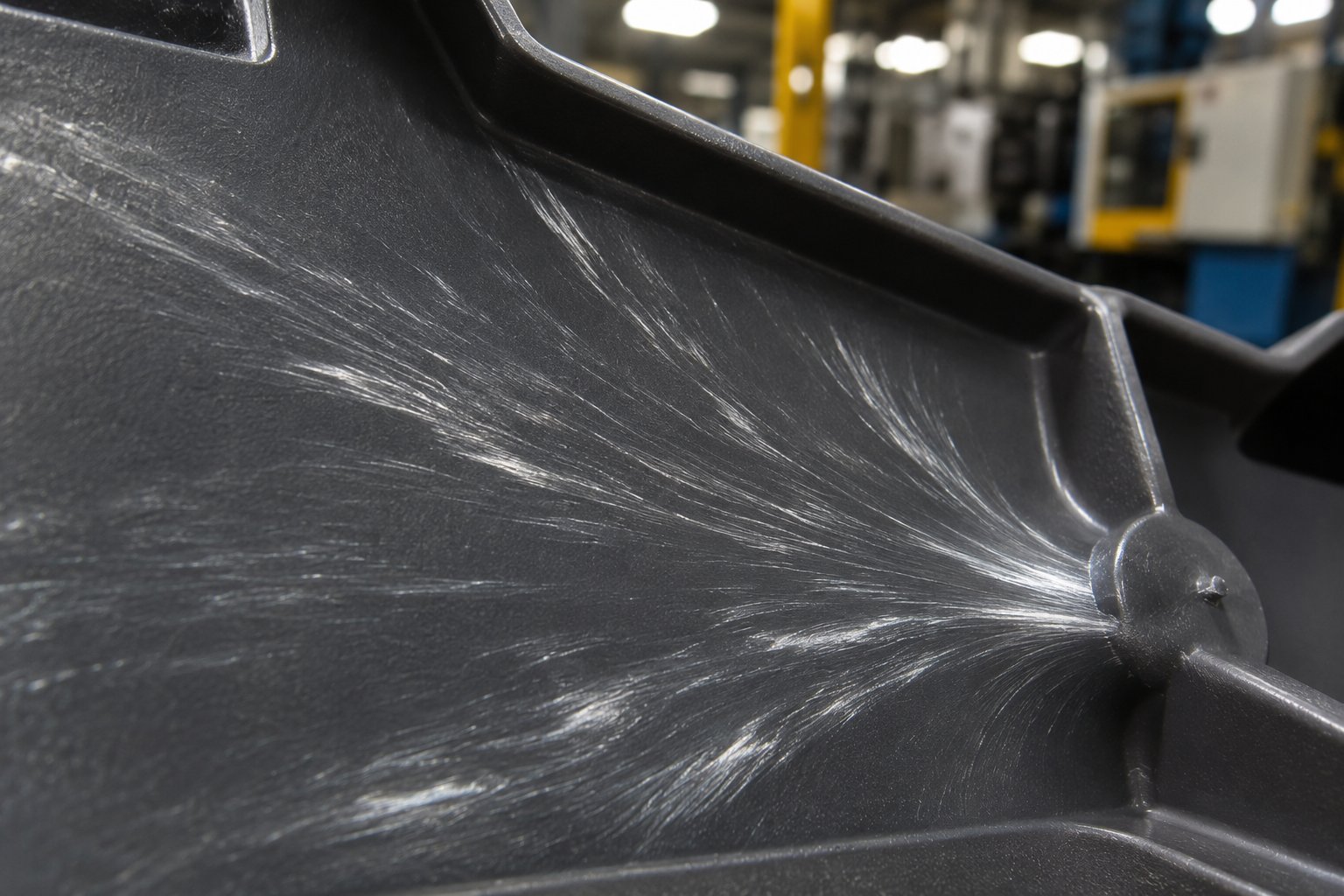
- Splay marks (silver streaks): The most recognizable moisture defect. Steam bubbles trapped in the melt stretch into streaks as the material flows through the mold cavity, leaving characteristic silvery lines radiating from the gate. Even if parts are structurally acceptable, splay is a cosmetic reject in nearly every visible application.
- Bubbles and voids: When steam cannot escape fast enough, it remains trapped as internal bubbles or surface blisters. These voids act as stress concentrators that weaken the part well below datasheet values, especially under impact or fatigue loading.
- Poor surface finish: Excess moisture disrupts the smooth melt-front flow that produces a glossy or uniform matte surface. Parts may appear hazy, rough, or mottled — defects that no amount of room dehumidification on the plant floor can reverse once they are molded in.
- Drooling and flash: Water acting as a plasticizer lowers melt viscosity beyond the process window. The result is a runny melt that drools from the nozzle between shots and flashes into parting-line gaps that would normally seal cleanly.
- Reduced weld-line strength: Where two melt fronts meet inside the mold, moisture disruption weakens the bond between them. Weld-line strength in wet nylon can drop by 30% or more compared to properly dried material, creating hidden weak points that only reveal themselves under load.
- Hydrolytic chain degradation: This is the silent killer. Water at melt temperature breaks amide bonds, permanently shortening polymer chains and reducing intrinsic viscosity. Parts may look acceptable yet fail prematurely in service because their molecular weight — and therefore their toughness, fatigue life, and chemical resistance — has been irreversibly compromised. Sepe's studies documented a 20% decline in intrinsic viscosity in parts molded at just 0.20% total moisture for a 43% glass-filled PA66, with significant performance failures as a direct consequence.
The critical word in that last bullet is irreversible. Splay marks and bubbles are obvious enough to trigger an immediate halt and investigation. Hydrolytic degradation, by contrast, can lurk undetected through visual inspection and only surface weeks or months later as brittle field failures. You cannot re-polymerize broken chains by drying the parts after the fact — the damage is baked in at the moment the wet melt hits processing temperature. This is why proactive moisture control, from how to reduce humidity in your home resin-storage area all the way through inline monitoring at the press, is the only reliable defense.
Identifying the threshold and the defects is half the battle. The other half is removing the moisture efficiently and verifying that it stays gone from the dryer hopper to the mold cavity — a challenge that demands the right drying equipment, the right parameters, and the right verification tools.
Drying Nylon Before Processing: Why Your Dryer Type Matters
Knowing the moisture limits is only useful if you can actually hit them — consistently, shift after shift, without guessing. That is where drying equipment and protocol take center stage. A surprising number of nylon processing problems trace back not to the resin itself but to a dryer that was never designed for the job, set to the wrong temperature, or simply trusted without verification. The difference between a reliable drying process and a frustrating one often comes down to three choices: the right dryer type, the right parameters, and a willingness to measure rather than assume.
Desiccant Dryer Setup for Nylon Resins
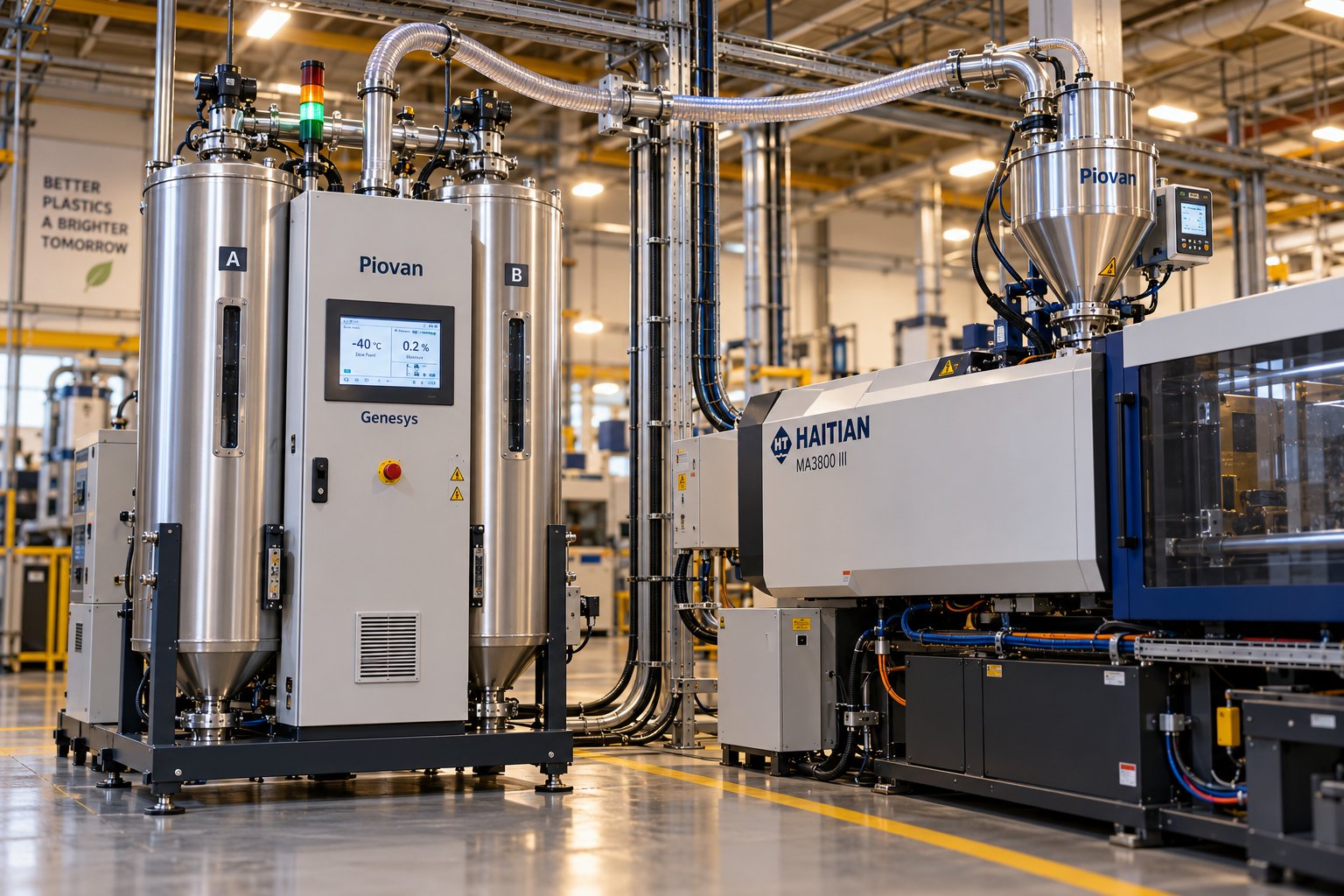
Standard hot-air dryers — the kind that pull ambient air across a heating element and blow it through a hopper — work fine for materials like ABS or polystyrene. For nylon, they are the wrong tool. Here is why: a hot-air dryer recirculates whatever moisture is already present in the plant atmosphere. On a humid summer day, the supply air might carry a dewpoint of 15–20 degrees Celsius, which means it physically cannot strip nylon pellets below roughly 0.30–0.40% moisture no matter how long you run it. You would be trying to dry a sponge with damp air.
Desiccant dryers solve this problem by passing the supply air through a bed of desiccant material — typically molecular sieve or silica gel — that strips water vapor to extremely low levels before the air ever contacts the resin. A properly maintained desiccant dryer delivers supply air with a dewpoint of -40 degrees Celsius or lower, which is dry enough to pull nylon well below the 0.20% threshold required for defect-free processing. Nylene's processing guides consistently specify a dewpoint of -40 for their extrusion and injection molding resins, and most major resin suppliers echo that recommendation.
Imagine trying to decrease humidity in a house by opening windows during a rainstorm — it defeats the purpose. A hot-air dryer on a humid plant floor creates exactly the same contradiction. Desiccant dryers break that cycle by conditioning the drying air independently of ambient conditions.
Typical drying parameters for the most common nylon grades are:
| Nylon Grade | Drying Temperature | Drying Time | Target Dewpoint | Target Moisture After Drying |
|---|---|---|---|---|
| Nylon 6 (PA6), unfilled | 66–82 °C (150–180 °F) | 2–4 hours | -40 °C or lower | < 0.20% (< 0.10% for cosmetic parts) |
| Nylon 6/6 (PA66), unfilled | 65–82 °C (150–180 °F) | 2–4 hours | -40 °C or lower | < 0.20% (< 0.10% for cosmetic parts) |
| PA6 Wire & Cable Extrusion | 60–71 °C (140–160 °F) | 2–4 hours | -40 °C or lower | < 0.15% |
| PA66, glass-reinforced (15–50%) | 82 °C (180 °F) | 2–4 hours max | -40 °C or lower | < 0.14% (adjusted for polymer fraction) |
| Nylon 12 (PA12) | 82 °C (180 °F) | 2–4 hours max | -40 °C or lower | < 0.10% |
| PA 6/12 Specialty | 65–82 °C (150–180 °F) | 2–4 hours | -40 °C or lower | < 0.20% |
These values are drawn from Nylene's published processing considerations and align closely with recommendations from other major PA suppliers. Notice that PA6 wire and cable extrusion grades call for a lower drying temperature — 60–71 °C rather than the 80–82 °C range — because some heat-sensitive formulations can begin to oxidize or lose essential volatiles at higher settings. Always check the specific datasheet for your compound; a few degrees in the wrong direction can mean the difference between stable resin and degraded resin.
Dryer sizing is another factor that often gets overlooked. The hopper must hold enough material for 4–5 hours of residence time at your machine's throughput rate. Teknor Apex's engineering team recommends calculating dryer capacity from part weight, cycle time, and bulk-density conversion to confirm the resin actually spends the full drying cycle inside the hopper. An undersized hopper pushes partially dried pellets into the barrel before they have reached their target moisture level — and no amount of temperature adjustment compensates for insufficient time.
Monitoring Dryness and Avoiding Over-Drying
Here is a scenario that plays out in plants every day: the technician sets the dryer to 80 degrees Celsius, starts a four-hour timer, and walks away. Four hours later, the material goes straight to the press. No one checks whether the pellets actually reached the required moisture level. No one checks whether the desiccant bed has regenerated properly. The assumption is that time plus temperature equals dry resin. That assumption is wrong often enough to be dangerous.
A dryer moisture sensor — whether integrated into the dryer or used as a standalone analyzer — removes the guesswork. Gravimetric (loss-on-drying) analyzers offer quick spot checks in minutes, while Karl Fischer titration provides laboratory-grade accuracy when you need definitive numbers. The signs of too much moisture in a house are visible: foggy windows, peeling paint, musty odors. The signs of too much moisture in nylon pellets are invisible until you mold them and see splay, bubbles, or brittle failures. Measurement is the only way to catch the problem before it reaches the mold cavity.
Over-drying is the opposite trap, and it is just as real. Nanto Tech's engineering team documents that prolonged drying of PA6 at temperatures above 100 degrees Celsius promotes oxidation, which causes yellow discoloration and degrades mechanical properties. Even within the recommended 80 degrees Celsius range, leaving resin in the dryer for significantly longer than four hours — overnight, for instance, after a delayed production start — can begin to affect PA6's color and toughness. Nylene explicitly warns that drying PA6 longer than four hours or at higher-than-recommended temperatures may cause discoloration or adversely affect important physical properties. For PA66, the risk shifts slightly toward oxidation and volatile loss rather than discoloration, but the principle holds: more is not always better.
To put this moisture sentence plainly — every drying cycle needs verification, not just faith. The following best-practice sequence keeps you in the safe zone between too wet and too dry:
- Check initial moisture content — use a moisture analyzer to establish a baseline before drying. Knowing whether your resin starts at 0.40% or 1.80% determines how long it actually needs in the hopper.
- Set the correct drying temperature for your specific grade — refer to the supplier datasheet, not a generic "nylon" setting. PA6 wire and cable formulations dry at 60–71 °C; standard PA66 injection grades dry at 80–82 °C.
- Confirm the dewpoint of supply air — verify that the desiccant dryer is delivering air at -40 °C dewpoint or lower. A dewpoint meter on the supply line catches exhausted desiccant beds before they compromise an entire hopper of resin.
- Verify post-drying moisture with an analyzer — do not rely solely on time and temperature. Pull a sample from the hopper discharge and confirm the reading falls below your grade's threshold (typically below 0.20% for unfilled PA6 and PA66, below 0.10% for filled or cosmetic grades).
- Transfer material in a sealed system to the machine hopper — exposed transfer lines, open hoppers, and long conveying runs re-expose dried resin to ambient humidity. Use sealed loader lines and blanketed hoppers wherever possible. Even a 15-minute exposure in a humid plant can add enough moisture to push borderline resin over the limit.
Inline near-infrared (NIR) moisture sensors represent an emerging best practice that eliminates the lag between spot-check sampling and actual processing. Mounted in the hopper throat or feed section, these sensors provide continuous, real-time moisture readings and can trigger alarms or even shut down the feeder if moisture spikes above the set threshold. For high-volume or safety-critical nylon molding operations, inline monitoring closes the last gap between the dryer and the barrel — the gap where undetected moisture most often sneaks through.
Proper drying delivers resin to the barrel in ideal condition: dry enough to prevent hydrolysis and defects, but not so over-processed that the polymer itself has begun to degrade. That freshly molded, bone-dry part, however, is only halfway through the moisture story. What happens after it leaves the mold — and whether the processor deliberately adds moisture back — determines whether the part meets its design-intent toughness or ships as a brittle shell waiting to crack in service.
Post-Mold Conditioning and Fiber-Grade Moisture Considerations
A freshly ejected nylon part is about as dry as it will ever be — and, paradoxically, about as fragile. All that careful drying stripped the resin of the very plasticizer that gives nylon its legendary toughness. Ship that bone-dry part straight to a customer and you are delivering a component that may shatter on impact, crack under vibration, or snap during assembly. Getting moisture out before molding is critical, but putting a controlled amount back in afterward is equally important.
Why Manufacturers Add Moisture Back After Molding
Dry-as-molded nylon — typically sitting below 0.20% moisture — behaves like a stiff, brittle version of itself. Tensile strength reads high on the test coupon, but elongation at break and impact resistance plummet. For many engineering applications, the design engineer specified conditioned properties, not dry properties. That means the part must absorb moisture back to its equilibrium level before it delivers the toughness, ductility, and energy absorption the application demands.
For Nylon 6/6 at room temperature and 50% relative humidity, equilibrium moisture content settles around 2.0–2.5%, which corresponds to roughly 0.5–0.6% dimensional growth. At that moisture level, impact strength can increase by 200–300% compared to the dry state, and elongation at break rises dramatically. These are not minor adjustments — they represent the difference between a part that survives a drop test and one that shatters.
Three conditioning methods are common, each trading speed against control:
- Ambient conditioning: Simply place parts in a standard environment (23 °C, 50% RH) and wait. This is the least labor-intensive option but also the slowest. Thin-walled parts may equilibrate in days, while thick sections can take weeks or even months. A temp and humidity monitor in the conditioning area confirms that conditions stay consistent throughout the process.
- Water-bath immersion: Submerging parts in heated water (typically 60–80 °C) accelerates diffusion dramatically. A part that would need three weeks at ambient may condition in 24–48 hours in a water bath. The trade-off is tighter process control — over-conditioning can push moisture beyond the target and temporarily soften the material more than intended.
- Humidity chambers: Controlled-environment chambers set to elevated temperature and humidity (for example, 70 °C and 62% RH) offer a middle ground — faster than ambient, more uniform than immersion, and easier to standardize for production-scale batches.
Whichever method you choose, the endpoint is the same: verify that moisture content has reached the target equilibrium for the specific grade. Just as you would not skip verification after drying, you should not skip it after conditioning. A gravimetric or Karl Fischer check on sample parts confirms the process hit its mark.
Fiber-Grade Versus Engineering-Grade Moisture Perspectives
The conversation so far has centered on injection molding and extrusion — but nylon is also one of the world's most important textile fibers. In that world, the moisture discussion flips almost entirely.
Nylon fiber at standard textile testing conditions (20 °C, 65% RH) exhibits a moisture regain of approximately 4%. That absorbed water is not a defect to be managed — it is a performance feature. Moisture regain influences how comfortably a fabric sits against skin, how evenly dyes penetrate the fiber, and how effectively the material dissipates static charge. Nylon's moderate regain, higher than polyester's but lower than cotton's, is precisely why it works so well in activewear that wicks moisture away from the body and in hosiery that needs to feel smooth rather than plasticky.
Humidity in a textile mill matters for different reasons than humidity in a house or a molding plant. Textile engineers monitor ambient conditions to ensure consistent fiber behavior during spinning, weaving, and dyeing — not to prevent hydrolytic degradation. The concern is uniformity and comfort, not molecular-weight loss.
In nylon, moisture is a defect risk during melt processing but a performance asset in the finished molded part and an essential quality attribute in the fiber. The same hygroscopic property that forces processors to invest in desiccant dryers is the reason nylon textiles feel comfortable, accept dyes readily, and resist static buildup.
This dual identity is what makes nylon moisture content such a uniquely layered topic. A plastics processor asking how to prevent humidity from reaching stored resin is solving the opposite problem from a textile engineer who needs controlled humidity in the conditioning room. Yet both are managing the same hydrogen-bonding mechanism discussed earlier — just pulling the lever in different directions. Understanding which direction your application requires is half the battle; the other half is measuring accurately enough to know you have arrived at the right level.
How to Measure and Monitor Nylon Moisture Content Accurately
Pulling the lever in the right direction — whether drying before molding or conditioning afterward — only works if you know where the moisture level actually stands. Guessing is not a quality strategy. Yet in many plants, moisture measurement remains an afterthought: a lab test run once per shift, a dryer timer treated as proof of dryness, or worse, no measurement at all until splay marks appear on parts. The tools available for measuring nylon moisture content range from gold-standard laboratory titration to real-time sensors mounted directly in the feed throat. Choosing the right one depends on how much accuracy you need, how fast you need it, and where in the process you need the answer.
Karl Fischer Titration and Loss-on-Drying Methods
Karl Fischer titration is the reference standard for a reason. The method uses a chemical reagent that reacts exclusively with water molecules, ignoring every other volatile substance in the sample. A titration cell with a platinum electrode measures exactly how much reagent is consumed, and that consumption translates directly into a precise moisture reading — typically accurate down to single-digit parts per million. If a dispute arises over whether resin meets spec, Karl Fischer is the method both parties trust.
The trade-off is practical. Setup takes roughly 25–30 minutes per test, the equipment costs between $20,000 and $40,000, and operators need training to handle the hazardous liquid reagents involved. That combination makes Karl Fischer a laboratory instrument, not a production-floor tool. You will not see a technician running titration between shots on a 30-second cycle.
Loss-on-drying (LOD) analyzers — often called halogen or infrared moisture balances — take the opposite approach. They weigh a resin sample, heat it with a halogen lamp or infrared element to drive off moisture, then weigh it again. The weight difference is reported as moisture content. Halogen LOD analyzers can complete a test in as little as 3–10 minutes and cost a fraction of a Karl Fischer setup, making them far more accessible for routine quality checks on the plant floor.
The catch? LOD methods are non-selective. They cannot distinguish water from other volatile compounds that evaporate during heating. For nylon pellets that contain processing aids, lubricants, or residual caprolactam, an LOD reading may overestimate true water content. In most day-to-day quality control scenarios — confirming that pellets leaving the dryer are below 0.20% — that margin of error is acceptable and the speed advantage is decisive. When the room is humid and production cannot wait for a lab result, an LOD analyzer sitting next to the press gives you an actionable number in minutes rather than hours.
Think of it this way: Karl Fischer tells you exactly how many drops of water are in the glass. LOD tells you roughly how much liquid is in the glass, and for most nylon processing decisions, "roughly" is good enough to keep defects off the line. Reserve Karl Fischer for incoming material certification, dispute resolution, and calibration validation of faster methods.
Inline and At-Press Moisture Monitoring
Both Karl Fischer and LOD share a fundamental limitation — they measure a single sample taken at a single moment. Production continues while the sample travels to the lab or sits on the analyzer. A dryer upset, a wet pocket in a regrind blend, or moisture absorbed during a conveying delay can slip through the line entirely between scheduled checks. Periodic lab testing leaves the intervals between samples unobserved, and that blind spot is where many moisture-related scrap events originate.
Near-infrared (NIR) inline sensors close that gap. Mounted above a hopper, conveyor belt, or feed throat, these sensors direct a beam of infrared light at the moving resin and analyze the reflected wavelengths. Water has a distinct NIR absorption signature, and application-specific calibrations convert the spectral data into a continuous moisture reading — updated every few seconds, with no sample preparation, no operator involvement, and no production interruption.
The practical value is straightforward. An inline sensor positioned after the dryer confirms that every pound of material leaving the drying hopper meets target. A second sensor near the machine hopper reveals whether moisture crept back in during conveying — an especially common problem in plants where transfer lines run through unconditioned spaces or where vacuum leaks introduce humid air. Comparing readings at both points isolates whether a moisture problem originated at the dryer or downstream, cutting troubleshooting time from hours to minutes.
Inline NIR does have limits. Accuracy depends heavily on the quality of the initial calibration, and the sensor must be validated against Karl Fischer reference samples for each specific resin and color. The upfront cost — typically several thousand dollars per measurement point — also puts it beyond the reach of smaller operations. For high-volume or safety-critical nylon molding lines, though, the treatment of dampness problems in real time rather than after the fact can pay for the sensor in avoided scrap within weeks.
The table below compares all three methods across the dimensions that matter most to quality control teams selecting measurement equipment:
| Method | Accuracy | Speed | Cost | Best Use Case |
|---|---|---|---|---|
| Karl Fischer Titration | Highest — water-specific, accurate to single-digit ppm | 25–30 min setup + test time | $20,000–$40,000 (instrument); ongoing reagent costs | Lab reference standard; incoming material certification; dispute resolution; calibration of other methods |
| Loss-on-Drying (Halogen / IR) | Good — may overestimate if non-water volatiles are present | 3–10 minutes per sample | $700–$15,000 depending on readability | Routine QC checks at dryer discharge or press side; fast go/no-go decisions; high-throughput screening |
| Inline NIR Sensor | Good to very good — dependent on calibration quality | Continuous (readings every few seconds) | Several thousand dollars per point; calibration development required | Real-time process monitoring; catching transient upsets; comparing dryer vs. machine-side moisture; high-volume lines |
A layered approach works best for most operations. Use Karl Fischer in the lab to establish reference values and validate your faster instruments. Deploy an LOD analyzer at the press for daily spot checks — especially when resin lots change or the dryer has been idle overnight. Add inline NIR on critical lines where undetected moisture excursions would mean thousands of dollars in scrapped parts or, worse, compromised structural components shipped to customers.
No single method covers every need, but every nylon processing facility needs at least one reliable measurement tool in active use — not gathering dust on a shelf. Accurate, timely moisture data is what transforms drying from a hopeful ritual into a controlled process. And that controlled process, in turn, depends on more than just the dryer and the analyzer. The plasticizing hardware itself — the screw and barrel that convert dried pellets into a homogeneous melt — plays a larger role in moisture-related quality than most processors realize.
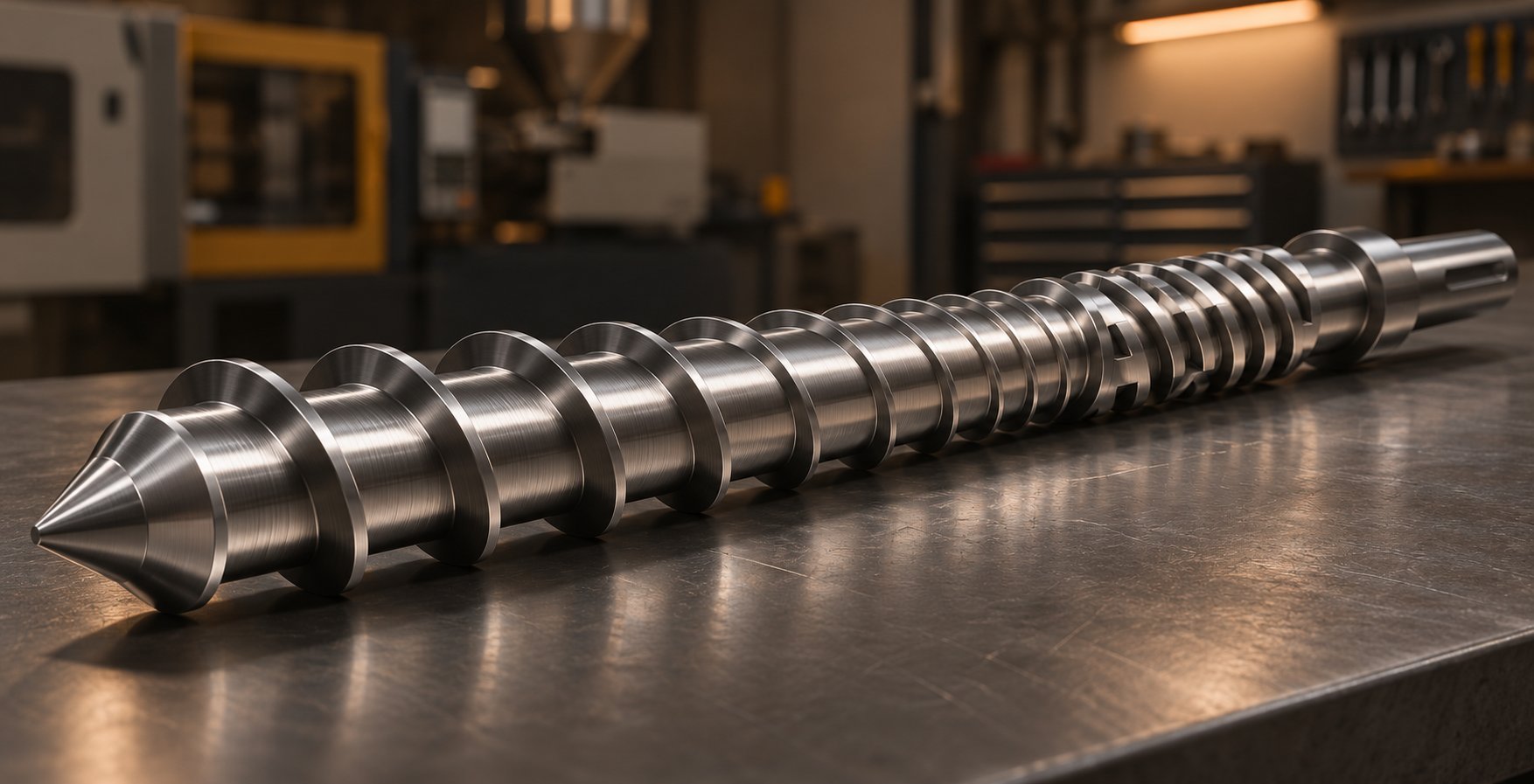
Matching Screw and Barrel Selection to Nylon Processing Demands
Drying resin to spec and verifying it with an analyzer are essential steps — but they are not the finish line. Every pellet still has to travel through a screw, melt under shear and conduction, and exit the barrel as a uniform, defect-free melt. If the plasticizing hardware is not matched to nylon's specific melting behavior, even perfectly dried material can produce parts riddled with the same splay marks, voids, and inconsistencies you worked so hard to prevent. The screw and barrel are the last gatekeepers of nylon moisture content control, and overlooking them is one of the most expensive blind spots in the entire process chain.
How Screw Geometry Affects Nylon Melt Quality
Picture your screw as a three-stage pump: it feeds solid pellets in the rear, compresses and melts them through the transition zone, and meters uniform melt out the front. Each zone's geometry — channel depth, flight pitch, and compression ratio — determines how efficiently that transformation happens. Get the geometry wrong for nylon and you invite trouble, regardless of how dry the resin is.
Compression ratio is the first variable that matters. It is simply the ratio of the feed-zone channel depth to the metering-zone channel depth (H1 divided by H2). As Plastics Technology's Jim Frankland explains, nylon screws typically start with a 4:1 compression ratio — significantly higher than the 3:1 used for polyethylene — because polyamides require more shear energy input to complete melting. An insufficient compression ratio leaves unmelted pellets or partially fused gels in the melt stream. Those solid fragments act as nucleation points for any residual trace moisture to flash into steam, amplifying defects that a properly designed screw would have prevented entirely.
Mixing sections matter just as much. Standard three-zone screws without dedicated mixing elements can struggle to homogenize color concentrates, glass fibers, or micro-pockets of residual moisture that survive the drying process. A Maddock or barrier mixing section integrated into the metering zone breaks up these inconsistencies and produces a more uniform melt, reducing the likelihood that a tiny moisture pocket expands into a visible splay streak on the finished part.
Worn screws compound every one of these problems. As Glycon Corp.'s Jeff Kuhman documents, the clearance between screw flight and barrel wall starts at roughly 0.001 inch per side per inch of diameter. As that clearance opens through abrasive or adhesive wear, compressive efficiency drops. Material leaks backward over the flights instead of being driven forward, melt temperature becomes inconsistent, and the processor starts compensating — raising backpressure, bumping screw speed, increasing barrel temperatures. Each of those compensations adds energy and residence time that a moisture-sensitive polymer like nylon simply cannot tolerate without risking hydrolytic degradation. A concrete moisture meter can tell you how wet your resin is; only a screw-pull inspection and flight-depth measurement can tell you whether your plasticizing hardware is still capable of doing its job.
Selecting Plasticizing Components Matched to Nylon Applications
When it is time to replace or upgrade worn screws and barrels, the temptation is to order a generic replacement and get the press running again as quickly as possible. For commodity resins, that approach may be adequate. For nylon, it leaves performance on the table — and risk on the production floor.
Nylon-specific screw and barrel selection involves several considerations that go beyond simple dimensional matching:
- Compression ratio tailored to polyamide melting behavior: As noted above, nylon's sharp melting point and high energy requirement favor compression ratios near 4:1. But that starting point must be adjusted based on whether you are running unfilled resin, glass-reinforced compounds, or recycled feedstock with variable bulk density. A screw designed for virgin PA66 may cause solids wedging — where unmelted material plugs the channel and forces the screw against the barrel wall — if switched to a lower-bulk-density regrind without modifying the feed section.
- Corrosion-resistant barrel linings: Nylon melts release trace amounts of acidic byproducts, especially when moisture is present or when processing flame-retardant grades. Standard nitrided steel barrels can corrode over time under these conditions. Bimetallic barrels with high tungsten-carbide-content linings resist both the abrasive wear from glass-filled nylons and the corrosive attack from acidic volatiles, extending useful service life significantly.
- Metering-zone design for consistent shot weight: Nylon's relatively low melt viscosity compared to materials like polycarbonate means melt can leak past worn check valves or poorly designed metering sections more easily. A properly sized metering zone with tight flight-to-barrel clearances ensures consistent shot-to-shot delivery — critical for maintaining the dimensional tolerances that nylon moisture content fluctuations already challenge.
- Mixing elements for filled and colored compounds: Glass-fiber-reinforced nylons benefit from mixing sections that disperse fibers without excessive breakage. Barrier or variable-pitch screws can optimize the shear profile to preserve fiber length while still ensuring the melt is homogeneous enough to avoid weak spots and moisture-related surface defects.
This is where a supplier with application-specific engineering capability becomes valuable. Rather than selecting screws from a catalog based on diameter alone, processors benefit from a technical review that evaluates screw geometry, current wear patterns, melting performance, mixing quality, and material-retention concerns. NANHAIYA's custom injection molding screw barrels are one option built around this philosophy — manufactured to match specific machine specifications, resin characteristics, and shot requirements rather than offered as one-size-fits-all replacements. Their technical review process examines the full plasticizing picture, including how the screw and barrel interact with nylon's unique processing demands, to help processors move from generic hardware toward application-matched components.
The payoff from this kind of deliberate hardware selection is cumulative. A properly matched screw delivers more consistent melt temperature, fewer unmelted particles, and tighter shot-to-shot weight control. Those improvements reduce the window in which residual trace moisture can cause visible defects and lower the overall sensitivity of the process to the minor moisture variations that are inevitable in real-world production environments. Think of it as a humidity indicator for your entire plasticizing system: when the hardware is right, small fluctuations in resin condition stay within the process window instead of pushing parts over the edge.
For processors wondering how to lower humidity in your home resin-storage operation, the answer involves sealed packaging, desiccant dryers, and verified moisture levels — all topics covered earlier in this guide. But the parallel question — how to decrease the humidity in your home plasticizing system, metaphorically speaking — comes down to screw and barrel condition. Worn, mismatched, or poorly designed plasticizing components amplify every upstream moisture control failure. Properly engineered components absorb those small upstream imperfections and still deliver a clean melt.
Across every stage of the nylon moisture management chain — from warehouse storage and desiccant drying, through measurement and verification, to post-mold conditioning and the plasticizing hardware that ties it all together — the central principle remains the same. Nylon's hygroscopic nature is not a flaw to be feared; it is a material characteristic to be understood and managed. Control the moisture deliberately at every step, and nylon rewards you with one of the most versatile, tough, and reliable engineering polymers available. Ignore it at any step, and you will watch your parts fail.
Frequently Asked Questions About Nylon Moisture Content
1. What is the maximum allowable moisture content for nylon before injection molding?
Most unfilled nylon grades (PA6 and PA66) must be dried to 0.20% moisture or below before injection molding. For cosmetic-critical or glass-filled parts, the limit tightens to 0.10-0.15%. Glass-filled compounds require an adjusted threshold because the filler itself absorbs no water, meaning the polymer fraction carries a higher effective moisture concentration than the total reading suggests. Always verify against your specific resin supplier's datasheet.
2. How long does it take to dry nylon resin in a desiccant dryer?
Typical drying times for nylon in a properly functioning desiccant dryer range from 2 to 4 hours at temperatures between 65 and 82 degrees Celsius, depending on the grade and initial moisture level. The dryer must deliver supply air at a dewpoint of -40 degrees Celsius or lower. Standard hot-air dryers are inadequate for nylon because they recirculate ambient moisture. Critically, drying time alone should never be trusted as proof of dryness - always verify final moisture content with a moisture analyzer before processing.
3. Why do nylon parts need moisture conditioning after molding?
Freshly molded nylon parts are extremely dry and brittle, with low impact resistance and elongation at break. Controlled moisture conditioning - through ambient exposure, water-bath immersion, or humidity chambers - allows the parts to reabsorb water to their equilibrium level (around 2.0-2.5% for PA66 at 50% RH). This restores the toughness, ductility, and energy absorption that the design engineer specified. Impact strength can increase by 200-300% compared to the dry-as-molded state, making conditioning essential for most engineering applications.
4. Which nylon grade absorbs the least moisture?
Among common aliphatic nylons, Nylon 12 (PA12) absorbs the least moisture at roughly 0.20-0.25% at 50% RH, thanks to its long hydrocarbon segments that dilute the concentration of water-attracting amide groups. Semi-aromatic nylons like PPA (polyphthalamide) absorb even less, at 0.15-0.30%, because aromatic ring structures further reduce amide density and limit free volume for water molecules. These low-absorption grades are preferred for dimensionally critical applications or parts exposed to continuous humidity.
5. How does screw and barrel selection affect nylon moisture-related defects?
Even properly dried nylon can produce splay marks and voids if the screw geometry is mismatched. Nylon typically requires a compression ratio near 4:1 to fully melt the resin, and worn screws with increased flight-to-barrel clearance lose compressive efficiency, allowing melt inconsistencies that amplify residual trace moisture into visible defects. Suppliers like NANHAIYA offer custom injection molding screw barrels engineered to match specific machine specs and nylon resin characteristics, using a technical review process that evaluates geometry, wear, and melting performance to help processors maintain defect-free melt quality.
Written by
Nanhaiya Technical Team
Zhoushan Nanhaiya Plastic Machinery Co., Ltd.
The Nanhaiya technical team supports screw and barrel manufacturing projects through application review, technical communication, custom manufacturing coordination, and production and quality control.
Discuss Your Application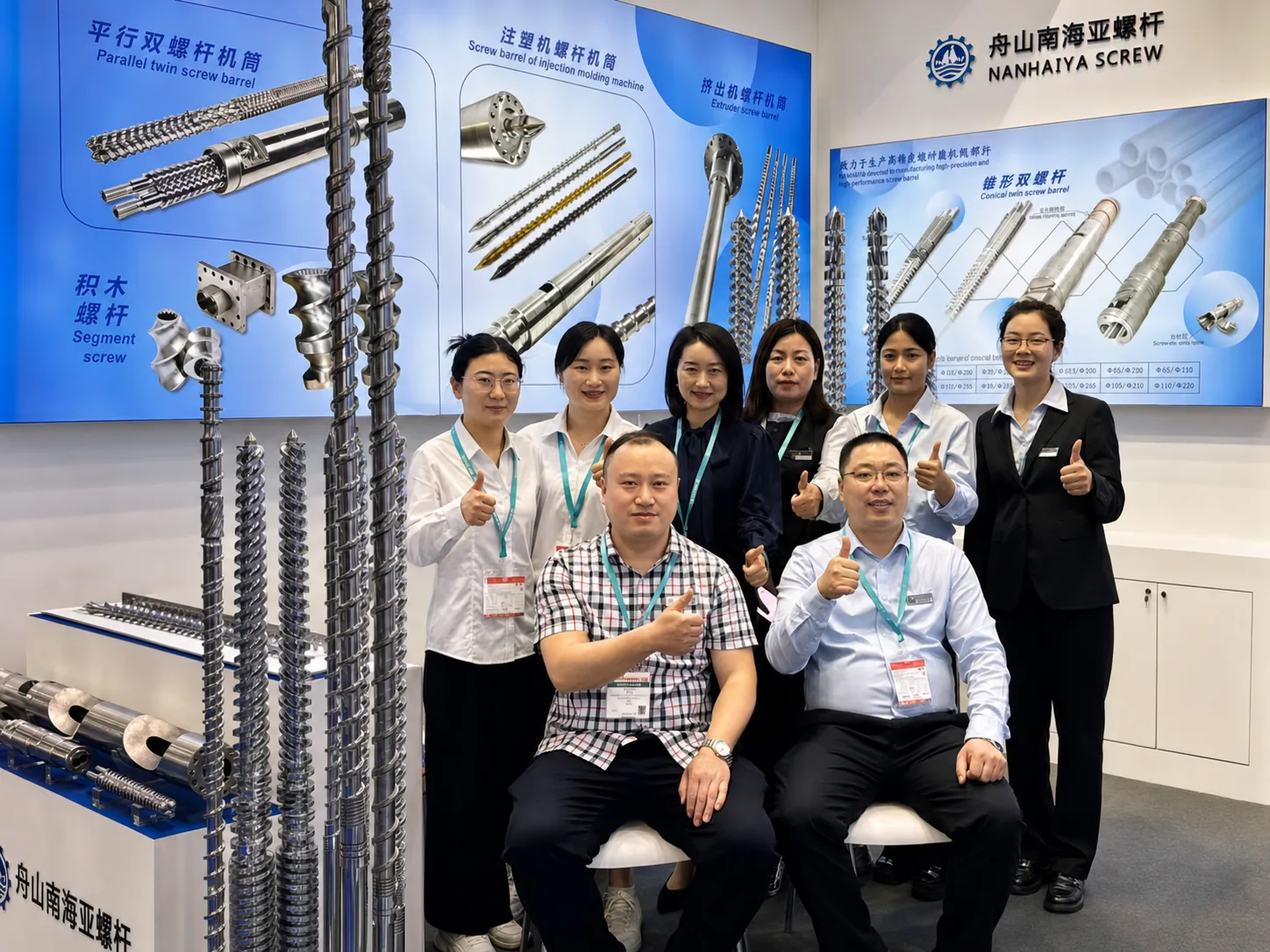
Related Articles
More insights on screw barrel technology and plastics processing.
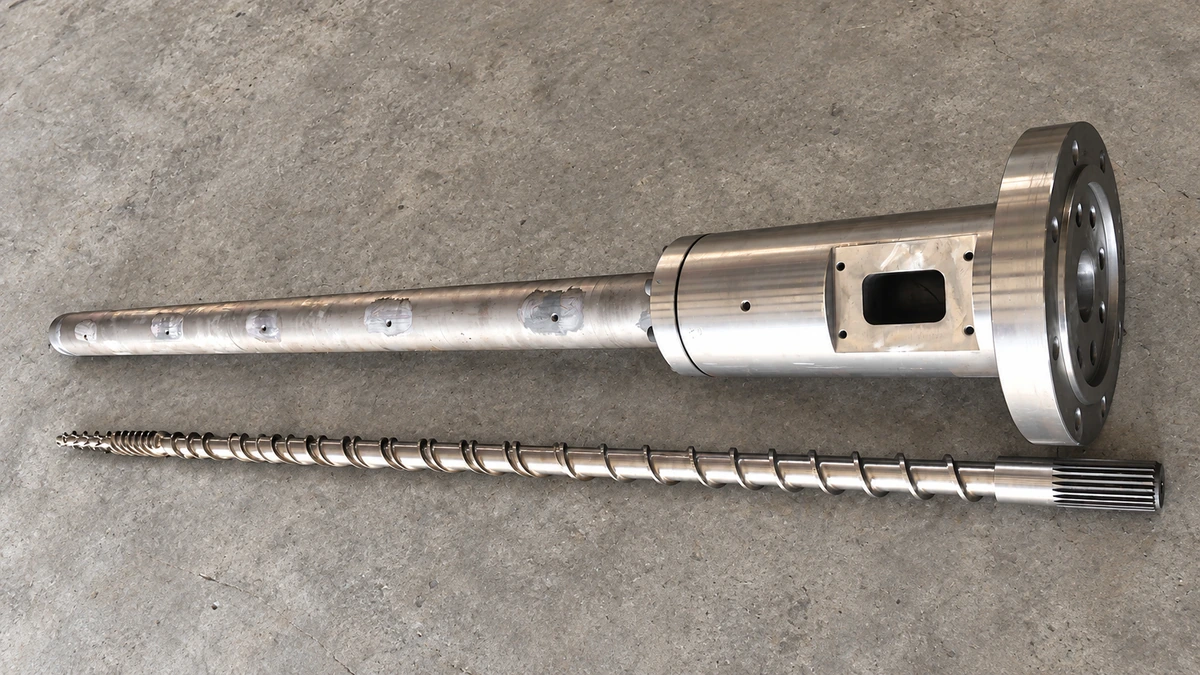
Why Your Single Screw Extruder Design Causes Extrusion Defects
Nov 13, 2026
Learn how single screw extruder design parameters—L/D ratio, compression ratio, channel depth, and mixing elements—affect melt quality, throughput, and defects.
Read Article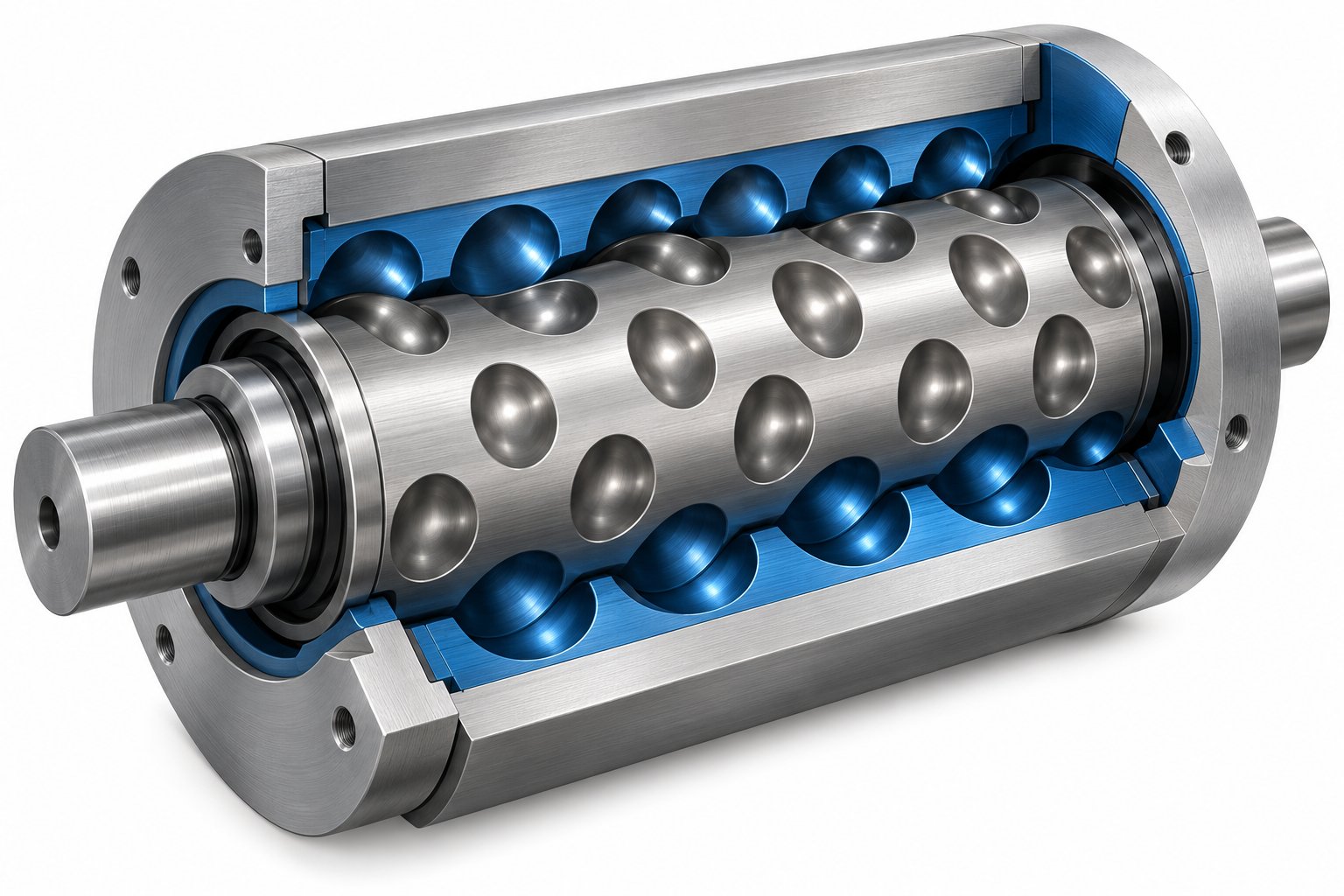
Cavity Transfer Mixer: The Blender Your Extruder Didn't Know It Needed
Nov 13, 2026
Learn how a cavity transfer mixer (CTM) upgrades single-screw extruder mixing. Covers working principles, key parameters, integration, applications, and comparisons.
Read Article
Extruder Barrel Alignment Decoded: Tolerances Most Plants Miss
Nov 13, 2026
Learn extruder barrel alignment tolerances, laser procedures, thermal offsets, and proactive schedules most plants miss — for single-screw and twin-screw lines.
Read ArticleLooking for something else?
Search by material, symptom or product and jump straight to the relevant page.
These are navigation suggestions based on keyword matching — not a quotation, not a delivery commitment, and not a substitute for engineering review. Final specification is confirmed by our engineers against your drawings and processed material.
Need help with screw barrel selection?
Share your machine model, processed material and application. Our team can help with pricing and technical support.